
- Release Year: 2006
- Platforms: Windows
- Publisher: Dennis Plöger
- Developer: Dennis Plöger
- Genre: Adventure
- Perspective: Side view
- Game Mode: Single-player
- Gameplay: Graphic adventure, Puzzle elements
- Setting: House
- Average Score: 71/100
Description
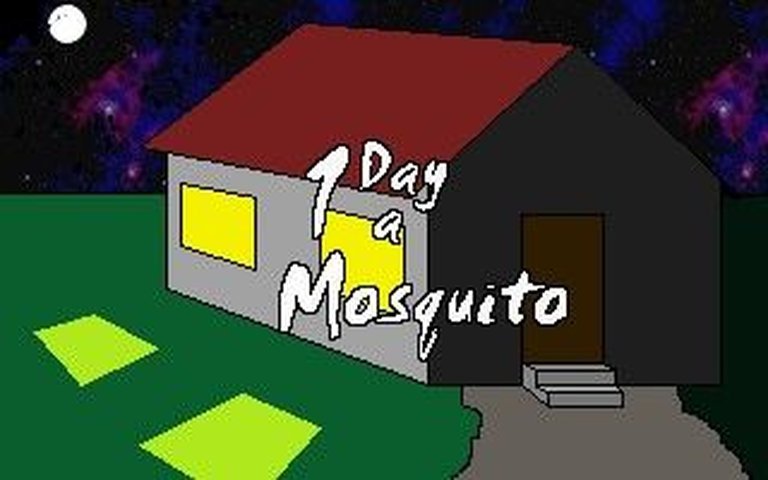
In ‘1 Day a Mosquito’, you play as a mosquito trapped inside a house after a window suddenly closes behind you. This short, puzzle-filled adventure game features unique gameplay where you must adjust your mosquito’s speed to interact with objects and find a way to escape, all rendered in 2D with a side-view perspective.
1 Day a Mosquito Free Download
Guides & Walkthroughs
Reviews & Reception
mobygames.com (60/100): A very short room-escaping game with an unusual gameplay.
myabandonware.com (82.8/100): it’s a good game
1 Day a Mosquito: Review
Introduction
In the annals of experimental game design, few titles encapsulate the spirit of amateur game development as perfectly as 1 Day a Mosquito. Released in 2006 as a freeware entry in the MAGS (Monthly AGS Game) competition, this 10-minute micro-adventure from German developer Dennis Plöger (under the label “deepgames”) challenges players to escape a room as a trapped mosquito. Its legacy lies not in narrative depth or technical spectacle, but in its audacious simplicity—a radical reimagining of point-and-click mechanics that subverts player expectations through insectoid gameplay. As a historical artifact, 1 Day a Mosquito exemplifies the AGS community’s embrace of absurdity and constraint, offering a fascinating case study in how minimalism and unconventional perspectives can yield profound gameplay innovation. This review dissects its origins, mechanics, and enduring appeal to argue that beneath its pixelated wings lies a critique of player agency and a testament to the creative power of limitations.
Development History & Context
1 Day a Mosquito emerged from the fertile soil of the Adventure Game Studio (AGS) community in 2006. AGS, a free engine for creating 2D adventures, had democratized game development since the late 1990s, enabling solo creators like Plöger to craft ambitious projects without corporate backing. Plöger, who developed the game single-handedly, participated in the July 2004 MAGS contest themed “Animals,” a competition designed to push developers toward novel concepts. The title itself is a deliberate pastiche of Ben “Yahtzee” Croshaw’s cult Chzo series (5 Days a Stranger, 7 Days a Skeptic), which shared AGS’s roots and used numbered titles to imply confined timelines. Technologically, Plöger worked within AGS’s constraints: 320×200 resolution, 256-color graphics, and basic scripting systems. This stripped-down environment forced creativity, as seen in the game’s unique interaction mechanics.
The 2006 gaming landscape was dominated by AAA blockbusters like The Elder Scrolls IV: Oblivion and Gears of War, making 1 Day a Mosquito a defiantly anti-commercial gesture. As freeware distributed via AGS forums and platforms like MyAbandonware, it bypassed traditional publishing channels, aligning with the indie ethos of accessible, experimental art. Plöger’s vision was unapologetically minimalist: “The story is simple: you are a mosquito. One day you fly through a window… Now you are trapped.” This focus on singular, constrained interactions reflected a growing fascination in micro-games that distill gameplay to its essence—a precursor to the “hypercasual” movement of the 2010s. The game’s brevity (completable in under 30 minutes) and lack of commercial ambition underscore its status as a creative exercise rather than a commercial product.
Narrative & Thematic Deep Dive
The narrative of 1 Day a Mosquito operates on two levels: a literal escape plot and a metaphorical exploration of powerlessness. On the surface, the premise is deceptively straightforward: a mosquito enters a house via an open window, only to be trapped when the window inexplicably slams shut. The mosquito’s singular goal—escape via a ventilation shaft—drives the entire experience. Yet this simplicity masks a subversive thematic core. By forcing players into the perspective of a “pest,” the game challenges anthropocentric narratives common in adventure games. Human objects (a broom, a window, a vent) become monumental obstacles reframed through insect-scale vulnerability.
The dialogue and tone lean into absurdist comedy, with Plöger’s deadpan descriptions (“The mosquito cannot be moved freely”) emphasizing the futility of the mosquito’s struggle. This lack of overt character development is deliberate; the mosquito is a vessel for player frustration, its “mind” reduced to primal escape instincts. The game’s ending—a “little surprise” involving the vent—reinforces this theme of futility, suggesting that even successful escape is pyrrhic. Critically, the mosquito’s inability to move freely symbolizes the constraints of player agency in games. Unlike traditional adventure heroes, the player’s control is mediated through a rigid, multi-step process (click, adjust speed, “attack”), mirroring the mosquito’s physical limitations. This transforms escape from a triumph of intellect into a battle against systemic constraints, making 1 Day a Mosquito a quiet critique of how game design itself can entrap players.
Gameplay Mechanics & Systems
1 Day a Mosquito’s gameplay is a masterclass in constrained design. Abandoning traditional point-and-click conventions, Plöger introduces a unique interaction system: players cannot directly manipulate objects. Instead, they must select a target (e.g., a broom or window), set a “speed” level (1–5), and press an “attack” button. Success hinges on finding the correct speed for each object—too slow, and nothing happens; too fast, and the mosquito fails. After each attempt, the mosquito snaps back to its starting position, eliminating exploration and emphasizing trial-and-error. This creates a puzzle loop where memorization and pattern recognition replace inventory management or environmental navigation.
The mechanics are intentionally opaque. The lack of visual or textual feedback on speed requirements forces players to experiment, heightening tension. For instance, the “broom” bug cited in player reviews exemplifies this flaw—its solution requires counterintuitive timing, turning a simple object into a source of frustration. Character progression is nonexistent; the player’s only “growth” is learning object-specific solutions. The UI, while minimalist, includes a “mosquitoesque” GUI (as noted in AGS forums), with sound effects that buzz audibly—a feature some players found immersive and others grating. Save slots are unlimited, a nod to AGS standards, encouraging experimentation. This system’s brilliance lies in its inversion of adventure game norms: instead of empowering players, it simulates the helplessness of an insect, making triumph feel earned through persistence rather than intellect.
World-Building, Art & Sound
Set in a single, cluttered room, 1 Day a Mosquito’s world is a study in confined spaces. The room—a typical suburban living area—serves as both environment and antagonist, with mundane objects (a bookshelf, a lamp) becoming existential threats. Plöger’s 2D art, rendered in AGS’s 320×200 resolution, employs bold, cartoonish lines and a limited color palette. The mosquito itself is a simple black pixel sprite, buzzing with jagged, animated lines to convey motion. This abstraction forces players to project themselves onto the insect, amplifying immersion. Lighting and shadows are minimal, but the game’s side-view perspective creates a sense of verticality, with the ceiling looming like a trap.
Sound design is integral to the experience. A persistent, high-pitched buzz accompanies the mosquito, serving as both diegetic sound and player irritation. Object interactions produce satisfying clicks or clanks, but the overall soundscape is sparse—a deliberate choice to emphasize the mosquito’s isolation. The absence of music underscores the tension of the escape attempt. Together, the art and sound forge an atmosphere of oppressive domesticity, transforming a familiar setting into a labyrinth of scale. The room’s design is a triumph of suggestion; a closed window and a vent shaft become grand symbols of freedom and entrapment, respectively. This microcosm of confinement is the game’s strongest world-building tool, proving that atmosphere can thrive within extreme limitations.
Reception & Legacy
Upon release, 1 Day a Mosquito polarized players. On AGS forums, reactions ranged from “Cute game, I liked it” (larino87, 2007) to “The mosquito’s buzzing annoyed me bad. Too easy” (boyswillbeboys, 2010). Its brevity and experimental mechanics divided audiences: some praised its inventive concept, while others dismissed it as a gimmick. Commercially, it achieved niche success as freeware, with over 4,000 downloads on the AGS site by 2010. Critically, it was largely overlooked by mainstream outlets, though MyAbandonware later awarded it a 4.14/5 user rating based on 14 votes. Its legacy, however, endures in the AGS community as a benchmark for constraint-based design.
The game’s influence is subtle but profound. Its speed-based interaction system prefigured mechanics in titles like Octodad (2010), where unconventional controls drive comedy and challenge. Plöger’s emphasis on perspective—shifting the player’s viewpoint to a non-human entity—resonates in modern games like Untitled Goose Game (2019). 1 Day a Mosquito also exemplifies the MAGS competition’s role in fostering experimental games, inspiring developers to embrace absurd themes and limited scopes. Over time, it has been recontextualized as a piece of “digital folk art,” preserved on platforms like the Internet Archive and cited in academic discussions of playable media. Its cult status among retro gamers underscores a growing appreciation for micro-games that prioritize concept over content.
Conclusion
1 Day a Mosquito is a paradox: a game defined by its brevity yet rich in subtext, technically simple yet themically profound. As a historical artifact, it captures the ingenuity of the AGS era, where developers turned limitations into strengths. Its gameplay—an inverted point-and-click system that simulates insect helplessness—remains a bold critique of player agency, while its micro-narrative of trapped desperation resonates beyond its 10-minute runtime. Though divisive in its reception, it endures as a testament to the power of perspective, proving that the most memorable games are not always the longest. In the pantheon of experimental adventures, 1 Day a Mosquito stands as a tiny, buzzing giant—a reminder that sometimes, the most compelling stories are told in a single room, through the eyes of a mosquito.