
- Release Year: 2010
- Platforms: Windows
- Publisher: GSP Software
- Developer: Selectsoft
- Genre: Compilation
- Perspective: Top-down
- Game Mode: Single-player
- Gameplay: Arcade, Board game, Card game, Casino, Hidden object, Puzzle solving, Shooting, Sports, Tile matching, Word puzzle
Description
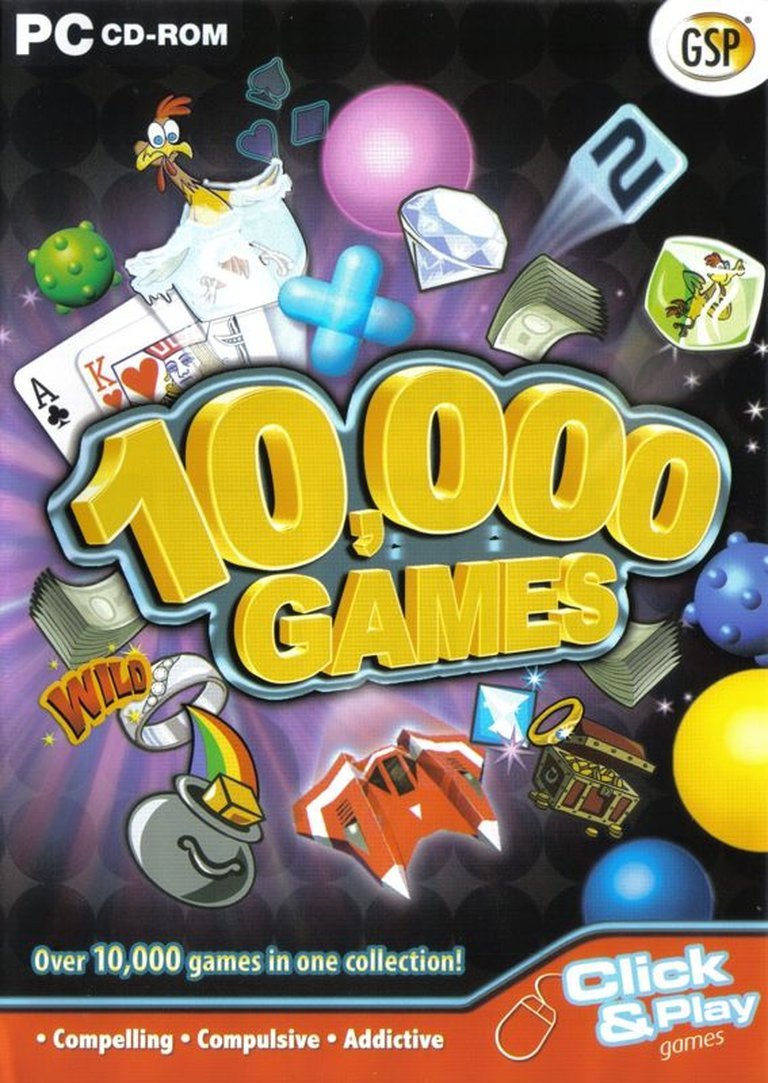
10,000 Games is a massive compilation of Selectsoft’s titles, offering a sprawling collection of over 10,000 games across diverse genres like Arcade, Card & Casino, Puzzle, Sudoku, Sports, and Word games. Players can install standalone titles such as ‘2002 Games Championship,’ ‘King Solomon’s Lost Mines,’ and ‘3003 Slot Games,’ each featuring hundreds to thousands of levels or variations. While the compilation boasts immense variety, it mixes challenging puzzles and classic board games with simplistic, repetitive entries, many built using generic templates. The installation process is fragmented, with multiple setup menus and inconsistent folder structures, but the sheer volume of content caters to casual gamers seeking endless casual entertainment.
10,000 Games Free Download
10,000 Games: A Cautionary Tale of Quantity Over Quality in the Compilation Era
Introduction
In an industry dominated by the rise of digital distribution, social gaming revolutions, and AAA blockbusters like Red Dead Redemption and Mass Effect 2, 10,000 Games (2010) stands as a curious artifact of an older era—the age of the shovelware compilation. Marketed as the ultimate bargain with its titular promise, this Windows-exclusive anthology epitomizes the paradox of excess: a tidal wave of content drowning in its own mediocrity. This review posits that 10,000 Games is less a celebration of gaming diversity and more a cynical exploitation of consumer psychology—a product whose legacy lies in exposing the absurdity of quantifying artistic value through sheer volume.
Development History & Context
The Selectsoft Strategy
Developed by GSP Software and published under the budget-focused Selectsoft label, 10,000 Games emerged from a long tradition of low-risk, high-quantity compilations. The late 2000s saw PC retail racks flooded with bargain-bin collections targeting casual players seeking perceived value. With the indie revolution still nascent and mobile gaming yet to explode, these compilations thrived on novelty metrics—a trend epitomized by GSP’s decision to repackage existing Selectsoft titles into a Frankensteinian megabundle.
Technological Constraints and Market Positioning
Released on CD-ROM with no online integration, 10,000 Games was technologically archaic even for 2010. Its nine disjointed installation processes (each requiring separate directories) reflected an era struggling to adapt to digital ecosystems like Steam. At a time when FarmVille and Angry Birds redefined accessibility, GSP’s insistence on physical media and bloated installations (notably the hours-long 2002 Games setup) felt like a relic. The compilation’s $9.99 price point weaponized FOMO: Who wouldn’t want 10,000 games for less than a pizza?
Narrative & Thematic Deep Dive
The Illusion of Choice
10,000 Games weaponizes the myth of abundance. While marketed as a diverse library spanning arcade, card, puzzle, sports, and word games, its catalog reveals a startling truth: the “10,000” figure derives from counting Sudoku permutations and Breakout clone variants as standalone titles. Take Sudoku Mania!: its 455 puzzles inflate the count by disguising a single-engine math tool as a game library. Similarly, 1001 Tangram Puzzles—a genuine highlight—contributes 1% of the compilation’s purported volume through level padding.
Existential Questions: What Is a Game?
Through its brazen accounting, 10,000 Games inadvertently critiques gaming’s commodification. Titles like Guess the Color (predicting red/black card sequences) or Alien Space Shoot (a Space Invaders knockoff with fewer features than 1978’s original) stretch the definition of interactivity to breaking point. Thematic cohesion is nonexistent: juxtaposing Chicken Freeze! (a frantic poultry rescue) with Club Vegas: Blackjack underscores a nihilistic disregard for curation.
Gameplay Mechanics & Systems
A Fragmented Galaxy of Minigames
The compilation’s structure is anarchic:
- Arcade & Action (424 “games”): Tank Duel clones, Space Out (a Breakout derivative with 200 variations), and Wacky Bird Hunter—a point-and-click shooting gallery devoid of challenge.
- Card & Casino (219 entries): 66 solitaire variants and 100+ slot machines mechanically identical beyond paytable tweaks.
- Puzzle & Board (350): Mahjongg reskins and Electroblock—Tetris with none of Nintendo’s polish.
The Best Game Hits menu offers slight redemption: Hidden Objects Mania!, Championship Chess, and Pressure Pop! demonstrate fleeting competency but lack depth.
Progression and UI Chaos
- Character Progression: Nonexistent. Most games lack save systems or unlockables.
- UI/UX: A labyrinthine launcher buries better titles beneath endless submenus. Installers scatter files across
Selectsoft,Selectsoft Games, and game-specific folders—a nightmare for organization.
World-Building, Art & Sound
Aesthetic Anarchy
-
Visual Direction: Two camps dominate:
- Generic Engine Clones: Titles like Pop! Drop! & Stack! use a cookie-cutter template with interchangeable assets (e.g., tiles, timers), rendering 30% of the library visually indistinguishable.
- “Budget Quirk”: Games like Baby Beaver and Christmas Bounce deploy garish colors and chintzy sprites reminiscent of early Flash games.
Standouts like King Solomon’s Lost Mines (a tile-matching adventure) and Tangram Puzzles showcase rare artistry, but they drown in the noise.
-
Sound Design: Repetitive MIDI loops plague 80% of titles. Slot machines mimic tinny casino sounds, while action games deploy stock explosion effects.
Reception & Legacy
Critical and Commercial Failure
Upon release, 10,000 Games earned a 2/5 average from players, dismissed as a “definition-stretching” gimmick. Critics ignored it entirely—a stark contrast to 2010’s acclaimed indies (Super Meat Boy) and AAA landmarks (God of War III). Financially, it vanished beneath Selectsoft’s own catalog, outsold by the studio’s standalone sudoku and solitaire packs.
Industry Influence: A Cautionary Benchmark
While 10,000 Games itself left no legacy, it epitomized practices the industry slowly rejected:
– The Fall of Shovelware: As digital stores prioritized quality control (e.g., Steam Greenlight, App Store curation), lazy compilations died out.
– Viral Value Redefined: Zynga and King proved microcontent (FarmVille crops, Candy Crush levels) could monetize addiction without deceiving players.
– Preservation Irony: Unlike Minecraft or Dark Souls, no one demands remasters for Spot the Card.
Conclusion
10,000 Games is gaming’s Infinite Jest—a monument to the madness of excess. Its 11,000+ “games” (as one player meticulously calculated) symbolize a last gasp of physical media desperation, a swan song for CD-ROM bloat. Yet within its failures lie lessons: curation matters, respect player time, and never equate quantity with value. As a historical artifact, it’s fascinating; as entertainment, it’s a desert masquerading as an ocean. In the pantheon of gaming’s 2010s evolution—defined by Breath of the Wild’s artistry and Fortnite’s innovation—this compilation earns its place only as a footnote: What happens when we count pixels, not experiences?
Final Verdict: 10,000 Games is not a celebration of gaming, but a tax on curiosity. ★☆☆☆☆