
- Release Year: 2006
- Platforms: Windows
- Publisher: Selectsoft Publishing
- Developer: Olga Pudrovska
- Genre: Puzzle
- Perspective: Top-down
- Game Mode: Single-player
- Gameplay: Cards, Tiles
- Average Score: 93/100
Description
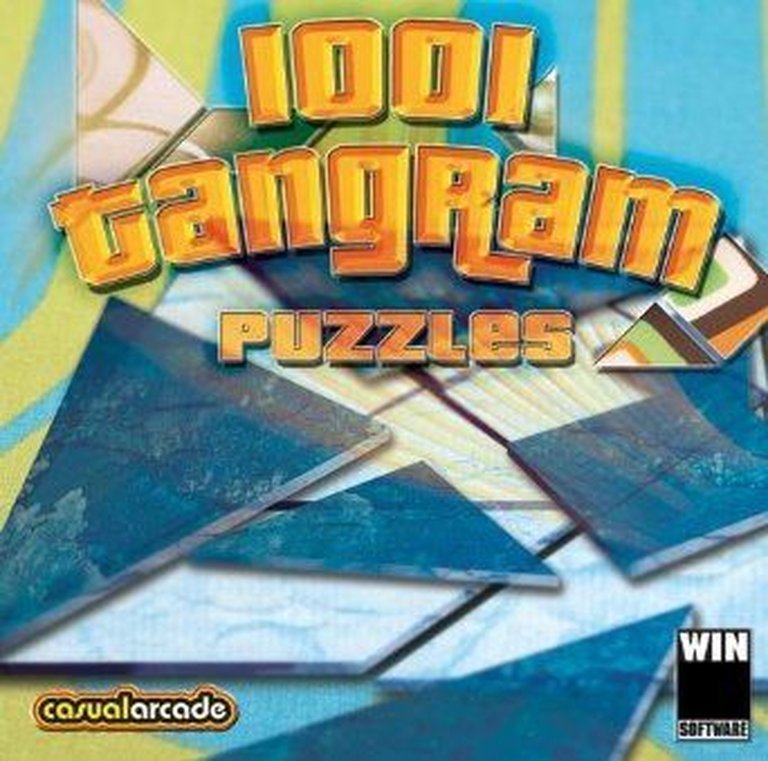
1001 Tangram Puzzles is a 2006 Windows puzzle game where players arrange seven geometric tiles to complete 1001 unique silhouette outlines, organized into ten menus of 100 patterns each plus one special finale. Players select puzzles manually or opt for random challenges, with a ‘magic eye’ feature to reveal solutions if stuck; completed puzzles flash green before advancing to another random one, all controlled via mouse in a silent environment without saves or scores.
1001 Tangram Puzzles: Review
Introduction
Imagine a humble square of silk-wrapped glass, shattered on a treacherous mountain pass during China’s Song Dynasty, its fragments miraculously reforming into seven geometric wonders—a legend that, though debunked as a hoax by puzzle maestro Samuel Loyd, captures the timeless allure of the tangram. This ancient dissection puzzle, originating in 18th-century imperial China as the “Chin-Chiao Pan” or “intriguing seven-piece puzzle,” has captivated minds from emperors to schoolchildren, evolving from wooden tans to digital frontiers. Enter 1001 Tangram Puzzles (2006), a Windows-exclusive digital anthology that distills this 4,000-year-old (or so the myths claim) tradition into 1,001 meticulously crafted challenges. Developed amid the casual gaming boom of the mid-2000s, this unassuming title by solo author Olga Pudrovska and publisher Selectsoft Publishing serves as a pure, unadorned tribute to tangram’s mathematical elegance. My thesis: While starkly minimalist in an era of flashy blockbusters, 1001 Tangram Puzzles endures as a historiographical gem, faithfully preserving the puzzle’s educational essence and spatial paradoxes, cementing its niche legacy in puzzle gaming history.
Development History & Context
1001 Tangram Puzzles emerged from the shadows of indie development in 2006, a time when Windows PCs dominated casual gaming via CD-ROMs and early downloads, fueled by the post-Tetris puzzle renaissance. Publisher Selectsoft Publishing, known for budget-friendly brain-teasers like Bookworm Adventures, championed accessible titles amid the Xbox 360 and PlayStation 3 launches. The game’s sole credited creator, Olga Pudrovska, a enigmatic figure with credits on just one other MobyGames entry, embodied the era’s lone-wolf developers leveraging simple tools like Flash or early DirectX for mouse-driven interfaces.
Technological constraints shaped its spartan design: no save states or high scores reflect the limitations (and philosophies) of 2006 shareware engines, prioritizing endless replayability over progression systems. The gaming landscape buzzed with World of Warcraft‘s social sprawl and Wii Sports‘ motion innovations, yet casual puzzles thrived—echoing tangram’s own trajectory from 1815’s American import via Captain M. Donaldson’s clipper ships to Europe’s 1817-18 craze. Pudrovska’s vision, inferred from the game’s structure, mirrors tangram’s historical purity: 10 menus of 100 puzzles each, plus a “solitary” 1,001st, drawing from Loyd’s hoax-laden The Eighth Book of Tan (1903) with its 700+ designs. No grand studio fanfare; this was a labor of geometric love, bridging ancient Chinese banquet tables (Song Dynasty precursors) and digital democratization, when apps like the 2011 Android Tangram hinted at mobile futures.
Narrative & Thematic Deep Dive
1001 Tangram Puzzles eschews traditional narrative—no protagonists, dialogue, or plot arcs—embracing tangram’s wordless storytelling tradition. Instead, its “plot” unfolds through silhouettes: animals, objects, and abstractions begging assembly from seven tans (five triangles, one square, one parallelogram). This mirrors tangram lore’s mythical sages recounting journeys via broken glass panes, as in Loyd’s fabricated tale of “Tan,” the god-inventor whose tile shatters en route to the emperor, birthing endless forms.
Thematically, the game probes spatial philosophy and perceptual illusion, channeling tangram’s mathematical paradoxes. Henry Dudeney’s “two monks” paradox—identical figures, one with a “foot” compensated by a bulkier body—lurks implicitly, challenging players’ visual literacy. Themes of impermanence echo the sage’s fall; completion’s green flash evokes fleeting triumph before randomization resets the cycle. No characters speak, but the puzzles personify creativity: a camel for desert treks, a boat for rivers, per legend. Underlying motifs—geometry as education, from Liu Hui’s 3rd-century rearrangements proving Pythagoras’ theorem to modern STEAM tools—position the game as a silent treatise on problem-solving. In an industry obsessed with lore-heavy epics (BioShock, 2007), its absence is profound: pure abstraction fosters introspection, much like Archimedes’ 2,200-year-old Stomachion, proving narrative unnecessary for profundity.
Gameplay Mechanics & Systems
At its core, 1001 Tangram Puzzles deconstructs tangram’s elegant loop: select a puzzle from categorized menus or embrace randomness, then manipulate seven tans via point-and-click mouse controls to fill an outline without overlaps or gaps. Pieces rotate, flip (crucially, the parallelogram’s asymmetry demands this for mirror images), and drag seamlessly, with fixed/flip-screen visuals ensuring focus. Completion triggers a satisfying green flash, yielding to another random challenge—no persistence, mirroring life’s impermanence.
Innovations are subtle yet pivotal: the “magic eye” hint unveils solutions, a digital nod to solution books like 1815’s Ch’i chi’iao t’u. No progression gates or high scores enforce pure meritocracy; difficulty escalates organically via outline complexity, from simple cats to labyrinthine abstractions. Flaws abound—no save function strands mid-solvers, random starts forget progress, and mouse-only input lacks modern touch fluidity. Yet, this purity shines: replayability soars with 1,001 variants, fostering mastery of spatial relations. UI is utilitarian—top-down menus, draggable workspace—prioritizing function over flair. Compared to kin like 1994’s DOS Tangram or 2008’s Tangram Mania, it innovates via sheer volume, dissecting loops into meditative flow states, educational for geometry and logic without gamification crutches.
World-Building, Art & Sound
No expansive worlds here; the “setting” is an abstract void, a flip-screen canvas evoking tangram’s silhouette origins—shadow play on banquet tables or Lingering Garden’s butterfly variants. Visual direction is minimalist triumph: clean, scalable outlines against neutral backdrops highlight geometric interplay, with tans rendered crisply for Windows resolutions. Atmosphere builds tension through negative space; the looming silhouette taunts, resolved in harmonious fills. This sparse aesthetic contributes profoundly, distilling tangram’s paradox—endless forms from finitude—without distractions, akin to The Witness‘ (2016) zen puzzles.
Sound design? Utterly absent—no music, effects, or ambiance—amplifying isolation. In 2006, amid Oblivion‘s orchestral swells, this silence is deliberate asceticism, forcing auditory imagination: the mental “click” of placement. It enhances immersion paradoxically, like a monk’s vow, underscoring tangram’s meditative roots. Artfully, it elevates the experience to philosophical plane, where visuals alone conjure narratives from voids.
Reception & Legacy
Launch reception was ghostly: MobyGames logs no critic scores, just three player ratings averaging 4.3/5—high praise from obscurity, collected by two enthusiasts. Metacritic echoes voids, no reviews amid casual deluge. Commercially, Selectsoft’s CD-ROM/download model targeted bargain bins, thriving quietly as shareware.
Reputation evolved modestly: post-2013 MobyGames entry by “piltdown_man” canonized it among 10+ tangram titles (Tangram Attack, 2014). Influence ripples subtly—inspiring digital evolutions like AR tangrams or Portal‘s spatial twists, it exemplifies puzzle purity amid freemium booms (Candy Crush). Industry-wide, it underscores tangram’s endurance—from WWI trench “Sphinx” to VR frontiers—boosting STEAM via spatial skills. Legacy: a historiographical footnote, preserving 1,001 patterns amid hoaxes and paradoxes, influencing indies prioritizing depth over dazzle.
Conclusion
1001 Tangram Puzzles is no revolutionary titan but a steadfast archivist, faithfully digitizing tangram’s ancient soul amid 2006’s cacophony. Olga Pudrovska’s minimalist mastery—1,001 challenges, magic eye aids, silent voids—transcends flaws, delivering meditative geometry that educates and enchants. In video game history, it claims a venerable niche: alongside Tetris, a bridge from imperial China to digital eternity, proving simplicity’s supremacy. Verdict: Essential for puzzle historians (8.5/10), a timeless download for spatial sages. Happy puzzling—lest your square shatter into infinity.