
- Release Year: 2006
- Platforms: Windows
- Publisher: ak tronic Software & Services GmbH, Aspyr Media, Inc., Koch Media GmbH (Austria), n3vrf41l Publishing, Noviy Disk, Sunflowers Interactive Entertainment Software GmbH, Ubisoft Entertainment SA
- Developer: Related Designs Software GmbH
- Genre: Strategy, Tactics
- Perspective: Diagonal-down
- Game Mode: Online Co-op, Single-player
- Gameplay: Business simulation, Managerial
- Setting: Age of Discovery, Enlightenment
- Average Score: 79/100
Description
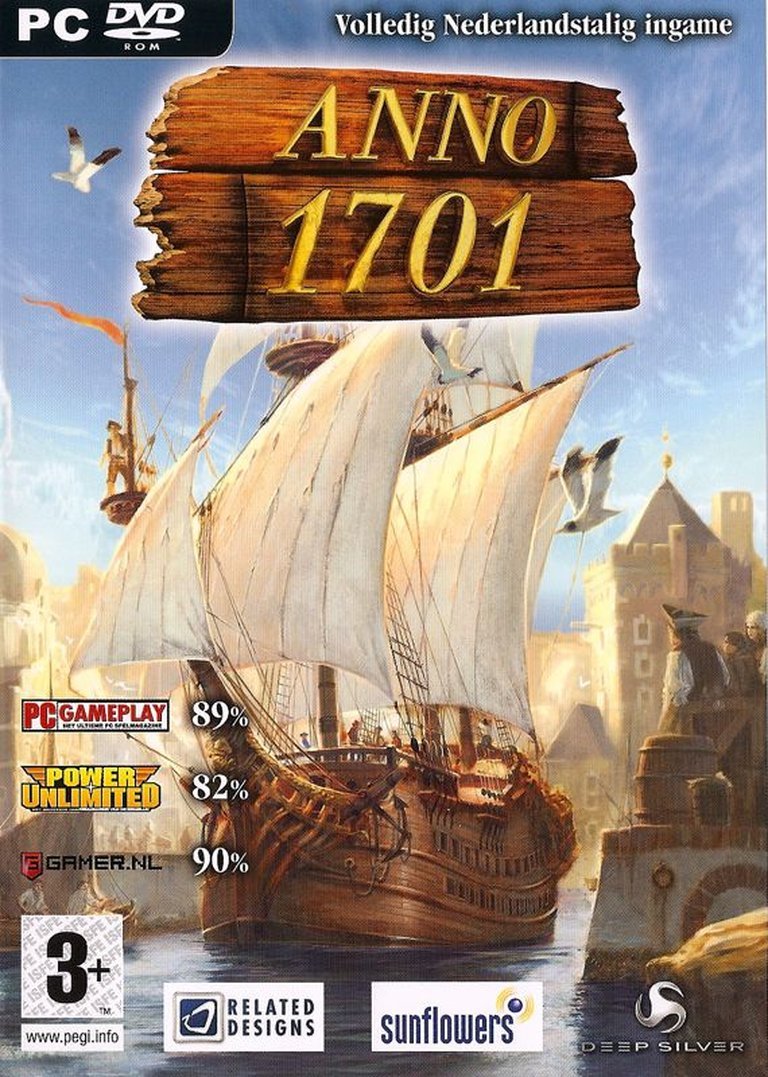
1701 A.D. is a strategy game where players build and manage a settlement in the Age of Discovery, advancing from pioneers to aristocrats by constructing a thriving economy and supplying inhabitants with special buildings and goods, while also defending against pirates and competitors.
Gameplay Videos
Where to Buy 1701 A.D.
PC
1701 A.D. Cracks & Fixes
1701 A.D. Patches & Updates
1701 A.D. Guides & Walkthroughs
1701 A.D. Reviews & Reception
metacritic.com (79/100): Great game at a great price. Easy to pick up for inexperienced gamers and complicated enough to please the hardcore RTS fan.
honestgamers.com : Chances are you know the game’s titular century well enough; the late 1600’s and early 1700’s serve as the backdrop for just about every pirate movie, game, and comic book known to man. Do pirates factor into 1701? A little, but the game’s focus is more on the other, less popularized aspects of the era.
1701 A.D. Cheats & Codes
1701 A.D. (PC)
Rename your warehouse to one of the following case-sensitive names to activate the cheat function.
| Code | Effect |
|---|---|
| BonanzaCreek | 100,000 gold |
| Linlithgow | Warehouse filled with tools |
| SiliconValley | All (current) research completed when you build the correct building |
| ParadiseCity | Warehouse filled with all custom goods your people need to stay happy |
| MariaDelTule | Plant trees and other plants using the pipette |
1701 A.D. (EU version)
Display the console window, then type one of the following codes:
| Code | Effect |
|---|---|
| BonanzaCreek | 100,000 money |
| ParadiseCity | All custom goods |
| SiliconValley | All research completed |
| Linlithgow | All tools |
| MariaDelTule | Trees and plants |
1701 A.D. Gold Edition (PC)
Rename your warehouse to one of the following case-sensitive names to activate the cheat function.
| Code | Effect |
|---|---|
| BonanzaCreek | 100,000 gold |
| Linlithgow | Warehouse filled with tools |
| SiliconValley | All (current) research completed when you build the correct building |
| ParadiseCity | Warehouse filled with all custom goods your people need to stay happy |
| MariaDelTule | Plant trees and other plants using the pipette |
1701 A.D.: A Masterful Reinvention of the Anno Legacy
In the annals of city-building strategy games, few titles have managed to capture the essence of colonial ambition and economic mastery quite like 1701 A.D. Released in 2006 by Related Designs and published by Sunflowers Interactive, this third installment in the acclaimed Anno series not only revitalized a beloved franchise but also set a new standard for the genre. With its lush 3D visuals, intricate economic systems, and a pace that balances accessibility with depth, 1701 A.D. remains a benchmark for strategy enthusiasts and casual players alike.
Development History & Context
The journey to 1701 A.D. was one of reinvention. Following the success of Anno 1602 and 1503, the series faced a crossroads. Developer Max Design, the original creators, was no longer involved due to a dispute, leaving Related Designs to chart a new course. The studio, based in Mainz, Germany, embraced the challenge, assembling a team of over 100 developers and investing €10 million—making it the most expensive German game of its time.
The development process was meticulous. Related Designs built a new 3D engine from scratch, drawing inspiration from their earlier title No Man’s Land. The goal was to create a world that felt alive, with dynamic water effects, detailed island landscapes, and a free-roaming camera that allowed players to immerse themselves in the colonial Caribbean. The team conducted extensive research, including a survey of over 5,000 players, to ensure the game met the expectations of both veterans and newcomers.
The result was a game that honored its predecessors while boldly stepping into the future. Released on October 26, 2006, in Germany, 1701 A.D. was met with critical acclaim and commercial success, selling over 200,000 copies in its first two weeks and becoming the fastest-selling German computer game at the time.
Narrative & Thematic Deep Dive
While 1701 A.D. is primarily a sandbox experience, its narrative framework is steeped in the spirit of the Age of Discovery. Players take on the role of a European explorer and governor, commissioned by Queen Marybeth to establish colonies in the New World. The game’s setting—a fictionalized Caribbean archipelago—captures the allure and peril of 18th-century colonialism, where ambition and survival go hand in hand.
Thematically, 1701 A.D. explores the complexities of colonial expansion. Players must navigate the delicate balance between economic growth and the needs of their citizens, who progress through five social classes: Pioneers, Settlers, Citizens, Merchants, and Aristocrats. Each class has unique demands, from basic food and shelter to luxuries like chocolate and jewelry, reflecting the stratified societies of the era.
The game also introduces minor factions, such as the Iroquois, Chinese, and Aztecs, who inhabit smaller islands and offer trade opportunities. These interactions add depth to the narrative, highlighting the interconnectedness of the colonial world. However, the game’s portrayal of colonialism is not without its flaws. The inclusion of animals like gorillas and zebras in the Caribbean, while visually appealing, is a historical inaccuracy that underscores the game’s romanticized view of the era.
Gameplay Mechanics & Systems
At its core, 1701 A.D. is a masterclass in economic simulation. The game’s mechanics revolve around building and managing production chains, where raw materials are transformed into finished goods to meet the needs of your growing population. For example, wheat farms feed into mills and bakeries to produce bread, while hop plantations supply breweries for alcohol. These chains become increasingly complex as you progress, requiring careful planning and resource management.
The game’s interface is a standout feature. Information is presented through intuitive tooltips and progress bars, eliminating the need for overwhelming spreadsheets. Players can easily monitor their economy, track resource levels, and adjust taxes to maintain citizen happiness. The inclusion of the “ANNOpedia,” a comprehensive in-game guide, further enhances accessibility, making the game approachable for newcomers while offering depth for veterans.
Warfare, while not the game’s primary focus, adds a strategic layer. Players can build armies and navies to defend their colonies or engage in conflict with rivals. However, the combat system is relatively simplistic, relying on point-and-click tactics rather than intricate strategy. This design choice aligns with the game’s emphasis on economic growth over military conquest.
The game offers multiple modes, including a sandbox “Continuous Play” mode, 10 challenging scenarios, and a “Playground” mode for experimentation. Multiplayer support for up to four players adds replayability, though the online community has waned over time.
World-Building, Art & Sound
1701 A.D. is a visual and auditory feast. The game’s 3D graphics bring the Caribbean to life with stunning detail. Lush tropical islands, bustling settlements, and dynamic water effects create an immersive environment that feels alive. The free-roaming camera allows players to zoom in and witness the daily lives of their citizens, from farmers tending crops to merchants haggling in the market.
The sound design is equally impressive. The orchestral soundtrack, composed by Pierre Langer and Tilman Sillescu of Dynamedion, features live recordings by the Brandenburg State Orchestra. The music blends lush romanticism with Baroque influences, evoking the grandeur and adventure of the colonial era. Ambient sound effects, such as the creaking of ships and the chatter of townsfolk, further enhance the immersive experience.
Reception & Legacy
Upon its release, 1701 A.D. received widespread critical acclaim. It holds an average score of 83% on Metacritic, with reviewers praising its economic depth, stunning visuals, and accessible interface. GameSpot lauded its “addictive city-building simulation,” while IGN highlighted its “significant advancements in 3D graphics.”
Commercially, the game was a resounding success. It sold over 320,000 copies in Germany alone in 2006, making it the second-best-selling game of the year. Globally, it surpassed 1 million copies sold by 2007. The game’s success solidified the Anno series’ place in the strategy genre and influenced subsequent titles, including Anno 1404 and Anno 1800.
In 2020, Ubisoft re-released 1701 A.D. as part of the Anno History Collection, updating it for modern systems with 4K support, improved multiplayer, and enhanced performance. This remaster introduced the game to a new generation of players, ensuring its legacy endures.
Conclusion
1701 A.D. is more than just a game; it is a testament to the power of thoughtful design and meticulous craftsmanship. By blending economic simulation, city-building, and exploration into a cohesive and engaging experience, it set a new standard for the genre. Its accessibility, depth, and visual splendor make it a timeless classic that continues to captivate players nearly two decades after its release.
In the pantheon of strategy games, 1701 A.D. stands as a shining example of what is possible when creativity and innovation converge. It is a game that invites players to dream of new worlds, to build empires, and to leave their mark on history. For fans of the genre, it is not just a game—it is an essential journey into the heart of colonial ambition.