
- Release Year: 2006
- Platforms: Windows
- Publisher: rondomedia Marketing & Vertriebs GmbH, Strategy First, Inc.
- Developer: h2f Informationssysteme GmbH
- Genre: Simulation
- Perspective: 1st-person
- Game Mode: Single-player
- Gameplay: Mission generator, Patrol missions, Realism settings, Route Planning, Submarine simulation, Time acceleration, Torpedo Combat
- Setting: Historical events, World War I
- Average Score: 46/100
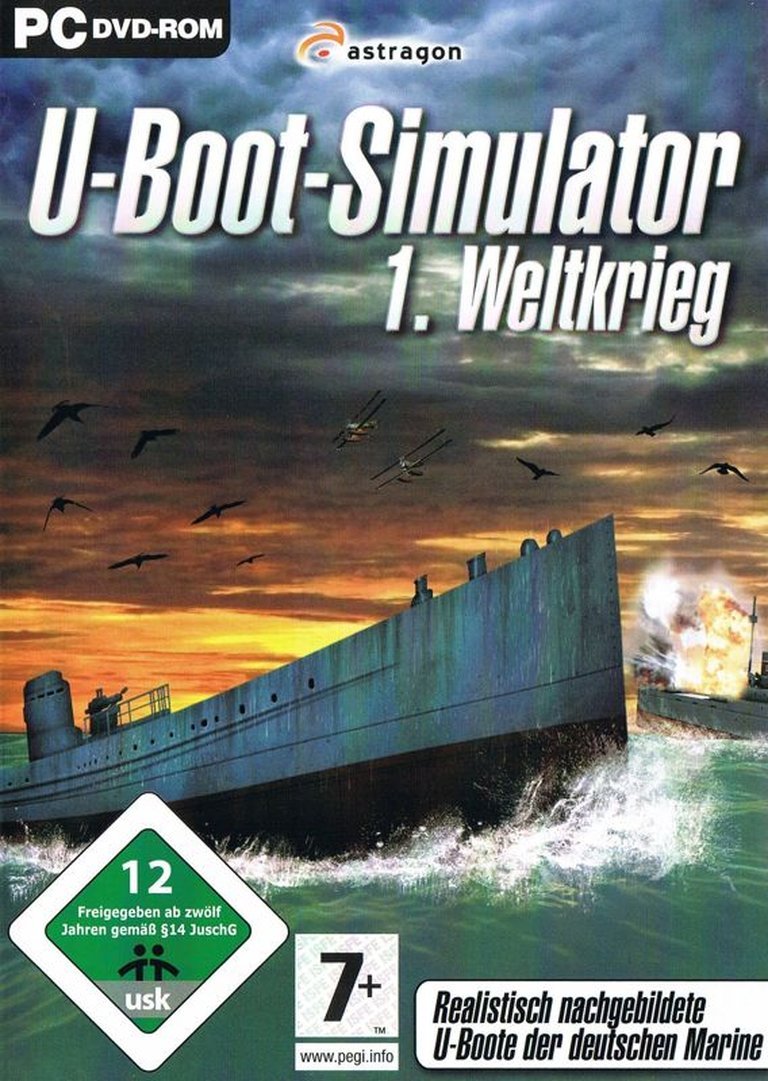
Description
1914: Shells of Fury is a submarine simulation game set during World War I, where players take command of German U-boats on patrol missions across historical campaigns. With adjustable realism settings, multiple submarine classes, and a mission editor, the game focuses on tactical underwater warfare without modern aids like sonar, emphasizing authentic early 20th-century naval combat.
Gameplay Videos
1914: Shells of Fury Mods
1914: Shells of Fury Reviews & Reception
metacritic.com (50/100): A tentative little game without much depth.
metacritic.com (49/100): In summary, I’d say the biggest weakness with 1914 Shells of Fury is the feeling that you have little control over what happens.
metacritic.com (40/100): Shells of Tedium would be a more appropriate title.
tallyhocorner.com : what you have here is a little gem – a bead of Baltic amber perfectly encapsulating the spirit of sub sim classics like Aces of the Deep.
1914: Shells of Fury: Review
Introduction: A Niche Forged in the Deep
In the vast ocean of naval combat simulations, the vast majority have fixated on the high-tech, globally-spanning conflicts of World War II. The claustrophobic, precarious, and tactically distinct warfare of the First World War’s U-boat fleets has, until recently, remained a startlingly underexplored theater. Into this quiet sector of the timeline sailed 1914: Shells of Fury in 2006, a game boasting a seminal claim: it was, to widespread knowledge, the first submarine simulation to focus exclusively on the Great War. This review argues that Shells of Fury is a title of profound, if imperfect, historical significance. It successfully captures the unique, tense, and technologically primitive essence of early 20th-century submarine warfare, offering a Experience that is both a compelling homage to a bygone era of naval combat and a product whose technical and design shortcomings ultimately prevent it from achieving classic status. Its legacy is not one of mainstream acclaim, but of carving a crucial and thoughtful niche in the genre’s lineage.
Development History & Context: A Small Studio, A Big Historical Gap
Developed by h2f Informationssysteme GmbH, a German studio with a background in simulation and training software, and published by rondomedia Marketing & Vertriebs GmbH (with Strategy First handling North American distribution), 1914: Shells of Fury arrived in a crowded market dominated by Ubisoft’s Silent Hunter series. Released in October 2006 for Windows, the game was conceived as a direct response to a glaring historical omission. As noted by Tally-Ho Corner’s reviewer, “there was nothing original about Adolf Hitler’s strategy… A quarter of a century earlier, his pointy-hatted predecessor, Kaiser Bill, had attempted the exact same thing. Not that you’d know it from playing submarine games.”
The technological constraints of the mid-2000s are evident. While Silent Hunter III (2005) was pushing 3D graphics and detailed deck-level exploration, Shells of Fury retained a more interface-heavy, station-based presentation reminiscent of earlier classics like Silent Service. The game’s vision was clearly to prioritize period-authentic mechanics over graphical spectacle. However, it was inevitably measured against the juggernaut that was Silent Hunter, leading most critics to conclude, as PC Powerplay did, that it “hink[ed] in Technik und Details mindestens zwei Jahre hinterher” (lagged behind in technology and details by at least two years). Its development represented a calculated risk: tackle an underserved historical period with a smaller budget and a focus on gameplay authenticity over technical prowess.
Narrative & Thematic Deep Dive: War Through the Periscope
Shells of Fury eschews a traditional character-driven narrative for an operational and strategic one. The “story” is the career of a generic German U-boat commander (Kapitänleutnant) during World War I, told entirely through text-based mission briefings. These briefings provide historical context, strategic objectives (patrol zones, interdiction of specific convoys, minelaying), and sometimes vague intelligence. There is no protagonist with a personal arc; the player is the historical force.
The narrative is therefore emergent and systemic. The theme is one of primitive tension and technological determinism. Without radar, sonar, or long-range torpedo fire control computers, every attack is a desperate, close-quarters gamble. The game’s systems force a mindset shift from WWII submarine sims. As the Tally-Ho Corner review vividly describes, it is akin to “hunting dangerous game by catching only a brief glimpse before shooting. You stalk blindly and very close for a deadly short range shot. 200-300 meter was considered ideal then. The target will not have a chance to side-step at that range.”
The campaigns (four in total, covering periods like “1914: The First Flotilla” and “1917: The Second Flotilla”) structure this experience, attempting to mirror the ebb and flow of the unrestricted submarine warfare campaign. The feeling is one of isolated, brutal commerce raiding. The absence of advanced detection tech makes the ocean a shrouded, terrifying space. The narrative theme is isolation, vulnerability, and the blunt calculus of attrition. You are not a stealth hunter with a full crew complement and advanced systems; you are in a fragile, slow-diving metal tube, reliant on brief glimpses through the periscope and the mercy of the weather. The game’s limited AI—noted by several critics for being “scarily vigilant”—ironically reinforces the theme, making every surface ship a hyper-aware threat that amplifies the player’s sense of precariousness.
Gameplay Mechanics & Systems: The Essence of the Hunt
The core gameplay loop is a masterclass in simplified, period-accurate simulation. It breaks down into the classic triad: Navigate, Detect, Attack.
- Navigation & Strategic Layer: Using a strategic map, the player plots a course for their designated patrol area. The time acceleration feature is critical, allowing the passage of hours or days to be compressed until an encounter is triggered by the game’s event system. This is a direct analog to the long, monotonous stretches of real U-boat patrols.
- Detection: Detection is entirely visual and auditory through the hull. The player can:
- Use the periscope (the primary tool), but doing so risks detection (“periscope depth” is a vulnerable state).
- Perform surface lookouts with binoculars.
- Listen for engine sounds through the hull (a rudimentary hydrophone effect).
There is no sonar (SSN), no radar. This is the single most defining and successful mechanic, perfectly capturing the WWI experience.
- Attack: Once a target is spotted and ranged (using the periscope’s stadimeter), the player can:
- Use the “lock-and-fire” simplified torpedo system, which calculates a basic firing solution automatically for the player.
- Engage in manual targeting, requiring the player to manually calculate gyro angles, run distances, and torpedo depth settings—a complex process mimicking the manual “firing party” drills of the era.
- Employ the deck gun (against unarmed or damaged merchants) or, for minelaying submarines like the UC-II, lay minefields in shipping lanes.
The realism sliders are a major feature. Players can toggle unlimited fuel/oxygen, torpedo reliability, crew fatigue, and damage models. This allows the game to scale from a fairly accessible experience to a brutally hardcore simulation where single torpedo duds or battery failures can spell doom.
Submarine Classes are period-accurate and mechanically distinct:
* Early boats (U-9 type): Slow, few torpedoes, minimal armament. Represent the infancy of the weapon.
* Minelayers (UC-II): A unique and celebrated class, trading torpedoes for the ability to lay minefields—a historically crucial tactic.
* Later fleet boats (Type U-93): Faster, more torpedoes, a deck gun, representing the technological peak of the war.
Flaws in the System: The game’s weaknesses are often mechanical.
* AI Perception: Multiple reviews (GameZone, Tally-Ho Corner) cite enemy ships with unrealistically sharp vision, spotting a periscope tip at extreme ranges, which can feel punitive rather than challenging.
* Combat Flow: Game Chronicles pinpointed a core issue: “the torpedo combat system is not as streamlined as arcade-style naval games, but it also is far too easy for hardcore sub players who prefer to plot out their own firing solutions.” It struggles to satisfy either audience fully.
* Campaign & Save: The lack of a mid-mission save function is a notorious pain point, forcing players to complete multi-hour patrols in one sitting or risk losing all progress—a design choice that feels archaic even for 2006.
* Deck Gun & Damage: The deck gun’s auto-fire option is often more effective than manual aim, and ship damage/physics models are simplistic compared to later titles.
World-Building, Art & Sound: A dated but functional vessel
The presentation is where Shells of Fury shows its age and budget most clearly.
- Visuals & Atmosphere: The game uses pre-rendered 2D station screens for the control room, engine room, etc., similar to Silent Hunter II. The 3D external view is functional but dated, with simplistic water and ship models. The claustrophobic, detail-rich interior screens are arguably its strongest visual asset, successfully conveying the cramped, industrial feel of a WWI U-boat. The atmosphere is built through these tight quarters and the sparse, often ominous ocean sounds. However, as PC Games (Germany) bluntly stated, the graphics “halten selbst dem Vergleich zum drei Jahre alten Silent Hunter 3 nicht stand” (don’t stand up to comparison with the three-year-old Silent Hunter 3).
- Sound Design: This is a major weakness. Reviews consistently describe sound effects as “kaum vorhanden oder qualitativ unterirdisch” (hardly present or qualitatively subterranean) (PC Games). The ambient creaks, engine noises, and torpedo launch sounds are sparse and low-quality, severely undermining the immersive tension that is so critical to a sub sim. The music is minimal and unobtrusive.
- Setting & Immersion: The historical setting is the game’s greatest asset. The feeling of being in a WWI U-boat is communicated through the mechanics more than the aesthetics: the slow dive times, the limited battery life, the absence of advanced gadgets, the presence of wireless telegraphy for briefings. The limited, grainy visuals and poor sound ironically force the player’s imagination to fill the gaps, which can, for the historically minded, enhance the sense of period.
Reception & Legacy: A Modest Success in a Narrow Channel
Shells of Fury received a mixed-to-negative critical reception, with a MobyGames average of 60% and a Metacritic score around 50%. The consensus was that it was a competent but unpolished niche title.
- Positive Reception (e.g., Out Of Eight 75%, PC Action 71%): Critics in this camp celebrated its unique setting and accessible simulation approach. They appreciated the functional, “no-frills” reproduction of WWI U-boat combat and found value in its budget price ($20). The adjustable realism and inclusion of minelaying were definite pluses.
- Negative Reception (e.g., GameZone 50%, Gamers’ Temple 40%): Critics here focused on the dated graphics, poor sound, simplistic AI, and frustrating design choices (no mid-mission save). They unfavorably compared it to Silent Hunter III in every technical category and found the core loop either too boring or too frustrating.
Commercial & Cultural Legacy: The game was not a commercial blockbuster but found a modest audience among sub-sim enthusiasts desperate for a change of scenery. Its true legacy is twofold:
1. Historical: It proved the WWI U-boat setting was viable and interesting, directly paving the way for later, more polished entries like Uboat (2024) and The Great War: Western Front (2022), which also feature naval components.
2. Community: A dedicated modding community emerged, as seen on sites like Subsim.com. The “U-Boot Kurs West” mod is explicitly mentioned in the Tally-Ho Corner review as improving the game, addressing AI vision issues and adding content. This modding support extended the game’s lifespan and demonstrated a core appreciation for its foundational systems, even if the developers didn’t fully realize their potential.
It sits in the lineage as a proof-of-concept—a game that got the historical heart right but lacked the technical muscle and polish to become a genre-defining classic. Its influence is more about opening a historical door than establishing new gameplay paradigms.
Conclusion: A Flawed but Foundational Vessel
1914: Shells of Fury is not a great game by any conventional metrics. Its graphics are mediocre, its sound design is poor, its AI is inconsistent, and its user experience is marred by archaic design decisions like the lack of a mid-mission save. For the casual or even many hardcore simulation fans, these flaws are likely insurmountable.
Yet, to dismiss it entirely is to miss its profound achievement. As a historical simulator, it is a remarkable success. It isolates and amplifies the core, terrifying experience of World War I submarine warfare: the visceral tension of the periscope peek, the terrifying proximity of the attack, the helplessness against merchant ships with deck guns, and the slow, grinding reality of a diesel-electric boat. The simplified but functional systems, the four historically distinct submarine classes (with the UC-II minelayer being a standout), and the campaigns that span the war all coalesce to create an experience that feels correct for its era.
Its place in video game history is that of a pioneering niche title. It dared to explore a forgotten front of naval warfare and, in doing so, provided a template—warts and all—that later developers could study and improve upon. It is a game for the historian-enthusiast, the player willing to overlook technical shortcomings to metaphorically step into the claustrophobic, oil-stained hull of a 1914 German U-boat. For them, Shells of Fury remains a fascinating, intermittently thrilling, and ultimately valuable dive into a unique and brutal chapter of military history. Its verdict is thus a qualified one: a flawed artifact, but an essential one for understanding the evolution of historical submarine simulation.
Final Verdict: 6.5/10 – A historically pioneering but technically uneven simulation that succeeds in spirit where it fails in presentation. A must-play for WWI naval buffs, a skip for everyone else.