
- Release Year: 2002
- Platforms: PlayStation, Windows
- Publisher: Eidos Interactive Limited, Sold Out Sales & Marketing Ltd.
- Genre: Compilation
- Perspective: Third-person
- Game Mode: Single-player
- Average Score: 72/100
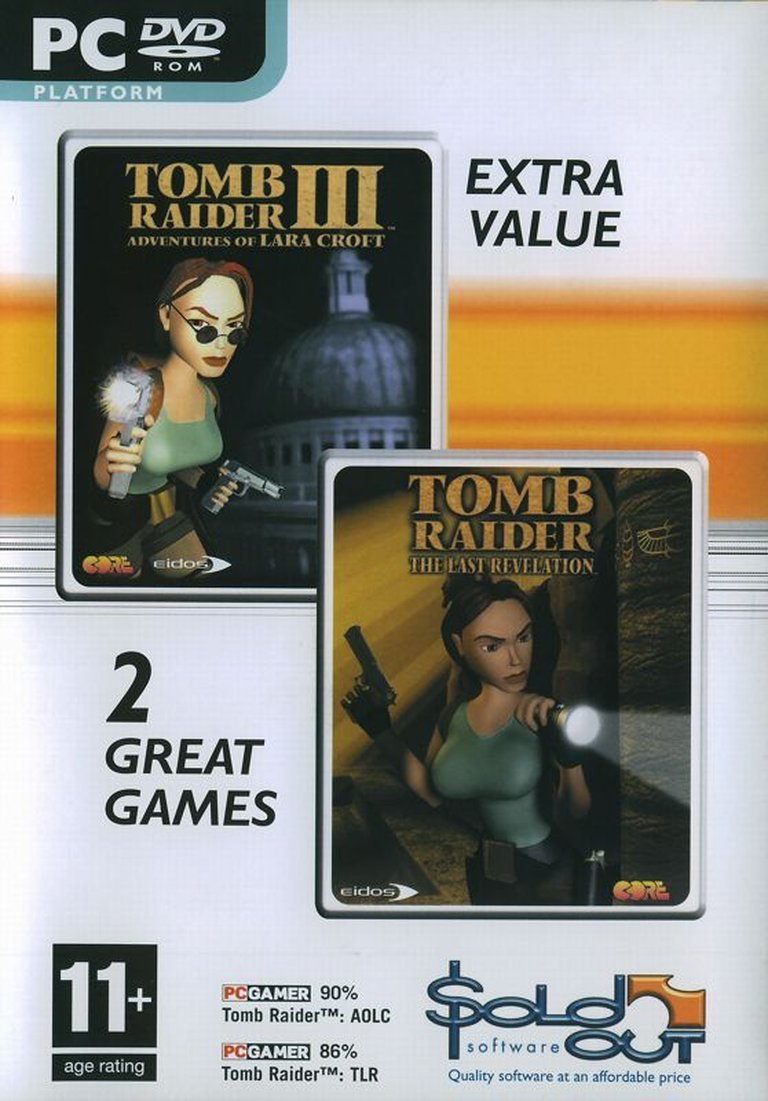
Description
This twin pack compilation brings together Tomb Raider III: Adventures of Lara Croft and Tomb Raider: The Last Revelation, allowing players to experience two classic adventures of the iconic archaeologist. Tomb Raider III takes Lara on a global quest to uncover an ancient artifact across diverse locations like India, Nevada, and the South Pacific, while Tomb Raider: The Last Revelation transports her to the deserts of Egypt to confront dark forces and uncover forgotten secrets. Both games feature signature gameplay mechanics including exploration, puzzle-solving, and combat within richly detailed historical settings.
2 Games: Tomb Raider III / Tomb Raider: The Last Revelation Cracks & Fixes
2 Games: Tomb Raider III / Tomb Raider: The Last Revelation Cheats & Codes
PC (Original)
Position Lara facing exactly North. Go to inventory and highlight the specified item without selecting, then hold the key sequence.
| Code | Effect |
|---|---|
| H+E+L+P | Skip level |
| G+U+N+S | All Items |
| W+E+A+P+O+N+S | All Weapons |
PlayStation (Original)
Position Lara facing exactly North. Go to inventory and highlight the specified item without selecting, then hold the specified buttons and press the required button.
| Code | Effect |
|---|---|
| L1+L2+R1+R2+Up+Triangle | Skip level |
| L1+L2+R1+R2+Up+Triangle | All Weapons |
| L1+L2+R1+R2+Down+Triangle | Unlimited objects |
| L1+L2+R1+R2+Down+Square+Triangle+Circle | All special objects |
Dreamcast (Original)
Position Lara facing exactly North. Go to inventory and highlight the specified item without selecting, then hold the specified buttons and press the required button.
| Code | Effect |
|---|---|
| L+R+Y | Skip level |
| L+R+Y | All weapons |
| L+R+Up+Right+Up+Start+Start | Unlimited ammo |
| L+Up+X+Up+R+Y | All weapons with unlimited ammo and medipacks |
PC (Remastered)
Position Lara facing exactly North. Go to inventory and highlight the specified item, then hold the key sequence.
| Code | Effect |
|---|---|
| H+E+L+P | Skip level |
| G+U+N+S | All Weapons, Unlimited Ammo, Health & Flares |
PlayStation (Remastered)
Position Lara facing exactly North. Go to inventory and highlight the specified item, then hold the button sequence.
| Code | Effect |
|---|---|
| L1+L2+R1+R2+Up | Skip level |
| L1+L2+R1+R2+Up | All Weapons, Unlimited Ammo, Health & Flares |
Xbox (Remastered)
Position Lara facing exactly North. Go to inventory and highlight the specified item, then hold the button sequence.
| Code | Effect |
|---|---|
| LB+LT+RB+RT+Up | Skip level |
| LB+LT+RB+RT+Up | All Weapons, Unlimited Ammo, Health & Flares |
Switch (Remastered)
Position Lara facing exactly North. Go to inventory and highlight the specified item, then hold the button sequence.
| Code | Effect |
|---|---|
| L+ZL+R+ZR+Up | Skip level |
| L+ZL+R+ZR+Up | All Weapons, Unlimited Ammo, Health & Flares |
2 Games: Tomb Raider III / Tomb Raider: The Last Revelation: Review
Introduction
Tomb Raider stands as one of gaming’s most iconic franchises, a testament to Lara Croft’s enduring legacy as a cultural phenomenon. The compilation 2 Games: Tomb Raider III / Tomb Raider: The Last Revelation bundles two pivotal entries from the original “Classic Era” trilogy, offering players a window into the series’ evolution during its peak. Released in 2002 for PlayStation and 2005 for Windows, this package bridges the gap between the genre-defining first two games and the controversial Angel of Darkness. While Tomb Raider III solidified the formula but faced criticism for stagnation, The Last Revelation elevated storytelling and atmosphere yet stumbled in execution. Together, they represent a crucial, if flawed, chapter in Lara’s journey—a snapshot of ambition constrained by technology and a rapidly evolving industry. This review deconstructs both titles, analyzing their design, narrative, and legacy to evaluate their collective impact on gaming history.
Development History & Context
Developed by Core Design under publisher Eidos Interactive, both titles emerged from a period of unprecedented success and intense pressure. Tomb Raider III (1998) was conceived as an expansion pack for its predecessor before ballooning into a full sequel, leveraging the PlayStation’s hardware capabilities to introduce colored lighting, weather effects, and complex geometry. Core Design, riding the wave of Lara’s global superstardom, faced the Herculean task of innovating without alienating fans. By 1999, with The Last Revelation, the team doubled down on narrative ambition, shifting focus to Egyptian mythology and Lara’s mentorship under Professor Werner Von Croy. Technologically, the PlayStation’s 16-bit palettes and memory constraints dictated design choices, necessitating grid-based movement and rigid save systems. The gaming landscape was dominated by platform wars, with Tomb Raider competing against rising stars like Resident Evil 2 and Metal Gear Solid. This context explains the games’ paradox: ambitious in scope but hamstrung by technical limits and a “if it ain’t broke” philosophy that would later contribute to franchise fatigue.
Narrative & Thematic Deep Dive
Tomb Raider III spins a globe-trotting tale centered on meteorite artifacts granting evolutionary powers. Lara, hired by the enigmatic Dr. Willard, retrieves the Infada Stone in India, then pursues three more relics across the South Pacific, London, and Nevada. The narrative emphasizes hubris and unintended consequences, as Willard’s experiments mutate humans into grotesque “Damned.” Thematic depth lies in Lara’s isolation—she’s a lone treasure hunter in a world of corporate greed (RX-Tech) and unethical science (Sophia Leigh’s cosmetic immortality rituals). The episodic structure, with levels playable in any order after India, fractures cohesion, but standout set-pieces like the London cityscape and Antarctic meteorite site deliver pulpy charm.
The Last Revelation refines the formula with a more cohesive, myth-driven narrative. A 1984 Cambodia training level establishes Lara’s bond with Von Croy, whose later murder frames her in the present. The core plot—Lara accidentally freeing the Egyptian god Set—explores fate and redemption. Themes of legacy and responsibility permeate, with Lara confronting her role as a “destroyer” of ancient powers. The Egyptian setting offers rich lore, blending mythology with historical accuracy, though the story’s abrupt ending (Lara trapped in a collapsing tomb) felt unresolved at launch, necessitating Chronicles. Both games prioritize spectacle over character depth, but Last Revelation‘s tragic undertones elevate it beyond mere adventure.
Gameplay Mechanics & Systems
Movement & Controls: Both games retain the signature “tank controls” (forward/backward relative to camera), criticized for imprecision. Tomb Raider III introduces welcome additions: sprinting for speed bursts, crawling through tight spaces, and the “monkey swing” mechanic. Vehicles like quad bikes and kayaks add variety but suffer from clunky physics. The Last Revelation refines traversal with rope climbing and corner-hugging, yet the grid-based movement persists, leading to frustrating platforming deaths. The remastered versions (included in modern bundles) address this with optional modern controls, a vital accessibility update.
Combat & Progression: Combat is rudimentary but iconic. Lara’s dual pistols have infinite ammo, encouraging aggressive play, while weapons like the grenade launcher (TR3) or Desert Eagle (TRLR) require scavenging. Tomb Raider III features more enemies—mutants, T-Rexes, and piranhas—but underwater sections (e.g., River Ganges) are notoriously punishing due to limited oxygen and strong currents. TRLR simplifies combat with fewer foes but emphasizes stealth in Parisian locales. The inventory system evolves: TRLR allows item combination (e.g., attaching laser sights) and introduces binoculars for puzzle-solving, though poor UI design obscures these features.
Puzzles & Level Design: Tomb Raider III puzzles are switch-based and location-specific, but non-linear level paths (e.g., choosing between London or Nevada) encourage replayability. TRLR‘s Egyptian tombs excel in interconnected design, requiring backtracking with a compass for navigation. Both games rely heavily on environmental hazards—spike traps, collapsing ceilings, and quicksand—demanding patience over skill. The lack of auto-saves (PlayStation versions consume Save Crystals) amplifies frustration, though modern ports remedy this.
World-Building, Art & Sound
Visuals & Atmosphere: Tomb Raider III showcases Core Design’s technical strides: colored lighting illuminates Indian jungles, Antarctic ice gleams, and London’s rooftops feel lived-in. However, muddy textures and pop-in mar the immersion. The Last Revelation excels artistically, with Egyptian locales (Karnak’s Great Hypostyle Hall, Sphinx Complex) bathed in golden light and shadow. The game’s palette of deserts, tombs, and ruins creates a palpable sense of dread, amplified by Set’s impending apocalypse. Lara’s model is more detailed, though animations remain stiff.
Sound Design: Nathan McCree’s scores are masterful—TRLR‘s Egyptian themes blend traditional instruments with orchestral grandeur, while TR3‘s tribal beats and industrial ambience match its diverse settings. Sound effects (gunshots, water drips) are crisp but repetitive. Voice acting is minimalistic, with Lara’s quips (“Do I look like a people person?”) becoming iconic. TRLR shines here, using environmental audio (sandstorms, temple echoes) to heighten tension.
Cultural Significance: Both games cement Lara as a feminist icon, though their portrayal of violence against women (e.g., TR3’s mutant experiments) has aged poorly. The settings—from Area 51’s sci-fi intrigue to Cambodia’s temples—reflect 90s fascination with exoticism and archaeology, blending real-world history with pulp fiction.
Reception & Legacy
Original Reception: Tomb Raider III (1998) sold ~6 million copies but drew criticism for its “tried and tested” formula and punishing difficulty. Critics lauded its scale and visuals but lamented minimal innovation. The Last Revelation (1999) earned praise for its narrative depth and atmosphere but faced backlash for controls and a cliffhanger ending. Both titles were commercial successes but marked the start of franchise fatigue, leading to Angel of Darkness‘s 2003 reboot attempt.
Evolution of Reputation: Over time, TRLR is revered as a high point of the Classic Era, celebrated for its storytelling and level design. TR3 remains divisive—admired for ambition but criticized for bloat. The compilation’s 2002/2005 releases arrived post-Angel of Darkness, positioning these as “last great” entries. Modern remasters (2024-2025) have revitalized them, with players praising TRLR‘s puzzles while acknowledging TR3‘s flaws.
Influence on the Industry: Both games influenced level design, emphasizing large, non-linear hubs and environmental storytelling. TRLR‘s focus on myth and mentorship prefigured the Legend trilogy’s reboot. The compilation itself exemplifies the era’s trend of bundling legacy titles, a practice now standard in remaster culture. However, their technical limitations also highlight how franchises can stagnate without innovation—a lesson Crystal Dynamics applied to the 2013 reboot.
Conclusion
2 Games: Tomb Raider III / Tomb Raider: The Last Revelation is a time capsule of ambition and limitation. Tomb Raider III captures the series’ peak popularity but falters under its own weight, while The Last Revelation achieves narrative and atmospheric brilliance despite technical shackles. Together, they embody the Classic Era’s strengths—iconic characters, rich settings, and groundbreaking design—and weaknesses—formulaic gameplay and clunky controls. The compilation’s value lies in its historical significance, offering a bridge between Tomb Raider’s origins and its rebirth. For newcomers, the remastered versions are entry points into a foundational series; for veterans, they’re a bittersweet reminder of a bygone era. Ultimately, these games are not flawless masterpieces, but essential chapters in Lara’s odyssey—proving that even in imperfection, Tomb Raider’s legacy endures. Verdict: A compelling artifact for historians and a nostalgic trip for fans, but newcomers should start with the 2013 reboot for a more polished experience.