
- Release Year: 1998
- Platforms: Windows
- Publisher: Swing! Entertainment Software GmbH, UCON Interactive GmbH
- Genre: Compilation
- Game Mode: Single-player
- Average Score: 43/100
Description
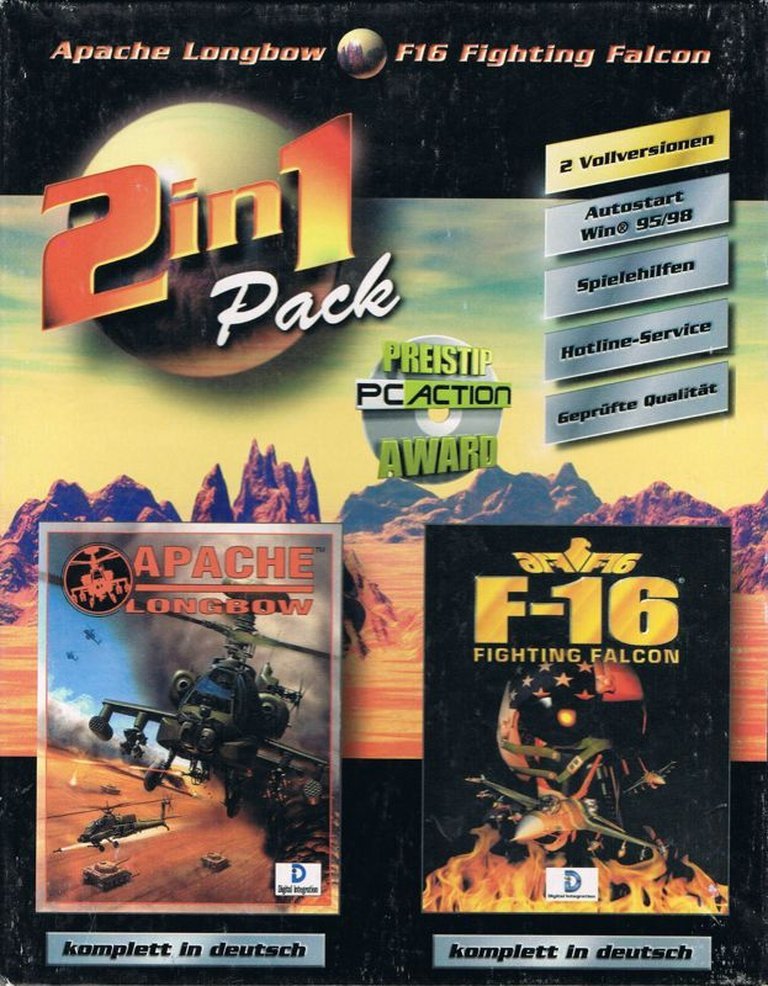
The ‘2 in 1 Pack: Apache / iF-16’ compilation, released in 1998 for Windows, bundles two combat flight simulation games: the 1995 title ‘Apache’, which places players in the cockpit of the Apache attack helicopter for tactical military missions, and the 1997 title ‘iF-16’, featuring the F-16 Fighting Falcon in intense aerial combat scenarios. This collection delivers dual aviation experiences on a single CD-ROM, catering to enthusiasts of helicopter and jet simulations.
2 in 1 Pack: Apache / iF-16 Cheats & Codes
PC
Enter codes at the main menu.
| Code | Effect |
|---|---|
| Lyn Wins | Enables cheats and full weapons |
| [Alt] V | Empty tank |
| [Alt] T | Over torque |
| [Shift] V | Refill tank |
| [Ctrl] T | Terrain follow |
| Turn overtorque off, then type [Shift] [Alt] [tab] [ctrl] simultaneously, repeatedly press: [tab] for speed increase | Turbo |
| Enter Lyn Wins as your name | Invincibility & Unlimited Ammunition |
| Enter Flamdwyn Aiobhell as your name | Unlimited Ammunition |
2 in 1 Pack: Apache / iF-16: Review
Introduction
In the golden age of PC gaming during the mid-to-late 1990s, flight simulations reigned as paragons of technological ambition and niche appeal. Among the era’s most prolific developers, Digital Integration Ltd. carved a niche with its “Front Line Fighters” series, blending meticulous hardware accuracy with explosive combat scenarios. 2 in 1 Pack: Apache / iF-16, a 1998 Windows compilation published by Swing! Entertainment Software GmbH and UCON Interactive GmbH, serves as a time capsule of this era. Bundling the 1995 helicopter combat simulator Apache and the 1997 jet fighter title iF-16, it offered European gamers dual access to two distinct yet philosophically aligned aerial warfare experiences. This review argues that while the compilation represents the pinnacle of 1990s flight simulation—prioritizing authenticity, technical depth, and visceral combat—it is ultimately a product of its time, flawed by hardware constraints and overshadowed by more ambitious contemporaries. Its legacy lies not in longevity, but as a testament to the genre’s brief, brilliant zenith and the developer’s unwavering dedication to simulating the art of aerial combat.
Development History & Context
Digital Integration Ltd.’s ascent to flight simulation prominence was built on a foundation of technical rigor and military authenticity. Founded in the late 1980s, the studio gained acclaim with titles like Tornado (1993) and Hind (1996), which combined complex avionics modeling with accessible combat mechanics. For Apache (1995), director David K. Marshall and designer Rod J. Swift envisioned a helicopter simulator that embraced both accessibility and realism, while iF-16 (1997) sought to replicate the F-16’s “Viper” reputation as a lightweight but deadly fighter.
Technologically, both titles operated under significant constraints. Released during the DOS-to-Windows 9x transition, they initially ran on systems with 486 or Pentium processors (33–75 MHz), 8MB of RAM, and SVGA graphics (320×200 or 640×480 resolutions). Hardware acceleration was limited; iF-16 later patched in 3DFX support, but its core engine struggled with frame rates, particularly in complex environments. Compromises were necessary: terrain textures were rudimentary, explosions replaced with simple particle effects, and AI behavior relied on scripting rather than dynamic logic.
The 1990s gaming landscape was saturated with flight sims, from Jane’s Combat Simulations’ ultra-realistic Longbow (1996) to Novalogic’s arcade-style F-22 Lightning II (1997). Digital Integration positioned itself between these extremes, emphasizing “actionable realism” where technical depth coexisted with engaging combat. The 1998 compilation was a strategic move by Swing! Entertainment, a German publisher specializing in budget releases. By bundling two of Digital Integration’s strongest titles, Swing! capitalized on the European market’s appetite for value-priced military sims while capitalizing on the studio’s established reputation.
Narrative & Thematic Deep Dive
Both games abandon traditional narrative structures in favor of procedural, mission-driven scenarios, framing conflict as a series of tactical engagements rather than a cohesive story. This reflects a thematic focus on the isolated heroism of the modern combat pilot and the dehumanizing efficiency of modern aerial warfare.
Apache unfolds across three fictional conflict zones: Yemen, Korea, and Cyprus. Each campaign opens with a pre-mission briefing—a voiceover narration outlining objectives, threats, and environmental variables. While devoid of character development, these briefings create a sense of urgency and realism. For instance, a Yemen mission might task the player with eliminating SCUD launchers while avoiding civilian casualties, embedding ethical dilemmas into the gameplay. The absence of named characters shifts focus to the player’s role as an anonymous instrument of state power, with victory measured solely by mission completion.
iF-16 extends this approach but with a geopolitical sheen. Its campaigns traverse Korea, Cyprus, and Israel, regions selected for their real-world tension. Missions involve air superiority sweeps, ground-attack sorties, and reconnaissance flights, often blurring the line between aggression and defense. The theme here is technological supremacy: the F-16’s agility and sensor suite are portrayed as decisive advantages against outdated Soviet-era hardware like MiG-29s and Su-25s. Dialogue is minimal—restricted to radio chatter (“Fox Two!” “Splash one!”)—reinforcing the player’s isolation in the cockpit.
Beneath the surface, both titles explore the burden of responsibility. Apache‘s co-op multiplayer mode (pilot/gunner duos) implicitly addresses teamwork, while iF-16‘s laser-guided bomb mechanics demand precision to avoid collateral damage. Neither game moralizes, but their systems simulate the ethical tightrope of modern warfare, making “victory” a complex calculus of collateral damage and mission success.
Gameplay Mechanics & Systems
Core Gameplay Loops
Both games prioritize authentic flight dynamics and weapon-system modeling, but diverge in execution. Apache offers a dual-mode philosophy: an “Arcade” mode with simplified controls and auto-hover, enabling newcomers to enjoy dogfights, and a “Realistic” mode requiring mastery of collective pitch, torque management, and navigation. iF-16 is relentlessly simulation-focused, demanding knowledge of radar modes, radar warning receivers (RWR), and missile avoidance maneuvers.
Combat Systems
– Apache: Armaments include Hellfire air-to-ground missiles, Stinger air-to-air missiles, Hydra rockets, and a 30mm M230 chain gun. The gunner view (in multiplayer) allows manual targeting of infantry or light vehicles, adding tactical nuance.
– iF-16: Features AIM-7 Sparrows, AIM-9 Sidewinders, and laser-guided bombs (LGBs). LGBs are particularly punishing; losing laser lock mid-flight results in mission failure, mirroring real-world difficulty.
Innovation and Flaws
Apache excels in environmental interaction: cities and airfields are populated with destructible structures, and ground battles unfold dynamically between allied (M1 Abrams tanks, F-15s) and enemy (Mi-24 Hinds, T-72s) units. However, terrain rendering is flat and repetitive, and collision detection is inconsistent. iF-16 suffers from a “slow graphics engine,” with stutters during high-speed maneuvers. Both games lack dynamic campaigns, missions feeling static and isolated.
UI and Controls
Menus are functional but dated. Apache uses a mouse-driven interface for mission planning, while iF-16 relies on keyboard shortcuts for avionics. Cockpit layouts are detailed but cluttered, overwhelming new players. No reverse collective control in Apache and Thrustmaster joystick compatibility issues in iF-16 further hinder accessibility.
World-Building, Art & Sound
Visual Direction
– Apache: The world is a patchwork of diverse terrains. Yemen offers canyons and deserts; Korea features mountains and rice paddies; Cyprus blends urban zones with coastal cliffs. Aircraft and ground vehicles are meticulously modeled, with the Apache’s rotor blades and F-16’s intake细节 evident even at low resolutions. Cities, however, are repetitive clusters of cubic buildings, and landscapes stretch into infinite, textureless horizons.
– iF-16: Korean mountain ranges and Cypriot coastlines are rendered with greater topographical complexity than Apache, but the trade-off is performance. The F-16’s model is lauded for its accuracy, yet cockpit textures are pixelated, and missile trails appear as simple lines.
Atmosphere and Immersion
Both games use dynamic lighting and weather effects to heighten tension. Night missions in Apache require NVG goggles, limiting visibility to tracers and explosions. iF-16‘s Israeli campaign simulates desert heat haze, distorting the horizon. Ground units engage in scripted battles, but their behaviors feel artificial—tanks firing at walls, helicopters hovering statically.
Sound Design
Apache excels here. Engine whines shift pitch with rotor speed, weapon impacts resonate with satisfying thuds, and radio chatter (“Tally bandits!”) situates the player in a combat orchestra. iF-16‘s audio is more sterile, with jet engines sounding like white noise and missile launches emitting generic whooshes. Both games feature menu-driven rock tracks, but silence in-flight amplifies immersion.
Reception & Legacy
Launch Reception
Individually, Apache and iF-16 were critical darlings. Apache earned a 86% Moby Score and praise from PC Gamer for its “realistic flight model” and “arcade/realistic duality.” iF-16 scored a 76%, lauded for its F-16 accuracy but criticized for its sluggish engine. As a compilation, 2 in 1 Pack targeted budget-conscious Europeans, offering two titles for the price of one. It lacked standalone acclaim but served as an accessible entry point for flight sim newcomers.
Evolution of Reputation
Over time, the compilation’s reputation has fossilized. Modern retrospectives (e.g., MyAbandonware) frame it as a “historical artifact,” its technical limitations glaring compared to modern titles like DCS: Black Shark. The absence of dynamic campaigns and AI depth relegates it to niche status among simulation purists. Yet, it retains cult appeal for its authentic weapon modeling and tight combat loops.
Influence and Legacy
Digital Integration’s work directly influenced later titles. Team Apache (1998) streamlined Apache‘s mechanics, while Falcon 4.0 (1999) adopted its focus on avionics depth. The compilation also popularized the “budget twin-pack” format, a model Swing! replicated with Der Planer 2 / Mad TV 2 (1998). Today, Apache and iF-16 survive on abandonware sites, preserved by communities nostalgic for an era when flight sims prioritized over hardware spectacle.
Conclusion
2 in 1 Pack: Apache / iF-16 is a product of its time—a snapshot of 1990s flight simulation at its most ambitious and compromised. While Apache excels in accessibility and environmental dynamism, and iF-16 delivers jet-fighting authenticity, both are constrained by era-defining limitations: dated graphics, rigid mission structures, and a punishing learning curve. As a compilation, it offers value by showcasing Digital Integration’s range, from agile helicopters to supersonic jets, but fails to transcend its niche.
Its place in history is assured not as a masterpiece, but as a pioneering artifact. It embodied the genre’s peak—a time when technical depth stood alongside gameplay—and its influence echoes in modern sims’ commitment to realism. For contemporary players, it is a curio: challenging, dated, yet undeniably evocative. For historians, it is a vital link between the arcade flights of the 1980s and the hyper-realistic simulations of today. In the end, 2 in 1 Pack: Apache / iF-16 is less a game and more a time machine—a flawed, fascinating portal to an era when soaring through virtual skies was its own reward.