
- Release Year: 1999
- Platforms: Windows
- Publisher: Swing! Entertainment Software GmbH
- Genre: Compilation
- Game Mode: Single-player
- Average Score: 100/100
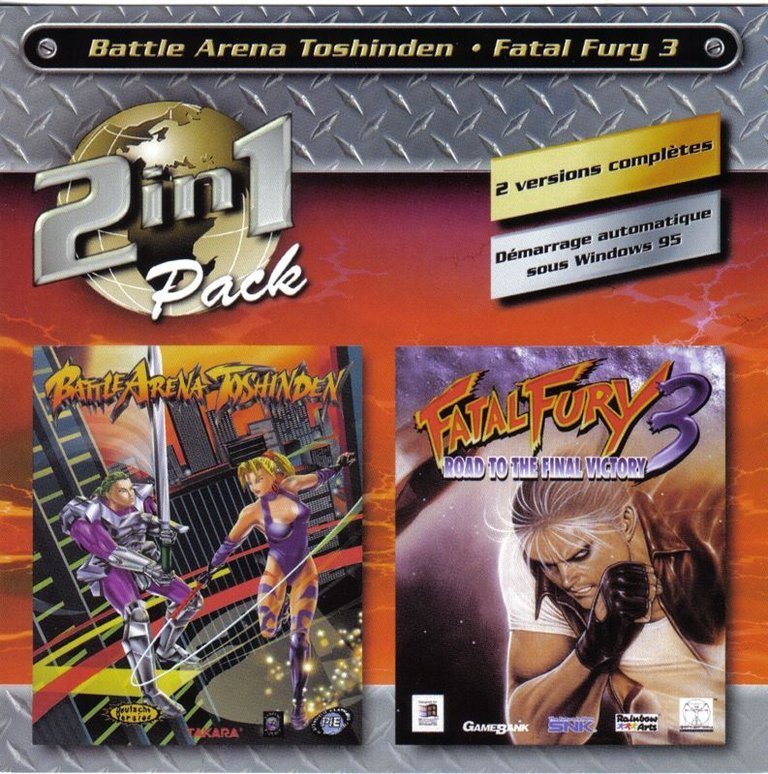
Description
2 in 1 Pack: Battle Arena Toshinden / Fatal Fury 3 is a 1999 PC compilation combining two classic fighting games from 1995. The package includes Battle Arena Toshinden, a 3D weapon-based fighter featuring tournament combatants, and Fatal Fury 3: Road to the Final Victory, a 2D arcade-style sequel continuing the Geese Howard saga. Released on CD-ROM by Swing! Entertainment, this collection offers both single-player and local multiplayer modes for fans of vintage fighting game action.
2 in 1 Pack: Battle Arena Toshinden / Fatal Fury 3 Cheats & Codes
PlayStation
Enter codes at the title screen while the words are appearing on the screen.
| Code | Effect |
|---|---|
| Square + Circle + Triangle + X then press Select twice | Removes power bars and allows shoulder buttons to zoom and pan around the arena. |
| Select | Select a character’s alter ego when highlighting the character. |
| Right, Left, Right, Left + Square on controller 2 | Instant Desperation and Super Moves at any difficulty level (after entering Gaia, Sho, and Instant Super moves codes). |
| Down/Left + X on controller 1 | Instant Super Moves (after entering Gaia and Sho codes). |
| Select + L1 + L2 + R1 + R2 | Perform secret moves more easily (after entering Gaia and Sho codes). |
| Down, Down/Left, Left + Square | Play as Gaia (highlight Eiji, hold Up and press any button). |
| Right, Left, Right, Left + Square on controller 2 | Play as Sho (highlight Kayin and press any button). |
| right, down, down/right + circle–controller 2 | Enable Sho as a playable character (Japanese version). |
| down, down/right, right + square | Enables Gaia for 1P and 2P modes (Japanese version). |
| down/right + X | Perform secret moves more easily (Japanese version). |
Saturn
Enter codes at the Press Start Screen.
| Code | Effect |
|---|---|
| Up, Down, X, B, A, Y, C, Z and press Start | Boss Code. |
| Up, Down, Up, Down, Right, Left, Right, Left and press Start | Boss Code (Toshinden S). |
| Pause, then hold X+Y+Z | Clean Pause; text is removed from pause screen. |
PC
Enter these codes during gameplay.
| Code | Effect |
|---|---|
| funnyheads | Big Heads. |
| virtual1 | First Person Mode. |
| lifeisunfair | One Key Specials. |
| gimmejim | Select Bosses. |
2 in 1 Pack: Battle Arena Toshinden / Fatal Fury 3: Review
A relic of the late 90s compilation craze, this bundle encapsulates two divergent paths in fighting game evolution. While neither title is a masterpiece, together they reflect an era of bold experimentation—and cautionary tales of technological overreach.
Introduction
Released in 1999 by Swing! Entertainment, 2 in 1 Pack: Battle Arena Toshinden / Fatal Fury 3 compiles two 1995 fighting game relics. This pairing is a microcosm of the mid-90s genre clash: one pioneering 3D weapons-based combat, the other refining 2D sprite artistry. Though financially forgettable and critically overlooked, the package offers a time capsule of ambition and compromise.
Development History & Context
Studio Vision & Technological Constraints
- Battle Arena Toshinden (Tamsoft/Takara, 1995): Developed in six months for the PlayStation’s 1994 launch, Toshinden was Takara’s weapon against Virtua Fighter. Leveraging the PS1’s power, it boasted gouraud shading, 90,000 polygons per second, and true 3D movement via sidestepping—a first for console fighters. However, its Saturn port (Remix, 1995) exposed rushed optimization, with textures and effects downgraded.
- Fatal Fury 3 (SNK, 1995): SNK’s Neo Geo swan song before The King of Fighters domination. It expanded the series’ plane-shifting mechanics but struggled with Neo Geo hardware limitations, sacrificing fluidity for detailed animations and branching paths.
The 1999 Compilation
Published by German studio Swing! Entertainment, this bundle targeted budget PC gamers seeking arcade experiences. Technically, it offered no enhancements—merely ports bundled on a CD-ROM—and relied on DOS compatibility. Released amid the Tekken 3 and Soulcalibur boom, it felt outdated at birth.
Narrative & Thematic Deep Dive
Battle Arena Toshinden: Style Over Substance
- Plot: A clandestine tournament orchestrated by the “Secret Society,” featuring fighters like Eiji Shinjo (a wandering swordsman seeking his brother) and Sofia (a detective with amnesia). The narrative is wafer-thin—typical for early 3D fighters—but dripping with anime melodrama.
- Themes: Betrayal, identity, and legacy (e.g., Ellis’ quest to find her father Gaia, the tournament’s sponsor). Character motivations are explored minimally in the Saturn Remix story mode, absent here.
Fatal Fury 3: SNK’s Gritty Revenge Opera
- Plot: Geese Howard’s resurgence ignites South Town gang wars, with Terry Bogard returning alongside newcomers like Sokaku Mochizuki (an ex-Yakuza seeking redemption).
- Themes: Cycles of violence (“Road to the Final Victory”) and moral ambiguity (playable anti-heroes like Blue Mary). Cutscenes and endings flesh out motivations, a hallmark of SNK’s storytelling depth.
Gameplay Mechanics & Systems
Battle Arena Toshinden: Flawed Innovation
- Core Loop: Weapon-based combat with eight characters (plus unlockable bosses). The sidestep mechanic allowed 360° movement but suffered from camera obstruction and unresponsive inputs (especially in PC ports).
- Systems: Desperation moves (executed at low health) and ring-outs added depth, but imbalanced rosters (e.g., Fo Fai’s overpowered claws) marred competitive play. The PC version added Earthworm Jim as a novelty reskin of Rungo Iron.
Fatal Fury 3: 2D Mastery with Caveats
- Core Loop: Two-plane movement (dodging via backdashes) and the Chain Combo System—a proto-Street Fighter III parry mechanic rewarding precise counters.
- Systems: Branching paths (three “Roads”) enhanced replayability, but input lag and stiff animations (vs. Garou: Mark of the Wolves) plagued the Neo Geo original. The PC port retained these flaws without addressing performance.
UI & Technical Issues
Both games suffer from archaic menus and minimal options. The compilation lacks resolution settings or controller remapping—critical oversights for a late-90s PC release.
World-Building, Art & Sound
Battle Arena Toshinden: Aesthetic Ambition
- Visuals: Early 3D models with anime-inspired designs (Tsukasa Kotobuki’s art) and varied arenas (catacombs, glaciers). The PC version’s lower-resolution textures aged poorly versus PlayStation’s gouraud shading.
- Sound: Techno-rock OST by Yasuhiro Nakano, with jarring PC audio compression. Character voices—like Sofia’s suggestive whip cracks—were toned down in Western releases.
Fatal Fury 3: Pixel Art Mastery
- Visuals: Lush spritework (South Town rooftops, Sakazaki dojos) and motion-captured animations for special moves (e.g., Terry’s Power Geyser).
- Sound: Hard-rock anthems and gruff voice acting (“Are you OK?”), though PC MIDI renditions lack Neo Geo’s Punch Wave impact.
Reception & Legacy
Launch Reception
- Battle Arena Toshinden: Acclaimed early (EGM’s 1995 Best Fighting Game) but later criticized for shallow combat (vs. Tekken 2). The PC port averaged 68% on GameRankings, slammed for clunky controls.
- Fatal Fury 3: Mixed reviews—praised for mechanics (GameFan: 92%) but faulted for “stagnation” (vs. Real Bout series).
Long-Term Impact
- Toshinden: Pioneered 3D arena fighters (influencing Soulcalibur) but faded after sequels flopped. Its PS1 version is now a retro curiosity.
- Fatal Fury 3: Overshadowed by KOF ’95 but revered for combo innovations. Today, it’s a cult classic among SNK purists.
The compilation itself left no legacy, selling poorly and ignored by critics—a footnote in the budget-PC era.
Conclusion
2 in 1 Pack: Battle Arena Toshinden / Fatal Fury 3 is a historical curiosity, not a must-play. Its value lies in preserving two transitional titles: one a 3D trailblazer hobbled by hubris, the other a polished but flawed 2D gem. For retro enthusiasts, it’s a fascinating artifact of 90s ambition—but casual players should seek Tekken or Garou for refined experiences. 5/10: A time capsule, not a classic.