
- Release Year: 1998
- Platforms: Windows
- Publisher: Swing! Entertainment Software GmbH
- Genre: Compilation
- Game Mode: Single-player
- Average Score: 40/100
Description
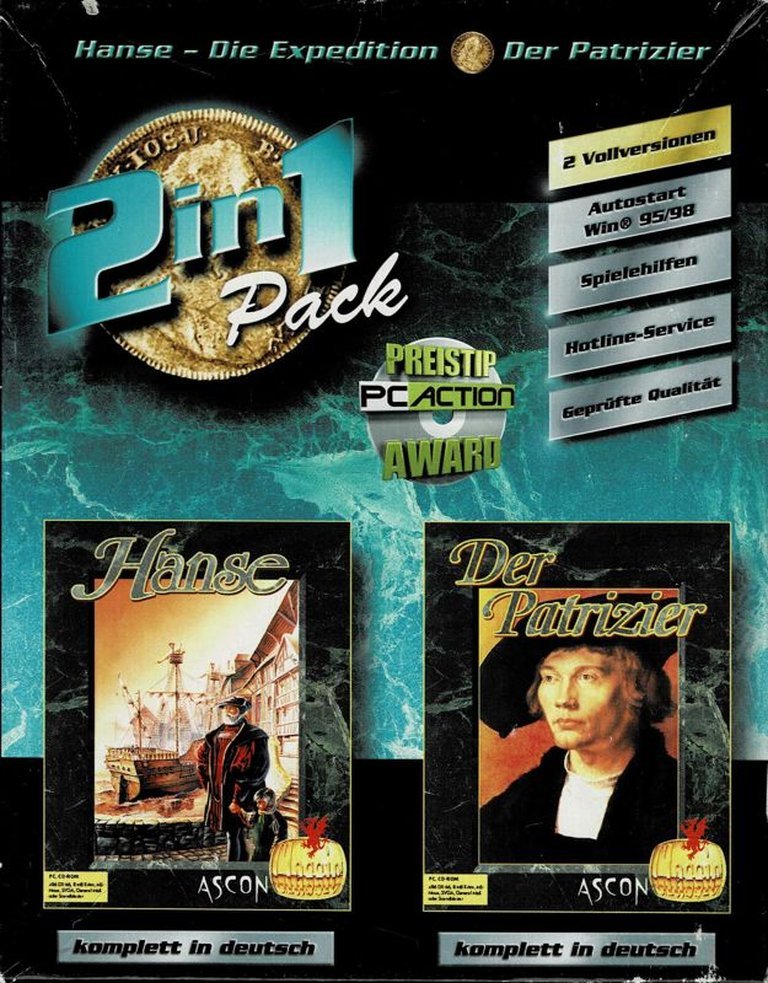
The ‘2 in 1 Pack: Hanse: Die Expedition / Der Patrizier’ is a compilation of two classic strategy games set in the medieval Hanseatic League. ‘Hanse: Die Expedition’ focuses on exploration and trade, while ‘The Patrician’ (Der Patrizier) challenges players to build a merchant empire in the Baltic Sea region. Both games blend economic management with historical settings, offering a mix of adventure and business simulation.
2 in 1 Pack: Hanse: Die Expedition / Der Patrizier Reviews & Reception
mobygames.com (40/100): Average score: 40% (based on 1 ratings)
retro-replay.com : This compilation encourages players to shift between immediate tactical choices on the high seas and long-term empire-building ashore.
2 in 1 Pack: Hanse: Die Expedition / Der Patrizier Cheats & Codes
PC
Enter in Savegames (HANSE*.zwi) starting from offset B21H the bytes 7F 7F 7F 7F.
| Code | Effect |
|---|---|
| 7F 7F 7F 7F | Released by cash problems |
2 in 1 Pack: Hanse: Die Expedition / Der Patrizier: A Dual Masterpiece of Medieval Trade and Strategy
Introduction
The 2 in 1 Pack: Hanse: Die Expedition / Der Patrizier is a fascinating artifact of late-1990s gaming, a compilation that bundles two seminal economic strategy titles into a single CD-ROM experience. Released in 1998 by Swing! Entertainment Software GmbH, this package offers players a dual-pronged journey into the mercantile world of the Hanseatic League, blending the high-seas trading of Hanse: Die Expedition (1994) with the city-building and political intrigue of Der Patrizier (1992). For historians of gaming, this compilation is a snapshot of an era when economic simulations were carving out a niche, appealing to players who craved depth, complexity, and historical authenticity over flashy graphics or twitch gameplay.
This review will dissect the compilation’s development history, narrative and thematic depth, gameplay mechanics, world-building, and its lasting legacy. By examining these elements, we can understand why this package, despite its mixed critical reception, remains a cult favorite among strategy enthusiasts and a testament to the golden age of German economic simulations.
Development History & Context
The Studio and Creators’ Vision
The 2 in 1 Pack is a product of Swing! Entertainment Software GmbH, a German publisher known for its budget-friendly compilations in the late 1990s. Swing! specialized in bundling older titles into affordable packages, often targeting the European market where economic simulations and strategy games had a dedicated following. While Swing! did not develop the games themselves, their role in curating and repackaging these titles for a new audience was crucial in preserving their accessibility.
Hanse: Die Expedition was developed by Ascon GmbH, a studio with a strong pedigree in economic and managerial simulations. Ascon’s vision for Hanse was to create a historically grounded trading simulation that emphasized the risks and rewards of medieval maritime commerce. The game’s design, led by Ralf Glau and Renate Langenkämper, focused on dynamic economic systems, where player decisions directly influenced their standing within the Hanseatic League. The inclusion of family dynamics—such as marriage, inheritance, and expeditions—added a layer of generational strategy rarely seen in contemporary titles.
Der Patrizier, also developed by Ascon, took a broader approach, blending city management with political maneuvering. The game’s design philosophy was rooted in the idea of player agency within a historically accurate framework. Unlike Hanse: Die Expedition, which was more of a pure trading simulator, Der Patrizier incorporated elements of urban development, guild politics, and long-term economic planning. This duality made the two games complementary, offering players a choice between the immediacy of seafaring trade and the depth of city-building.
Technological Constraints and the CD-ROM Era
The 2 in 1 Pack was released in 1998, a transitional period in PC gaming. The shift from floppy disks to CD-ROMs was well underway, and while 3D graphics were becoming more prevalent, many strategy games still relied on 2D pixel art and isometric perspectives. Both Hanse: Die Expedition and Der Patrizier were originally designed for DOS and Amiga systems, respectively, and their inclusion in this Windows-compatible compilation required minimal graphical upgrades. The CD-ROM format allowed for higher-quality audio and more extensive data storage, but the core visuals remained largely unchanged from their original releases.
The technological constraints of the era are evident in the games’ presentation. Hanse: Die Expedition features simple yet effective 2D maps of the North and Baltic Seas, with ships represented as small sprites and ports as static images. Der Patrizier employs an isometric city view, a common technique in strategy games of the time, which allowed for detailed urban layouts without the computational demands of 3D rendering. The UI in both games is text-heavy, reflecting the era’s reliance on menus and statistical feedback over visual storytelling.
The Gaming Landscape of the Late 1990s
The late 1990s were a boom period for strategy and simulation games. Titles like Sid Meier’s Civilization II (1996), Age of Empires (1997), and Railroad Tycoon II (1998) dominated the market, offering players deep, complex systems to master. German developers, in particular, excelled in economic and managerial simulations, with games like The Settlers (1993) and Anno 1602 (1998) gaining international acclaim.
Within this context, the 2 in 1 Pack catered to a niche but dedicated audience. Economic simulations were not as mainstream as real-time strategy or action games, but they had a loyal following, particularly in Europe. The compilation’s appeal lay in its historical authenticity and the depth of its gameplay mechanics. For players who enjoyed the intricacies of supply chains, market fluctuations, and political maneuvering, these games offered a level of complexity that was both challenging and rewarding.
However, the compilation’s release in 1998 also coincided with the rise of more visually impressive and accessible strategy games. The lack of significant graphical updates or modernized UI in the 2 in 1 Pack made it feel dated compared to newer titles. This tension between depth and presentation would ultimately shape its critical reception.
Narrative & Thematic Deep Dive
Hanse: Die Expedition – The Emergent Saga of a Merchant Dynasty
Hanse: Die Expedition is not a game driven by a traditional narrative arc. Instead, it offers an emergent storytelling experience, where the player’s actions and decisions shape their merchant dynasty’s legacy. The game begins in Lübeck, the de facto capital of the Hanseatic League, where the player starts as a humble trader with a single ship and a modest sum of money. The overarching goal is to amass wealth, reputation, and influence, ultimately aiming to become the mayor of Lübeck or to establish a lasting merchant empire.
The narrative unfolds through the player’s trading voyages. Each journey across the North and Baltic Seas is fraught with risks—pirate attacks, storms, and shifting market demands—and rewards—discovering new ports, securing lucrative trade deals, and expanding one’s fleet. The game’s dynamic economic system ensures that no two playthroughs are identical. Ports’ demands for goods fluctuate based on supply and demand, and random events—such as a sudden shortage of wool in London or a pirate blockade near Riga—force players to adapt their strategies on the fly.
One of the most innovative narrative elements in Hanse: Die Expedition is its generational mechanics. Players can marry, have children, and send their offspring on expeditions to discover new trade routes. Upon the player’s death, their heir takes over the business, inheriting their wealth, ships, and reputation. This system creates a sense of legacy, as players strive not just for personal success but for the long-term prosperity of their merchant family. The game’s timespan of up to 250 years allows for multiple generations of traders, each facing their own challenges and opportunities.
The thematic core of Hanse: Die Expedition is the interplay between risk and reward. The game captures the precarious nature of medieval trade, where a single storm or pirate raid could wipe out a fortune, but a well-timed investment could secure generational wealth. The Hanseatic League itself is portrayed as a powerful but fragile alliance, where merchants must balance cooperation with competition to thrive.
Der Patrizier – The Rise of a Merchant Prince
Der Patrizier takes a more structured approach to narrative, framing the player’s journey as a rise from obscurity to the pinnacle of Hanseatic power. The game begins with the player as a lowly trader, but through shrewd investments, political maneuvering, and economic dominance, they can ascend to become a patrician—a member of the ruling elite of a Hanseatic city.
The narrative in Der Patrizier is mission-driven, with the player receiving tasks from city councils, guilds, and other powerful factions. These missions range from securing trade monopolies to mediating disputes between rival merchant families. The game’s story is deeply intertwined with its historical setting, incorporating real-world events such as the Black Death, territorial conflicts, and the evolving politics of the Hanseatic League. These elements provide context and stakes for the player’s economic decisions, making each trade deal or political alliance feel consequential.
Unlike Hanse: Die Expedition, which focuses on the immediacy of seafaring trade, Der Patrizier is a game of long-term strategy. Players must manage multiple cities, invest in production chains, and navigate the complex web of guild politics. The game’s narrative is one of ambition and power, as players strive to outmaneuver rival families and secure their place in the Hanseatic League’s hierarchy.
The thematic depth of Der Patrizier lies in its exploration of power dynamics. The game portrays the Hanseatic League not just as an economic alliance but as a political entity, where influence is as valuable as gold. Players must balance their economic ambitions with their political obligations, often making difficult choices that can alienate allies or create powerful enemies.
Thematic Synergy: Trade, Power, and Legacy
Together, Hanse: Die Expedition and Der Patrizier offer a comprehensive exploration of the Hanseatic League’s golden age. Hanse focuses on the micro-level challenges of trade—navigating storms, outsmarting pirates, and seizing market opportunities—while Der Patrizier zooms out to the macro-level strategies of city management and political intrigue. This duality makes the compilation a rich thematic experience, appealing to players who enjoy both the immediacy of tactical decision-making and the depth of long-term planning.
The overarching themes of trade, power, and legacy are woven throughout both games. In Hanse, the player’s legacy is tied to their merchant dynasty, with each generation building on the successes (or failures) of the last. In Der Patrizier, the player’s legacy is political, as they rise from a mere trader to a patrician with the power to shape the fate of cities. Both games emphasize the precarious nature of medieval commerce, where fortune can be made or lost in an instant, and where reputation is as valuable as gold.
Gameplay Mechanics & Systems
Hanse: Die Expedition – The Art of the Deal
At its core, Hanse: Die Expedition is a trading simulation with a strong emphasis on risk management and dynamic economics. The gameplay loop revolves around purchasing goods in one port, transporting them to another, and selling them at a profit. However, the game’s depth lies in the myriad factors that influence this seemingly simple process.
Dynamic Economics and Market Fluctuations
The game’s economic system is driven by supply and demand. Each port has specific goods it produces (e.g., wool in London, furs in Novgorod) and goods it demands. Prices fluctuate based on the availability of these goods, creating a dynamic marketplace where players must constantly adapt their trade routes. For example, if a player floods the market with wool in Lübeck, the price will drop, forcing them to find alternative buyers or wait for demand to recover.
Risk and Reward: Pirates, Storms, and Random Events
No trading voyage in Hanse is without peril. Players must contend with pirates, who can ambush their ships and steal their cargo, and storms, which can delay voyages or even sink ships. The game’s random event system ensures that each journey is unpredictable, requiring players to weigh the potential rewards of a lucrative trade against the risks of loss.
Ship Management and Fleet Expansion
Players start with a single ship but can expand their fleet by purchasing additional vessels in Lübeck’s shipyard. Each ship has limited cargo space, forcing players to make strategic decisions about which goods to transport. Larger fleets allow for more complex trade routes but also increase the risk of loss from pirates or storms.
Family and Generational Mechanics
One of the most unique aspects of Hanse is its generational system. Players can marry and have children, who can be sent on expeditions to discover new trade routes or inherit the family business upon the player’s death. This system adds a layer of long-term strategy, as players must balance immediate profits with the need to secure their dynasty’s future.
UI and Accessibility
The game’s UI is functional but dated by modern standards. Players navigate through menus to buy and sell goods, manage their fleet, and track their reputation. While the interface is text-heavy, it is well-organized, allowing players to quickly access the information they need. The lack of modern conveniences like tooltips or contextual help can make the game challenging for newcomers, but the learning curve is rewarding for those who persist.
Der Patrizier – The Merchant Prince’s Playbook
Der Patrizier expands on the trading mechanics of Hanse by incorporating city management, political intrigue, and long-term economic planning. The gameplay is more complex and multi-layered, requiring players to juggle multiple systems simultaneously.
City Management and Urban Development
Unlike Hanse, which focuses on seafaring trade, Der Patrizier tasks players with managing entire cities. Players must invest in workshops, hire craftsmen, and develop production chains to generate goods for trade. The game’s isometric city view allows players to oversee their urban empire, with each building and street contributing to the city’s economic health.
Political Intrigue and Guild Negotiations
Politics play a central role in Der Patrizier. Players must navigate the complex web of guild alliances, city council demands, and rival merchant families. Missions from the city council—such as mediating disputes or securing trade monopolies—add a narrative layer to the gameplay, while guild negotiations require careful diplomacy to avoid alienating powerful factions.
Economic Systems and Trade Networks
The game’s economic system is more intricate than that of Hanse, incorporating production chains, resource management, and long-term investments. Players must balance their budget, ensuring that they have enough funds to expand their city while also maintaining a profitable trade network. The game’s dynamic market system ensures that prices fluctuate based on supply and demand, requiring players to adapt their strategies continually.
Competition and Rivalry
Der Patrizier introduces direct competition with rival merchant families, adding a layer of strategic depth. Players must outmaneuver their rivals by securing trade deals, sabotaging their operations, or forming alliances with powerful guilds. This competitive element makes the game more challenging but also more rewarding, as players strive to outsmart their opponents and rise to the top of the Hanseatic League.
UI and Complexity
The game’s UI is more complex than that of Hanse, reflecting its deeper gameplay systems. Players must navigate multiple menus to manage their city, track their trade routes, and monitor their political standing. While the interface is well-organized, it can be overwhelming for newcomers, requiring a significant time investment to master.
Comparative Analysis: Complementary Gameplay Loops
The 2 in 1 Pack offers players two distinct but complementary gameplay experiences. Hanse: Die Expedition is a fast-paced trading simulator with a focus on immediate decision-making and risk management. Its gameplay loop is tight and addictive, with each voyage offering a new set of challenges and opportunities. In contrast, Der Patrizier is a slow-burn strategy game that rewards long-term planning and political maneuvering. Its gameplay loop is more complex, requiring players to balance multiple systems simultaneously.
Together, the two games cater to different playstyles. Players who enjoy the thrill of high-stakes trading will find Hanse endlessly engaging, while those who prefer the depth of city management and political intrigue will gravitate toward Der Patrizier. The compilation’s strength lies in this duality, offering a comprehensive exploration of the Hanseatic League’s economic and political landscape.
World-Building, Art & Sound
Setting and Atmosphere
Both Hanse: Die Expedition and Der Patrizier are set in the medieval world of the Hanseatic League, a powerful alliance of merchant guilds and market towns that dominated trade in Northern Europe from the 12th to the 17th centuries. The games’ settings are richly detailed, with each port and city reflecting the historical and cultural context of the era.
Hanse: Die Expedition focuses on the maritime world of the Hanseatic League, with players navigating the North and Baltic Seas to trade between ports like Lübeck, London, and Novgorod. The game’s maps are simple but effective, with each port rendered in earthy tones that evoke the wooden piers and stone walls of medieval Europe. The sense of place is strengthened by the game’s dynamic events, such as storms and pirate attacks, which reinforce the perilous nature of seafaring trade.
Der Patrizier expands the setting to include the urban centers of the Hanseatic League. The game’s isometric city views allow players to oversee their merchant empire, with each building and street contributing to the city’s economic and political life. The atmosphere is one of bustling commerce and political intrigue, as players navigate the complex web of guild alliances and city council demands.
Visual Direction and Retro Charm
The visuals in both games are a product of their time, reflecting the technological constraints of the early-to-mid 1990s. Hanse: Die Expedition features 2D pixel art, with ships represented as small sprites and ports as static images. The color palette is warm and earthy, evoking the natural materials of medieval Europe—wood, stone, and cloth. While the graphics may feel dated by modern standards, they possess a nostalgic charm that enhances the game’s historical authenticity.
Der Patrizier employs an isometric perspective, a common technique in strategy games of the era. The cityscapes are detailed, with each building rendered in a three-quarters view that allows players to appreciate the urban layout. The UI is clean and functional, with economic graphs and market menus providing the necessary information without overwhelming the player. Character portraits and cutscenes are sparse, but the overall presentation is coherent and immersive.
Sound Design and Atmosphere
The sound design in both games is minimal but effective. Hanse: Die Expedition features simple sound effects for ship movements, market transactions, and random events like storms or pirate attacks. The lack of a full musical score is notable, but the ambient sounds—waves lapping against the hull, the creaking of wooden ships—contribute to the game’s immersive atmosphere.
Der Patrizier incorporates more varied sound effects, reflecting its broader scope. The bustling sounds of a medieval city—merchants haggling, craftsmen at work, the clatter of horse-drawn carts—create a lively urban atmosphere. The game’s music, composed by Dag Winderlich, is sparse but evocative, with simple melodies that reinforce the historical setting.
The Role of World-Building in Gameplay
The world-building in both games is integral to their gameplay. Hanse: Die Expedition’s dynamic economic system and random events create a living, breathing world where players must constantly adapt their strategies. The sense of place is strengthened by the game’s historical accuracy, with each port reflecting the real-world trade routes of the Hanseatic League.
Der Patrizier’s world-building is more political, with the game’s missions and guild negotiations reflecting the complex power dynamics of medieval cities. The isometric city views and detailed urban layouts reinforce the player’s role as a merchant prince, overseeing a sprawling empire of trade and influence.
Reception & Legacy
Critical Reception at Launch
The 2 in 1 Pack: Hanse: Die Expedition / Der Patrizier received a lukewarm critical reception upon its release in 1998. GameStar, a prominent German gaming magazine, gave the compilation a score of 40%, criticizing it as a “graceful exploitation of tired oldies” that paled in comparison to more modern economic simulations. The review noted that while the games were solid in their own right, the lack of significant updates or improvements made the compilation feel outdated.
Player reception was similarly mixed. The compilation’s MobyGames score of 2.0 out of 5 reflects a divided audience. Some players appreciated the depth and historical authenticity of the games, while others found the dated graphics and complex UI off-putting. The compilation’s niche appeal—targeting fans of economic simulations rather than mainstream gamers—likely contributed to its polarized reception.
Commercial Performance and Market Context
The 2 in 1 Pack was released during a period of transition in the gaming industry. The late 1990s saw the rise of more visually impressive and accessible strategy games, such as Age of Empires and Anno 1602. In this context, the compilation’s lack of modernized graphics or streamlined UI made it a tough sell to casual players. However, its budget-friendly price and the inclusion of two full games likely appealed to strategy enthusiasts and collectors.
The compilation’s commercial performance is difficult to gauge, as sales figures are not readily available. However, its inclusion in Swing!’s 2 in 1 Pack series—known for its affordable compilations—suggests that it was aimed at a budget-conscious audience rather than mainstream gamers.
Evolution of the Franchise and Influence
Despite the mixed reception of the 2 in 1 Pack, the Hanse and Patrizier franchises continued to evolve. Hanse: Die Expedition spawned several sequels and spin-offs, including Hanse 1480: Das Vermächtnis (1999) and Hanse: The Hanseatic League (2018). These later titles built on the original’s trading mechanics, incorporating modern graphics and streamlined UI while retaining the series’ historical authenticity.
The Patrizier series also saw multiple sequels, with Patrizier II: Aufschwung der Hanse (2001) and Patrizier IV (2010) expanding on the original’s city management and political intrigue. These games introduced 3D graphics, more complex economic systems, and enhanced political mechanics, appealing to a broader audience while staying true to the series’ roots.
The influence of Hanse and Patrizier can be seen in later economic simulations, such as Anno and The Guild series. These games borrowed elements from the Hanse and Patrizier franchises, including dynamic economic systems, generational mechanics, and political intrigue. The 2 in 1 Pack’s legacy, therefore, lies in its role as a precursor to modern economic strategy games, demonstrating the enduring appeal of historical authenticity and complex gameplay systems.
Retrospective Appreciation
In retrospect, the 2 in 1 Pack: Hanse: Die Expedition / Der Patrizier is a fascinating artifact of late-1990s gaming. While its dated graphics and complex UI may deter modern players, its depth and historical authenticity make it a rewarding experience for those willing to invest the time. The compilation’s strength lies in its duality, offering two distinct but complementary gameplay experiences that cater to different playstyles.
For historians of gaming, the 2 in 1 Pack is a snapshot of an era when economic simulations were carving out a niche, appealing to players who craved complexity and depth over flashy presentation. Its influence on later strategy games is undeniable, and its place in the evolution of the genre is secure.
Conclusion: A Dual Masterpiece of Medieval Strategy
The 2 in 1 Pack: Hanse: Die Expedition / Der Patrizier is a compelling compilation that offers a deep dive into the mercantile world of the Hanseatic League. Hanse: Die Expedition excels as a fast-paced trading simulator, with its dynamic economics and generational mechanics creating an emergent narrative of risk and reward. Der Patrizier, on the other hand, shines as a slow-burn strategy game, blending city management, political intrigue, and long-term economic planning into a richly detailed experience.
While the compilation’s dated graphics and complex UI may feel jarring to modern players, its depth and historical authenticity make it a rewarding experience for strategy enthusiasts. The games’ influence on later economic simulations is evident, and their place in the evolution of the genre is secure.
Final Verdict: 7.5/10 – A Cult Classic for Strategy Enthusiasts
The 2 in 1 Pack is not for everyone. Its steep learning curve, text-heavy UI, and retro aesthetics may deter casual players. However, for those who appreciate the intricacies of economic strategy and the challenges of medieval trade, this compilation is a hidden gem. It stands as a testament to the golden age of German economic simulations, offering a level of depth and complexity that is rarely seen in modern games. Whether you’re charting stormy seas in Hanse or building a merchant dynasty in Der Patrizier, this two-in-one collection is a rewarding journey into the heart of the Hanseatic League.