
- Release Year: 2015
- Platforms: Windows
- Publisher: Fruitbat Factory, Inc.
- Developer: Orange_Juice
- Genre: Role-playing (RPG)
- Perspective: 3rd-person
- Game Mode: Online PVP, Single-player
- Gameplay: Character recruitment, Equipment system, Grid-based battles, Party management, Turn-based combat
- Setting: Fantasy, Interdimensional
- Average Score: 59/100
Description
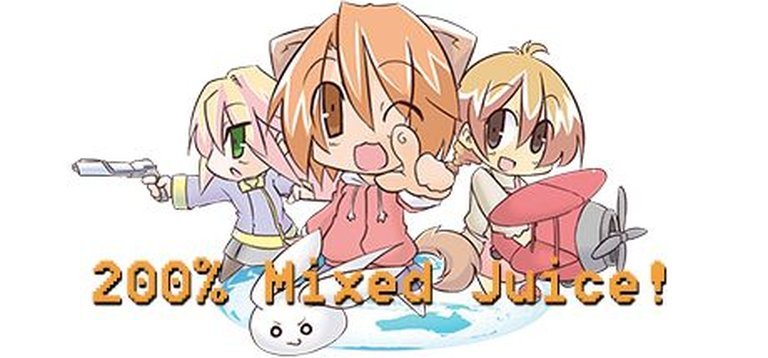
200% Mixed Juice! is a turn-based role-playing game that brings together characters from various Orange_Juice titles, such as 100% Orange Juice! and Suguri, in a lighthearted interdimensional crisis. Players assume the role of a hero traveling across diverse regions to recruit allies, engage in grid-style combat with strategic positioning, and battle enemies to restore balance to reality, featuring both single-player and multiplayer modes for party customization and humorous storytelling.
Gameplay Videos
Where to Buy 200% Mixed Juice!
PC
200% Mixed Juice! Guides & Walkthroughs
200% Mixed Juice! Reviews & Reception
metacritic.com (60/100): 200% Mixed Juice is an easy recommendation for fans of prior Orange_Juice games, but it fails to bring much to the table outside of that.
howlongtobeat.com (58/100): it’s adorable and a great follow on from 100% Orange Juice
200% Mixed Juice!: Review
Introduction: A Toast to Ten Years of Chaos
In the vast, often mercenary landscape of modern game development, there exists a peculiar and passionate corner of the industry devoted to the “all-star game”—a title that gathers a developer’s entire roster of beloved characters into one concentrated experience. Few games embody this concept with the unapologetic, chaotic heart of 200% Mixed Juice!, the tenth-anniversary celebration from the Japanese doujin circle Orange_Juice. It is not a game built from a desire for mainstream appeal, but from a decade of inside jokes, interconnected lore, and a developer’s palpable affection for its own creations. This review posits that 200% Mixed Juice! is a fascinating, quintessential doujin work: a deliberately simplistic JRPG that uses its rudimentary mechanics and nonsensical plot as a scaffold for an elaborate, meta-textual love letter to its own universe. Its legacy is not one of critical darling or commercial blockbuster, but as a potent case study in niche game design, where the primary “gameplay” is the act of recognizing and reuniting with a sprawling cast of familiar faces across shattered realities.
Development History & Context: A Decade in a Cup
The studio behind the juice is Orange_Juice, a small Japanese circle (consisting primarily of the duo hono and Junpyon) with a cult following built on quirky, mechanically inventive shoot-’em-ups and the wildly popular online board-game 100% Orange Juice!. By 2014, they had amassed a disparate family of characters from titles like Acceleration of Suguri, QP Shooting: Dangerous!!, Flying Red Barrel, and Sora. The genesis of 200% Mixed Juice! was deeply personal: it was conceived as a 10th-anniversary project, first physically released at Comiket 86 on August 17, 2014, and digitally on DLsite shortly after.
The stated vision was an “old school RPG featuring a 200% mix of Orange_Juice characters.” This ambition existed within clear technological and budgetary constraints. The game was built using the RPG Maker engine (a common tool for doujin devs), resulting in the “simplistic” and “cutting-edge” (in a deliberately retro way) visuals noted in promotional material. Its localization and Western release via Fruitbat Factory on October 23, 2015 was a strategic move to tap into the growing Western appreciation for Japanese doujin culture and the existing fanbase of 100% Orange Juice! on Steam. The gaming landscape of 2015 was dominated by AAA open-world RPGs, making 200% Mixed Juice!’s small-scale, character-driven approach a bold, counter-programming statement. It was not competing with The Witcher 3; it was speaking directly to a specific community.
Narrative & Thematic Deep Dive: A Fiction Within a Fiction
The plot of 200% Mixed Juice! is a masterclass in charming, self-aware absurdity, functioning as a narrative “glue” for the crossover. It begins with a sleeping princess (the Protagonist) being awakened by a fairy named Navi. This framing device is quickly revealed to be a simulation created by Navi (later Sumika) for the amusement of Suguri, a powerful, socially withdrawn hero from the Suguri series. This meta-layer is the game’s core thematic engine.
Phase 1: The School Sim. The initial world is a high school, a familiar JRPG trope, immediately deconstructed. Navi admits to “messing with the world’s settings” for convenience. The “battle training” curriculum—where every classmate is an enemy to be defeated for “wins”—is a direct parody of RPG progression systems. Characters like QP, Syura, and Fernet appear with their pre-existing canon grievances (e.g., Syura mad at QP for failing QA), blending their established personalities with the game’s arbitrary rules.
Phase 2: The World-Hopping. After the school collapses, the “Mix Phenomenon” (the game’s term for the dimensional merger) brings in the Flying Red Barrel universe (pilot Marc, the Guild) and the Sora universe (soldier Sora, researcher Yukito). The narrative becomes a road movie through familiar locations: Marc’s town, Yukito’s facility. The quest refocuses from “gathering friends” to “stopping the Mix Phenomenon,” introducing Reika/Star Breaker as a catastrophic MacGuffin whose power causes reality to “mix like… well, mixed juice.”
Phase 3: Cosmic Gambits & Godhood. The plot escalates to ludicrous heights. Sweet Breaker, a “god of happiness,” is introduced. The search for a “god” to stop the mixing leads to encounters with Tomomo (Sweet Eater), another god, and ultimately the Guildmaster aligning with Star Breaker. The climax reveals the true architects: Navi/Sumika and the Protagonist/Suguri. Suguri, the legendary warrior, is reduced to a mute shell, requiring “social skills training.” The final conflict is a battle of developer intent vs. character agency. Sumika (the “game director”) wants spectacle; Suguri (the “character”) finds it silly and wants genuine connection. Her ultimate act—healing the party—is a rejection of scripted final boss tropes. The resolution, with worlds separating and Suguri/Sumika leaving for “an unknown location in space,” mirrors a development team finishing a passion project and moving on.
Thematically, the game is about canon, legacy, and play. It treats its own lore not as sacred text but as a sandbox. The line “All this does not feel right, because she does not want to fight the group” (referring to Suguri) is a profound moment of character autonomy within a crossover framework. The ultimate message is one of reunion and perpetual possibility: “Suguri says that everyone can meet each other again without any trouble in the future.” The game is a celebration of its own history, insisting that these characters and relationships exist beyond any single narrative.
Gameplay Mechanics & Systems: Simple to a Fault, Deep in Roster-Building
200% Mixed Juice! employs a turn-based, grid-focused combat system reminiscent of classic titles like Final Fantasy Tactics or Super Mario RPG, but heavily streamlined. The core loop is:
1. Explore overworld maps (school, town, facility) with random or scripted encounters.
2. Engage in battles on a small isometric grid.
3. Select actions (Attack, Skill, Guard) for your front-line party member.
4. Win to gain EXP, unlock new “cards” (characters), and progress.
Combat: Positioning matters due to attack ranges (front-line melee vs. back-line ranged) and area-of-effect skills. The “Rock-Paper-Scissors“-like element system (referenced in player reviews) likely governs damage multipliers, though the source material doesn’t detail the exact triangle. Bosses introduce gimmicks, but the general difficulty is described by critics as “stupidly easy” and “JRPGs for Dummies.” This simplicity is a deliberate design choice to prioritize fast-paced roster experimentation over tactical grind.
Progression & The “Mixdus”: The central meta-system is the Mixdus (a pun on “mix” and “deck”). Defeated enemies and story events add their character “cards” to your collection. The player does not level a fixed party; they assemble teams from a growing pool of 80+ characters, each with unique stats, attack patterns, and signature moves (e.g., QP’s pudding attacks, Sora’s shield counters). True to its crossover nature, a character mixer (unlocked later) allows fusing cards (e.g., “QP and dangerous pudding to get QP (Dangerous)”), creating variants. This is the game’s deepest mechanic: the joy of discovery and collection, not stat optimization.
UI & Flaws: The interface is functional but basic. The “how long to beat” data (4-12 hours for main story) aligns perfectly with critic consensus: it’s “short” unless you chase “that last elusive combine.” The primary flaw, noted by Brash Games and others, is the “repetitive and bland gameplay loop” once the novelty of combat wears off and the simple AI is exposed. The promise of “over 80 characters” is a double-edged sword; it encourages collection but many feel like palette-swaps with minor tweaks.
World-Building, Art & Sound: A Patchwork of Nostalgia
The game’s atmosphere is a collage of Orange_Juice’s past. The “setting” is literally a simulation containing shards of other worlds: QP’s generic school, Marc’s aviation town, Sora’s war-torn facility. This allows for visually distinct biomes within a single game, each borrowing assets and ambiance from their source material.
Art Direction: The visuals are anime/manga-styled 2D sprites on simple backgrounds. The “cutting-edge graphics” claim is tongue-in-cheek; the charm lies in the consistent, cute character design by hono. The art succeeds in making over 80 characters visually distinct at a glance, a Herculean task for a small team. It’s a stylistic choice favoring clarity and cuteness over technical fidelity.
Sound Design: The “stunning digital soundtrack” is a bit of hyperbole, but the music is effective and nostalgic. It pulls from the vast library of Orange_Juice’s previous soundtracks (credited to various chiptune/chiptune-inspired artists like Kurage Koushou, Pipoya), creating an aural tapestry that instantly signals which universe you’re in. The cheerful, sometimes driving synth tracks complement the lighthearted tone perfectly. Sound effects are crisp and arcade-like.
Together, art and sound do the heavy lifting of emotional world-building. When you step from the school into Marc’s town, the music changes, the sprite style shifts subtly, and you feel the genre shift from “school comedy” to “aviation adventure.” This creates a powerful sense of franchise cohesion that is the game’s greatest