
- Release Year: 2009
- Platforms: iPad, iPhone, Macintosh, Windows
- Publisher: Anuman Interactive SA, Game Factory Interactive Ltd., M.INDIE, Russobit-M, S.A.D. Software Vertriebs- und Produktions GmbH
- Developer: Mzone Studio, Solilab
- Genre: Adventure
- Perspective: 1st-person
- Game Mode: Single-player
- Gameplay: Hidden object, Puzzle elements
- Setting: Steampunk
Description
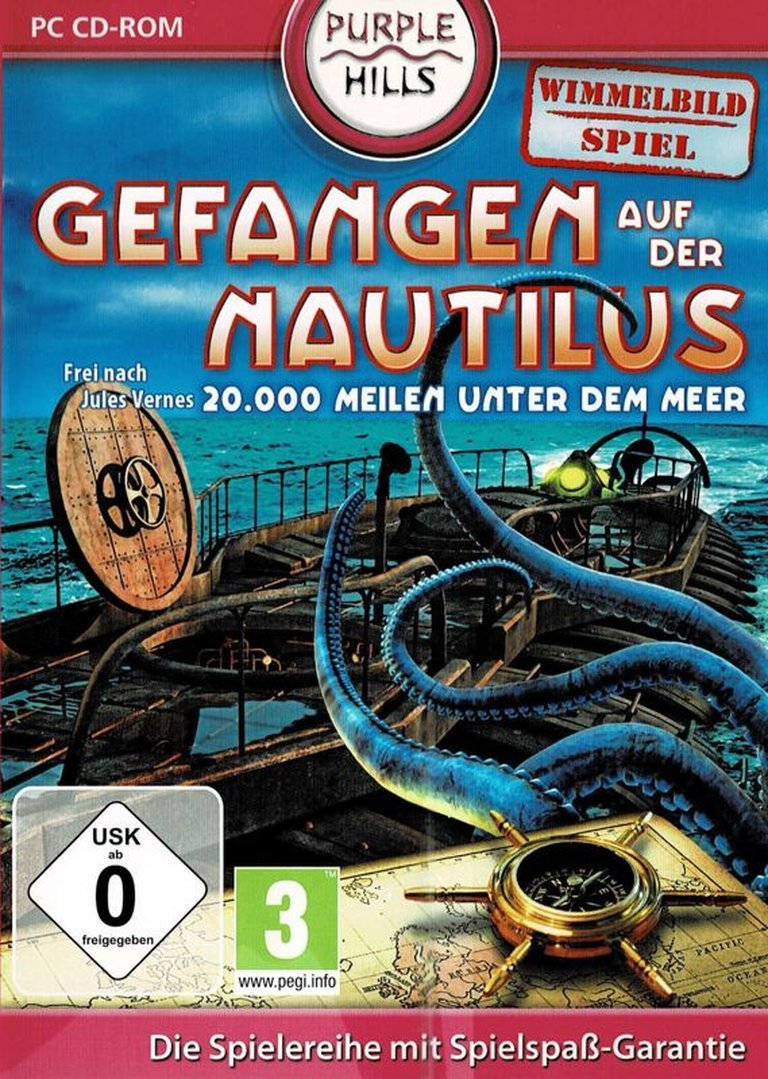
Based on Jules Verne’s classic 1869 novel, ‘20,000 Leagues Under the Sea: Captain Nemo’ is a hidden object adventure game that follows Professor Pierre Aronnax, his assistant Conseil, and harpooner Ned Land after they are captured by the enigmatic Captain Nemo aboard his futuristic submarine, the Nautilus. Players explore the intricately designed rooms of the vessel, searching for hidden items listed on screen to progress through the steampunk-inspired underwater world and uncover the mysteries of Captain Nemo’s mission.
Gameplay Videos
Where to Buy 20,000 Leagues Under the Sea: Captain Nemo
PC
20,000 Leagues Under the Sea: Captain Nemo Guides & Walkthroughs
20,000 Leagues Under the Sea: Captain Nemo: A Submerged Disappointment
Introduction
To adapt Jules Verne’s Twenty Thousand Leagues Under the Seas into interactive entertainment is a task of mythic proportions, conjuring images of the Nautilus‘s brass fittings, the majesty of unexplored abysses, and the enigmatic genius of Captain Nemo. Released in 2009 by Anuman Interactive, 20,000 Leagues Under the Sea: Captain Nemo promised to plunge players into Verne’s Victorian-era underwater odyssey. However, despite its literary pedigree and ambitious premise, this hidden object adventure emerges as a mechanically shallow and visually inconsistent experience, failing to capture the novel’s grandeur or thematic depth. Its legacy, one of missed opportunity and middling reception, serves as a cautionary tale about the challenges of adapting classic literature into a rigid gameplay template.
Development History & Context
20,000 Leagues Under the Sea: Captain Nemo emerged from a specific era of gaming: the late 2000s hidden object boom, where casual games dominated digital storefronts. Developed by the French studio Mzone Studio in collaboration with Solilab, the project was spearheaded by producer Franck Berrois and game designer Christophe Leclerc, drawing inspiration from Verne’s 1869 classic. The team explicitly cited the novel’s original illustrators, Alphonse de Neuville and Édouard Riou, as visual touchstones, aiming for a steampunk aesthetic that blended period authenticity with fantastical elements. Technologically, the game was constrained by the genre’s conventions, relying on pre-rendered static scenes and point-and-click mechanics tailored for PC, Mac, and later mobile platforms (iOS in 2010). Its release on November 18, 2009, positioned it alongside other literary adaptations like Around the World in Eighty Days: Phileas Fogg, reflecting Anuman Interactive’s strategy of targeting casual gamers with familiar brand names. Yet, the studio’s focus on accessibility and broad appeal came at the cost of innovation, resulting in a product that felt more like a checklist adaptation than a genuine reimagining of Verne’s world.
Narrative & Thematic Deep Dive
The game’s narrative follows Verne’s foundational premise with commendable fidelity: Professor Pierre Aronnax, his assistant Conseil, and the harpooner Ned Land are shipwrecked and captured by Captain Nemo aboard the Nautilus. Their forced voyage becomes a tour of submerged wonders—from the wreckage of the Battle of Vigo Bay to the mythical kingdom of Atlantis—while Nemo’s anti-imperialist rage and scientific curiosity simmer beneath the surface. Dialogue fragments and brief cutscenes attempt to evoke the novel’s tension between Nemo’s benevolence and his tyranny, as he declares, “I am still, and shall be, to my last breath, one of them!” regarding the oppressed. However, the adaptation drastically truncates the novel’s thematic richness. Nemo’s complex backstory—his Polish origins later revised to Indian prince, his role in rebellion against colonial powers—is reduced to a shallow monologue. The profound ecological themes, Verne’s prescient warnings about humanity’s impact on the oceans, and the existential dread of the Maelstrom finale are glossed over in favor of simplistic “find-and-escape” objectives. Aronnax’s scientific awe is reduced to sporadic exclamations, and Ned Land’s yearning for freedom feels perfunctory. The result is a narrative skeleton stripped of its flesh, where the Nautilus becomes a mere backdrop for repetitive tasks rather than a symbol of technological rebellion and isolation.
Gameplay Mechanics & Systems
As a hidden object game, Captain Nemo revolves around its core loop: players are presented with cluttered, static scenes (e.g., the Nautilus‘s library, coral reefs) and must locate items listed in a sidebar—a mix of plot-critical objects (keys, maps) and random clutter (corks, scissors). This loop is interrupted by rudimentary mini-games, such as reproducing submarine maneuvers, decoding messages, or solving jigsaw puzzles. While the game advertises “34 sites to see,” the gameplay suffers from severe repetition. Objects are often minuscule and poorly integrated into scenes, requiring pixel-hunting exacerbated by inconsistent artwork. The “unlimited help” features—zoom and rechargeable hints—are welcome but underscore the game’s design flaws, as they’re frequently necessary to locate cursor-sized items. Combat encounters, like fending off sharks or giant squid, are reduced to timed click-fests, stripping away Verne’s tension and replacing it with arcade-like simplicity. Character progression is nonexistent; there are no skills, stats, or meaningful choices, rendering the trio of protagonists interchangeable vessels for the player’s cursor. The UI is functional but uninspired, with a cluttered inventory and linear progression that stifles exploration. Ultimately, the mechanics feel dated even at release, prioritizing checklist completion over engagement or narrative immersion.
World-Building, Art & Sound
The game’s steampunk world-building is its most compelling, yet flawed, aspect. The Nautilus is rendered with intricate brass details, portholes revealing shifting oceanic vistas, and rooms that evoke Verne’s descriptions—from the Captain’s organ to the library’s shelves. Environments like sunken galleons and bioluminescent trenches attempt to capture Verne’s sense of wonder, but the visual execution is inconsistent. Static scenes suffer from muddy textures and repetitive assets (e.g., identical fish schools reused across levels), while character models are rudimentary, lacking expressiveness. The art direction oscillates between charming homage (e.g., using de Neuville’s illustration style for key moments) and jarring modernity, undermining the period atmosphere. Sound design fares better, with Dan Foster’s orchestral score evoking adventure and melancholy, effectively punctuating scenes of peril or discovery. Subtle ambient sounds—creaking metal, distant whale calls—enhance immersion, though voice acting is limited to sparse, stilted dialogue snippets. The audiovisual contrast highlights a fundamental disconnect: the game tells players they are in a wondrous, dangerous world but shows them only fragments of it, failing to sustain the illusion.
Reception & Legacy
At launch, 20,000 Leagues Under the Sea: Captain Nemo received lukewarm reception. GameZebo awarded it a middling 50%, praising its “nice music” and story elements but criticizing “objects too small and difficult” and “inconsistent artwork.” Player reviews on platforms like Steam (where it was re-released in 2018 with a “Mixed” 67% rating) echoed these sentiments, noting repetitive gameplay and confusing directions. The game’s commercial performance, while buoyed by Anuman Interactive’s casual-game distribution strategy, never achieved breakout success. Its legacy is one of minor footnote status in gaming history. It exemplifies the pitfalls of rigid genre templating applied to rich source material, serving as a contrast to later, more ambitious adaptations like Daedalic Entertainment’s 20,000 Leagues Under the Sea (which, despite its own flaws, attempted deeper integration of narrative and puzzles). Culturally, it did little to revitalize interest in Verne’s IP, overshadowed by the novel’s enduring presence in films, comics, and other media. The Nautilus and Nemo remain icons, but this game’s contribution is limited to a niche audience of hidden object enthusiasts.
Conclusion
20,000 Leagues Under the Sea: Captain Nemo is a profoundly frustrating experience—a game that possesses the ingredients of greatness yet fails to bake them into a coherent whole. Its faithful adherence to Verne’s plot and its occasional moments of visual and auditory charm are ultimately undone by rote hidden object mechanics, a lack of thematic depth, and technical inconsistencies. For players seeking a genuine underwater odyssey, this adaptation offers only a shallow dip, leaving the vast, unexplored depths of Verne’s imagination tantalizingly out of reach. While it holds niche appeal as a casual diversion, its place in history is as a cautionary example of how literary ambition can be stifled by formulaic design. In the end, the Nautilus in this game feels less like a vessel of adventure and more like a submerged coffin—containing a story that deserved to breathe, but is instead left gasping for air.