
- Release Year: 2002
- Platforms: Windows
- Publisher: ValuSoft, Inc.
- Genre: Compilation
Description
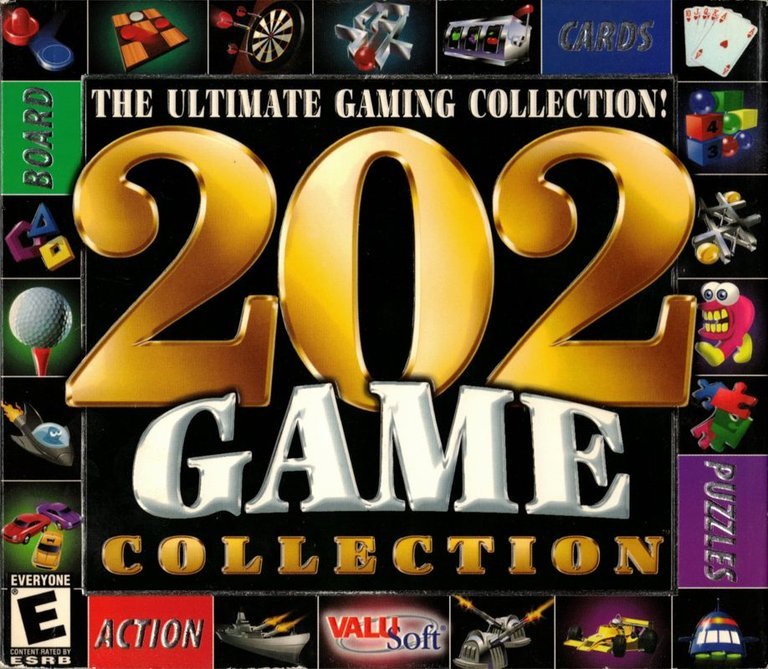
202 Game Collection is a budget compilation released in 2002 for Windows by ValuSoft, Inc., bundling the contents of Ultimate Game Pak and 100+ Great Games: Volume II into a single package, providing players with over 200 casual games spanning various genres in an accessible, family-friendly format rated Everyone by ESRB.
202 Game Collection Free Download
202 Game Collection: Review
Introduction
In the shadow of 2002’s titans—Grand Theft Auto: Vice City shattering sales records with over 5 million copies in its first year, Metroid Prime redefining first-person adventure with a 97/100 Metacritic score, and The Legend of Zelda: The Wind Waker earning perfect Famitsu scores—a humble CD-ROM slipped into bargain bins: 202 Game Collection. Published by ValuSoft, this unassuming Windows compilation bundled Ultimate Game Pak and 100+ Great Games: Volume II, delivering over 200 bite-sized casual titles across action, board, puzzle, and card genres. Amid an industry exploding with $10.3 billion in U.S. sales (a 10% jump from 2001, per NPD), where consoles like PlayStation 2 dominated and PC gaming embraced RTS epics like Warcraft III, 202 Game Collection embodied the unsung budget sector: accessible, nostalgic entertainment for the everyman. My thesis? This collection isn’t just a relic; it’s a time capsule of early-2000s casual gaming, preserving arcade echoes and solitaire variants that democratized play for non-hardcore audiences, even as it highlights the era’s technological and creative trade-offs.
Development History & Context
ValuSoft, Inc., a Minneapolis-based publisher specializing in low-cost PC software, spearheaded 202 Game Collection in 2002, a year when the PC market thrived on shareware roots and CD-ROM compilations flooded retail. The disc (redumped with serial P/N: 10203, volume label “202Games,” pressed August 22, 2002) combines Ultimate Game Pak (2003-dated but included here) and 100+ Great Games: Volume II (2002), developed partly by Antidote Entertainment and Frogster Interactive Pictures AG. These weren’t prestige projects from giants like EA or Blizzard—ValuSoft targeted impulse buys at $4.44–$4.99 (eBay/Amazon used prices today), capitalizing on Windows 95+ compatibility amid a post-Sims boom in accessible PC gaming.
The era’s constraints shaped it profoundly: 44-minute CD-ROM (466 MB) limited assets to 2D sprites and simple algorithms, fitting keyboard/mouse input for solo play. 2002’s landscape was console-heavy—PS2’s Vice City best-seller, GameCube’s Super Mario Sunshine at 37/40 Famitsu—but PC compilations like this echoed 1990s shareware (e.g., 100 Great Games predecessors). No E3 spotlight; ValuSoft’s vision was pragmatic: repackage public-domain-inspired minigames (checkers, darts, solitaires) with originals like T-Roy Returns or Worm Feast. Technological limits—no 3D acceleration mandates—kept it lightweight, contrasting Battlefield 1942‘s multiplayer revolutions. In a year of Xbox Live launches and mobile gaming seeds (Sega Mobile), this was anti-trend: offline, evergreen fun for families (ESRB Everyone), preserving gaming’s arcade heritage as hardware wars raged.
Narrative & Thematic Deep Dive
202 Game Collection eschews singular plots for modular vignettes, a deliberate anthology format grouping 200+ titles into Action (e.g., Sea Invaders, Sky Gunner), Board (Checkers Crowded, Tower of Hanoi), Puzzle (Labyrinth, Tantrix), and Cards (Aces Square, Picture Patience). No overarching story binds them—unlike Morrowind‘s epic quests—but thematic threads emerge: nostalgia for analog play in digital form. Board games like Darts (Shanghai) or Go Moku evoke pub nights; solitaires (Agnes Bernauer, Willow Wisp) mirror Victorian patience, with “dialogue” limited to rule prompts (“Match pairs above/below”).
Characters? Absentee protagonists—faceless pilots in Dog Fight, abstract worms in Worm Feast—prioritize mechanics over lore, thematizing isolation and repetition. Themes probe human basics: competition (Pente, Reversi), spatial logic (Cube Slide, Sphere Shift), survival (Base Defender, Robotic Invaders). Casino nods (Simple Faro, Caribbean Poker) flirt with risk-reward, while action romps (Bubble Plunge, Wake Race) channel 1980s arcade adrenaline sans narrative depth. In 2002’s context—Metal Gear Solid 2 questioning player agency—this collection thematizes pure escapism, a counterpoint to Vice City‘s moral ambiguity. Subtle motifs like progression (Miner-X levels) or chaos (Crazy Creeps) underscore casual gaming’s philosophy: fleeting triumphs over epic arcs, democratizing joy for rainy afternoons.
Gameplay Mechanics & Systems
Core loops are elegantly simple, windowed play with menu-driven selection (screenshot previews, brief instructions). Action (26+ titles): Twin-stick shooters (Aim And Fire, Weapon Earth) demand pattern recognition—dodge waves, amass scores; racers (Pad Hop, Bounce Back) emphasize timing, anti-gravity physics via basic momentum. Flaws: Repetitive without saves, clunky mouse controls for precision (Snow Fight pixel-hunts).
Board (18 titles): Turn-based purity—Checkers variants scale difficulty (American classic, Crowded chaotic); Hex/Keryo Pente explore combinatorial explosion. Innovative: Roll A Ball probability dice-rolling. Puzzle (21 titles): Grid-shifting (Rows And Columns, Train) akin to Sokoban; wordplay (Spell This, Word Up) tests lexicon. Strengths: Progressive unlocks via mastery; flaws: No tutorials beyond text, frustrating on low-res (Geo-Match color-blind issues?).
Cards (30+ solitaires): Klondike evolutions (Bakers Game, Superior Canfield) with undo-limited purity; Reversi AI scales aggressively. UI: Clean 800×600 launcher, fullscreen toggles, but dated DirectX reliance crashes modern VMs. Progression? High scores, no metas. Innovative: Hybrid Tower Hanoy (puzzle-board fusion). Overall, loops excel in 5–15 minute bursts—addictive for casuals—but lack depth, mirroring shareware ethos amid 2002’s Neverwinter Nights complexity.
| Category | Key Titles | Core Loop | Strengths | Flaws |
|---|---|---|---|---|
| Action | Sea Invaders, T-Roy Returns | Shoot/dodge waves | Fast-paced scoring | Repetitive, no power-ups |
| Board | Darts (301), Pente | Turn-based strategy | AI variety | Mouse-drag imprecision |
| Puzzle | Labyrinth, Tantrix | Tile/ pattern matching | Brain-teasing | Trial-error heavy |
| Cards | Black Hole, Triad | Solitaire draws | Relaxing redraws | Luck-dependent |
World-Building, Art & Sound
No expansive worlds—each game a self-contained diorama. Settings: Abstract arenas (Space Canyon nebulae, Dune Faces deserts) via pixel art, evoking 1990s DOS. Atmosphere: Cheerful nostalgia—vivid primaries (Fish’n Hole aquariums), chiptune bleeps (Beaver Fever plops). Visual direction: 256-color sprites, scalable but blurry; no 3D, prioritizing speed on Pentium-era rigs.
Sound design: MIDI loops (upbeat chiptunes for action, plinks for puzzles), SFX libraries (explosions, shuffles). Contributions: Builds cozy immersion—Wake Race splashes enhance flow; Mirror Faces eerie tones amp tension. In 2002’s orchestral booms (Kingdom Hearts 36/40 Famitsu), this lo-fi charm fosters intimacy, like flipping cards at a table. Cover art (three-panel jewel case scans on Archive.org) screams “value”: Explosive collages, promising variety.
Reception & Legacy
Launch reception? Silent—no MobyScore, no Metacritic, zero critic/player reviews on MobyGames/IGN. In a year of Splinter Cell (93/100) and Mafia (88/100), budget packs like this flew under radar, yet sold via Walmart bins (eBay rarities today). Commercial? Modest—part of ValuSoft’s chain (303 Game Collection, 505 Game Collection), influencing eBay resales ($4.44 used).
Reputation evolved: Archival gems (Internet Archive ISO, 2025 upload), crediting preservers like “qwertyuiop.” Influence: Precursor to Steam bundles, Big Fish casuals; echoes in Game & Watch Collection (DS). Industry-wide: Amid 2002’s $10B boom, it sustained PC’s shareware soul, bridging arcade decline to mobile free-to-plays. No hall-of-fame, but vital for historians—preserves obscurities like Slight O’ Hand.
Conclusion
202 Game Collection distills 2002’s dual gaming soul: blockbuster ambition versus humble abundance. Exhaustive in variety yet minimalist in ambition, its 200+ minigames capture casual joy—addictive loops, thematic simplicity—flawed by dated UI/tech but redeemed by accessibility. In video game history, it claims a niche: budget beacon amid excess, influencing endless compilations. Verdict: Essential archival curiosity (8/10 for historians, 6/10 modern play). Unearth the ISO; rediscover why gaming began with simplicity.