
- Release Year: 2006
- Platforms: Windows
- Publisher: rondomedia Marketing & Vertriebs GmbH
- Developer: cerasus.media GmbH
- Genre: Action, Adventure, Driving, Puzzle, Racing
- Game Mode: Single-player
Description
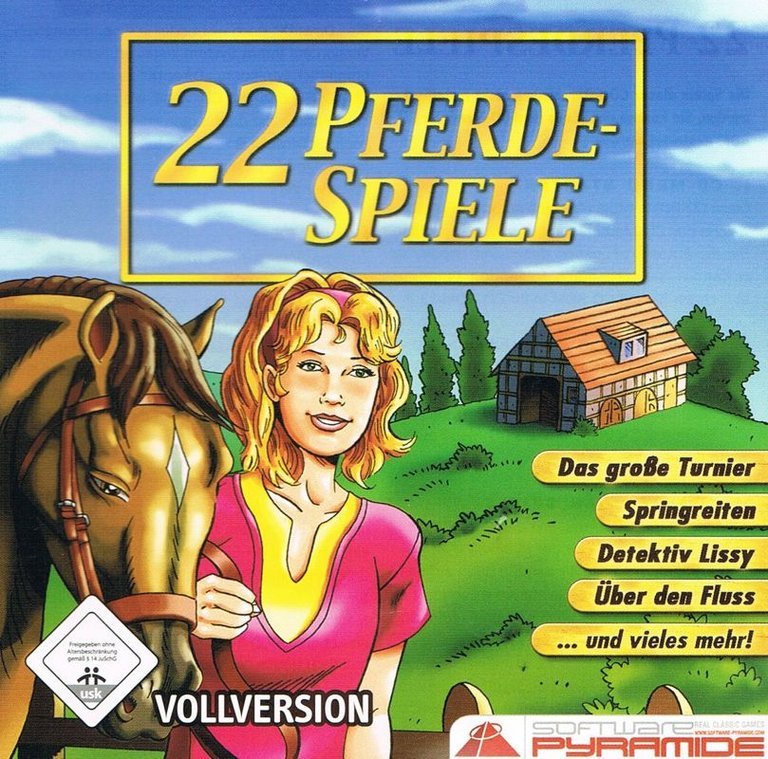
22 Pferde-Spiele is a collection of 22 horse-themed mini-games designed for children, featuring a mix of arcade, puzzle, and strategy challenges. Players join Lissy on her holiday adventures at the Riedmann riding stables, engaging in activities like show jumping, photo reporting, memory games, and quizzes. The game combines 2D drawings and real horse photos, offering a variety of gameplay styles, from racing and maze navigation to classic puzzles like mahjong and slide puzzles.
22 Pferde-Spiele: A Niche Gem in the Landscape of Children’s Gaming
Introduction: The Unsung Hero of Equestrian Edutainment
In the vast, ever-expanding universe of video games, where blockbuster titles and indie darlings vie for attention, there exist quiet, unassuming gems that cater to niche audiences with unwavering dedication. 22 Pferde-Spiele (2006), known internationally as Chloé: 20 aventures autour du cheval, is one such title—a humble yet ambitious collection of horse-themed mini-games designed exclusively for children. Developed by the German studio cerasus.media GmbH and published by rondomedia Marketing & Vertriebs GmbH, this game is a testament to the power of focused, thematic design in the realm of edutainment.
At first glance, 22 Pferde-Spiele might appear as little more than a curiosity—a relic of the mid-2000s, when CD-ROM-based children’s software was a staple of family computing. Yet, beneath its modest exterior lies a carefully crafted experience that blends education, entertainment, and equestrian enthusiasm into a cohesive whole. This review seeks to unpack the game’s development history, narrative and thematic depth, gameplay mechanics, artistic and auditory design, reception, and lasting legacy. In doing so, we will argue that 22 Pferde-Spiele is not merely a forgotten footnote in gaming history, but a pioneering example of how niche interests can be transformed into engaging, accessible digital experiences for young audiences.
Development History & Context: The Rise of Thematic Mini-Game Collections
The Studio Behind the Stables: cerasus.media GmbH
Cerasus.media GmbH, the developer of 22 Pferde-Spiele, was a German studio specializing in educational and children’s software during the 2000s. While the studio’s broader catalog remains relatively obscure outside of Germany, its focus on creating themed game collections for young audiences positioned it as a key player in the European edutainment market. The studio’s name, derived from the Latin word for “cherry tree,” hints at a philosophy rooted in nurturing young minds—a mission that 22 Pferde-Spiele embodies wholeheartedly.
The game was part of a larger trend in the mid-2000s, where developers sought to capitalize on the popularity of specific themes (e.g., animals, sports, or fantasy) by bundling mini-games into cohesive packages. This approach was particularly prevalent in Germany, where the market for children’s software was robust, and parents were increasingly turning to digital tools to supplement traditional education. 22 Pferde-Spiele was not cerasus.media’s first foray into equestrian-themed gaming; it was preceded by Lissy: 30 Neue Pferde-Spiele (2005) and followed by Lissy: 50 Pferde-Spiele (2006), indicating a deliberate strategy to corner the horse-game niche.
Technological Constraints and Design Philosophy
Released in 2006, 22 Pferde-Spiele was a product of its time, designed to run on the technological standards of the early-to-mid 2000s. The game’s system requirements—a 400 MHz processor, 8 MB of graphics memory, and compatibility with Windows 98/ME/2000/XP—reflect the hardware limitations of the era. These constraints shaped the game’s visual and mechanical design, resulting in a 2D-heavy aesthetic that relied on simple animations, static images, and straightforward interactions.
The decision to structure the game as a collection of mini-games was both a creative and practical one. Mini-games allowed the developers to explore a wide range of mechanics and themes without the need for a complex, overarching narrative or advanced 3D rendering. This modular approach also made the game more accessible to younger players, who could dip in and out of activities without the pressure of a linear progression system. Moreover, the mini-game format aligned with the educational goals of the title, as it encouraged repetition, skill-building, and incremental learning—key principles in child development.
The Gaming Landscape of 2006: A Crowded Market
The year 2006 was a pivotal one for the video game industry. The seventh generation of consoles was in full swing, with the Xbox 360 having launched in 2005 and the PlayStation 3 and Wii on the horizon. Meanwhile, PC gaming was thriving, with titles like The Elder Scrolls IV: Oblivion, Company of Heroes, and Hitman: Blood Money dominating the charts. Amidst this landscape of high-budget, technically ambitious games, 22 Pferde-Spiele occupied a distinctly different space: the children’s edutainment market.
This market was characterized by a mix of licensed titles (e.g., Dora the Explorer: World Adventure!), creative software (e.g., The Sims 2: Pets), and themed mini-game collections. 22 Pferde-Spiele fit squarely into the latter category, competing with titles like Meine Pferde Spiele-Box (2009) and Let’s Ride!: Friends Forever (2007). What set it apart, however, was its laser-focused theme. While many children’s games of the era attempted to appeal to broad audiences with varied interests, 22 Pferde-Spiele zeroed in on a single passion—horses—and built an entire experience around it. This specificity, while limiting its mainstream appeal, endeared it to its target audience: young equestrian enthusiasts.
Narrative & Thematic Deep Dive: The World of Lissy and the Riedmann Riding Stables
The Premise: A Holiday Adventure
22 Pferde-Spiele is framed by a simple yet effective narrative premise: Lissy, the game’s protagonist, is on holiday at the Riedmann riding stables, where she embarks on a series of equestrian adventures. This framing device serves as a loose connective tissue for the game’s 22 mini-games, each of which is presented as an activity or challenge that Lissy encounters during her stay. The narrative is minimalistic, with no dialogue or cutscenes to speak of, but it is reinforced through the game’s visual design, which features illustrations of Lissy and the stables in a cheerful, cartoonish style.
The decision to center the game around a holiday adventure is a clever one. Holidays are universally relatable to children, evoking feelings of excitement, freedom, and discovery. By positioning Lissy as a visitor to the stables—rather than a permanent resident—the game creates a sense of novelty and exploration, encouraging players to engage with each mini-game as a new experience. This narrative framing also allows the game to avoid the pitfalls of over-complication; there are no complex character arcs or plot twists, just a straightforward, inviting setup that serves as a gateway to the gameplay.
Themes: Passion, Learning, and Play
At its core, 22 Pferde-Spiele is a celebration of passion. The game assumes that its players are already interested in horses, and it seeks to deepen that interest through a variety of interactive experiences. This thematic focus is reflected in the diversity of the mini-games, which range from realistic simulations (e.g., show jumping, stable management) to whimsical fantasies (e.g., horse-themed mahjong, solitaire). By blending education with entertainment, the game reinforces the idea that learning about a subject can be as fun as it is enriching.
Several key themes emerge from this blend:
- Exploration and Discovery: Many of the mini-games, such as “The Mysterious Map” and “Lost in the Forest,” encourage players to explore virtual spaces, reinforcing the idea that curiosity and problem-solving are rewarding.
- Responsibility and Care: Games like “Food for the Riding Stables” and “In the Horse Stable” simulate the responsibilities of caring for horses, teaching players about the practical aspects of equestrian life.
- Skill Development: The arcade-style games, such as “The Big Tournament” and “Show Jumping,” emphasize hand-eye coordination and timing, while puzzle games like “Puzzlemania” and “Remember It!” focus on memory and pattern recognition.
- Creativity and Imagination: The game’s use of horse-themed adaptations of classic games (e.g., “Horse Trio” as tic-tac-toe, “Horse Solitaire”) encourages players to see familiar concepts in new, imaginative ways.
Characters and World-Building: The Riedmann Riding Stables
While 22 Pferde-Spiele lacks the deep character development of narrative-driven games, its world-building is subtle yet effective. The Riedmann riding stables serve as the game’s central hub, a place where all of Lissy’s adventures unfold. The stables are depicted in a bright, inviting art style, with pastel colors and rounded shapes that evoke a sense of warmth and safety. This visual language is crucial, as it helps to create an environment that feels welcoming and non-threatening to young players.
Lissy herself is a relatable protagonist—a young girl with a passion for horses, whose enthusiasm is infectious. Though she is never given a voice or personality beyond her role as the player’s avatar, her presence is felt in the game’s design. The mini-games are framed as her experiences, and the player is invited to share in her joy and curiosity. This approach fosters a sense of identification, allowing young players to see themselves in Lissy’s shoes.
The horses, too, play a central role in the game’s world-building. They are depicted in a mix of 2D illustrations and photographs, blending realism with cartoonish charm. This duality reinforces the game’s educational goals—players are exposed to real-world equestrian concepts while still engaging with a fantastical, game-like experience.
Gameplay Mechanics & Systems: A Mini-Game Masterclass
The Core Loop: Variety as a Virtue
22 Pferde-Spiele is, at its heart, a compilation of mini-games, and its strength lies in the diversity of its offerings. The game’s 22 activities are divided into four broad categories: arcade games, puzzle games, strategy games, and riding mechanics. Each category explores different facets of gameplay, ensuring that players are constantly engaged with new challenges and mechanics.
The core loop of 22 Pferde-Spiele is simple: players select a mini-game from the main menu, complete the activity, and then return to the menu to choose another. There is no overarching progression system or unlockable content; the reward for playing is the joy of engagement itself. This design philosophy is particularly well-suited to the game’s target audience, as it allows for short, digestible play sessions that can be easily paused and resumed.
Arcade Games: Action and Reflexes
The arcade games in 22 Pferde-Spiele are designed to test players’ reflexes, timing, and hand-eye coordination. These games are the most action-oriented in the collection, and they often simulate real-world equestrian activities in a simplified, game-like format. Key examples include:
- The Big Tournament: A racing game where players press the spacebar to accelerate their horse and compete against AI opponents. The simplicity of the controls makes it accessible to young players, while the competitive element adds excitement.
- Show Jumping: A more complex arcade game that requires players to time their jumps (using the Ctrl key) to navigate a course of obstacles. This game introduces a layer of strategy, as players must balance speed with precision.
- Lissy as a Photo Reporter: A visual recognition game where players must click on specific horse images as they appear on screen. This game tests observation skills and reaction time.
- Over the River: A navigation challenge where players guide a horse across a river, avoiding obstacles and pitfalls. The game’s three-strike system adds tension without being punitive.
These arcade games are notable for their accessibility. The controls are intuitive (primarily mouse-based, with occasional keyboard inputs), and the difficulty is calibrated to ensure that young players can experience success without frustration. The games also incorporate subtle educational elements—for example, “Show Jumping” teaches the basics of equestrian course navigation, while “Over the River” reinforces the importance of careful movement and planning.
Puzzle Games: Logic and Memory
The puzzle games in 22 Pferde-Spiele focus on cognitive skills such as memory, pattern recognition, and problem-solving. These games are less about reflexes and more about mental agility, making them a valuable counterpoint to the arcade-style activities. Standout examples include:
- Detective Lissy: A Simon Says-style memory game where players must replicate a sequence of lit-up plates. This game is excellent for developing short-term memory and concentration.
- What is Fake?: A spot-the-difference game where players must identify discrepancies between two nearly identical horse images. This activity sharpens observational skills and attention to detail.
- Puzzlemania: A jigsaw puzzle game featuring horse-themed images. Players can adjust the number of pieces, allowing for scalable difficulty. The game also includes a rotation mechanic, adding an extra layer of challenge.
- The Mysterious Map: A hidden-object game where players search for horseshoes within a detailed illustration. This game encourages thorough exploration and visual scanning.
The puzzle games are particularly effective in their educational goals. They are designed to be engaging without being overly complex, and they reinforce skills that are valuable both in and out of the classroom. The use of horse-themed imagery also ensures that the educational content remains thematically coherent, tying back to the game’s central premise.
Strategy Games: Planning and Tactics
The strategy games in 22 Pferde-Spiele introduce elements of planning, tactics, and turn-based decision-making. These games are the most cerebral in the collection, requiring players to think ahead and consider multiple variables. Key examples include:
- Horse Mahjongg: A tile-matching game where players must clear the board by removing pairs of horse-themed tiles. The game’s rules (e.g., only exposed tiles can be selected) add a layer of strategic depth.
- Marble Game: A match-three game where players align colored marbles to clear them from the board. This game tests spatial reasoning and forward planning.
- Horse Solitaire: A card game that adapts the classic solitaire formula with horse-themed imagery. The game’s rules are simplified for young players, but it still requires careful sequencing and decision-making.
- In the Horse Stable: A logic puzzle where players must move hay bales to designated spots. The game’s push-based mechanics (players can push but not pull bales) introduce a spatial challenge that encourages problem-solving.
These strategy games are notable for their adaptability. While they are simpler than their adult-oriented counterparts (e.g., Mahjong Titans or Klondike Solitaire), they still provide a meaningful introduction to strategic thinking. The horse-themed adaptations also make the games feel fresh and engaging, even for players who may be familiar with the underlying mechanics.
Riding Mechanics: Simulation and Immersion
While 22 Pferde-Spiele is not a full-fledged horse simulator, it does include mechanics that simulate aspects of equestrian life. These mechanics are primarily found in the arcade and puzzle games, but they are worth examining as a distinct category due to their thematic significance. Key examples include:
- Show Jumping: As mentioned earlier, this game simulates the experience of navigating a jumping course, complete with timing-based controls for acceleration and jumping.
- Food for the Riding Stables: A resource-collection game where players gather food for the stables, reinforcing the idea of responsibility and care.
- In the Horse Stable: A puzzle game that simulates the logistical challenges of stable management, such as moving hay bales and organizing equipment.
These mechanics are simplified for accessibility, but they still provide a glimpse into the practical aspects of equestrian life. For young players with a passion for horses, these games offer a taste of what it might be like to care for and interact with real animals—a valuable form of experiential learning.
User Interface and Accessibility
The user interface (UI) of 22 Pferde-Spiele is a model of simplicity and clarity. The main menu is a straightforward grid of icons, each representing a different mini-game. Players can navigate the menu using the mouse, and each game is accompanied by a brief text description (in German) that explains the objective. The in-game UI is equally minimalistic, with score counters, timers, and progress indicators displayed prominently but unobtrusively.
This approach to UI design is particularly well-suited to the game’s target audience. Young players may not have the reading comprehension or spatial awareness to navigate complex menus, so the game’s reliance on visual cues and simple interactions is a smart choice. The lack of a save system or progression tracking also ensures that the game remains accessible to players who may not have the patience for long-term commitment.
One potential drawback of the UI is its lack of customization options. There are no difficulty settings or accessibility features (e.g., text-to-speech, colorblind modes), which may limit the game’s appeal to players with specific needs. However, given the game’s age and target audience, this omission is understandable.
World-Building, Art & Sound: Crafting an Inviting Equestrian Universe
Visual Design: A Blend of Realism and Whimsy
The visual design of 22 Pferde-Spiele is a harmonious blend of realism and whimsy, reflecting the game’s dual goals of education and entertainment. The game’s art style is primarily 2D, with a mix of hand-drawn illustrations and photographed elements. The illustrations, which depict Lissy, the stables, and the various game scenarios, are rendered in a bright, cartoonish style that is both inviting and age-appropriate. The use of soft colors, rounded shapes, and exaggerated expressions creates a sense of warmth and friendliness, making the game’s world feel safe and engaging.
The photographed elements, particularly the images of real horses, add a layer of authenticity to the experience. These photographs are used in games like “What is Fake?” and “Puzzlemania,” where players interact with realistic horse imagery. This blend of styles serves a dual purpose: the illustrations create a fantastical, game-like atmosphere, while the photographs ground the experience in reality, reinforcing the educational aspects of the game.
The game’s visual design is also notable for its attention to detail. Each mini-game has its own distinct aesthetic, tailored to its mechanics and themes. For example, “The Mysterious Map” features a detailed, treasure-map-style illustration, while “Show Jumping” uses a more dynamic, action-oriented visual language. This variety ensures that the game remains visually engaging, even as players switch between different activities.
Sound Design: A Subtle but Effective Atmosphere
The sound design of 22 Pferde-Spiele is understated but effective, contributing to the game’s overall atmosphere without overwhelming the player. The game features a mix of ambient sounds, simple musical cues, and minimal sound effects, all of which are designed to enhance immersion without distracting from the gameplay.
The ambient sounds are particularly noteworthy. In games like “Over the River” and “Lost in the Forest,” the background audio includes subtle nature sounds (e.g., flowing water, rustling leaves) that create a sense of place. These sounds are not intrusive, but they add depth to the game’s world, making it feel more alive and dynamic.
The musical cues are similarly restrained. The game’s soundtrack consists of short, looping melodies that play during the main menu and certain mini-games. These melodies are cheerful and upbeat, reinforcing the game’s positive, child-friendly tone. The music is not particularly memorable, but it serves its purpose well, providing a pleasant backdrop to the gameplay.
The sound effects are minimal but functional. For example, in “The Big Tournament,” the sound of hooves galloping accompanies the horse’s movement, while in “Catching Apples,” a simple “plink” sound plays when an apple is collected. These effects are basic, but they provide necessary feedback to the player, reinforcing the connection between action and consequence.
Atmosphere: A Safe and Engaging Space
The combination of visual and auditory design in 22 Pferde-Spiele creates an atmosphere that is both safe and engaging—a crucial balance for a children’s game. The bright colors, friendly illustrations, and cheerful music work together to create a world that feels welcoming and non-threatening. At the same time, the variety of mini-games and the occasional challenge (e.g., the three-strike system in “Over the River”) ensure that the experience remains engaging and dynamic.
This atmosphere is further reinforced by the game’s narrative framing. The Riedmann riding stables are depicted as a place of adventure and discovery, where Lissy can explore, learn, and have fun. This framing encourages players to approach the game with a sense of curiosity and enthusiasm, rather than pressure or anxiety.
Reception & Legacy: A Quiet Influence on Children’s Gaming
Critical and Commercial Reception: A Niche Success
22 Pferde-Spiele was released in a market that was increasingly dominated by high-profile, big-budget titles, making it difficult for niche games to gain widespread attention. As a result, the game received little critical coverage upon its release, and there are no recorded reviews from major gaming publications. However, its reception among its target audience—young equestrian enthusiasts—was likely positive, given its focused theme and accessible design.
Commercially, the game was part of a broader trend of children’s software in Germany, where titles like Lissy: 30 Neue Pferde-Spiele and Meine Pferde Spiele-Box found success. While exact sales figures are unavailable, the game’s inclusion in the “Software Pyramide” releases (a German software distribution label) suggests that it was marketed as a mid-tier product, likely selling modestly but steadily to its intended audience.
Evolution of Reputation: From Obscurity to Nostalgia
In the years since its release, 22 Pferde-Spiele has faded into obscurity, remembered primarily by those who played it as children or collected it as part of the broader Lissy franchise. However, the game has experienced a minor resurgence in recent years, thanks to the efforts of preservationists and retro gaming enthusiasts. Websites like MobyGames and the TMQ Horse Game Database have documented the game’s existence, ensuring that it is not entirely forgotten.
The game’s reputation has also been shaped by its availability on digital platforms. While it was originally released on CD-ROM, copies of the game can now be found on eBay and other second-hand markets, often selling for modest prices. The game’s preservation on the Internet Archive further ensures that it remains accessible to those interested in retro children’s software.
Influence on Subsequent Games: The Horse-Game Genre
22 Pferde-Spiele may not have been a commercial juggernaut, but its influence can be seen in the broader landscape of horse-themed games that followed. The Lissy franchise, in particular, continued to expand, with titles like Lissy: 50 Pferde-Spiele (2006) building on the formula established by 22 Pferde-Spiele. These games refined the mini-game collection approach, adding more activities and deeper educational content.
Beyond the Lissy franchise, 22 Pferde-Spiele contributed to the growing trend of themed mini-game collections for children. Games like Meine Pferde Spiele-Box (2009) and Let’s Ride!: Friends Forever (2007) adopted similar structures, blending education and entertainment in a way that appealed to young audiences. The success of these titles suggests that 22 Pferde-Spiele was part of a broader movement in children’s gaming—one that prioritized accessibility, thematic focus, and incremental learning.
The Broader Impact: Edutainment in the Digital Age
22 Pferde-Spiele also reflects the evolving role of edutainment in the digital age. In the 2000s, as computers became more prevalent in households, parents and educators increasingly turned to software as a tool for supplementing traditional learning. Games like 22 Pferde-Spiele filled a crucial niche, providing children with engaging, interactive experiences that reinforced real-world skills and knowledge.
The game’s focus on a specific theme—horses—also highlights the importance of niche interests in children’s development. By catering to a passionate subset of young players, 22 Pferde-Spiele demonstrated that games could be both educational and deeply personal, resonating with children on an individual level. This approach has since been adopted by a wide range of educational software, from language-learning apps to STEM-focused games.
Conclusion: A Small Game with a Big Heart
22 Pferde-Spiele is not a game that will appear on lists of the greatest video games of all time. It lacks the technical ambition of a Half-Life 2, the narrative depth of a The Legend of Zelda: Ocarina of Time, or the cultural impact of a Grand Theft Auto IV. Yet, within its narrow scope, it achieves something remarkable: it creates a cohesive, engaging, and educational experience that speaks directly to its target audience.
The game’s strengths lie in its simplicity, its thematic focus, and its unwavering commitment to accessibility. By structuring itself as a collection of mini-games, 22 Pferde-Spiele ensures that players are constantly engaged with new challenges and mechanics. By centering its design around a single, passionate interest—horses—it creates a world that feels personal and inviting. And by prioritizing accessibility and ease of use, it ensures that even the youngest players can experience success and enjoyment.
In the grand tapestry of video game history, 22 Pferde-Spiele is a small thread—a niche title that catered to a specific audience at a specific time. But it is also a reminder of the power of focused, thematic design in gaming. Not every game needs to appeal to the masses; some can thrive by speaking directly to a passionate few. 22 Pferde-Spiele is a testament to that idea, and for that, it deserves to be remembered.
Final Verdict: 7.5/10 – A charming, well-crafted niche title that succeeds in its mission to educate and entertain young equestrian enthusiasts.
While 22 Pferde-Spiele may not have the polish or ambition of modern children’s games, its heart is in the right place. It is a game that understands its audience and delivers an experience tailored to their interests and abilities. For young horse lovers of the mid-2000s, it was a delightful digital playground—and for retro gaming enthusiasts today, it remains a fascinating artifact of a bygone era in children’s software.