
- Release Year: 2010
- Platforms: Windows
- Publisher: Big Finish, Inc.
- Developer: Big Finish, Inc.
- Genre: Adventure
- Perspective: 1st-person
- Game Mode: Single-player
- Gameplay: Hidden object, Puzzle elements
- Setting: Horror
- Average Score: 43/100
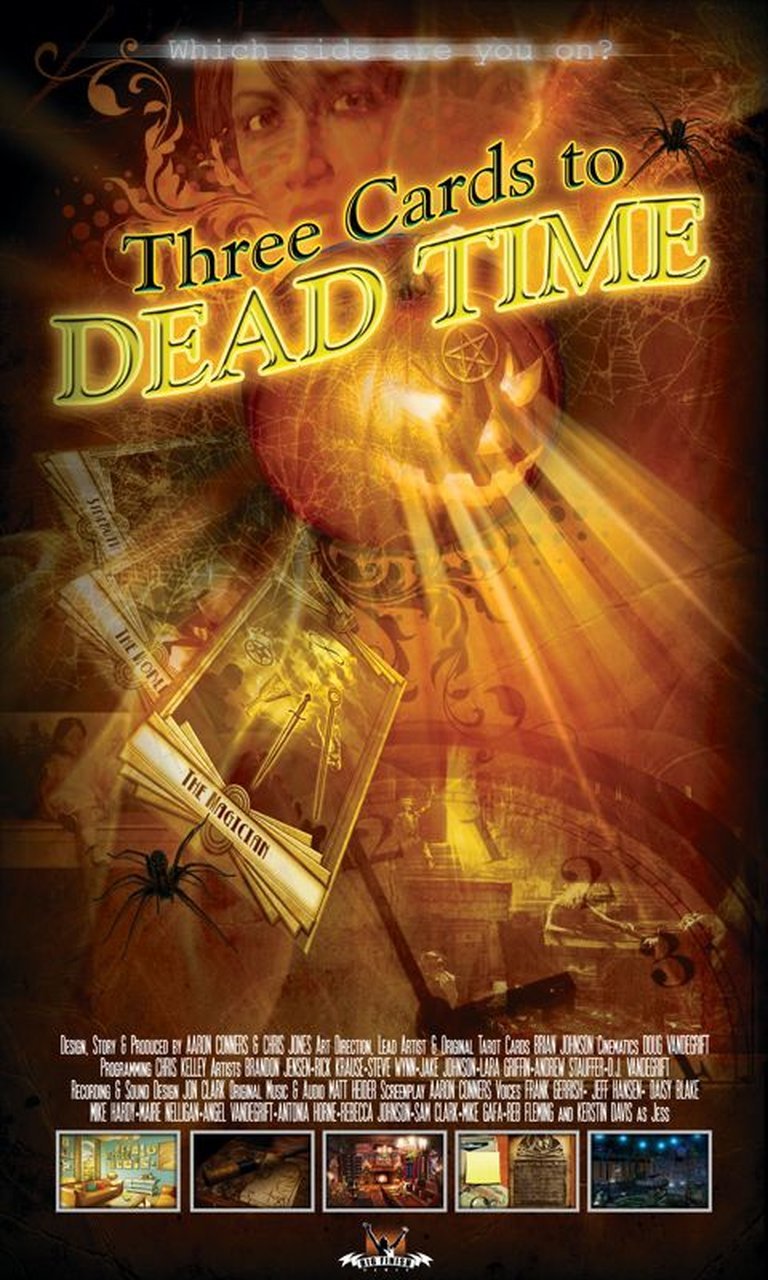
Description
In ‘3 Cards to Dead Time’, players assume the role of Jess, a medium plagued by psychic visions and the ability to commune with the dead. Guided by a shadowy figure in her nightmares, she investigates a haunted Halloween convention in Maine to unravel her mysterious past. The game is a supernatural-themed hidden object adventure where players search for items within categories (e.g., ‘rodent’) across tarot card-themed chapters, with mini-games involving puzzles like jigsaw assembly and mechanism manipulation to progress.
Gameplay Videos
Where to Buy 3 Cards to Dead Time
PC
3 Cards to Dead Time Guides & Walkthroughs
3 Cards to Dead Time Reviews & Reception
metacritic.com (70/100): 3 Cards to Dead Time is a (very) lite word-based adventure that offers a gripping ghost story full of interesting characters. However, its casual nature means it isn’t for everyone, and the sequel doesn’t quite measure up to the standards of its predecessor.
gamepressure.com (19/100): The next installment of the series of adventure games “hidden object”, in which the subject of paranormal phenomena was taken up. The production tells the story of Jess Silloway’s adventures.
justadventure.com (42/100): I really didn’t like this game. This is no Tex Murphy game. I didn’t think things gelled and with the ordinary acting and poorly-integrated puzzles, I found it confusing and boring to play.
adventureclassicgaming.com : Three Cards to Dead Time is the sequel to Big Finish Games’ Three Cards to Midnight. Picking up where the first game has left off, the story in the second game is an urban fantasy centering around a young women named Jess Silloway with a unique supernatural gift, as she tries to learn about the history of her gift and come to terms with the various supernatural forces that have a role to play in her life.
3 Cards to Dead Time Cheats & Codes
PC
Press the specified function keys to activate the cheats.
| Code | Effect |
|---|---|
| F1 | Game-Wide Max Fame |
| F2 | Set Fire Control |
| F3 | Mission XP Unlocks |
| F4 | Hero Skill Points |
| F5 | Game Updates Give Max Resources |
| F6 | Mega Campaign Money |
| F7 | Always Full Complete Rescue Civilians |
| F8 | Unlimited Torch Duration |
| F9 | Unlimited Energy Fuel |
| F10 | Max Avoidance |
| F11 | Unlimited Cannon Energy |
| HOME | Disable All |
3 Cards to Dead Time: Review
In the pantheon of hidden object games, 3 Cards to Dead Time stands as a unique and intriguing entry. Developed by Big Finish Games, this sequel to 3 Cards to Midnight builds upon its predecessor’s supernatural themes and hidden object gameplay, offering a more streamlined and accessible experience. Released in January 2010, the game quickly garnered attention for its innovative approach to the genre, blending horror elements with a compelling narrative. This review will delve into the game’s development history, narrative depth, gameplay mechanics, world-building, reception, and its enduring legacy.
Introduction
3 Cards to Dead Time is a hidden object game that transcends the typical genre conventions by integrating a rich narrative and supernatural themes. The game follows Jess Silloway, a medium whose psychic abilities manifest after her 30th birthday, leading her on a journey to uncover the mysteries of her past and the haunted town of Beacon Bay. The game’s legacy lies in its ability to blend engaging storytelling with innovative gameplay mechanics, making it a standout title in the hidden object genre. This review will argue that 3 Cards to Dead Time is a seminal work that deserves recognition for its unique contributions to the genre and its enduring appeal.
Development History & Context
Studio and Creators’ Vision
Big Finish Games, the developer behind 3 Cards to Dead Time, is known for its adventure and hidden object games. The studio’s founders, Aaron Conners and Chris Jones, brought a wealth of experience to the project, having previously worked on the acclaimed Tex Murphy series. Their vision for 3 Cards to Dead Time was to create a game that was both accessible to a broader audience and challenging enough to engage hardcore fans of the genre.
Technological Constraints and Gaming Landscape
Released in 2010, 3 Cards to Dead Time benefited from the technological advancements of the time, allowing for high-quality graphics and sound design. The game was designed to run on Windows XP, Vista, and 7, with a minimum requirement of a 1.2 GHz processor and 256 MB of RAM. This made it accessible to a wide range of players, ensuring that the game could reach a broad audience.
The gaming landscape in 2010 was dominated by casual games, with hidden object games being particularly popular. 3 Cards to Dead Time stood out in this crowded market by offering a more complex and engaging narrative, setting it apart from other titles in the genre.
Narrative & Thematic Deep Dive
Plot and Characters
The narrative of 3 Cards to Dead Time revolves around Jess Silloway, a young woman who discovers she has psychic abilities after turning 30. Haunted by visions and dreams, Jess is drawn to the haunted town of Beacon Bay, where she uncovers the secrets of her past and the supernatural forces that have been influencing her life. The plot is rich with twists and turns, keeping players engaged as they unravel the mysteries surrounding Jess’s heritage.
Jess is accompanied by a cast of supporting characters, including Sydney, her boyfriend, and various supernatural entities that guide and challenge her throughout the game. The characters are well-developed, each with their own motivations and secrets, adding depth to the narrative.
Dialogue and Themes
The dialogue in 3 Cards to Dead Time is well-written, with a focus on character development and narrative progression. The game explores themes of identity, destiny, and the supernatural, delving into the complexities of Jess’s psychic abilities and her struggle to understand her place in the world.
The game’s themes are woven into the narrative and gameplay, with each chapter exploring different aspects of Jess’s journey. The use of tarot cards as a narrative device adds a layer of mysticism and intrigue, making the game’s themes more accessible and engaging.
Gameplay Mechanics & Systems
Core Gameplay Loops
3 Cards to Dead Time features a core gameplay loop that involves selecting tarot cards to choose a setting and then searching for hidden objects connected to a particular theme. Each chapter is framed around a trio of tarot cards, with players having the freedom to choose the order in which they play them. This non-linear progression adds replayability and allows players to tailor their experience to their preferences.
Combat and Character Progression
Unlike traditional adventure games, 3 Cards to Dead Time does not feature combat or character progression in the traditional sense. Instead, the game focuses on puzzle-solving and narrative progression. Players earn points for finding hidden objects and completing puzzles, with higher scores unlocking additional content and achievements.
User Interface
The user interface in 3 Cards to Dead Time is intuitive and easy to navigate. The game features a hint system that provides players with assistance when they get stuck, as well as a limited number of wrong clicks before the game resets the location. This ensures that players can enjoy the game without getting frustrated by difficult puzzles.
World-Building, Art & Sound
Setting and Atmosphere
The game’s setting is the haunted town of Beacon Bay, a place steeped in mystery and supernatural activity. The town is brought to life through detailed environments and atmospheric sound design, creating a sense of immersion and intrigue. The use of tarot cards as a narrative device adds a layer of mysticism, making the game’s setting more engaging and memorable.
Visual Direction
The visual direction in 3 Cards to Dead Time is characterized by its use of still scenes and voice acting to tell the story. The game features high-quality graphics and detailed environments, with a focus on creating a sense of atmosphere and immersion. The use of tarot cards and other supernatural elements adds a layer of visual interest, making the game’s art direction more distinctive and memorable.
Sound Design
The sound design in 3 Cards to Dead Time is top-notch, with a focus on creating an immersive and atmospheric experience. The game features an original musical score that complements the narrative and gameplay, as well as professional voice acting that brings the characters to life. The use of sound effects and ambient noise adds to the game’s sense of immersion, making it a more engaging and memorable experience.
Reception & Legacy
Critical and Commercial Reception
Upon its release, 3 Cards to Dead Time received mixed reviews from critics. While the game was praised for its innovative approach to the hidden object genre and its engaging narrative, it was criticized for its lack of polish and the disconnect between the puzzles and the story. Despite these criticisms, the game was a commercial success, selling well and garnering a dedicated fanbase.
Influence on Subsequent Games and the Industry
3 Cards to Dead Time has had a lasting influence on the hidden object genre, paving the way for other games that blend narrative and puzzle-solving. The game’s use of tarot cards as a narrative device and its focus on character development and thematic exploration have been emulated by other titles in the genre. The game’s legacy lies in its ability to push the boundaries of the hidden object genre and create a unique and engaging experience for players.
Conclusion
3 Cards to Dead Time is a seminal work in the hidden object genre, blending engaging storytelling with innovative gameplay mechanics. The game’s rich narrative, well-developed characters, and atmospheric world-building make it a standout title in the genre. Despite its mixed critical reception, the game has had a lasting influence on the industry, paving the way for other titles that blend narrative and puzzle-solving. 3 Cards to Dead Time deserves recognition for its unique contributions to the genre and its enduring appeal. It is a must-play for fans of hidden object games and adventure games alike, offering a unique and engaging experience that stands the test of time.