
- Release Year: 1998
- Platforms: Windows
- Publisher: Sierra On-Line, Inc.
- Developer: Dynamix, Inc.
- Genre: Miniature golf, Sports
- Perspective: 1st-person
- Game Mode: Hotseat, Online Co-op
- Gameplay: Arcade
- Setting: Fantasy, Whimsical
- Average Score: 79/100
Description
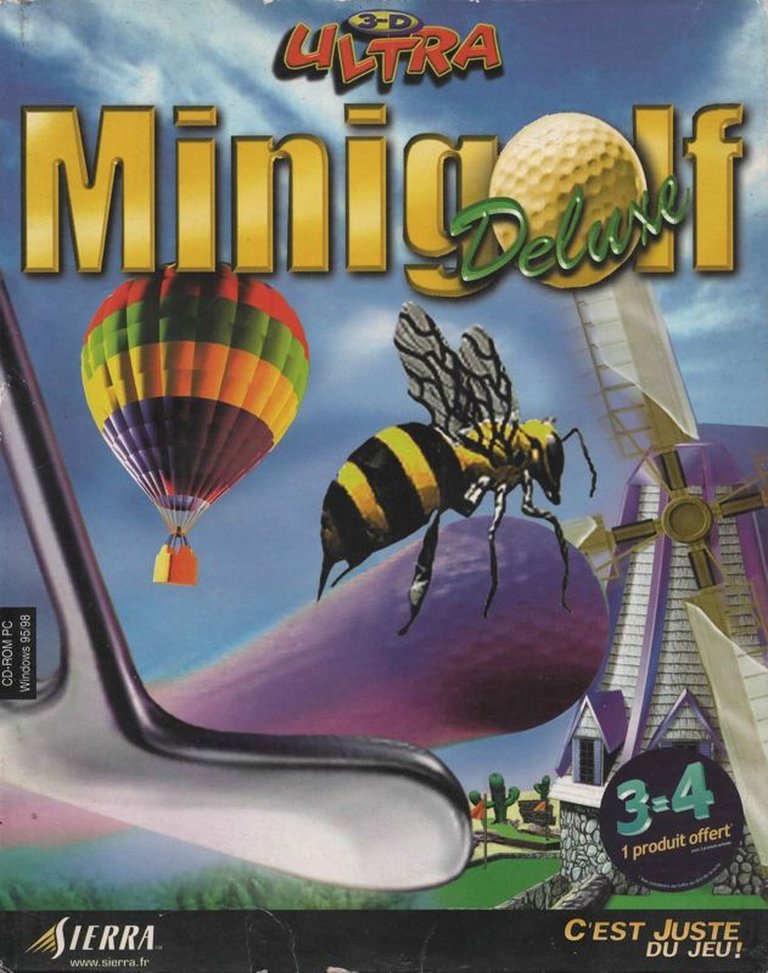
3-D Ultra MiniGolf Deluxe is an arcade-style first-person miniature golf game featuring 27 uniquely themed holes that expand upon the original 3-D Ultra Minigolf. Players navigate surreal challenges like avoiding roadworks vehicles, playing through cloud-filled skies with planes and balloons, and overcoming difficult obstacles across 9 new courses while maintaining the same accessible core gameplay. The game supports local hot-seat and online multiplayer for up to four players.
Gameplay Videos
3-D Ultra MiniGolf Deluxe Free Download
3-D Ultra MiniGolf Deluxe Patches & Updates
3-D Ultra MiniGolf Deluxe Mods
3-D Ultra MiniGolf Deluxe Guides & Walkthroughs
3-D Ultra MiniGolf Deluxe Reviews & Reception
myabandonware.com (92/100): a really nice sports game
zombs-lair.com : 3D Ultra Minigolf is a really fun, constantly smile-inducing time that’s really worth a look.
3-D Ultra MiniGolf Deluxe: A Timeless Whirlwind of Whimsy and Precision
Introduction
In the sun-dappled, high-octane summer of 1998, amidst a gaming landscape dominated by sprawling RPGs and gritty shooters, a quiet titan emerged: 3-D Ultra MiniGolf Deluxe. Developed by the legendary studio Dynamix and published by Sierra On-Line, this unassuming CD-ROM gem defied conventions by focusing not on epic quests or adrenaline-pumping combat, but on the universal joy of miniature golf. Yet, beneath its cartoonish exterior lay a meticulously crafted experience that pushed the boundaries of physics, creativity, and multiplayer camaraderie. This review delves deep into the game’s legacy, dissecting its development, thematic brilliance, mechanical ingenuity, and enduring appeal, arguing that 3-D Ultra MiniGolf Deluxe remains a pinnacle of accessible, endlessly replayable arcade design—a testament to the idea that the most profound joy can be found in the simplest of pursuits.
Development History & Context
3-D Ultra MiniGolf Deluxe emerged from the fertile grounds of Dynamix, a studio renowned for its innovative spirit and technical prowess. Having established the “3-D Ultra” brand with titles like 3-D Ultra Pinball, Dynamix sought to translate the whimsical, physics-driven fun of pinball into a new sport. The original 3-D Ultra MiniGolf (1997) laid the groundwork with 18 holes, but the Deluxe iteration—released July 1, 1998—was more than a mere expansion. It was a statement.
The team, led by Executive Director Jeffrey Tunnell and Director Randy Thompson, envisioned a game that captured the tactile satisfaction of real minigolf while embracing the imaginative absurdity of cartoons. Technological constraints of the era were significant: 3D rendering relied on software-based engines (pre-dating widespread hardware acceleration), and memory was a premium. The team employed innovative solutions, including Markus Oberhumer’s LZO Real-Time Data Compression to fit lush environments onto a CD-ROM, and collaborated with experts like Rhett Anderson and Mike Gingerich of Impressions Games to refine ball physics. The result was a game that ran at a fluid 30 FPS in a 640×480 window—a technical marvel for its time.
The gaming landscape of 1998 was dominated by Sierra’s own adventure games (King’s Quest, Space Quest), but MiniGolf Deluxe carved a unique niche. It arrived alongside Sierra’s “3-D Ultra Fun Center” (2001) and predated the studio’s closure of Dynamix in 2001—a fate that would shelve the planned sequel Minigolf Maniacs (later reworked into 3-D Ultra MiniGolf Adventures in 2006). Despite this, Deluxe’s vision was clear: deliver pure, unadulterated fun without the complexity of its contemporaries.
Narrative & Thematic Deep Dive
Though devoid of a traditional plot, 3-D Ultra MiniGolf Deluxe weaves a rich tapestry of themes through its 27 courses. Each hole is a self-contained vignette, celebrating creativity, problem-solving, and the joy of discovery. The courses are a symphony of absurdity and familiarity:
- Banshee Castle: A gothic haunted course where spectral ghouls and floating coffins challenge players to navigate eerie corridors. The theme evokes playful horror, inviting players to conquer fear with skill.
- On Cloud 9: Players putt through celestial realms, dodging storm clouds and gusts of wind. This course embodies aspiration and the whimsy of childhood dreams.
- Mad Scientist’s Lab: A Rube Goldberg-inspired nightmare of lasers, teleporters, and bubbling potions. Here, science is not just a theme but a playful antagonist, demanding precision over brute force.
- Even More Incredible Machine: A direct nod to Sierra’s beloved The Incredible Machine series, this course is a puzzle where timing and trajectory are paramount. It celebrates the marriage of logic and creativity.
Underlying these themes is a profound emphasis on accessibility and inclusivity. The game’s non-violent, family-friendly design (rated “Everyone” by the ESRB) positions minigolf as a democratic sport—one where age or skill level doesn’t preclude enjoyment. Courses like Drive In Movie (a nostalgic tribute to 1950s Americana) and Deep Sea Diving (an aquatic adventure) evoke universal memories, fostering a sense of shared experience. Dialogue is minimal, conveyed through charming animations (e.g., a triumphant dance after a hole-in-one), reinforcing the game’s “show, don’t tell” philosophy. Ultimately, MiniGolf Deluxe champions the idea that play itself is the narrative—a joyful rebellion against the grim realism of late-’90s gaming.
Gameplay Mechanics & Systems
At its core, 3-D Ultra MiniGolf Deluxe is a masterclass in intuitive design. The gameplay loop is deceptively simple: aim, set power, putt. Yet, its depth lies in the physics and variety of challenges.
- Physics Engine: The game’s crown jewel is its ball physics, developed in consultation with golf experts. Surfaces have distinct friction (sand slows the ball, ice causes skidding), while hazards like windmills, bumpers, and moving platforms introduce unpredictable trajectories. A well-executed bank shot off a castle wall or a perfectly timed ricochet off a tornado feels like a triumph of skill, not luck.
- Control Scheme: Two putting techniques cater to different skill levels. Traditional putting offers precision, while the “Power Shot” (holding a modifier) adds force for longer distances. This dual system ensures both casual players and purists can find satisfaction.
- Game Modes: Beyond standard stroke play, the game offers “Hole-by-Hole” (focus on individual challenges) and “Race Mode” (timed gameplay for up to four players). Multiplayer is a highlight: hot-seat play lets friends crowd around a single keyboard, while online play (via Sierra’s matchmaking) connected players across dial-up connections—a forward-thinking feature in 1998.
- Progression & Challenge: Courses increase in complexity, introducing new mechanics (e.g., the Tornado Alley’s cyclones that fling the ball wildly). Shortcuts and hidden paths reward exploration, turning each hole into a puzzle. The absence of a traditional “ending” ensures replayability; players chase lower scores, hole-in-one bonuses, or simply the joy of mastering a tricky layout.
The UI is a model of clarity: a top-down preview of each hole, adjustable camera angles, and unobtrusive score tracking. Even the “frustrating” difficulty noted by some critics (e.g., PC Gamer’s 43% score) is a feature—it transforms failure into a learning opportunity, making eventual success all the sweeter.
World-Building, Art & Sound
3-D Ultra MiniGolf Deluxe’s art direction is a vibrant explosion of personality. The 27 courses form a cohesive yet wildly diverse world:
– Visual Design: Each hole is a self-contained diorama. Banshee Castle’s crumbling stone arches and cobwebs contrast with Future City’s neon-lit skyscrapers and hovercars. The art team, led by Anthony Lewis and Paul Rheinfelder, used pre-rendered 3D models painted with a cartoonish hand-drawn aesthetic, creating a timeless look. Textures are rich—wood grain on windmill blades, shimmering water in Deep Sea Diving—even if resolution is capped at 640×480.
– Atmosphere: The game thrives on contrast. On Cloud 9’s serene, pastel skies create a sense of calm, while Road Repair’s chaotic construction site (with jackhammers and bulldozers) evokes frantic energy. Lighting and particle effects (e.g., dust clouds in Tornado Alley) add dynamism, immersing players in each micro-world.
– Sound Design: Often cited as the game’s unsung hero, the audio is meticulous. The satisfying thwack of the club on the ball, the gentle lapping of water, the distant wail of a banshee—all contribute to tactile realism. Music is upbeat and thematic: a jaunty accordion for Drive In Movie, eerie organ music for Banshee Castle. Sound cues (e.g., a warning hum before a laser activates) provide crucial feedback without breaking immersion.
Together, these elements craft an experience that feels both playful and polished. The art’s whimsy and sound’s precision elevate minigolf from a casual diversion to an art form.
Reception & Legacy
Upon release, 3-D Ultra MiniGolf Deluxe polarized critics yet cultivated a dedicated fanbase. Its MobyGames score of 6.8 (ranking #17,498 of 27,700 games) masks a more nuanced reality. Positive reviews celebrated its charm and accessibility:
- Electric Games (80%) lauded its “fantastic sound” and “fun” new holes, despite noting their “frustrating” difficulty.
- The Adrenaline Vault (80%) called it “the best possible job in bringing [minigolf] to the computer,” praising its diversity and options.
- GameBlitz (80%) highlighted its “surreal” courses (e.g., playing in clouds with planes) as “huge fun.”
Criticism, however, focused on its lack of innovation—Gamezilla (75%) noted it was “quick to learn and easy to master,” while PC Gamer (43%) dismissed it as inferior to other minigolf titles. German reviews were mixed: PC Action (66%) called it a “short-lived pastime for the whole family,” but PC Games (47%) lamented its “lack of long-term motivation.”
Commercially, the game struggled against Sierra’s blockbuster franchises but found a niche as a family-friendly multiplayer staple. Its legacy, however, has grown with time:
– Influence: It paved the way for later minigolf games like Hot Shots Golf and Mario Golf, emphasizing physics and creativity over realism. Its online multiplayer foreshadowed the rise of couch co-op and digital competition.
– Preservation: Fan communities (e.g., Zomb’s Lair) and preservationists (e.g., Internet Archive) have ensured its survival, with modern ports and fixes for Windows 10.
– Series Evolution: The unreleased Minigolf Maniacs (2001) was reborn as 3-D Ultra Minigolf Adventures (2006), Deluxe’s true spiritual successor. Its 50+ holes and Xbox Live Arcade integration expanded its vision, but Deluxe’s purity and charm remain unmatched.
Today, it’s revered as a cult classic—a reminder that gaming’s greatest achievements need not be grand in scale, only grand in heart.
Conclusion
3-D Ultra MiniGolf Deluxe is more than a game; it’s a time capsule of late-’90s ingenuity and pure, unfiltered joy. In an era obsessed with graphical fidelity and complex narratives, Dynamix proved that innovation could spring from simplicity. Its 27 courses are masterclasses in level design, blending physics, art, and theme into unforgettable challenges. The multiplayer remains a testament to communal gaming, while the physics engine still impresses with its tactile precision.
Flaws? Perhaps. Its dated visuals and limited long-term appeal for solo players are undeniable. Yet, these are minor blemishes on a masterpiece of accessibility. 3-D Ultra MiniGolf Deluxe transcends its genre by celebrating the universal language of play—a language of laughter, rivalry, and shared triumph. It stands as a historical artifact and a timeless artifact, proving that the hole-in-one of gaming isn’t always about power or speed, but about the perfect, joyful arc of a tiny ball rolling into its cup. In the grand course of video game history, 3-D Ultra MiniGolf Deluxe is a hole-in-one.