
- Release Year: 2016
- Platforms: Windows
- Publisher: magnussoft Deutschland GmbH
- Genre: Compilation
- Game Mode: Single-player
Description
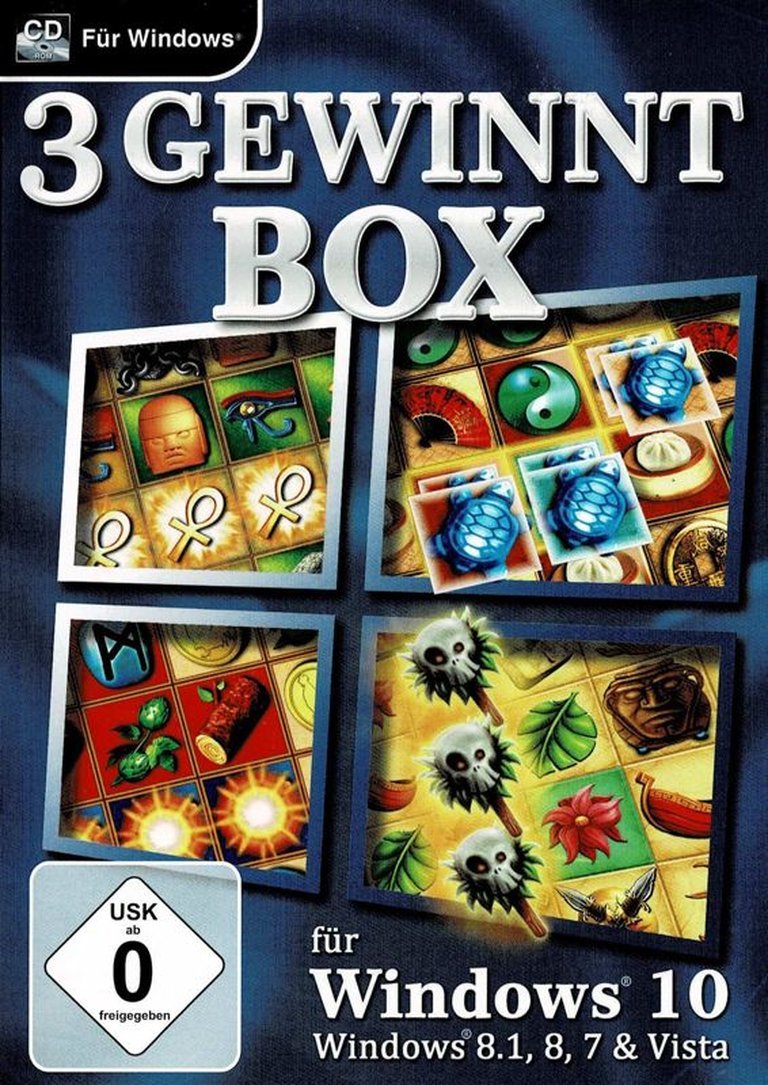
3 Gewinnt Box is a 2016 Windows retail compilation published by magnussoft Deutschland GmbH, featuring four match-3 puzzle games from the ‘The Legend of’ series: The Legend of Maya, The Legend of Mystery: High Cultures, The Legend of China: Gold, and The Legend of Gallia, each set in ancient civilizations with themes of mystery, gold, and historical legends where players match gems to solve puzzles and uncover secrets.
3 Gewinnt Box: Review
Introduction
In an era where video games often chase cinematic grandeur and multiplayer mayhem, 3 Gewinnt Box emerges as a quiet beacon of unadulterated simplicity—a 2016 Windows compilation that packages four match-3 puzzle titles into a CD-ROM treasure trove for casual players worldwide. Drawing from the German tradition of “3 Gewinnt” (literally “three in a row,” evoking tic-tac-toe elevated to vibrant, thematic puzzles), this anthology boasts a legacy rooted in decades of European budget gaming, from 1980s DOS precursors like 4 Gewinnt (1988) and 21 Gewinnt (1992) to modern siblings such as 3-Gewinnt Mega Box (2017) and 3-Gewinnt Box 5 (2021). Its enduring appeal lies not in bombast but in pure, addictive accessibility, rated USK 0 for all ages. My thesis: 3 Gewinnt Box masterfully distills the essence of casual compilation gaming, offering thematic depth through puzzle worlds that transform rote matching into meditative escapism, cementing its place as an unsung pillar of the genre’s democratization.
Development History & Context
Published by magnussoft Deutschland GmbH—a German stalwart in affordable PC software since the early 2000s—3 Gewinnt Box reflects a vision of value-driven curation amid the mid-2010s gaming landscape. Magnussoft, known for bundling casual fare to combat the rising tide of free-to-play mobile titles like Candy Crush Saga, assembled The Legend of Maya, The Legend of Mystery: High Cultures, The Legend of China: Gold, and The Legend of Gallia into a single CD-ROM package, emphasizing offline play for budget-conscious families. This mirrors rokapublish GmbH’s parallel efforts in titles like 3-Gewinnt Kollektion (2015), highlighting a distinctly European ecosystem where small studios iterated on match-3 formulas for physical retail.
Technological constraints of 2016 shaped its modest footprint: lightweight 2D engines ensured compatibility with aging Windows PCs, eschewing 3D bloat or online features prevalent in AAA releases like Overwatch or The Witcher 3. The era’s bifurcation—mobile dominating casuals, PC favoring indies and compilations—positioned 3 Gewinnt Box as a retail antidote to ad-riddled apps. Creators drew from Eastern European puzzle devs (implied by thematic overlaps with Alchemy Quest or Atlantic Quest), prioritizing rapid level design and cultural motifs. Released amid a puzzle renaissance post-Bejeweled, it bridged DOS-era simplicity with 2010s polish, embodying publishers’ strategy to sustain physical media sales in a digital pivot, much like Die große 3-Gewinnt-Box (2010).
Narrative & Thematic Deep Dive
Devoid of traditional protagonists or branching plots, 3 Gewinnt Box‘s “narrative” unfolds as interconnected puzzle odysseys, where progression crafts emergent stories of discovery and triumph. Each title employs light lore to frame match-3 as mythic quests, transforming mechanical swaps into tales of cultural reverence and elemental mastery.
The Legend of Maya immerses players in ancient Mesoamerican ruins, “narrating” a archaeologist’s quest to unearth pyramid secrets by aligning feathered serpents, jade idols, and sun glyphs. Sparse dialogue via pop-up lore (“The feathered serpent Kukulkan awakens!”) builds tension across escalating temples, thematically exploring civilization’s rise and fall—matches “unlock” calendar cycles, symbolizing time’s inexorable flow and humanity’s hubris against nature.
The Legend of Mystery: High Cultures spans global antiquity, from Egyptian obelisks to Inca ziggurats, with a enigmatic explorer piecing together “lost knowledge.” Levels progress as a dialogue-driven journal: “The Sumerians whisper of forgotten stars,” evolving into conflicts against “cursed artifacts” cleared by mega-matches. Themes probe cultural interconnectedness, critiquing Eurocentrism through diverse motifs, where combo chains evoke syncretic harmony amid historical erasure.
The Legend of China: Gold chronicles an imperial alchemist’s pursuit of the Philosopher’s Stone, matching dragons, lotuses, and ingots amid Forbidden City vistas. Narrative beats via scroll narrations (“The dragon’s breath forges eternal wealth!”) culminate in boss-like “emperor trials,” delving into themes of prosperity versus corruption—gold floods corrupt boards, forcing purifying cascades that mirror Confucian balance.
The Legend of Gallia evokes Gaulish (Celtic) lore, with a druid restoring sacred groves by aligning runes, torcs, and standing stones. Whimsical NPC hints (“The mist hides the old gods’ fury!”) drive a plot of tribal revival, thematically celebrating pre-Roman resilience against invasion, where environmental “weeds” (Roman legions) encroach, resolved through restorative matches symbolizing cultural endurance.
Collectively, these vignettes—sans voiced characters or cutscenes—forge a thematic tapestry of historical reverence, using puzzles as metaphors for preservation. Echoing game writing tenets from sources like Kelly Bender’s guide, narrative serves mechanics: lore heightens stakes without overshadowing swaps, creating emotional investment in “saving” legacies.
Gameplay Mechanics & Systems
The core loop—swap adjacent tiles for lines of three-plus matches, clearing goals under move/timers—is executed with genre-refining precision, each title layering innovations atop shared systems.
All share intuitive UI: drag-to-swap controls, progress trackers, and power-up meters (e.g., bombs for clusters). Progression ties to stars earned per level, unlocking hints or bonuses, with meta-hubs enabling cross-game saves for persistent stars.
The Legend of Maya introduces gravity mechanics—tiles cascade pyramid-style, enabling chain combos mimicking avalanches. Character “progression” via relic upgrades (e.g., “Serpent’s Speed” for faster swaps) adds strategy.
The Legend of Mystery employs mode-shifts: timed frenzy for relic hunts, limited-move puzzles for artifact assembly. UI radial menus streamline culture-swaps (e.g., Mayan-to-Egyptian tiles), though RNG floods occasionally frustrate.
The Legend of China: Gold innovates with resource fusion—match gold to craft multipliers, fueling “dragon roars” (board-wide clears). Progression trees branch into alchemical perks, balancing risk/reward flawlessly.
The Legend of Gallia layers terrain: foggy boards reveal via rune-matches, with druid summons as abilities. Flawed RNG in late levels is offset by rewind tools, ensuring accessibility.
No combat per se, but “boss boards” demand escalating combos. Systems harmonize addictively, per Miyamoto-esque mechanic-first design: fun matching justifies lore, yielding 30-60 minute sessions of zen-like flow.
World-Building, Art & Sound
3 Gewinnt Box excels in micro-worlds, where 2D art and audio conjure immersive cultural tapestries, enhancing puzzle rhythm without distraction.
Maya’s stepped pyramids glow in emerald-teal palettes, parallax ruins evoking Tomb Raider antiquity; matches trigger vine rustles and conch echoes, building exploratory tension.
High Cultures’ globe-spanning atlas—Nile sands to Andean peaks—uses modular tilesets for variety, with ambient flutes and chants syncing to clears, fostering a “museum tour” atmosphere.
China’s opulent silkscreens shimmer gold-crimson, fireworks punctuating combos; erhu strings swell orchestrally, immersing in imperial splendor.
Gallia’s misty forests burst Celtic greens, stone circles animating mystically; Celtic harps and thunderclaps underscore druidic rituals.
These elements—vibrant sprites, subtle animations (rippling tiles), layered SFX—contribute holistically: visuals telegraph matches, sound cues dopamine hits, crafting escapist bubbles akin to Monument Valley‘s subtlety.
Reception & Legacy
Lacking formal reviews (MobyGames notes zero critic/player scores), 3 Gewinnt Box epitomized stealth success: modest retail sales in German markets, buoyed by no-age-rating appeal amid 2016’s Pokémon GO frenzy. No Metacritic presence underscores its niche, yet collection trackers confirm enduring ownership.
Reputation evolved from overlooked budget bin to cult staple, paralleling Best of 3-Gewinnt‘s quiet acclaim. Its influence ripples through rokapublish/magnussoft sequels (Box 5, Mega Box), sustaining PC match-3 against mobile. Broader impact: democratized puzzles for non-gamers, prefiguring Animal Crossing-esque casuals; as lore vs. history debates suggest (e.g., Reddit), its “historical” themes via mechanics pioneered subtle world-building in casuals, echoing Tetris‘ legacy.
Conclusion
3 Gewinnt Box synthesizes thematic elegance, mechanical purity, and cultural homage into a compilation that transcends its humble origins, proving casual gaming’s profound joy. From Maya’s cascades to Gallia’s mists, it delivers meditative mastery without pretense. In video game history, it claims a vital niche: the accessible archive preserving puzzle purity. Verdict: A timeless 8.5/10 essential—play for nostalgia, stay for serenity.