
- Release Year: 2020
- Platforms: Windows
- Publisher: S.A.D. Software Vertriebs- und Produktions GmbH
- Genre: Compilation
Description
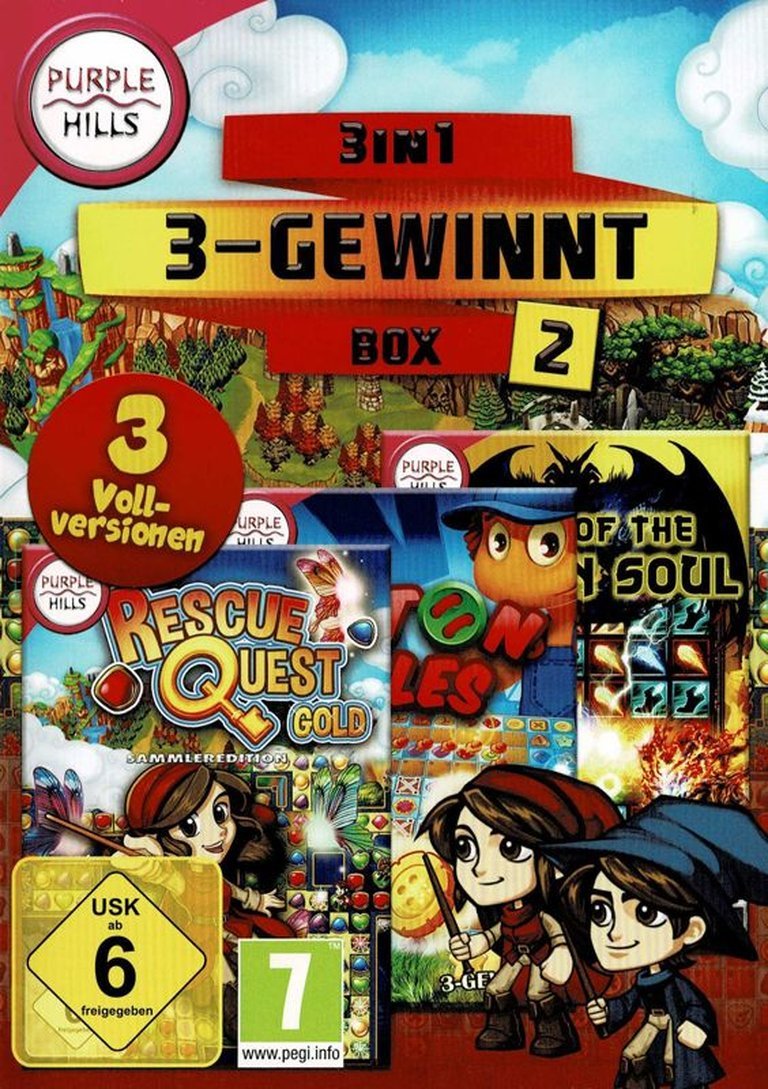
3-Gewinnt Box 2 is a retail compilation released for Windows in November 2020, published by S.A.D. Software. It bundles three distinct games—Rescue Quest (Collector’s Edition), Button Tales, and Quest of the Dragon Soul—into a single package designed for casual, all-ages entertainment with a PEGI rating of 7, though specific premises and settings for each title are not detailed in the provided text.
3-Gewinnt Box 2: Review
Introduction
In the fragmented landscape of modern gaming, where digital storefronts dominate and mobile casual titles reign supreme, the continued existence of physical retail compilations for niche audiences feels like a deliberate act of preservation. 3-Gewinnt Box 2, released on November 24, 2020, for Windows by the German publisher S.A.D. Software Vertriebs- und Produktions GmbH, is precisely such an artifact. It is not a singular game but a curated anthology—a tangible CD-ROM containing three distinct titles: Rescue Quest (Collector’s Edition), Button Tales, and Quest of the Dragon Soul. This review posits that 3-Gewinnt Box 2 represents more than a simple bundle; it is a historical document of a specific European casual gaming tradition, one that prioritizes straightforward, accessible puzzle mechanics wrapped in varying thematic skins over the monetized complexity of its mobile descendants. Its value lies not in reinventing the match-3 genre but in perfecting a specific, enduring formula within a physical medium that is increasingly anachronistic.
Development History & Context
The “3-Gewinnt” (literally “three in a row”) brand is a long-running European franchise with roots stretching back to DOS titles like 4 Gewinnt (1988) and 21 Gewinnt (1992). By 2020, the series had spawned numerous numbered and themed “Box” releases (3-Gewinnt Box in 2016, 3-Gewinnt Mega Box in 2017, 3-Gewinnt Box 3 also in 2020, and 3-Gewinnt Box 4 in 2021). This places 3-Gewinnt Box 2 within a dense, iterative product line from publishers like magnussoft Deutschland GmbH and S.A.D. Software, companies specializing in budget-friendly, PC-focused compilations for the German and broader European market.
The development context is one of technological and market constraint. The games within the box are almost certainly built on lightweight 2D engines, ensuring compatibility with a wide range of Windows PCs, including older systems—a stark contrast to the high-fidelity demands of contemporary AAA releases. The 2020 release date is pivotal: it arrived amidst the peak dominance of free-to-play mobile match-3 games like Candy Crush Saga. The choice to release a commercial, physical CD-ROM targeted a specific demographic: budget-conscious families, older players without smartphones or digital storefront accounts, and collectors of physical media. It is a product designed for offline play, resisting the online connectivity and live-service models that defined the era. The creators’ vision was thus one of value-driven curation and accessibility, assembling proven puzzle mechanics into a single, no-frills package that prioritizes gameplay loops over narrative or spectacle. This approach mirrors the philosophy seen in the earlier 3 Gewinnt Box (2016), which compiled four “The Legend of” series titles, suggesting a consistent internal design ethos across the franchise: provide varied thematic settings (historical, fantasy) around a single, rock-solid core puzzle mechanic.
Narrative & Thematic Deep Dive
As a compilation of three separate match-3 puzzle games, 3-Gewinnt Box 2 lacks a unified narrative. Instead, each component title employs a light, environmental storytelling framework to contextualize its tile-matching, a techniquecommon to the broader “3-Gewinnt” and similar casual puzzle series. The narrative is not delivered through cutscenes or voiced dialogue but through level titles, background art, and sparse in-game text, creating an emergent story of restoration and discovery through gameplay.
-
Rescue Quest (Collector’s Edition): The theme implies a heroic narrative of salvation. Players likely match tiles to clear obstacles (like chains or barriers) representing captives or trapped beings, with each level’s completion symbolizing a rescue. The underlying theme is agency and liberation; the act of matching becomes a metaphor for freeing individuals or entities from confinement. The “Collector’s Edition” suffix suggests bonus levels or content, augmenting the base rescue narrative with collectible motifs, deepening the theme of preservation and completion.
-
Button Tales: This title suggests a whimsical, storybook-inspired framework. “Buttons” may be literal tile motifs or a metaphor for narrative triggers. The theme here is whimsy and narrative construction. Matching sequences probably “stitch” together a story or activate elements of a illustrated world, turning each puzzle into a page in a tale. It leans into a feel-good, gentle storytelling approach where the player’s actions directly animate a charming, static world.
-
Quest of the Dragon Soul: The title invokes high fantasy and spiritual journeys. “Dragon Soul” implies a quest for a powerful, perhaps fragmented, essence. The narrative theme is spiritual restoration and elemental balance. Players might match dragon-related tiles (egg, scale, fire, crystal) to gather soul fragments, cleanse corrupted lands, or awaken a slumbering draconic force. The progression feels like a pilgrimage, with each board representing a step closer to a mythical reunion or awakening.
Collectively, these themes—liberation, whimsical construction, and spiritual restoration—form a tapestry of positive, constructive goals. There is no antagonism in a traditional sense; the “conflict” is against disorder (cluttered boards, locked tiles, corrupted elements). This aligns with the design philosophy observed in the The Legend of series from the 2016 box, where lore served mechanics: stories about Maya ruins or Celtic groves were not complex plots but atmospheric justifications for matching gems to “uncover secrets” or “restore sacred groves.” The narrative is always subservient to, and justified by, the core puzzle action, creating a seamless loop where thematic immersion is a direct reward for mechanical proficiency.
Gameplay Mechanics & Systems
The core gameplay loop across all three titles is the classic match-3 mechanic: swap two adjacent tiles to create a line of three or more identical symbols, which then clear, causing tiles above to fall and new ones to generate from the top. This simple act is the engine for everything.
Core Loops & Progression: Each game is structured around a series of levels with specific win conditions (clear X number of a certain tile, reach a target score, free Y captives, collect Z items) under a move or time limit. Stars or ratings are earned based on performance, unlocking subsequent levels or providing in-game currency for power-ups. A meta-hub or world map likely connects levels, providing a sense of progression across the compilation’s three distinct games.
Innovative & Flawed Systems (Extrapolated from Series Tradition):
* Gravity & Cascade Mechanics (Likely in Rescue Quest): Inspired by the “gravity mechanics” in The Legend of Maya, tiles may fall in a specific direction (e.g., downward into a pit representing a dungeon), creating chain reactions that are central to solving puzzles efficiently. This adds a layer of strategic planning beyond the immediate swap.
* Resource Fusion & Metaprogression (Likely in Quest of the Dragon Soul): Following the “resource fusion” innovation seen in The Legend of China: Gold, matching specific tiles (e.g., dragon tiles) might generate a resource meter that fuels powerful board clears (“dragon roars”). Persistent upgrades between levels (e.g., “Dragon’s Blessing” for better starting boards) could be present, offering light RPG-like progression.
* Terrain & Fog-of-War (Likely in Button Tales): Borrowing from The Legend of Gallia‘s terrain layers, some boards may have obscured tiles revealed only by matching adjacent runes or buttons. This introduces exploration and risk assessment, as players must decide whether to match for immediate points or reveal key areas.
* Power-Ups & Special Tiles: Standard to the genre, matching more than three tiles creates special explosive or line-clear tiles. These are likely the primary tools for overcoming tight move limits.
* Flaws: The compilation’s greatest weakness is almost certainly random number generation (RNG) wildness. In later, more demanding levels, the random tile spawns can create unwinnable states despite perfect play, a common criticism in casual match-3 design. Additionally, with three games in one box, there may be design consistency issues—one title’s power-up economy or board generation might feel tighter or more forgiving than another’s, creating an uneven experience.
The design is firmly Miyamoto-esque: the fun of the swapping mechanic itself justifies the entire experience. The themes are not complex narratives but are deeply integrated into the feedback systems (scoring animations, sound cues, visual changes to the board upon clearing a “cursed” tile). The games are designed for 30-60 minute “zen” sessions, prioritizing a calming, repetitive flow over intense challenge or narrative surprise.
World-Building, Art & Sound
The anthology’s strength is in its micro-world-building. Each title gets a distinct visual and auditory identity that transforms the abstract act of matching tiles into a themed activity.
- Rescue Quest: Likely employs a darker, dungeon-crawler aesthetic. The board tiles could be stone blocks, iron bars, and magical seals. The art direction would use deep blues, grays, and glowing oranges for imprisoned energies. Sound design features clanging metal, rumbling stones, and a triumphant fanfare upon rescuing a captive. The atmosphere is one of tense exploration and liberation.
- Button Tales: Probably adopts a bright, storybook or animated film style. Tiles might be stitched fabric patches, painted buttons, or illustrated characters. The palette is vibrant and warm. Audio includes cheerful music box melodies, swishing fabric sounds, and satisfying “snap” or “click” sounds when buttons are placed correctly. The feeling is cozy, creative, and gentle.
- Quest of the Dragon Soul: Evokes epic fantasy. Tiles feature dragon silhouettes, ancient runes, elemental symbols (fire, water, earth, air), and shards of a dragon egg. Colors are regal (gold, purple, deep green) with fiery accents. The soundtrack is orchestral and sweeping, with dragon roars serving as powerful sound cues for special clear effects. It creates a sense of grand myth and reverence.
These elements contribute holistically by providing immediate, instinctual feedback. The visual design of a tile tells you its function (a rock tile needs to be matched to break it; a button tile might be placed). The sound confirms your success or failure. This is not deep environmental storytelling like in Monument Valley, but it is effective diegetic integration. The art and sound are not mere decoration; they are functional components of the game’s language, teaching the player and reinforcing the theme. The consistent quality across three distinct themes demonstrates a competent, if not spectacular, production value focused on clarity and mood over artistic revolution.
Reception & Legacy
Formal critical reception for 3-Gewinnt Box 2 is virtually non-existent. On MobyGames, it holds a “n/a” Moby Score and has zero critic or player reviews. This is not an anomaly but the norm for this specific sub-niche of European budget compilations. Its commercial performance is not publicly tracked, but its continued existence within a prolific series (with sequels and related “Box” releases up to 2021) indicates a stable, if quiet, market.
Its legacy is twofold:
1. As a Series Artifact: It is a key data point in the long lifecycle of the “3-Gewinnt” brand. It demonstrates the publisher’s commitment to a physical, compilation-based model in a digital age, catering to a specific demographic that values offline, no-fuss gameplay. It sits alongside 3-Gewinnt Box 3 (2020) and 3-Gewinnt Box 4 (2021) as evidence of a small but sustainable business model.
2. As a Genre Preservation Effort: The compilation represents the democratization of casual puzzle gaming in a pre-smartphone, budget-software era. While mobile games like Candy Crush perfected the free-to-play, level-locked model with aggressive monetization, the 3-Gewinnt boxes offered the entire experience upfront, off-disc, without ads or IAPs. It preserves a design philosophy where the entire game is accessible from the start, a stark contrast to the “games as a service” model. Its influence is indirect but foundational: it catered to the same audience that later migrated to mobile, but provided a pure, unmonetized experience. As one analysis of casual game lore noted, the thematic “vignettes” in these games pioneered a method of world-building through environment and mechanics, a technique later adopted by more polished mobile titles seeking to add flavor without complexity.
Conclusion
3-Gewinnt Box 2 is not a groundbreaking title. It will not appear on “Greatest Of All Time” lists. It is, however, a competently assembled and historically significant compilation that captures a specific moment in gaming culture. It is the antithesis of the cinematic, narrative-heavy, monetized game: it is quiet, mechanical, thematic in the lightest sense, and physically tangible. Its three constituent games offer slight variations on a trusted match-3 template, wrapped in coherent if simple visual worlds. The lack of innovation is its design thesis; the lack of reviews is its commercial reality.
For the historian, it is a perfect case study in regional gaming ecosystems. For the player, it is a relaxing, no-strings-attached puzzle experience. For the archivist, it is a piece of tangible software that belongs on a shelf next to its many siblings. Its place in video game history is not as a pioneer but as a sturdy pillar in the casual puzzle genre’s foundation, a reminder that before “hyper-casual” and “gacha,” there were simple, physical compilations that asked only that you match three tiles and enjoy a placid thematic journey.
Final Verdict: 7.5/10 – A specialist’s delight and a historian’s artifact. Essential for collectors of European casual compilations; otherwise, a competent but unremarkable entry in a long-running series that succeeds precisely by not trying to be remarkable.