
- Release Year: 2001
- Platforms: Windows
- Publisher: Encore Software, Inc.
- Genre: Card, Patience, Solitaire, Tile game
- Game Mode: Single-player
- Gameplay: Card game, Tile matching
- Average Score: 5/100
Description
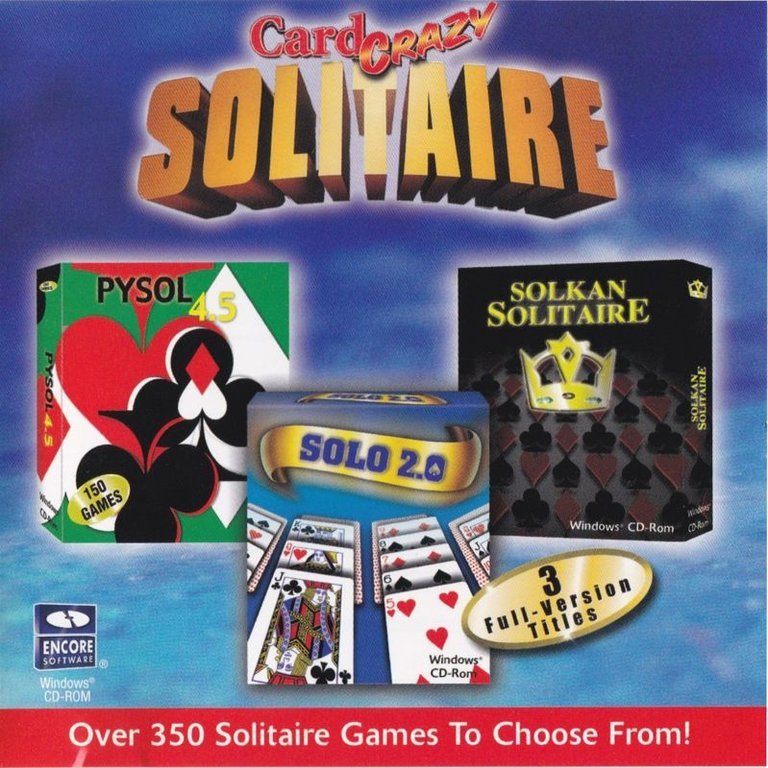
3 in 1 Gold Collection: Card Crazy Solitaire is a 2001 Windows compilation that bundles three full versions of solitaire software: PySol v4.50 (including Mah Jongg tile matching), Solo v2.09, and Solkan Solitaire v4.0, each installing separately with its own Windows start menu entry.
3 in 1 Gold Collection: Card Crazy Solitaire Guides & Walkthroughs
3 in 1 Gold Collection: Card Crazy Solitaire Reviews & Reception
sockscap64.com (5/100): What’s your reaction?
3 in 1 Gold Collection: Card Crazy Solitaire Cheats & Codes
PC
Enter codes during gameplay.
| Code | Effect |
|---|---|
| Right-click | Automatically moves cards to the correct positions at the end of the game |
| Ctrl+Alt+Shift + click on card deck | Draws a single card in standard (3-card draw) mode |
| Ctrl+Shift+F10 + enter 5 | Creates a fifth card hold area |
| Shift+Alt+2 | Automatically wins the game |
| Ctrl+Alt+Shift + click on deck (3-card draw mode) | Draws only one card instead of three |
3 in 1 Gold Collection: Card Crazy Solitaire: Review
In the early 2000s, the PC gaming landscape was dominated by a curious yet enduring phenomenon: the solitaire compilation. Amid a sea of first-person shooters and sprawling RPGs, a quiet contender emerged—3 in 1 Gold Collection: Card Crazy Solitaire. Released in 2001 by Encore Software, this unassuming CD-ROM promised over 500 solitaire variations across three distinct programs: PySol, Solo, and Solkan Solitaire. At first glance, it might seem like just another budget title destined for the discount bin. But peel back the layers, and you’ll find a fascinating snapshot of gaming history, a testament to the enduring appeal of card games, and a curious relic of a time when solitaire was king of the casual market.
Development History & Context
To understand Card Crazy Solitaire, one must first appreciate the era in which it was born. The year 2001 was a transitional period for PC gaming. The industry was still reeling from the dot-com bubble burst, and while blockbuster franchises like Half-Life and The Sims were capturing headlines, there remained a robust market for casual, accessible titles. Solitaire, in particular, had become a cultural touchstone, thanks in no small part to Microsoft’s inclusion of Klondike Solitaire in Windows 3.0 (1990). This simple card game had become a ubiquitous time-waster in offices and homes worldwide, ingraining itself in the public consciousness.
Encore Software, the publisher behind Card Crazy Solitaire, was no stranger to the budget software market. Known for releasing compilations and value-priced titles, Encore saw an opportunity to capitalize on the solitaire craze by bundling together three popular solitaire programs into a single package. The result was Card Crazy Solitaire, a compilation that offered not just the classic Klondike, but a dizzying array of solitaire variants, including Mahjong tile-matching games courtesy of PySol.
The technological constraints of the era shaped the game’s development. CD-ROMs were still the dominant distribution medium, and the minimum system requirements—Windows 95, a 2X CD-ROM drive, and 32 MB of RAM—reflected the modest hardware of the time. The compilation was designed to be accessible, running smoothly on even the most basic machines. This focus on accessibility, combined with the sheer volume of content, made Card Crazy Solitaire an attractive proposition for casual gamers and solitaire enthusiasts alike.
Narrative & Thematic Deep Dive
While Card Crazy Solitaire is, at its core, a collection of card games, it’s worth considering the thematic undercurrents that run through the compilation. Solitaire, by its very nature, is a solitary pursuit. It’s a game of patience, strategy, and self-reliance—a digital meditation, if you will. In an age before smartphones and social media, solitaire offered a brief respite from the chaos of daily life, a chance to lose oneself in the simple pleasure of organizing cards.
Thematically, Card Crazy Solitaire embodies the spirit of the early 2000s: a time of transition, of seeking solace in the familiar amidst the rapid pace of technological change. The compilation’s diverse array of games—from the classic Klondike to the more esoteric Spider and FreeCell—reflects the era’s fascination with choice and customization. Players could tailor their experience, selecting from hundreds of variations to suit their mood or skill level.
Yet, for all its thematic richness, Card Crazy Solitaire is, at its heart, a utilitarian product. There is no overarching narrative, no grand quest to complete. Instead, the game offers a series of self-contained challenges, each a microcosm of the larger solitaire experience. In this sense, Card Crazy Solitaire is a reflection of its time: a product designed to provide comfort, familiarity, and a sense of control in an increasingly complex world.
Gameplay Mechanics & Systems
At its core, Card Crazy Solitaire is a masterclass in simplicity. The compilation offers three distinct programs, each with its own unique features and gameplay mechanics:
-
PySol v4.50: The crown jewel of the collection, PySol boasts over 300 solitaire games, including a selection of Mahjong tile-matching games. The program is highly customizable, allowing players to tweak card designs, backgrounds, and even create their own solitaire variants using the built-in Solitaire Graphical Game Maker. The inclusion of Mahjong games adds a layer of variety, appealing to fans of both card and tile-based puzzles.
-
Solo v2.09: A more streamlined offering, Solo focuses on classic solitaire games like Klondike, Spider, and FreeCell. The program features multiple difficulty levels, customizable card decks, and detailed statistics tracking. Its clean interface and intuitive controls make it a joy to use, even for newcomers to the genre.
-
Solkan Solitaire v4.0: The most niche of the three, Solkan Solitaire offers a selection of lesser-known solitaire games, including Yukon, Scorpion, and Spiderette. While it lacks the polish of PySol and Solo, it more than makes up for it with its unique offerings, providing a refreshing change of pace for seasoned solitaire players.
The compilation’s gameplay mechanics are straightforward: players are presented with a tableau of cards and must manipulate them according to the rules of the chosen game. The goal is typically to move all cards to the foundation piles, sorted by suit and rank. While the core mechanics remain consistent across the collection, each program introduces its own twists and variations, ensuring that the experience never grows stale.
One of the compilation’s standout features is its attention to detail. The programs include features like automatic card returns, move highlighting, and save functionality, all of which enhance the overall experience. The inclusion of tournament formats and statistics tracking adds a competitive edge, encouraging players to improve their skills and beat their high scores.
World-Building, Art & Sound
While Card Crazy Solitaire is not a game in the traditional sense, it nonetheless excels in creating a cohesive and inviting atmosphere. The programs feature clean, intuitive interfaces that are easy to navigate, even for those unfamiliar with digital solitaire. The card designs are crisp and legible, with a variety of themes and styles to choose from. The backgrounds, while simple, are pleasant and unobtrusive, allowing the cards to take center stage.
The sound design is equally impressive. The programs feature subtle sound effects that enhance the gameplay experience without becoming distracting. The gentle shuffle of cards, the satisfying clink of a successful move, and the triumphant fanfare of a completed game all contribute to the overall sense of immersion.
In terms of world-building, Card Crazy Solitaire is a triumph of minimalism. The programs create a digital space that is both functional and inviting, a place where players can lose themselves in the timeless pleasure of solitaire. The compilation’s art and sound design work in harmony to create an atmosphere of calm and focus, a digital sanctuary from the chaos of the outside world.
Reception & Legacy
Upon its release, 3 in 1 Gold Collection: Card Crazy Solitaire received a mixed reception. Critics praised the compilation’s sheer volume of content and its accessibility, but some lamented the lack of innovation and the repetitive nature of the gameplay. Despite these criticisms, the compilation found a dedicated audience among casual gamers and solitaire enthusiasts, who appreciated its value and variety.
In the years since its release, Card Crazy Solitaire has faded into obscurity, overshadowed by more modern solitaire offerings and the rise of mobile gaming. However, its legacy endures. The compilation stands as a testament to the enduring appeal of solitaire, a genre that continues to captivate players to this day. Its influence can be seen in the countless solitaire apps and digital adaptations that have followed in its wake, each building on the foundation laid by Card Crazy Solitaire.
Moreover, the compilation serves as a fascinating time capsule, offering a glimpse into the early 2000s PC gaming landscape. It is a reminder of a time when solitaire was king of the casual market, a genre that brought comfort and joy to millions of players worldwide.
Conclusion
3 in 1 Gold Collection: Card Crazy Solitaire is a curious artifact of gaming history, a compilation that, while unremarkable in many ways, nonetheless holds a special place in the hearts of those who played it. Its sheer volume of content, its accessibility, and its attention to detail make it a standout title in the crowded solitaire genre. While it may not have the innovation or polish of more modern offerings, it remains a testament to the enduring appeal of solitaire and the power of simplicity in game design.
In the end, Card Crazy Solitaire is more than just a collection of card games. It is a reflection of its time, a digital sanctuary that offered solace and comfort in an increasingly complex world. For that alone, it deserves a place in the annals of gaming history.