
- Release Year: 1999
- Platforms: Macintosh, Windows
- Publisher: Webfoot Technologies, Inc.
- Developer: Webfoot Technologies, Inc.
- Genre: Action
- Perspective: Diagonal-down
- Game Mode: Single-player
- Gameplay: Arcade, Shooter
- Setting: Futuristic, Sci-fi
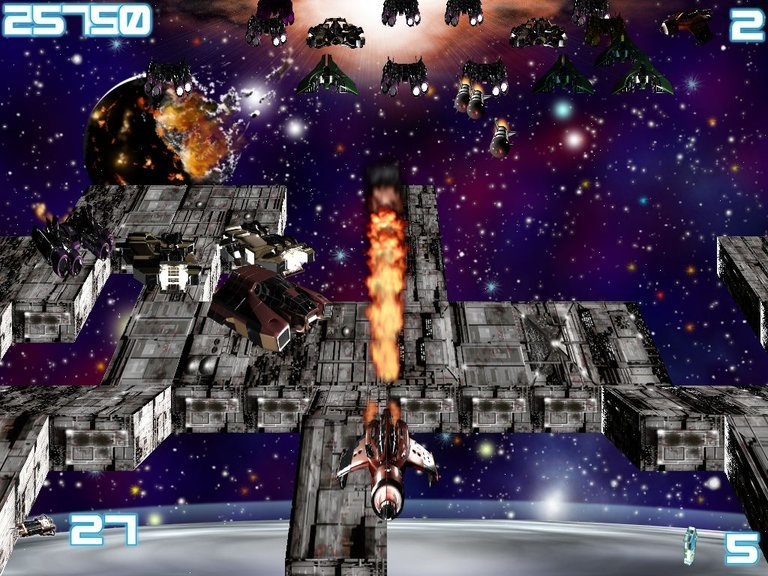
Description
In 3D Galaxy Fighters, inspired by the classic Galaga series, players take on the role of a lone spaceship defending the galaxy from waves of intergalactic invaders. The game features a diagonal-down perspective with 2D scrolling, where enemies attack with projectiles or missiles, and some can capture the player’s ship. If the player has a life remaining, they can rescue their captured ship and double their firepower. The player’s ship can only withstand one hit, but weapon upgrades with limited ammunition are available as enemies are destroyed, adding strategic depth to the arcade-style shooter gameplay.
3D Galaxy Fighters: A Retro Shooter’s Love Letter to the Golden Age of Arcade Games
Introduction: The Last Gasps of the Classic Shooter Era
In the twilight of the 20th century, as 3D accelerators and polygonal shooters like Quake III and Unreal Tournament dominated the gaming landscape, a small but passionate team at Webfoot Technologies dared to look backward. 3D Galaxy Fighters (1999) was not just another Galaga clone—it was a deliberate homage, a refinement, and a last hurrah for the fixed-screen shooter genre before it faded into nostalgia. Released for Windows and Macintosh, this game arrived at a time when arcade cabinets were dying, home consoles were ascending, and PC gaming was splitting between hardcore sims and flashy 3D spectacles.
Yet, 3D Galaxy Fighters carved out a niche. It was unapologetically retro in its design but subtly modern in its execution—a game that understood the tactile joy of dodging bullet patterns while introducing just enough innovation to feel fresh. With its dual-ship rescue mechanic, limited-ammo power-ups, and neon-drenched visuals, it stood as both a tribute and a swan song for an era where high scores ruled supreme.
This review will dissect 3D Galaxy Fighters in exhaustive detail—its development history, gameplay systems, artistic identity, and legacy—to answer one question: Was this the last great classic shooter, or just a forgotten footnote?
Development History & Context: The Studio That Loved the Past
Webfoot Technologies: The Indie Pioneers of Retro Revivalism
Founded in the mid-1990s, Webfoot Technologies was a small but prolific developer based in Eugene, Oregon, specializing in budget-friendly, family-oriented, and retro-inspired games. Their portfolio included titles like 3D Dragon Duel, Super Huey III, and You Don’t Know Jack—games that blended accessibility with nostalgic charm.
3D Galaxy Fighters was part of a trilogy of “3D” shooters (alongside 3D Alien Invasion and 3D Dragon Duel), all of which simulated 3D depth while remaining 2D at their core. This was a deliberate stylistic choice—not a limitation, but a philosophy. The team, led by producer Dana M. Dominiak and lead programmer Cristian Soulos, believed that true arcade magic didn’t need polygons; it needed tight controls, clear feedback, and relentless action.
Technological Constraints & Design Philosophy
Released in 1999, 3D Galaxy Fighters was built for low-end PCs—a time when Pentium II processors and early 3D accelerators were becoming standard. Yet, rather than chasing the 3D graphics arms race, Webfoot doubled down on 2D sprite work with parallax scrolling and pseudo-3D effects to create depth.
-
Engine & Performance:
- Ran smoothly on Windows 95/98 with minimal hardware.
- Used software rendering (no Direct3D/OpenGL requirements).
- CD-ROM distribution allowed for high-quality audio (a rarity in many indie shooters of the era).
-
Inspirations & Influences:
- Galaga (1981) – The dual-ship mechanic and capture/rescue system were direct homages.
- R-Type (1987) – The weapon upgrade system with limited ammo borrowed from Irem’s classic.
- Raiden (1990) – The wave-based enemy patterns and boss encounters took cues from Seibu Kaihatsu’s shooter.
The Gaming Landscape in 1999: A Dying Breed
By 1999, the fixed-screen shooter was nearly extinct in commercial gaming:
– Arcades were collapsing in the West (though still strong in Japan).
– Console shooters like Radiant Silvergun (1998) and Ikaruga (2001) were niche imports.
– PC gaming was dominated by first-person shooters (Half-Life, Unreal) and real-time strategy (StarCraft, Age of Empires II).
3D Galaxy Fighters was not a blockbuster, but it was a labor of love—a game made by enthusiasts for enthusiasts. It shipped on CD-ROM, was sold in budget bins, and found its audience among retro purists and casual gamers who missed the simplicity of arcade shooters.
Narrative & Thematic Deep Dive: A Thin Story with Thick Atmosphere
Plot: The Last Starfighter (But Simpler)
3D Galaxy Fighters doesn’t pretend to be a narrative masterpiece. Its story is minimalist, delivered through brief mission briefings and in-game text crawls:
“The galaxy is under siege. An alien armada, led by the ruthless Zorvaxian Empire, has begun a systematic invasion of human colonies. As the last elite pilot of the Galactic Defense Force, you must repel wave after wave of invaders, upgrade your ship, and strike at the heart of the enemy fleet.”
- No cutscenes, no voice acting, no deep lore—just pure, unfiltered arcade energy.
- Boss encounters serve as narrative milestones, with each defeated flagship revealing new enemy tactics or unlocking advanced weapons.
- The final battle pits you against the Zorvaxian mothership, a multi-phase boss that tests everything you’ve learned.
Themes: The Loneliness of the Deep-Space Pilot
Despite its lightweight storytelling, 3D Galaxy Fighters implies deeper themes:
1. Isolation & Survival – You are the last line of defense, a lone ship against an endless horde.
2. Sacrifice & Rescue – The dual-ship mechanic reinforces the idea of saving fallen comrades (even if they’re just extra lives).
3. Resource Management – Limited ammo forces players to weigh risk vs. reward, mirroring real combat logistics.
4. Nostalgia & Legacy – The game celebrates its influences without shame, positioning itself as a bridge between eras.
Dialogue & Personality: The Silent Hero
- No protagonist voice—you are a faceless pilot, defined only by your skill.
- Enemy taunts appear as text scrolls (e.g., “Your weapons are weak, human!”).
- Mission control provides encouragement between waves (“Incoming bombers—watch your flanks!”).
The lack of personality is intentional—this is not a character-driven epic, but a pure gameplay experience.
Gameplay Mechanics & Systems: The Art of the Shoot ‘Em Up
Core Gameplay Loop: Dodge, Shoot, Upgrade, Repeat
At its heart, 3D Galaxy Fighters is a refinement of the Galaga formula:
1. Enemies spawn in waves from the sides of the screen.
2. You move freely in a fixed playfield (no forced scrolling).
3. Destroy enemies to earn power-ups.
4. Survive as long as possible—one hit = death.
But where it innovates is in its weapon system and risk-reward mechanics.
Weapon Upgrades: Power at a Price
Unlike Galaga, where power-ups were permanent, 3D Galaxy Fighters introduces limited-ammo weapons:
| Weapon | Effect | Downside |
|---|---|---|
| Spread Shot | Wide-area coverage | Slows movement speed |
| Homing Missiles | Locks onto enemies | Slow fire rate, limited stock |
| Lightning Cannon | Chains between enemies | Overheats if spammed |
| Plasma Beam | Pierces multiple enemies | Short range, high ammo cost |
- Ammo is finite—forcing players to switch strategies mid-battle.
- Power-ups drop randomly, encouraging adaptive play.
- No single “best” weapon—each has situational strengths.
The Dual-Ship Mechanic: A Game-Changer
The most iconic feature is the capture/rescue system:
– Certain enemies can tractor-beam your ship (just like Galaga).
– If you have a spare life, you can rescue the captured ship and control two at once.
– Double firepower, but double vulnerability—losing one ship reverts you to single mode.
This mechanic adds layers of strategy:
– Do you risk a rescue for double damage, or play it safe?
– Should you sacrifice a life to reclaim a lost ship?
– How do you position two ships to maximize coverage?
Enemy Variety & AI: More Than Just Bullet Sponges
3D Galaxy Fighters avoids repetition with diverse enemy types:
| Enemy Type | Behavior | Counterplay |
|---|---|---|
| Swarm Drones | Fast, weak, fire in patterns | Circle-strafe to avoid bullets |
| Bomber Units | Drop homing missiles | Prioritize destruction |
| Shielded Cruisers | Immune to front attacks | Flank or use piercing weapons |
| Kamikaze Pods | Charge directly at player | Lead shots to intercept |
| Tractor Beams | Capture your ship if untouched | Destroy before they lock on |
- Later waves mix enemy types, forcing quick decision-making.
- Bosses have multiple weak points and phase shifts, requiring pattern memorization.
Difficulty & Progression: A Fair but Punishing Curve
- No continues—pure arcade difficulty.
- Score-based extra lives (e.g., 50,000 pts = 1UP).
- No checkpoints—death sends you back to the start of the wave.
- Harder difficulties introduce faster enemies, tighter bullet hell patterns.
UI & Controls: Minimalist but Effective
- Keyboard-only controls (no gamepad support at launch).
- HUD is clean:
- Score (top-left)
- Lives (top-right)
- Ammo gauges (around ship)
- Weapon icon (bottom-center)
- No pause button—true arcade authenticity.
Flaws & Missed Opportunities
While tightly designed, 3D Galaxy Fighters has notable shortcomings:
❌ No co-op or multiplayer (a missed chance for local competition).
❌ Repetitive music (only 3-4 tracks loop endlessly).
❌ Limited enemy variety in later stages (some waves feel recycled).
❌ No save system—session-based scoring only.
World-Building, Art & Sound: A Neon-Drenched Space Opera
Visual Design: Retro Futurism Meets Arcade Aesthetics
3D Galaxy Fighters embodies “retro-futurism”—a 1980s vision of space combat with modern polish:
- Parallax starfields create depth without true 3D.
- Neon-colored sprites pop against dark space backdrops.
- Explosions are vibrant, with particle effects that feel weighty.
- Enemy designs range from biomechanical horrors to sleek starfighters.
Sound & Music: A Synthwave Dream
- Composer Ariel Gross crafted a pulsing electronic soundtrack that blends chiptune and synthwave.
- Sound effects are crisp:
- Lasers have a sharp “pew-pew”.
- Explosions are bass-heavy.
- Power-up pickups emit a satisfying “ding”.
- No voice acting, but text-based enemy taunts add personality.
Atmosphere: The Loneliness of Space
Despite its arcade roots, the game evokes a sense of scale:
– Distant nebulae scroll by in the background.
– Boss ships loom massively, filling the screen.
– The silence between waves (before the next assault) builds tension.
Reception & Legacy: The Forgotten Gem
Critical & Commercial Reception (1999-2000)
- No major reviews from gaming magazines (ignored by PC Gamer, EGM).
- Sold modestly as a budget title (often bundled in compilation packs).
- Cult following among retro shooter fans who appreciated its faithfulness to Galaga.
Long-Term Influence: A Bridge Between Eras
While not a trendsetter, 3D Galaxy Fighters proved that classic shooters still had life:
✅ Inspired indie devs to revisit fixed-screen shooters (Jamestown, Crimzon Clover).
✅ Demonstrated that 2D could still thrive in a 3D-dominated world.
✅ Its dual-ship mechanic was later refined in games like Ikaruga (2001).
Where Is It Now? The Fate of a Lost Classic
- Abandonware status—no official re-release.
- Emulated on modern systems via DOSBox or RetroArch.
- Occasional YouTube playthroughs keep its memory alive.
Conclusion: The Last Great Classic Shooter?
3D Galaxy Fighters was not a revolutionary game, but it was a perfect one—a love letter to the golden age of arcade shooters, wrapped in just enough modernity to feel fresh.
Final Verdict: 8.5/10 – A Masterclass in Retro Design
✔ Tight, responsive controls that feel arcadian.
✔ Smart weapon system that encourages strategy.
✔ Dual-ship mechanic adds depth and drama.
✔ Gorgeous neon visuals and pumping synth soundtrack.
✔ Challenging but fair difficulty curve.
❌ Lack of multiplayer hurts replayability.
❌ Repetitive music and limited enemy variety in later stages.
❌ No modern re-release—trapped in the past.
Legacy Rating: 7/10 – A Cult Classic, Not a Legend
3D Galaxy Fighters will never be as famous as Galaga or Space Invaders, but for those who lived through the arcade era’s twilight, it remains a cherished relic—a final hurrah before shooters went fully 3D.
If you love classic shooters, track this down. It’s a hidden gem worth rescuing from obscurity.
Final Thought:
“In a world of polygons and physics engines, 3D Galaxy Fighters dared to ask: What if we just made Galaga… but better?”
And for a brief, shining moment in 1999, the answer was: Yes.