
- Release Year: 2017
- Platforms: Windows
- Publisher: Laush Studio
- Developer: Laush Studio
- Genre: Action
- Perspective: Side view
- Game Mode: Single-player
- Gameplay: Platform
- Average Score: 54/100
Description
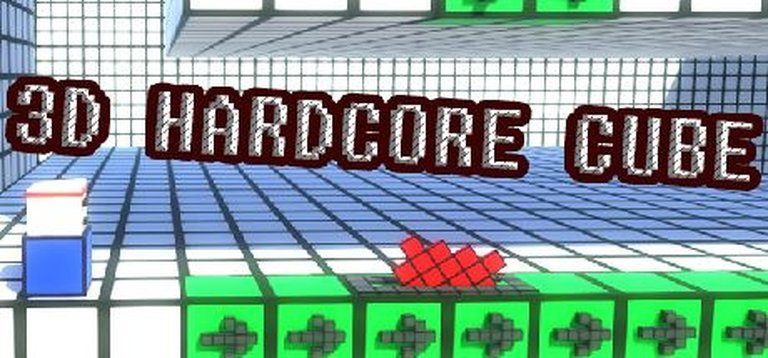
3D Hardcore Cube is a challenging platformer developed by Laush Studio, released in August 2017 for Windows. Players control a cube character navigating perilous levels filled with traps, boosters, falling obstacles, and turrets while attempting to reach portals without succumbing to hazards. Featuring a side-view perspective and direct control interface, the game tests reflexes with 1596 achievements to unlock, complemented by graphics and a designed soundtrack.
Gameplay Videos
Where to Buy 3D Hardcore Cube
PC
3D Hardcore Cube Cracks & Fixes
3D Hardcore Cube Guides & Walkthroughs
3D Hardcore Cube: Review
Introduction
In the sprawling landscape of indie platformers, few titles manage to embody the spirit of masochistic challenge and raw mechanical purity quite like 3D Hardcore Cube. Released on August 22, 2017, by solo developer Laush Dmitriy Sergeevich under Laush Studio, this unassuming 3D platformer has carved out a niche as a cult classic of frustration and perseverance. Its legacy lies not in polished narratives or cutting-edge graphics, but in its uncompromising difficulty and audacious design choices—a testament to a creator willing to prioritize player endurance over accessibility. This review posits that 3D Hardcore Cube is a fascinating artifact of the 2010s indie boom, a game defined by its technical flaws yet elevated by its singular vision, leaving an indelible mark on the “hardcore” platforming subgenre despite its polarizing reception.
Development History & Context
3D Hardcore Cube emerged from the workshop of Laush Dmitriy Sergeevich, a solo developer operating under Laush Studio, a venture with no prior notable releases. The game’s creation was heavily constrained by its reliance on Unity—a engine known for accessibility but criticized for performance issues in low-budget projects. Released during the peak of the “hardcore” indie wave alongside titles like Super Meat Boy and Celeste, 3D Hardcore Cube positioned itself as a purveyor of punishing difficulty, yet it lacked the polish or innovative design of its peers. The developer’s vision, articulated in the Steam ad blurb, was unapologetically focused on mechanical cruelty: “this is not an easy platformer in which you want to get to the portal and not to fall into the trap.” This ethos was executed with minimal resources, resulting in a game that felt less like a finished product and more like a self-imposed challenge for its creator.
Technologically, the game struggled with fundamental limitations. Its system requirements were deceptively low (Windows XP+, Athlon 2 X3 450 CPU, GeForce EN9600 GT GPU), but performance was marred by Unity’s notorious physics engine, leading to buggy collision detection and erratic camera behavior. The 2017 gaming landscape—dominated by AAA blockbusters and polished indie darlings—left little room for a title with such niche appeal. 3D Hardcore Cube was a product of its time: a solo passion project leveraging accessible tools to deliver a raw, unfiltered experience, for better or worse.
Narrative & Thematic Deep Dive
3D Hardcore Cube eschews traditional narrative in favor of pure gameplay abstraction. The player assumes control of a geometric cube navigating abstract, trap-laden environments toward a portal. There are no named characters, dialogue, or explicit plot—a deliberate choice that shifts focus entirely to the player’s struggle. Thematically, the game embodies a minimalist philosophy of existential perseverance. The cube, a blank slate in a hostile world, becomes a metaphor for overcoming insurmountable odds through repetition and adaptation.
Levels are devoid of context, yet their design reinforces themes of entropy and control. Falling cubes, turrets, and anti-bounce pads create a chaotic ecosystem where mastery requires mastering chaos. The lack of narrative framing forces players to project their own narratives of failure and triumph onto the experience. This stark approach aligns with the “hardcore” ethos: narrative is superfluous when the core challenge is survival. However, this minimalism also limits emotional resonance, reducing the game to a series of mechanical trials rather than a cohesive journey.
Gameplay Mechanics & Systems
At its core, 3D Hardcore Cube is a side-scrolling platformer with a focus on precision and timing. The player moves a cube using arrow keys and space for jumping, with direct control mechanics. The gameplay loop is simple: traverse 12 increasingly difficult levels, avoiding traps to reach the portal. However, this simplicity masks a host of innovative yet flawed systems.
- Obstacle Design: The game introduces diverse mechanics like boosters (propelling the cube forward), bounce pads (vertical momentum), anti-bounce pads (nullifying jumps), falling cubes (environmental hazards), and turrets (projectile-based threats). These elements create layered puzzles, but their execution is often inconsistent. For instance, falling cubes may trigger early due to minor collisions, leading to unfair deaths.
- Combat: While not a traditional combat game, turrets and traps function as enemies, requiring evasion rather than engagement. This reinforces the game’s focus on survival over confrontation.
- Character Progression: Progress is linear, with no skill trees or upgrades. The sole “progression” comes from mastering levels, though the game compensates with 1596 achievements—a staggering number that includes letter/shape-based emotes and even Cyrillic characters. These serve as digital trophies but feel excessive, with many unlocking passively and cluttering Steam profiles.
- UI & Controls: The interface is minimalistic, yet plagued by bugs. Players report getting “stuck to walls” during jumps, erratic camera angles that obscure platforms, and falling blocks causing “unnecessary deaths.” As one reviewer noted: “You get stuck to walls when jumping, the camera is sickening and you get stuck when running on falling blocks.” These issues undermine the core platforming loop, turning skill-based challenges into tests of patience.
The game’s difficulty is its defining feature, but it often leans into artificial inflation through trial-and-error mechanics. Levels like 11 and 12 require pixel-perfect timing, exacerbated by unreliable physics. This creates a love-hate dynamic: players driven by the “hardcore” label are rewarded with a sense of accomplishment, while casual players are repelled by frustration.
World-Building, Art & Sound
3D Hardcore Cube’s world is a sterile, geometric abstraction. Environments consist of minimalist platforms, monolithic walls, and vibrant hazard zones (e.g., red turrets, yellow bounce pads). The art direction prioritizes clarity over spectacle, using flat colors and simple shapes to ensure visibility—a practical choice given the game’s fast-paced, trap-heavy design. This aesthetic aligns with the “cube” protagonist, creating a cohesive visual language of industrial austerity.
Sound design, however, is a mixed bag. The Steam store description promises a “nice soundtrack,” but in-game music is limited to looping electronic tracks that, while pleasant, quickly become repetitive. Sound effects (e.g., jumps, deaths) are functional but unremarkable. The lack of auditory depth reinforces the game’s focus on mechanical challenge over immersion.
Atmosphere is derived from tension rather than narrative. The constant threat of falling cubes, turrets, and bottomless pits creates a palpable sense of dread. Yet, the sterile visuals and repetitive soundscape prevent this tension from evolving into a cohesive mood. The game’s world feels like a testing ground for mechanics rather than a lived space, a choice that limits its emotional impact.
Reception & Legacy
3D Hardcore Cube’s reception was polarized, mirroring its gameplay. On Steam, it holds a “Mixed” score (53% positive from 154 reviews), with critiques centering on its technical flaws and short length. Players like “Ascaard” lamented: “Camera, controls, graphics, gameplay… The game, in general,” while “Ninteida” praised its “increase difficulties” and “user-friendly interface.” The game’s most controversial feature—its 1596 achievements—became a double-edged sword. For achievement hunters, it was a goldmine; for others, it felt like an attempt to mask content scarcity.
Commercially, the game found modest success, priced at $2.99, and spawned sequels (3D Hardcore Cube 2, 2017) and spiritual successors (Hardcore Maze Cube, 2020). Its legacy lies in its influence on the “hardcore” platforming niche. While it lacks the polish of titles like Getting Over It with Bennett Foddy, it demonstrated that a punishing game could thrive on Steam if paired with a strong hook (e.g., achievements). Critically, it remains a footnote—Metacritic lists no professional reviews—but its community-driven lore (e.g., guides for unlocking achievements) underscores its cult status.
Conclusion
3D Hardcore Cube is a paradox: a technically flawed, frustratingly difficult game that nonetheless commands respect for its unfiltered ambition. As a product of solo development, it captures the spirit of the indie scene—raw, unpolished, and driven by passion over polish. Its minimalist design and punishing mechanics create a unique, albeit polarizing, experience that resonates with a specific audience of masochistic platformers. While its physics bugs, camera issues, and achievement spam prevent it from being a timeless classic, it remains a fascinating artifact of 2010s gaming—a testament to the idea that sometimes, the most memorable games are those that challenge players to endure. For historians, it’s a snapshot of solo developer ambition; for players, it’s a 19-minute test of willpower. Ultimately, 3D Hardcore Cube earns its place in video game history not as a masterpiece, but as a brave, flawed, and unforgettable experiment in controlled chaos.