
- Release Year: 2001
- Platforms: Windows
- Publisher: XDGames
- Developer: XDGames
- Genre: Puzzle
- Perspective: 1st-person
- Game Mode: Single-player
- Gameplay: Tile matching, Turn-based
- Average Score: 40/100
Description
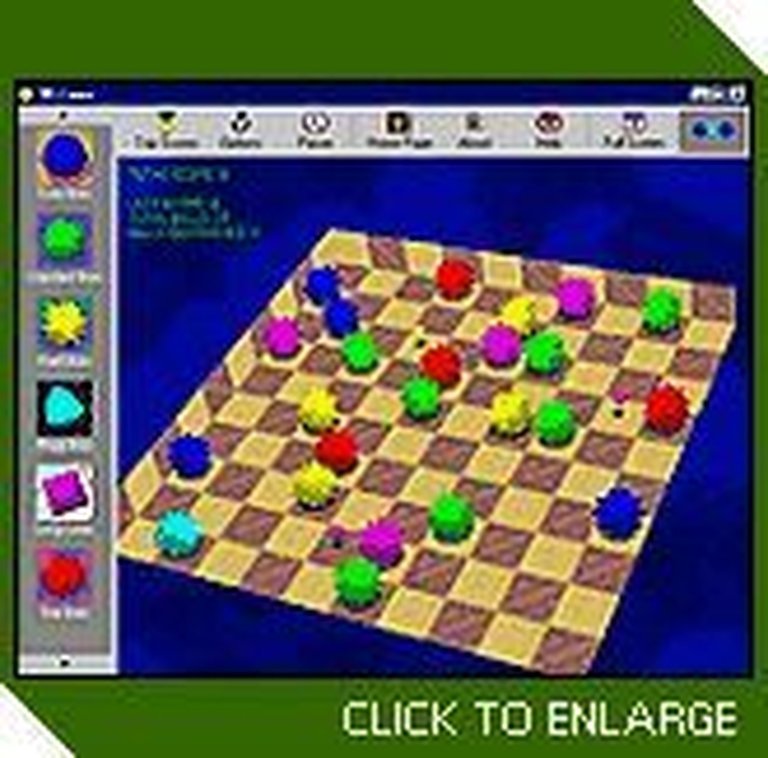
3D Lines is a single-player, turn-based tile-matching puzzle game for Windows, serving as a 3D rendition of the classic Color Lines, where players move one colored object per turn on an isometric grid, prompting three new random objects to appear, with the goal of aligning four or more matching colors horizontally, vertically, or diagonally to clear lines and score points until the board fills completely with no moves left.
3D Lines: Review
Introduction
In the sprawling digital arcade of early 2000s PC gaming, where blockbusters like Half-Life and The Sims dominated headlines, humble shareware titles quietly carved out niches for casual players seeking bite-sized addiction. 3D Lines, released on June 14, 2001, by the obscure Russian developer XDGames, stands as a testament to this era’s unsung heroes: minimalist puzzle games that prioritized pure mechanical elegance over bombast. A faithful 3D reinterpretation of the 1992 Russian classic Color Lines, it distills the essence of tile-matching into an isometric grid battle against encroaching chaos. This review argues that 3D Lines endures not as a revolutionary masterpiece, but as a polished artifact of shareware ingenuity—addictively replayable, technically adept for its time, and a bridge between 2D puzzle roots and emerging 3D casual gaming, deserving rediscovery in an age of endless mobile match-3 clones.
Development History & Context
XDGames, a diminutive studio helmed by programmers Alexander Shelemekhov and Vladimir Noskov, operated in the shadow of Moscow’s burgeoning tech scene during the post-Soviet PC boom. Both credited authors had prior collaborations on similarly themed shareware puzzles like Ball Breaker 3D, 3D Blocks, and Absolute Memory, revealing a niche focus on 3D-ified casual games. 3D Lines emerged from this modest portfolio as a direct evolution of Color Lines (aka Lines), a 1992 DOS hit by Gamos Ltd. that popularized the “match colored balls to clear lines” mechanic, spawning dozens of variants across platforms.
The early 2000s PC landscape was defined by technological democratization: Windows XP’s stability, affordable 3D accelerators like NVIDIA’s GeForce 2, and broadband’s rise fueled shareware distribution via sites like Download.com. Yet constraints abounded—consumer hardware varied wildly, demanding lightweight engines. XDGames’ vision was pragmatic: render Color Lines‘ addictive loop in pseudo-3D isometric perspective using fixed/flip-screen visuals, accessible via keyboard or mouse. No sprawling budgets or teams; just two developers leveraging DirectX for smooth rotation and modest effects. This mirrored the shareware model’s ethos—10-day full trials to hook users before nag screens prompted $10-20 unlocks—amid a market flooded with Tetris-likes (Tetris Attack, Dr. Mario) and emerging match-3 pioneers (Bejeweled, 2001). 3D Lines arrived as casual gaming’s underground pulse, prefiguring browser and mobile puzzles while dodging the AAA 3D arms race of Max Payne or Grand Theft Auto III.
Narrative & Thematic Deep Dive
3D Lines eschews traditional narrative entirely, embodying the abstract purity of pure-puzzle design—a deliberate choice reflecting its Color Lines lineage and the era’s text-adventure-free casual ethos. There are no protagonists, no lore-laden codex, no branching dialogues; instead, a silent 1st-person isometric void confronts players with an ever-filling grid. This minimalist “plot” unfolds turn-by-turn: move one colored sphere, spawn three more, form lines of four-plus identical hues (horizontal, vertical, diagonal), watch them vanish for points, repeat until gridlock.
Thematically, it explores order from chaos—a primal puzzle motif echoing Aristotle’s Poetics (arranging incidents into cathartic resolution) but stripped to geometry. Spheres multiply like unchecked entropy, demanding strategic foresight; each clear evokes triumphant alchemy, transmuting clutter into score. Subtle psychological layers emerge: frustration mounts as “bad” spawns block paths, mirroring real-world planning under uncertainty. Variants like “Easy Lines” (6×6 grid) teach patience, while “Hard Lines” (10×10) or “Speed Lines” punish hesitation, thematizing progression from novice to master. Absent overt characters, the player embodies an unseen curator, imposing will on randomness—a proto-existentialism akin to Tetris‘ falling blocks as life’s inexorable pile-up. In narrative design terms (per modern frameworks like plot/character/lore “Holy Trinity”), 3D Lines prioritizes emergent plot via player agency, forgoing scripted beats for infinite procedural “stories” of high-score chases. This anti-narrative boldness prefigures roguelikes and match-3s (Candy Crush), where theme resides in mechanical poetry, not exposition.
Gameplay Mechanics & Systems
At its core, 3D Lines refines Color Lines‘ loop into a taut, turn-based symphony of prediction and precision. The board—a scalable grid (6×6 to 10×10)—starts sparse; players select and drag one sphere to an empty cell per turn, triggering three random multicolored spawns (typically 5-7 hues). Clearing lines (4+ matching spheres) yields cascading chains, scoring exponentially (e.g., 4-sphere line: base points + bonuses for length/multiples). Game over hits when no moves remain amid a clogged board—often after 20-50 turns, demanding 10-30 minute sessions.
Innovative Systems:
– Nine Variants: “Easy/Hard Lines” scale grid size/difficulty; “Long Lines” requires 5+ matches; “Start Lines” begins fuller; “Speed Lines” adds timers. This modularity extends replayability, tailoring challenge like Tetris‘ modes.
– Progression & UI: No levels/exp, but high-score tables (local) track mastery. Clean isometric view rotates via mouse/keyboard; intuitive drag-select shines on era hardware. Boss key (hide window) nods to office warriors.
– Flaws & Strengths: Predictability falters late-game (RNG spawns frustrate purists); no multiplayer/achievements limits depth. Yet, chain-planning depth rivals Columns—sacrifice short-term for setups, balancing greed vs. survival.
Input fluidity (mouse/keyboard parity) and shareware unlock (post-10 days) ensure accessibility. Compared to contemporaries, it innovates visually (3D spheres pop vs. 2D dots) without bloat, yielding “just one more turn” compulsion.
| Variant | Grid Size | Key Twist | Difficulty |
|---|---|---|---|
| Easy Lines | 6×6 | Standard | Beginner |
| Hard Lines | 10×10 | Larger board | Expert |
| Long Lines | Varies | 5+ matches req. | Strategic |
| Speed Lines | Varies | Timed turns | Frenetic |
World-Building, Art & Sound
No expansive lore-world here; the “setting” is an abstract, infinite grid-chamber viewed in 1st-person isometric, evoking a cosmic puzzle arena. Fixed/flip-screen limits exploration to strategic viewport pans, fostering claustrophobic tension as spheres encroach—brilliant environmental storytelling via negative space.
Visuals: Modest 3D models (shiny spheres, subtle glows/shadows) leverage early DirectX for depth without taxing 500MHz Pentium IIs. Isometric tilt adds faux-perspective flair over flat Color Lines, with smooth animations on clears (pop/fade). Palette pops (vibrant primaries/secondaries); grid scales dynamically. Art direction: clean functionalism, prioritizing readability—legible even at 800×600.
Sound: Sparse but effective—plinks for moves, satisfying whooshes/crisps for clears, ambient electronica loops (non-intrusive). SFX reinforce feedback loops (chains crescendo), enhancing tactile joy sans voice/modern OST bombast. Collectively, elements craft meditative immersion: visuals hypnotize, audio punctuates, birthing “flow state” euphoria amid escalating dread.
Reception & Legacy
Launch reception? Nonexistent—MobyGames lists zero critic/player reviews, no MobyScore; collected by just two archivalists. Shareware obscurity doomed visibility amid 2001’s GTA III hype and post-dotcom indie flood. MyAbandonware rates it 2/5 (one vote), praising tinkering viability but noting dated feel. Commercially, modest: trial hooked offices/home users; unlocks sustained XDGames’ micro-catalog.
Legacy endures subterranean: as “Color Lines variant” (grouping Lines, Impossible Lines, etc.), it exemplifies 2000s shareware puzzles bridging Soviet math-games (Welltris) to mobile (Two Dots). Influenced casual 3D (Zuma, 2003); Noskov/Shelemekhov’s oeuvre hints at Eastern Europe’s puzzle prowess. In historiography (cf. Kent’s Ultimate History), it spotlights shareware’s role in democratizing gaming pre-Steam/App Store. Rediscover via abandonware: a time capsule of pre-mobile addiction.
Conclusion
3D Lines is no Portal—its charms lie in unadorned perfection: addictive mechanics, variant depth, and era-appropriate polish from a two-man team. Amid narrative-heavy modern discourse (The Last of Us), it reminds us puzzles thrive on emergent tales, not scripts. Flaws (RNG variance, brevity) pale against timeless compulsion; in video game history, it claims a quiet pedestal as shareware pinnacle—essential for puzzle historians, nostalgic for Y2K PC vets. Verdict: 8/10—Replay on a virtual XP machine; its grid awaits.