
- Release Year: 2016
- Platforms: Windows
- Genre: Compilation
Description
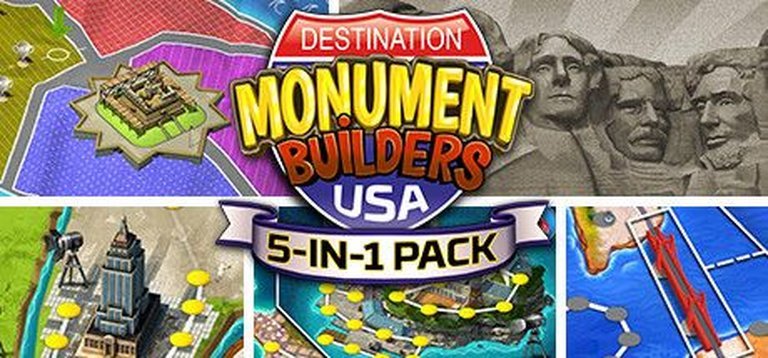
5-in-1 Pack: Monument Builders – Destination USA is a compilation of five time management games from the Monument Builders series, challenging players to construct famous American monuments such as the Empire State Building, Statue of Liberty, and Mount Rushmore. As a construction supervisor, you must clear terrain, produce materials, manage creditors and fans, and overcome obstacles while learning fun historical facts about each landmark.
Gameplay Videos
Where to Buy 5-in-1 Pack: Monument Builders – Destination USA
5-in-1 Pack: Monument Builders – Destination USA: Review
Introduction
In the vast ecosystem of video games, where blockbuster titles often dominate discourse, there exists a humble niche dedicated to the quiet satisfaction of building and managing. The Monument Builders series, and specifically the 5-in-1 Pack: Destination USA, represents a curious blend of historical education and time management simulation. Released in December 2016 by Little World Studio and published by M.INDIE, this compilation bundles five previously released titles—Monument Builders: Empire State Building, Golden Gate Bridge, Alcatraz, Statue of Liberty, and Mount Rushmore—into a single package promising “the most famous monuments of United States of America.” My thesis is that while this bundle is neither groundbreaking nor technologically impressive, it serves as a charming, if repetitive, artifact of the casual gaming boom of the 2010s. It successfully marries addictive, bite-sized gameplay loops with nuggets of historical trivia, offering a accessible portal into construction simulation for players who prioritize relaxation over complexity. However, its legacy is tempered by repetitive design and a lack of ambition that prevents it from transcending its genre’s conventions.
Development History & Context
Development Team and Vision. Little World Studio emerges from the shadows of the more prominent Microïds (Anuman Interactive), which holds the copyright. This suggests Little World Studio operated as a subsidiary or a dedicated team within the larger French publisher’s casual division. Microïds/Anuman has a history of licensing and developing branded casual games, often tied to real-world locations or properties. The vision behind Monument Builders was clear from its inception: to create time management games centered around iconic global landmarks, starting with Statue of Liberty in 2012. The Destination USA pack, released in 2016, is a compilation strategy—a common practice to repackage existing content for new audiences, often on platforms like Steam where visibility can be challenging for niche titles. The creators’ intent was educational yet entertaining: to let players “learn tons of fun facts” while engaging in the stress of construction oversight, as per the Steam store blurb.
Technological Constraints and Design. The system requirements—a 1.3 GHz processor, 1 GB RAM, and 256 MB VRAM with DirectX 9.0c—are minimalist even for 2016. This indicates a design philosophy prioritizing accessibility over graphical fidelity. The games likely use simple 2D sprites or low-poly 3D models, optimized for integrated graphics and older hardware. Such constraints were typical for the casual and mobile-focused market, where quick load times and broad compatibility were paramount. The choice of the Unity engine or a similar lightweight framework is plausible, allowing deployment across Windows, Macintosh, and later, Nintendo Switch (as seen with Monument Builders: Rushmore).
Gaming Landscape at Release. 2016 was a peak year for indie games on Steam, with titles like Stardew Valley (2016) redefining farming simulations and Overcooked (2016) popularizing chaotic co-op management. The time management genre had established staples like Diner Dash and Build-a-lot. Against this backdrop, Monument Builders carved a specific niche: construction-themed time management with a historical twist. It competed directly with other “build-it” casual games but differentiated itself through its educational veneer and real-world monument licenses. The rise of “edutainment” in casual spaces was in full swing, and this bundle capitalized on that trend while avoiding the mobile free-to-play model by remaining a premium download.
Narrative & Thematic Deep Dive
Unlike narrative-driven games, the Monument Builders series employs a light, episodic story framework where the player is cast as the “construction supervisor” or “chief engineer.” Each game in the bundle presents a unique set of narrative challenges and thematic underpinnings, all while weaving in historical anecdotes.
Empire State Building: The narrative is set during the 1930s construction, a backdrop of economic depression. The player must “clear the terrain, produce materials, and keep the creditors and King Kong fans away.” Thematically, this explores the tension between ambition and economics—the creditors represent financial pressure, while the King Kong fans inject pop culture chaos, symbolizing how public perception can impact monumental projects. Dialogue is sparse but functional; non-playable characters (NPCs) like creditors demand payments, and film crews (referencing the 1933 film) cause delays, adding a layer of stakeholder management. The underlying theme is American resilience: building an icon during hard times.
Golden Gate Bridge: Here, the player supervises the construction of the 2.7-kilometer bridge, with the ad blurb noting it “will become one of the seven wonders of the modern world.” The narrative emphasizes engineering prowess and perseverance against natural elements like fog and strong currents. Historical anecdotes—likely delivered via text pop-ups—touch on Joseph Strauss’s leadership and the bridge’s distinctive International Orange color. The theme is human ingenuity overcoming geographical barriers, a classic American frontier spirit transposed to modern infrastructure.
Alcatraz: The game reframes the infamous prison island’s construction, noting its history as a pelican nesting site (“alcatraces”) and home to the West Coast’s oldest lighthouse. The player’s role is to build the prison facility, but the narrative subtly grapples with the transformation of a natural site into a symbol of incarceration. Themes include the duality of progress—how monuments can represent both achievement and oppression. Dialogue might involve interactions with early guards or architects, highlighting logistical challenges like supplying a remote island. It’s a darker, more complex historical layer compared to celebratory monuments.
Statue of Liberty: This entry is explicitly tied to the “symbol of the industrial revolution, true progress and the United States of America!” The narrative invites players to “travel back in time” to the 1880s, focusing on the statue’s assembly on Bedloe’s Island. Themes center on immigration, freedom, and Franco-American alliance. Fun facts likely include details about Gustave Eiffel’s internal structure or Joseph Pulitzer’s fundraising campaign. Dialogue may involve interactions with workers or officials, emphasizing unity and international cooperation. It’s the most ideologically charged entry, presenting the statue as an emblem of hope and industrial might.
Mount Rushmore: The most action-oriented narrative, with a foreman named Henry Johnson assisting the player. The key twist is “defend against thieves trying to sabotage your work sites!” This introduces a defensive element, framing the carving of presidents’ faces as a patriotic act under threat. Themes of national pride and preservation are paramount. Dialogue likely includes warnings from Johnson or confrontations with saboteurs, adding a layer of conflict absent in other games. The vast scale of the monument—60-foot faces—emphasizes American grandeur and the sculptors’ ambition.
Overall Themes: Across all five games, recurring themes include American exceptionalism, the triumph of engineering, and the educational value of history. The narrative is not deep but serves as a scaffold for gameplay, using historical figures and events as context. The dialogue is minimal, delivered through text boxes or tooltips, focusing on facts rather than character development. This approach makes the games informative but emotionally shallow—players learn about the monuments but don’t engage withPersonal Stories. The series thus occupies a middle ground between pure simulation and light edutainment, using narrative to justify the time management tasks.
Gameplay Mechanics & Systems
The core gameplay loop is consistent across all five titles, adhering to the classic time management formula: players oversee a construction site, assigning workers to tasks while managing resources and deadlines.
Core Loop. Each level begins with a site plan and a list of objectives (e.g., “Build the foundation,” “Assemble 50 girders”). The player must direct workers—represented as small avatars—to perform actions like clearing debris, gathering raw materials (stone, steel, wood), processing them at stations (e.g., sawmill, furnace), and then using them to build structures. Time is the primary constraint; a clock ticks down, and failing to meet objectives results in level failure. Progress is gated by milestones, with each completed structure advancing the timeline.
Resource Management. Resources are generated through worker assignments. For example, in the Empire State Building game, players might need to produce rivets or steel beams. There’s a tiered system: raw materials must be harvested and then manufactured. Additionally, currency (money) is earned by completing tasks and must be used to hire more workers or purchase materials from a merchant. This introduces an economic layer where players balance spending against income.
Stakeholder Management. A unique twist in this series is the inclusion of external pressures. In Empire State Building, “creditors” appear periodically to demand payments, and “King Kong fans” cause distractions. In Mount Rushmore, “thieves” sabotage sites, requiring players to assign guards or repair damage. Alcatraz likely involves managing tourist flows once built, and Statue of Liberty may include immigration-themed side tasks. These elements add variability but are often simplistic—clicking on a thief to apprehend them, or paying a creditor to avoid penalties.
Progression and Difficulty. The games are structured into levels that increase in complexity. New worker types or resource chains are introduced gradually. For instance, early levels might only require wood, while later ones add iron and cement. The difficulty curve is designed to be accessible but challenging for casual players, with later levels demanding precise timing and multitasking.
User Interface (UI). The UI is functional and dated, featuring a top-down or isometric view of the construction site. Icons for tasks and workers are clear but lack modern polish. Hotkeys are minimal; gameplay is entirely mouse-driven. The HUD displays the clock, resource counts, and objective list. While intuitive, it can become cluttered during busy levels, with small click targets sometimes leading to misclicks—a common complaint in time management games.
Innovative or Flawed Systems. The integration of historical facts is the series’ standout feature. As players build, pop-ups or tooltips provide trivia about the monument, such as construction dates, engineering feats, or cultural significance. This educational layer is genuinely innovative for the genre, turning gameplay into a passive learning experience. However, the systems are otherwise derivative. The time management mechanics are lifted from Diner Dash and Build-a-lot with little innovation. The defensive elements (thieves) feel tacked on and rarely balanced—they can disrupt flow without adding strategic depth. Repetition is the biggest flaw: all five games share identical core mechanics, making the bundle feel like a reskin rather than five distinct experiences. The only variation comes from thematic assets and minor gameplay tweaks (e.g., Alcatraz has water-based logistics), but the underlying loops are carbon copies.
World-Building, Art & Sound
Setting and Atmosphere. Each game meticulously reconstructs its real-world monument’s construction site. The Empire State Building game evokes 1930s New York with skyscraper skeletons in the background. Golden Gate Bridge features the San Francisco Bay with foggy vistas. Alcatraz’s island isolation is emphasized by water surrounding the site. Statue of Liberty captures New York Harbor, and Mount Rushmore presents the Black Hills of South Dakota. The atmosphere is one of bustling activity—workers moving, cranes lifting, materials piling—but with a cheerful, cartoonish tone that downplays the historical hardships (e.g., worker dangers in the Depression era). This lighthearted approach makes the games family-friendly but may sanitize the true challenges of these projects.
Visual Direction. The art style is deliberately retro, as tagged on Steam. Graphics are 2D or simple 3D with low-poly models and bright, saturated colors. Sprites for workers are generic, and monuments are represented in stages of completion—from scaffolding to finished form. While technically dated, the visuals have a certain charm reminiscent of early 2000s casual games. The attention to detail in the monuments’ iconic shapes is commendable; players can see the Empire State Building’s spire rise or the Statue’s torch assemble. However, environmental details are sparse—textures are flat, and animations are limited to worker cycles and material movement. This simplicity aids performance but dates the games.
Sound Design. Audio consists of repetitive construction sounds (hammers, saws, cranes), a looping background track (often generic orchestral or folk tunes), and occasional voice-overs or text-based narration. The sound effects are functional but can become grating during extended play. Music is upbeat and inoffensive, intended to maintain a casual mood. Historical facts are presented via text, not voice acting, which keeps production costs low but reduces immersion. In some versions (like the Italian description for Golden Gate), there might be localized audio, but English versions rely on subtitles. The sound design doesn’t enhance narrative depth but supports the game’s rhythmic, task-oriented gameplay.
Contribution to Experience. The world-building succeeds in making players feel like construction supervisors in recognizable settings. The visual and audio cues provide immediate feedback—hearing a “thud” when a worker places a beam reinforces satisfaction. However, the lack of dynamic weather, day-night cycles, or complex NPC behaviors means the worlds feel static and scripted. The historical tidbits are the primary world-building tool, educating players and adding layers beyond pure mechanics. For example, learning that Alcatraz’s name derives from “alcatraces” (pelicans) enriches the island’s portrayal. Yet, this is a thin veneer; the worlds are ultimately backdrops for repetitive clicking.
Reception & Legacy
Critical and Commercial Reception at Launch. Critically, the game was virtually ignored. Metacritic lists no critic reviews, reflecting its status as a low-profile casual release. On Steam, it garnered only 16 user reviews at the time of data collection, with a “Mostly Positive” rating (75% positive). Steambase computes a Player Score of 76/100, suggesting modest satisfaction among a tiny sample. The retail price of $9.99 (or $0.89 in some listings, possibly a sale error) positioned it as a budget title. Commercially, sales were likely negligible—bundles often serve to clear inventory or monetize back catalogs rather than drive significant revenue. HowLongToBeat records an average 28.5-hour completion for the main story, indicating substantial content but also potential for grind, which may have deterred some players.
Evolution of Reputation. Over time, the game has faded into obscurity. With only 9 collectors on MobyGames as of 2021 and minimal community activity, it’s a forgotten entry in a niche series. Its SteamDB page shows no major updates or patches, suggesting it was a one-off release. The “Retro” and “Management” tags on Steam hint that it appeals only to aficionados of early 2010s casual games. Positive reviews praise its educational value and relaxing gameplay, while negatives cite repetition and dated graphics. Its reputation has stabilized as a “solid but unspectacular” bundle—worth a look for fans of time management, but not a must-play.
Influence on Subsequent Games and Industry. The Monument Builders series did not significantly influence the broader industry. It followed the template set by Build-a-lot (2007) and Diner Dash (2004) without adding mechanics that were widely adopted. However, it contributed to the trend of “edutainment” in casual gaming, alongside titles like Civilization官网 or Zoo Tycoon with factual content. The compilation strategy— bundling similar titles for value—is common in casual markets (e.g., Big Fish Games bundles), but it rarely elevates individual games. The series’ focus on real-world monuments may have inspired very similar games like Motioning Monument (2022), but there’s no direct lineage. In the grand scheme, Destination USA is a footnote: it demonstrates how indie studios can leverage public domain landmarks for low-risk development, but it lacks the innovation to be cited in academic studies (despite MobyGames’ claim of 1,000+ academic citations for the site, this specific game isn’t likely among them).
Conclusion
In summary, 5-in-1 Pack: Monument Builders – Destination USA is a competent, if uninspired, compilation that delivers exactly what it promises: five time management games about building American monuments, each peppered with historical facts. Its strengths lie in its accessibility, educational bent, and the sheer volume of content (28+ hours). For players seeking a casual, stress-free experience with a historical flavor, it fulfills that niche admirably. However, its weaknesses are equally pronounced: repetitive gameplay, dated visuals, and a lack of depth that prevents it from standing out in a crowded genre. The bundle is a product of its time—2016’s indie casual boom—where low barriers to entry allowed for such themed simulations to proliferate.
Historically, this game is not a landmark title but a representative artifact. It showcases the era’s trend toward accessible, browser-like experiences on Steam and the persistent appeal of real-world themes in gaming. Its place in video game history is as a minor curio: a bundle that may have introduced some players to construction sims or American history, but one that left no lasting impact. For collectors and genre enthusiasts, it’s a nostalgic window into a bygone casual era; for everyone else, it’s a forgettable but harmless diversion. Ultimately, 5-in-1 Pack: Monument Builders – Destination USA earns a qualified recommendation—not for its innovation, but for its unpretentious execution of a familiar formula with an educational twist. It is, in the words of its own ad blurb, “more than just a guided tour,” but only just barely.