
- Release Year: 2000
- Platforms: Windows
- Publisher: Atomax Ltd.
- Developer: Atomax Ltd.
- Genre: Puzzle, Strategy, Tactics
- Perspective: 1st-person
- Game Mode: LAN, Online Co-op, Single-player
- Gameplay: Color matching, Turn-based
- Average Score: 95/100
Description
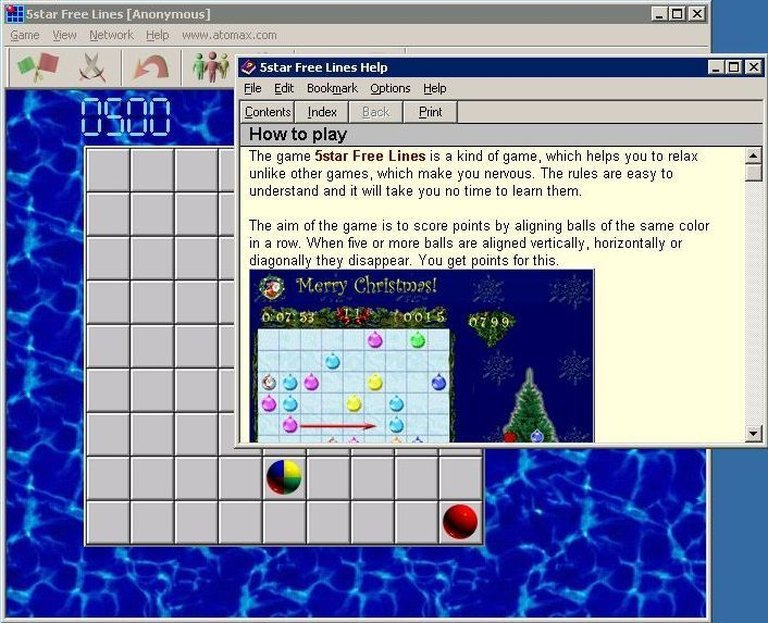
5star Free Lines is a Windows-based, turn-based puzzle game where players move colored objects on a board to form lines of five or more matching colors, with each move triggering new random objects to appear. The objective is to strategically arrange objects vertically, horizontally, or diagonally to clear lines and score points, offering features like Christmas-themed modes, difficulty levels, multiplayer options, and downloadable skins.
5star Free Lines Free Download
5star Free Lines Reviews & Reception
myabandonware.com (95/100): an above-average turn-based title in its time.
archive.org : attractive mind game that will keep you busy for a long time without getting tired or nervous.
5star Free Lines: A Microcosm of Pure Puzzle Perfection in the Millennium’s Dawn
Introduction
In the sprawling digital landscape of 2000, amidst the burgeoning complexity of 3D graphics and emergent online worlds, Atomax Ltd. released a game of deceptive simplicity: 5star Free Lines. This freeware Windows title, a masterclass in distilled puzzle design, represents a fascinating historical artifact – a product of its time yet timeless in its appeal. It eschews narrative spectacle and technological bravado, instead offering a pure, strategic experience centered on elegant, color-matching mechanics. This review argues that 5star Free Lines, despite its humble origins and obscurity in mainstream critical discourse, stands as a remarkably well-crafted exemplar of the abstract puzzle genre. Its enduring presence on abandonware archives and its direct lineage to later popular games like Lines and Piczle Lines underscore its significance as a foundational piece of digital strategy, a testament to the enduring power of elegant rulesets and accessible, deep gameplay.
Development History & Context
5star Free Lines emerged from Atomax Ltd., a developer whose focus seems to have been squarely on accessible, shareware/freeware puzzle titles for the burgeoning Windows PC market. The core development team was remarkably small, credited to just two individuals, highlighting the nature of freeware development in that era – often a labor of passion or a niche business model rather than a blockbuster enterprise. The game was distributed freely, a choice that significantly broadened its potential audience and contributed to its longevity, even as the company and its specific titles faded from active commercial promotion.
The technological context of 2000 is crucial. Windows 98 and Windows Me dominated the home PC landscape. While powerful 3D acceleration cards were becoming common and complex engines were being developed for FPS and RTS games, 5star Free Lines deliberately chose a minimalist path. It utilized the Windows GUI effectively, employing a mouse-driven interface (“Direct control”) and a “Fixed / flip-screen” perspective. This wasn’t a limitation born of technical incapacity but a deliberate aesthetic and functional choice. By avoiding the demands of 3D rendering and complex animation, Atomax ensured the game ran smoothly on a vast range of contemporary hardware, from entry-level machines to more powerful systems. The development focus was entirely on the core gameplay loop and user experience within the constraints of the Windows OS environment. This aligns with the broader puzzle game trend of the late 90s and early 2000s, where titles like Alhademic Lines (1999), Microsoft Freecell (2001), and the enduring Tetris variants thrived on accessibility and intellectual challenge rather than graphical fidelity. Atomax’s vision was clear: deliver a compelling, free, and easily distributable mind game.
Narrative & Thematic Deep Dive
5star Free Lines presents a fascinating case study in narrative minimalism, possessing no traditional plot, characters, or dialogue. There are no quests, no protagonists, no antagonists, and no overarching story. This absence is not a flaw but a deliberate design choice central to the game’s identity as an abstract strategy experience. The “narrative” is entirely emergent, created by the player’s interaction with the game’s systems and the ever-changing board state.
The core themes, therefore, are conveyed purely through gameplay mechanics and the player’s internal monologue. The primary theme is Order vs. Chaos. The player’s goal is to impose order – creating deliberate lines of five or more identical colored balls. However, every move disrupts the existing order by introducing new balls of random colors and positions. This constant tension is the engine of the game: strategic planning (order) is perpetually challenged by the randomness of new elements (chaos). Each successful line formation is a temporary triumph of order, clearing the board and awarding points, only for the next move to introduce new entropy.
Another profound theme is Strategic Constraint and Proactive Planning. The game’s turn-based nature (“Pacing: Turn-based”) forces the player to think ahead. Moving a single ball is not just about the immediate placement; it’s about anticipating where the new balls will appear and how their colors will impact future moves. This fosters a mindset of risk assessment and contingency planning. The player is never just reacting; they are constantly trying to shape the board’s future state amidst uncertainty. The inclusion of difficulty settings (“Beginner & Master”) and the optional time limit further modulates this theme, adding layers of pressure and demanding deeper strategic foresight. Even the “Christmas mode,” while thematically festive, operates on the same core principles of order imposed amidst seasonal chaos.
The lack of narrative elements reinforces the game’s purity as a test of logic and spatial reasoning. It strips away any thematic distractions, focusing the player entirely on the abstract challenge of manipulating space and color under specific constraints. This minimalist approach makes the game infinitely replayable, as the “story” of each game is unique to the player’s choices and the random sequence of ball appearances.
Gameplay Mechanics & Systems
5star Free Lines is built upon a deceptively simple yet endlessly engaging core loop:
- The Board & Objects: The player interacts with a grid-based board (typically 9×9, though this isn’t explicitly stated but implied by the genre standard). The objects are multi-colored balls, the visual representation of which could be customized via skins.
- The Move: Each turn, the player uses the mouse to select one ball and move it to an adjacent empty cell (up, down, left, or right – not diagonally for the move itself, though diagonal lines count for scoring).
- The Consequence: Crucially, every move, regardless of its strategic merit, causes three new balls of random colors to appear on random empty cells. This is the game’s central risk/reward mechanism.
- The Objective: The goal is to manipulate the balls to form horizontal, vertical, or diagonal lines of five or more balls of the same color. As soon as such a line is completed, it disappears, and the player scores points. The points earned are often tied to the length of the line and possibly the number of balls cleared simultaneously.
- The Failure State: The game ends when a player makes a move that leaves no empty cells for the new balls to appear, causing the board to fill completely and the game to lock up.
This core loop creates profound strategic depth:
* Spatial Awareness & Planning: Players must constantly visualize potential lines and plan moves that set up future combinations, often multiple moves ahead.
* Risk Management: Moving a ball to create a 3-line or 4-line is tempting but risky, as it occupies space and guarantees three new balls that could easily block future moves or create unwanted colors. Moving defensively to clear space or disrupt opponent setups (in multiplayer) is often necessary.
* Color Probability: While random, players must intuitively consider the likelihood of certain colors appearing and position balls to leverage or mitigate this randomness.
Additional Systems & Features:
* Difficulty Levels: “Beginner” likely introduces fewer new balls per move or starts with a more favorable board state, while “Master” increases the challenge (potentially more balls per move, faster time limits, or starting with a less favorable setup). This provides scalability for different skill levels.
* Time Limit: The optional time limit adds urgency, forcing quicker decisions and increasing pressure, transforming the game from pure strategy to a test of speed under pressure.
* High Score Table: A standard feature tracking the top scores, fueling competitive drive. The ability to “publish high scores on-line” was a forward-thinking feature for a freeware game in 2000, leveraging the nascent internet for community competition.
* Network Play (Internet/LAN): Supporting both LAN and internet play for two players was a significant technical achievement for a freeware puzzle game of the era. While specific mechanics (simultaneous turns, turn-based with waiting) aren’t detailed, this feature greatly extended the game’s lifespan and social appeal, allowing direct competition.
* Customization (Skins & Christmas Mode): The ability to download additional skins from the Atomax website allowed players to personalize the visual experience. The “Christmas mode” was a thematic overhaul, changing the background, tile set, and music, adding seasonal flavor without altering core mechanics. This demonstrates Atomax’s commitment to player engagement post-release.
* Business Model: Its status as “Freeware / Free-to-play / Public Domain” was key to its dissemination and preservation. It wasn’t shareware requiring payment; it was entirely free, removing barriers to entry and fostering a wider player base.
World-Building, Art & Sound
5star Free Lines operates within a distinctly abstract “world.” There is no detailed lore, geography, or character backstory. The “world” is the game board itself – a confined space defined by its grid and the colored balls occupying it. Its atmosphere is generated purely by the interplay of these elements and the player’s focus.
Visual Design:
* Aesthetic: The visual style is clean, functional, and colorful. The “Fixed / flip-screen” perspective suggests a static board view, likely with the ability to scroll or flip between sections if the board was larger than the screen, though evidence points to a standard board fitting the window. The core visual elements are the balls and the grid.
* Art Direction: The description “attractive graphics and colors” and the existence of multiple skins indicate a focus on visual clarity and appeal. The default art was likely simple but effective, ensuring color differentiation and easy recognition. The balls are distinct enough to be identifiable at a glance. The grid provides a necessary structure and order to the otherwise chaotic placement.
* Atmosphere: The atmosphere is one of calm focus and mental engagement. The lack of complex visuals removes distractions, allowing the player to concentrate entirely on the spatial and color puzzle. The “Christmas mode” transforms this atmosphere, replacing the standard visuals with festive themes, creating a different mood – perhaps one of cozy holiday puzzling – while maintaining the core challenge. The ability to change skins allowed players to tailor this atmosphere to their preference.
* UI: The interface is described as “Direct control,” implying a simple point-and-click system for selecting and moving balls. This is paramount for accessibility. The presence of menus for selecting difficulty, game mode (with/without time), high scores, and network options would be unobtrusive but functional, fitting the minimalist aesthetic.
Sound Design:
* Audio Elements: Sources mention “nice sound effects and lovely music to your choice.” This implies:
* Sound Effects (SFX): Likely subtle but satisfying sounds for actions: selecting a ball, moving it, the satisfying “pop” or “clear” sound when a line is formed, and perhaps a sound when new balls appear. These SFX provide crucial auditory feedback, reinforcing successful actions and the game’s state.
* Music: The presence of music suggests background tracks that enhance the atmosphere without being intrusive. Different skins, including the Christmas mode, would likely have their own unique musical themes, contributing significantly to the mood. The ability to choose music implies a selection of tracks, possibly ambient or light melodic pieces designed to aid concentration during play and relaxation.
* Role of Sound: The sound design complements the visual and gameplay experience. SFX confirm actions and provide tactile feedback, making interactions feel responsive. Music sets the overall tone, whether it’s the focused ambiance of the default mode, the cheerful festivity of Christmas, or the player’s preferred track from a skin. It contributes significantly to the game’s accessibility and appeal as a relaxing mind game, as stated in the Archive.org description: “perfect for relaxation after a hard working day.”
Reception & Legacy
5star Free Lines occupies a unique niche in the historical record, characterized by a distinct lack of contemporary mainstream critical reviews. Metacritic lists no critic scores or user reviews for the game, and MobyGames shows no aggregated critic reviews. This absence is common for small freeware titles, especially puzzle games, which often flew beneath the radar of major gaming publications focused on AAA releases and console market trends. Player reviews are similarly scarce across the documented sources.
However, its legacy is not defined by launch-day buzz but by its enduring presence and influence:
- Abandonware Presence & Community Recognition: The game is widely available and preserved on major abandonware sites like My Abandonware and the Internet Archive. My Abandonware notes it as an “above-average turn-based title” and awards it a high user rating (4.75/5 based on 4 votes), indicating appreciation from those who discovered or rediscovered it. Its inclusion in compilations like 100 Spel (2001) further attests to its perceived quality and value within the puzzle genre. The Retrolorean review explicitly states it “is still enjoyed by many gamers today” and has “stood the test of time.”
- Genre Influence & Lineage: 5star Free Lines is a clear and direct descendant of the “Color Lines” genre, originating with Color Lines (1992/1994). Its core mechanics – moving balls to form lines of 5+, with random balls added after each move – are the genre’s defining formula. Its legacy is evident in the numerous direct clones and similar games listed in the MobyGames “Related Games” section: Lines Free (2017), Lines (multiple versions), DX Lines (2003), 3D Lines (2001), Honey Lines (1995), Ley Lines (2016), and Lines XL (2020). These titles, spanning decades and platforms (Windows, Xbox, iOS, Switch), demonstrate the enduring appeal and adaptability of the core puzzle concept that 5star Free Lines so effectively implemented in 2000. It served as a polished, accessible, and free example of the formula that continued to evolve.
- Technical Influence (Multiplayer): The inclusion of functional Internet and LAN multiplayer for a freeware game in 2000 was noteworthy. While details are sparse, its presence shows Atomax’s commitment to extending the game’s social appeal beyond single-player solitaire, a feature that became more common later but was less frequent for simple freeware puzzles at the time.
- Defining Freeware Puzzle Design: As a well-regarded freeware title, 5star Free Lines exemplifies a model of game development focused on accessibility, pure gameplay, and community building through free distribution and online features (high score publishing). It represents a significant strand of PC gaming history alongside shareware giants, demonstrating that high-quality, compelling experiences could exist outside the commercial retail box.
While it may not have set sales records or won industry awards, 5star Free Lines secured its legacy through its elegant design, lasting presence in the abandonware ecosystem, and its clear role as a strong contemporary and predecessor within the enduring “Lines” puzzle family. Its reputation among niche puzzle enthusiasts and preservationists is notably positive, reflecting its successful execution of a simple, addictive concept.
Conclusion
5star Free Lines stands as a remarkable achievement in minimalist game design, a gem from the dawn of the new millennium that prioritizes pure, strategic gameplay over fleeting trends or technological spectacle. Released as freeware by Atomax Ltd., it distilled the complex satisfaction of spatial reasoning and probability into an elegantly simple loop: move a ball, face three random consequences, and strive to impose order by forming lines of five. Its development, born from a small team embracing the accessible nature of Windows and the freeware model, resulted in a product that ran smoothly on a vast range of hardware and reached a wide audience precisely because it cost nothing.
The game’s brilliance lies in its thematic purity. Without narrative or characters, it masterfully explores the tension between order and chaos through its mechanics, demanding foresight and risk management from the player every turn. The optional difficulty levels, time pressure, and particularly the innovative network play for a freeware puzzle game in 2000, showcase Atomax’s commitment to depth and player engagement. Its visual and audio design, while functional, successfully supported the core experience, with customizable skins and the thematic Christmas mode adding layers of personalization and seasonal flavor without sacrificing clarity.
Critically overlooked at launch, 5star Free Lines‘ legacy is not measured in sales or awards but in its enduring presence on abandonware archives and its clear lineage to the enduring “Lines” puzzle genre. It proved that a brilliant, addictive concept could thrive on accessibility and free distribution. Its influence is visible in countless subsequent titles that refined the formula it so effectively implemented. For players seeking a timeless test of logic, a relaxing mental challenge, or a piece of accessible PC gaming history, 5star Free Lines remains not just a curiosity, but a masterclass in distilled puzzle design. It holds a definitive, if niche, place in video game history as a pure, strategic experience that continues to engage and satisfy decades after its release.