
- Release Year: 1999
- Platforms: Windows
- Publisher: Encore Software, Inc.
- Genre: Compilation
- Game Mode: Online PVP, Single-player
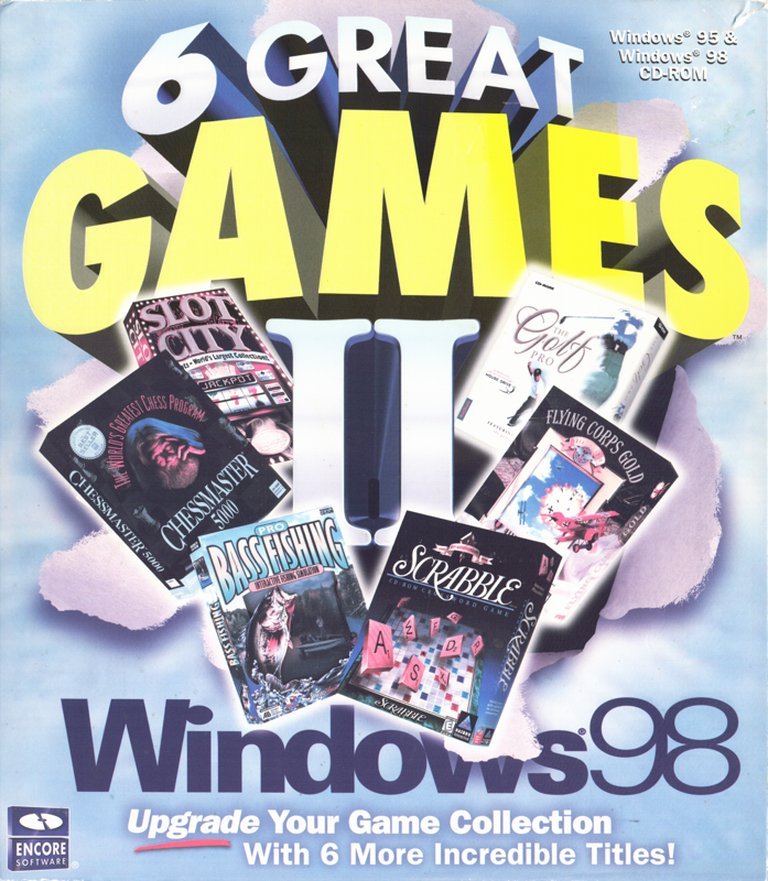
Description
6 Great Games II: Windows 98 is a 1999 compilation released by Encore Software for Windows PCs, bundling full versions of six diverse titles: Scrabble, Chessmaster 5000, Flying Corps Gold, Pro Bass Fishing, The Golf Pro, and Slot City, spanning board games, strategy, flight simulation, fishing, golf, and casino gaming.
6 Great Games II: Windows 98: Review
Introduction
In the neon-glow era of dial-up modems and CRT monitors, when Windows 98 reigned supreme as the gateway to personal computing’s golden age, compilations like 6 Great Games II: Windows 98 emerged as affordable portals to diverse entertainment. Released on October 15, 1999, by Encore Software, Inc., this CD-ROM gem bundles six full-version titles—Scrabble (1996), Chessmaster 5000 (1996), Flying Corps: Gold (1997), Pro Bass Fishing (1998), The Golf Pro (1998), and Slot City (1998)—offering a smorgasbord of strategy, simulation, sports, and casual play. As a professional game journalist and historian, I’ve pored over MobyGames archives, Retro Replay analyses, and preserved CD images from the Internet Archive to resurrect this unassuming treasure. My thesis: 6 Great Games II isn’t just a budget bundle; it’s a meticulously curated snapshot of late-’90s PC gaming’s breadth, democratizing high-quality experiences for families, casual players, and enthusiasts alike, while foreshadowing the compilation model’s enduring role in preserving gaming history.
Development History & Context
Encore Software, Inc., a prolific publisher of educational and entertainment titles in the late 1990s, spearheaded 6 Great Games II as part of the “6 Great Games” compilation series, following predecessors like 6 Great Games: Windows XP Edition (2001) and echoing earlier Windows packs such as Microsoft’s Windows 98 Plus! included games. The vision was straightforward yet ambitious: capitalize on the maturing Windows 98 ecosystem—boasting DirectX support, enhanced Plug and Play, and USB ports—to deliver full retail games at a fraction of the cost, targeting home users upgrading from Windows 95.
Technological constraints defined the era. Windows 98’s 16/32-bit hybrid architecture favored 2D sprites and early 3D via Glide or Direct3D, with Pentium II/III processors and 64-128MB RAM as the sweet spot. Developers like The Learning Company (for Scrabble and Chessmaster), Rowan Software (for Flying Corps), and Avalanche Software (for Pro Bass Fishing) optimized for these limits, prioritizing mouse/keyboard controls and optional internet multiplayer over console-like complexity. The gaming landscape in 1999 was explosive: RTS giants like StarCraft and FPS pioneers like Half-Life dominated, but budget compilations thrived amid economic pressures post-Asian financial crisis, offering value in a market shifting from shareware to CD-ROM retail. Encore’s pack, priced around $20 (per eBay relics), mirrored this trend, bundling titles from 1996-1998 to appeal to families avoiding pricier standalone releases. No individual creator credits are documented on MobyGames, underscoring the anonymous, assembly-line nature of mid-tier PC ports, but the result was a plug-and-play launcher emphasizing seamless genre-hopping on era-appropriate hardware.
Narrative & Thematic Deep Dive
As a compilation devoid of an overarching plot, 6 Great Games II forgoes cinematic storytelling for modular, self-contained experiences, thematically united by escapism and mastery. Each title’s “narrative” emerges through progression systems, historical context, or emergent player agency, reflecting late-’90s PC gaming’s emphasis on simulation over spectacle.
Chessmaster 5000 personifies chess as a ladder of intellectual combat, with AI opponents boasting biographies—e.g., the aggressive “The Crusher” or tactical “The Professor”—framing matches as duels against archetypal minds. Themes of strategy and growth culminate in a “championship” climb, echoing real-world grandmaster lore.
Flying Corps: Gold dives deepest into narrative, embedding World War I aviation history. Briefing screens detail real squadrons (e.g., No. 56 Squadron) and aces like Werner Voss, with missions progressing from reconnaissance to dogfights in a campaign mirroring the Western Front’s arc. Themes of heroism, futility, and technological dawn—biplanes amid trenches—imbue sorties with poignant weight, blending education and adrenaline.
Sports sims like Pro Bass Fishing and The Golf Pro adopt career arcs: in Pro Bass, anglers advance from novice casts to tournament glory, unlocking lures amid serene lakes symbolizing patience’s rewards; The Golf Pro spans courses like Hilton Head National, where birdies build legacies against AI pros, thematizing precision and perseverance. Minimal dialogue— terse tips or score recaps—keeps focus on tactile triumph.
Purer abstractions shine here too. Scrabble weaves social competition through wordplay battles, its dictionary enforcing linguistic purity amid multiplayer taunts, thematizing intellect’s joyride. Slot City‘s casino vignettes lack plot but evoke Vegas glamour via themed machines (e.g., fruit reels, bonus wheels), gambling on fortune’s whims.
Collectively, themes of accessible ambition prevail—no epic sagas, but micro-narratives fostering replayable growth, perfect for Windows 98’s multitasking ethos.
Gameplay Mechanics & Systems
6 Great Games II excels in variety, with a central launcher enabling instant swaps via keyboard/mouse navigation. Core loops span turn-based puzzles to real-time sims, all tuned for solo or internet play, with adjustable difficulties ensuring broad appeal.
Strategy Pillars (Scrabble & Chessmaster 5000): Scrabble‘s loop—draw tiles, form words, maximize scores via multipliers—features AI scaling from beginner blanks to tournament fiends, plus pass-and-play multiplayer. Chessmaster deconstructs the royal game with tutorials, openings books (over 100,000 positions), and personality-driven AI; analysis tools dissect blunders post-game, innovating progression absent in rivals.
Flight Sim Intensity (Flying Corps: Gold): Toggle novice/realistic modes for biplane dogfights. Mechanics include throttle management, banking dives, machine-gun bursts, and bomb drops across 50+ missions. Wingmen AI and dynamic weather add chaos, with customizable cockpits bridging arcade and sim.
Sports Simulations (Pro Bass Fishing & The Golf Pro): Pro Bass demands lure selection (worms, jigs), cast timing, and reeling amid physics-based water currents—schools evade via sonar, rewarding observation. The Golf Pro employs swing meters for power/accuracy, wind-affected trajectories, and modes like stroke play or multiplayer on varied courses; practice ranges hone putts.
Casual Thrill (Slot City): Point-and-click spins on multi-denomination machines trigger bonuses (free spins, pick-a-prize), with accumulating credits fueling endless sessions—randomness tempered by near-miss teases.
UI is era-typical: crisp menus, resizable windows, save states. Flaws? Dated controls (no gamepad primacy) and no unified progression, but innovations like Chessmaster‘s AI depth and Flying Corps‘ historical missions endure. On emulated Windows 98, compatibility shines via DOSBox or PCem.
World-Building, Art & Sound
The compilation’s “worlds” fragment across titles, yet late-’90s visuals—2D polish meets nascent 3D—craft immersive vignettes, amplified by evocative audio.
Scrabble and Chessmaster flaunt 2D elegance: glossy tiles/boards with 3D rotations, customizable skins (marble chess sets), and legible fonts. Soundscapes hum with plinks, whooshes, and victory fanfares, evoking parlor coziness.
Flying Corps: Gold soars with polygonal skies: blocky biplanes weave through cloudy trenches, explosions blooming orange. Engine roars, rat-a-tat gunfire, and propaganda briefings forge WWI grit.
Outdoor sims breathe life: Pro Bass Fishing‘s rippling lakes, foliage-shrouded banks, and splashing strikes pair with lap-steel twangs and reeling zips. The Golf Pro‘s verdant fairways, bunkers, and horizon-spanning vistas glow under Direct3D, accented by club clacks and crowd cheers.
Slot City dazzles with Vegas neon: spinning reels, jackpot symphonies, and coin cascades mimic casino frenzy.
Atmospherically, these elements coalesce into nostalgic escapism—Windows 98’s 640×480 glow evoking family PCs, where sound cards trilled MIDI mastery.
Reception & Legacy
Launch reception was muted; MobyGames logs no critic scores, IGN’s placeholder summary (“addicting game play for folks of all walks”) hints at marketing fluff, and zero player reviews underscore its budget obscurity amid 1999 blockbusters like Quake III. Commercially, eBay relics (big boxes at $18+) and Archive.org preservations suggest modest sales, buoyed by Encore’s distribution but eclipsed by freebies like Windows 98 shippable games.
Reputation evolved via retro communities: Retro Replay lauds its “bang for your buck,” praising enduring AI and sim depth. In broader context, it epitomizes compilation influence—paving for Humble Bundles and Steam sales—while preserving titles like Flying Corps from oblivion. Amid Windows 98 nostalgia (e.g., RAWG lists, Reddit desktops), it symbolizes OS-defining variety, influencing genre bundles and abandonware revivals. Cult status grows among preservationists, its Moby ID (43881) a beacon for historians.
Conclusion
6 Great Games II: Windows 98 distills late-’90s PC gaming’s essence: eclectic, accessible, timeless. From Chessmaster‘s cerebral duels to Slot City‘s serendipitous spins, it delivers unadulterated value, flaws (dated graphics, sparse narrative) paling against mechanical purity. In video game history, it claims a vital niche as a democratization artifact—affordable entry to simulations that shaped casual PC culture. Verdict: Essential retro acquisition (8.5/10). Fire up a virtual Win98 machine; this compilation awaits your checkmate.