
- Release Year: 2006
- Platforms: BREW, iPad, J2ME, Nintendo DS, PlayStation 2, PSP, Windows
- Publisher: MumboJumbo, LLC, Real Networks, Inc., The Codemasters Software Company Limited
- Developer: Hot Lava Games
- Genre: Puzzle
- Perspective: Side view
- Game Mode: Single-player
- Gameplay: Falling block puzzle, Tile matching puzzle
- Setting: Classical antiquity, Egypt (Ancient), Middle East
- Average Score: 63/100
Description
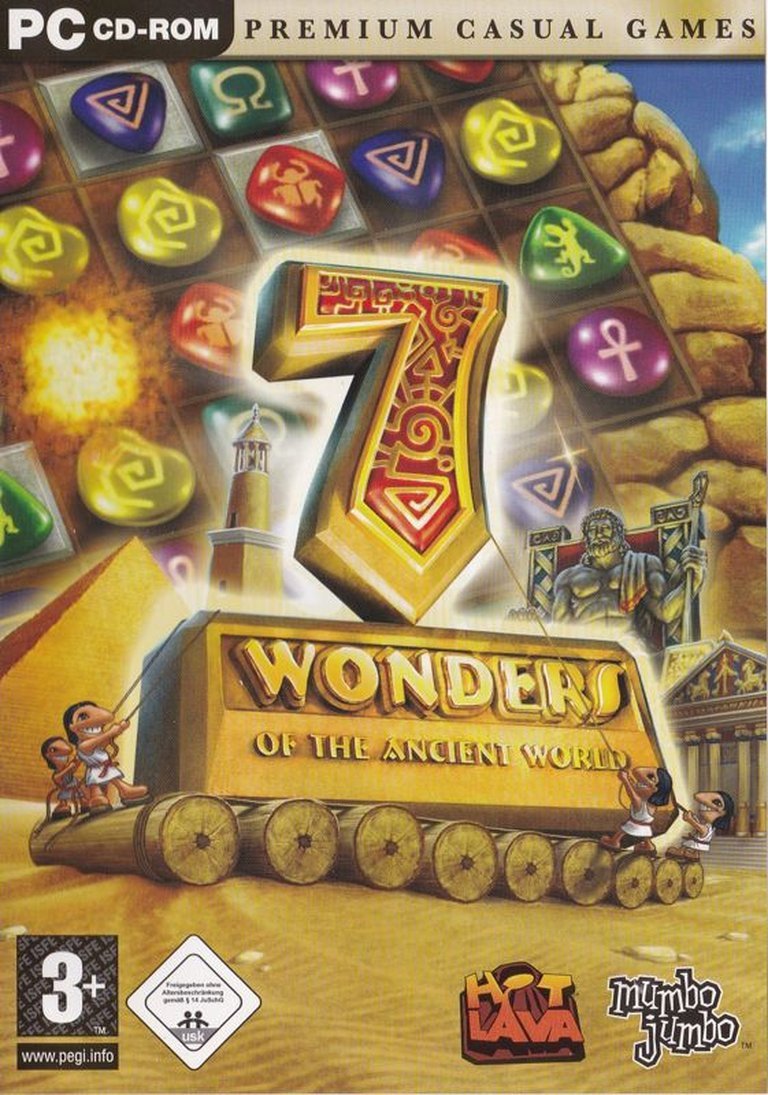
7 Wonders of the Ancient World is a Bejeweled-style tile-matching puzzle game set in classical antiquity, featuring the iconic wonders like the Great Pyramid of Giza and the Hanging Gardens of Babylon. Players match runes on material blocks to destroy them and build each wonder progressively in Story mode across 56 levels and three difficulty settings, with completed wonders unlocking for other play modes amid ancient Egyptian and Middle Eastern backdrops.
Gameplay Videos
Where to Buy 7 Wonders of the Ancient World
PC
7 Wonders of the Ancient World Free Download
7 Wonders of the Ancient World Guides & Walkthroughs
7 Wonders of the Ancient World Reviews & Reception
metacritic.com (51/100): Mixed or Average
gamesreviews2010.com (85/100): a timeless time management classic that continues to entertain and challenge players today.
gamespot.com (50/100): 7 Wonders is a competent clone of a competent Bejeweled clone that does little to set itself apart.
ign.com (70/100): Not as wonderful as other puzzlers out there.
7 Wonders of the Ancient World Cheats & Codes
Nintendo DS (EU)
Action Replay codes. Game ID: Y7WP-7BBAE54D
| Code | Effect |
|---|---|
| 0202e098 e3a01839 | Infinite Time |
PSP (US)
CWCheat codes. Game ID: ULUS-10227
| Code | Effect |
|---|---|
| 0x107BD54E 0x00004461 | Infinite Time |
PS2 (NTSC-U)
Codebreaker codes. Use with CodeBreaker/GameShark disc or PCSX2 emulator.
| Code | Effect |
|---|---|
| B4336FA9 4DFEFB79 5764D951 FF0C74A8 8E955931 4C0765FB F3F44889 8900C964 |
Enable Code (Must Be On) |
| ECF6E1FD 857D1392 | Gain 1000 Points Per Break |
| E5AF0398 C1C72EA8 | Gain 32000 Points Per Break |
| D22A6092 5518AB56 | Always have Hints |
| 258669F4 393BF5E7 | Infinite Time |
| 578D45BA 8E500A1E AE9087C8 D9133272 |
Always Give stones |
7 Wonders of the Ancient World: Review
Introduction
Imagine standing at the base of the Great Pyramid of Giza, not as a mere tourist, but as the master architect piecing together history’s greatest marvels one rune at a time—except your tools are colored gems falling from the sky, and time is your unrelenting Pharaoh. Released in 2006, 7 Wonders of the Ancient World emerged from the casual gaming renaissance, a Bejeweled-inspired tile-matching puzzler that tasked players with reconstructing antiquity’s iconic landmarks. Developed by the nimble Russian studio Hot Lava Games and published by MumboJumbo, it ported across platforms from Windows to Nintendo DS, PSP, PlayStation 2, and even iPad, capturing a snapshot of mid-2000s mobile and portable gaming fervor. Its legacy endures as a gateway drug for match-3 addicts, spawning a series that blended education with escapism. Thesis: While derivative and shallow in innovation, 7 Wonders excels as an addictive, thematically evocative puzzle experience that democratized historical wonder-building for casual audiences, influencing the genre’s proliferation without redefining it.
Development History & Context
Hot Lava Games, a boutique Russian developer, crafted 7 Wonders amid the explosive growth of casual PC games in the early 2000s. Led by a compact team of 12—featuring Executive Producer Matthew Lichtenwalter, Creative Director Kenda Lichtenwalter, Project Manager Ilya Plyusnin, and key talents like Lead Programmer Mikhail Rozhkov and Music/SFX composer Vasily Shestovets—this was a lean operation leveraging the Flintau engine for efficient tile-matching mechanics. MumboJumbo, a publisher specializing in accessible downloads and CD-ROMs, handled global distribution, aligning with the era’s shift toward browser portals like RealArcade and Big Fish Games.
The game’s 2006 Windows debut predated its 2007 console ports (PSP in April, DS in September, PS2 in November), capitalizing on the portable puzzle boom. Technological constraints were minimal: side-view, fixed/flip-screen visuals suited low-spec hardware (600 MHz CPU, 128 MB RAM minimum), with point-and-select interfaces perfect for touchscreens and styluses. The mid-2000s gaming landscape was dominated by PopCap’s Bejeweled (2001) and iWin’s Jewel Quest (2004), fueling a clone epidemic. 7 Wonders positioned itself as a “creation” variant—tile-matching tied to building progression—amid competitors like Luxor and emerging RPG-puzzlers like Puzzle Quest (2007). Publishers like Codemasters and Real Networks expanded it to BREW/J2ME mobiles, reflecting the pre-app-store mobile gold rush. ESRB Everyone-rated and single-player only, it embodied casual gaming’s ethos: quick sessions, broad appeal, no barriers.
Narrative & Thematic Deep Dive
7 Wonders eschews deep storytelling for a light, progression-driven “quest” framed as an epic journey through classical antiquity. The plot unfolds linearly in Story/Quest Mode: players begin at the Great Pyramid of Giza, supplying rune-matched “building stones” to animated workers who construct the wonder brick-by-brick. Success unlocks the next—Hanging Gardens of Babylon, Temple of Artemis at Ephesus, Statue of Zeus at Olympia, Mausoleum at Halicarnassus, Colossus of Rhodes, and Lighthouse of Alexandria—spanning Egypt, the Middle East, and Mediterranean Greece. Each wonder comprises 5-7 sub-levels (totaling ~56 across 3 difficulties), with boards reshaping to mimic architectural contours.
Characters are archetypal and voiceless: tireless workers scurry like ants, striking if progress stalls, while the player embodies an omnipotent overseer. Dialogue is sparse—copywritten by Ann Piper—limited to instructional pop-ups and trivia blurbs (e.g., “The Hanging Gardens were irrigated by an advanced aqueduct system”). Themes revolve around creation vs. entropy: matching runes symbolizes harnessing chaos into order, mirroring ancient engineering triumphs. Educational undertones lend whimsy—learning Phidias sculpted Zeus amid frantic swaps—but it’s superficial, more mnemonic than meditative. Rune Quest Mode adds variety, challenging specific matches (e.g., “clear 50 blue runes”), evoking mythic trials. Critically, the narrative’s charm lies in its progression loop: watching a wonder “complete” delivers dopamine hits, though repetition exposes thematic thinness—no branching paths, no lore-driven twists—cementing it as motivational framing over substantive saga.
Gameplay Mechanics & Systems
At its core, 7 Wonders refines the falling-block, tile-matching loop of Bejeweled/Jewel Quest: swap adjacent runes (side-view grid, 8×8 to irregular shapes) to form 3+ matches, clearing them for cascading drops. Core Loop: Accumulate “building stones” by exhausting the board (every tile cleared once) and sinking a golden block from top-to-bottom, all under a timer. Workers gauge progress; idleness triggers strikes, heightening urgency. Boards evolve per wonder—narrow for the Pyramid, tiered for Gardens—altering strategy (e.g., corner traps demand 4/5-matches for row-bombs).
Progression & Power-Ups: 3 difficulties ramp speed/block density. Power-ups (Lightning Bolt, Fire Bomb) emerge from 4/5/6-matches, shuffling rows or exploding clusters—vital for higher levels where luck influences drops. Quest Mode unlocks Free Play for replaying levels; Rune Quest demands targeted clears. UI is intuitive: point-and-select shines on DS/PSP touch (styluses praised), though PS2/PC mouse feels clunky. Flaws abound—overpowered specials trivialize difficulty, no multiplayer, short length (~5-8 hours)—but addictiveness stems from “just one more level” cascades. Innovative? Marginally: wonder-building ties matches to visual payoff, predating match-3 creation hybrids, yet it’s no Puzzle Quest RPG evolution.
| Mechanic | Strengths | Weaknesses |
|---|---|---|
| Matching | Fluid cascades, shape variety | Luck-dependent drops |
| Progression | Unlocking wonders motivates | Too easy post-power-ups |
| Modes | Free Play/Rune Quest extends life | No multiplayer/leaderboards |
| Controls | Portable perfection | Console ports lag |
World-Building, Art & Sound
The game’s setting evokes classical antiquity sans immersion: backgrounds depict wonders-in-progress against sandy Egyptian vistas, lush Babylonian terraces, or stormy Alexandrian shores—fixed/flip-screen ensures focus on grids. Visual Direction: Crisp, colorful runes (gold, emerald, ruby) pop against earthy palettes; animated workers (hauling bricks, hammering) add charm, scaling with progress. Lead Artist Kirill Korneev’s style is vibrant yet static—iPad HD ports elevate it to “gorgeous,” per Game Chronicles (93%)—but PS2/DS versions suffer aliasing. Atmosphere builds via escalation: early Pyramid levels feel methodical, later Colossus frantic.
Sound Design: Vasily Shestovets’ score blends ethereal flutes, percussive Middle Eastern motifs, and Greek lyres—low-key, non-intrusive, evoking Bollywood-lite (GamesRadar critique). SFX sparkle: crystalline matches, booming clears, worker cheers. It enhances zen-flow, though repetition grates in marathons. Collectively, elements forge a cozy historical sandbox: visuals/audios transport sans overwhelming, amplifying puzzle zen—perfect for commutes, less so for epic scopes.
Reception & Legacy
Launch reception was mixed, averaging 60% critics (MobyGames)/62% DS (GameRankings), 51% PSP (Metacritic). iPad HD shone (74% IGN, 93% Game Chronicles) for touch polish/addictiveness; handhelds faltered (49% IGN PSP: “shallow pretender”). Praises: “master class in engaging puzzles” (Pocket Gamer), visuals/animations (Gamers’ Temple). Critiques: “Bejeweled clone lacking originality” (GameSpot 5/10), no multiplayer/ease (GameSpy 2.5/5), eclipsed by Puzzle Quest. Players averaged 3.5/5 (Moby), Steam re-release Very Positive (88%).
Commercial/Legacy: Budget hit ($20 PSP/DS), series progenitor—7 Wonders II (2007), Treasures of Seven (2008), up to Ancient Alien Makeover (2012). Influenced match-3 proliferation (e.g., 7 Wonders clones, Steam bundles). Ports to Steam/iOS preserved it; trivia educated casuals, blending puzzles/history. In industry: epitomized casual boom, paving for mobile free-to-plays, though no genre revolution—solid B-tier artifact.
Conclusion
7 Wonders of the Ancient World distills match-3 mastery into a historically flavored addiction machine: addictive loops, charming progression, and accessible ports outweigh derivativeness and brevity. It shines as casual comfort food—building empires in minutes—yet falters against innovators. In video game history, it claims a niche as the series-launching everyman’s Bejeweled, a testament to 2000s puzzle ubiquity. Verdict: 7/10—Recommended for genre fans seeking low-stakes wonder; a relic worth resurrecting on Steam for nostalgia’s runes. Play it, build it, behold it—history in hyperlinks.