
- Release Year: 2002
- Platforms: Windows
- Publisher: Andrey Krutikov
- Developer: Andrey Krutikov
- Genre: Puzzle, Tile matching puzzle
- Perspective: Top-down
- Game Mode: Single-player
- Gameplay: Tile matching
- Average Score: 47/100
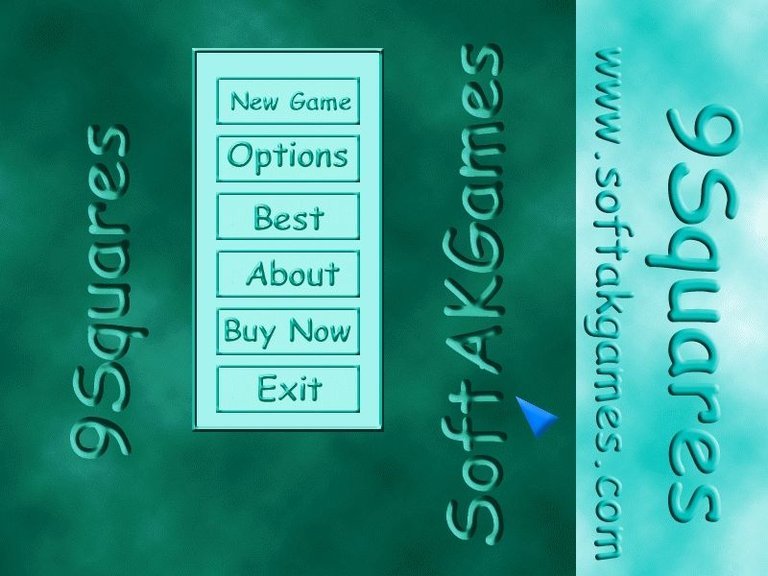
Description
9Squares is an arcade-style puzzle game where players earn points by matching identical colored tiles on a customizable game field. Players control randomly generated figures composed of colored squares, placing them to create vertical or horizontal lines of three or more matching tiles, which disappear when matched. The game offers adjustable difficulty levels, optional time limits, diverse tile sets, and scalable grid sizes ranging from 12×12 to 24×24.
9Squares Reviews & Reception
mobygames.com (40/100): The 9Squares is a fun arcade-style puzzle game for Windows.
retro-replay.com : 9Squares promises hours of strategic fun, making it the perfect pick‑up‑and‑play title for gamers of all ages.
9Squares: Review
Introduction
In the crowded pantheon of puzzle games, some titles ascend to legendary status through groundbreaking mechanics or immersive narratives, while others fade into obscurity despite offering moments of elegant simplicity. 9Squares, released on November 30, 2002, belongs firmly to the latter category—a Windows-exclusive shareware title that exemplifies the era’s love for bite-sized, mechanically pure puzzles. Devoid of grand narratives or cinematic ambitions, it instead offers a distilled experience of spatial reasoning and forward-planning, wrapped in the unpretentious aesthetics of early 2000s shareware. This review will argue that 9Squares, while critically overlooked and commercially insignificant, represents a fascinating microcosm of the puzzle genre’s evolution—a game whose minimalist design belies a surprising depth of strategic possibility, serving as both a time capsule of pre-social-media puzzle design and an unexpectedly compelling challenge for modern players seeking refuge from the bloat of contemporary titles.
Development History & Context
9Squares emerged from the solitary vision of programmer Andrey Krutikov, who stands as the sole credited developer on the project—a testament to the era’s indie scene where individuals could craft complete experiences with minimal resources. Released as shareware via digital download, the game capitalized on the burgeoning Windows market of the early 2000s, a period dominated by titles like Grand Theft Auto: Vice City, Halo: Combat Evolved, and Madden NFL 2003. Technologically, 9Squares was unremarkable: its top-down, fixed/flip-screen interface relied on simple colored tiles and basic animations, reflecting the constraints of a pre-3D-acceleration era where puzzle games prioritized function over flourish. Krutikov’s design choices—such as the random figure generation and customizable grid sizes—reveal a focus on replayability over narrative, aligning with the puzzle genre’s historical roots in arcade machines like Tetris. The timing is particularly noteworthy: 2002 marked Microsoft’s launch of Xbox Live, signaling a shift toward online multiplayer, yet 9Squares remained resolutely offline, emphasizing solitary contemplation—a relic of a pre-connected gaming world that valued self-contained challenges over social competition.
Narrative & Thematic Deep Dive
9Squares consciously eschews traditional narrative, presenting a universe defined by pure gameplay abstraction. There are no characters, dialogue, or explicit story—only the silent dance of colored squares across a grid. This minimalism, however, invites thematic interpretation through its mechanics. The game’s core loop of placing randomly generated figures to create matches can be read as a metaphor for order within chaos: each placement represents a human attempt to impose structure on entropy, while the clearing of identical tiles mirrors the satisfaction of finding patterns in randomness. The absence of a narrative framing device places the player’s personal journey at the forefront—the “story” becomes one of incremental improvement, where overcoming increasingly difficult grids (from 12×12 to 24×24) symbolizes mastering complexity. This aligns with broader trends in puzzle design, where narrative often serves as mere scaffolding for gameplay; as historian Mike Buckler notes, “most tension comes from challenges in gameplay rather than compelling plot developments.” 9Squares pushes this to an extreme, suggesting that true engagement arises from the player’s own internal struggle against the game’s systems—a theme that resonates with the genre’s enduring appeal.
Gameplay Mechanics & Systems
At its core, 9Squares is a masterclass in elegant mechanics. Players control randomly generated polyominoes—clusters of 2-4 colored squares—which must be placed on a grid to form horizontal or vertical lines of three or more identical tiles. Once placed, the figure locks, and the next appears instantly in a sidebar preview, demanding rapid adaptation. The genius lies in its tension between randomness and strategy: while the figures are procedurally generated, players must constantly rotate and position them to create combos and avoid filling the grid. Four difficulty levels (presumably affecting figure complexity and spawn rates) and an optional timer add layers of challenge, while adjustable grid sizes (12×12 to 24×24) cater to both quick sessions and marathon attempts.
The UI is admirably simple—a top-down grid, a preview panel, and a score counter—with mouse controls ensuring precise placement. Yet this simplicity masks subtle depth: the game rewards “forward-thinking,” as placing a figure might set up future matches by aligning colors with incoming pieces. There are no power-ups or special abilities, focusing instead on pure spatial reasoning—a refreshing contrast to modern puzzle games burdened by meta-progression. However, this purity is also a limitation; the lack of variety in objectives (beyond score maximization) may lead to monotony for some players, and the absence of a “hold” mechanic (common in Tetris-likes) occasionally creates frustrating moments where a desired figure is replaced by an incompatible one.
World-Building, Art & Sound
9Squares’ “world” is an abstract grid, but its art direction creates a surprisingly cohesive atmosphere. The tile sets—ranging from pastels to neon—offer distinct moods: soft palettes evoke a meditative, almost zen-like focus, while bold, high-contrast schemes induce a frenetic, arcade-like energy. Animations are functional yet satisfying; tiles vanish with a subtle fade effect, and remaining blocks drop with a gentle bounce, providing tactile feedback without distracting from the core gameplay. The fixed/flip-screen perspective ensures clarity, though larger grids (24×24) can become visually overwhelming, requiring players to mentally track distant matches.
Sound design is purely utilitarian—a minimalist click for placement, a soft chime for matches, and no background music. This absence of audio embellishment forces players to rely on visual cues, enhancing concentration. While not evocative in the traditional sense, the sparse soundscape reinforces the game’s meditative quality, turning each session into a focused puzzle-solving ritual. The overall aesthetic reflects the utilitarian ethos of early shareware: functional, clean, and unpretentious, prioritizing playability over artistic flourish.
Reception & Legacy
Upon release, 9Squares vanished without a trace. MobyGames records a paltry 1 player rating averaging 2.0/5, with no critical reviews or significant commercial traction. Its shareware model likely limited its visibility compared to full-priced retail titles, and its niche puzzle format struggled to stand out in 2002’s blockbuster market. Yet time has granted it a different kind of legacy: as a historical artifact of the puzzle genre’s pre-social-media era. Its mechanics—especially the random figure placement and combo chaining—presage modern “match-3” hybrids like Bejeweled Blitz, though with greater strategic depth. While it never influenced major franchises, its emphasis on spatial reasoning and customizable difficulty aligns with the enduring appeal of “pure” puzzle games. In the context of Buckler’s observation that narrative is “often an exposition to justify gameplay,” 9Squares stands as a radical counterpoint—a game where justification is unnecessary, and the mechanics are the point. Today, it survives as a curio for puzzle enthusiasts seeking the genre’s foundational principles, a reminder that not all influential titles need epic scale or polish.
Conclusion
9Squares is a paradox: a game of profound simplicity that reveals unexpected complexity, a product of its time that feels both archaic and refreshingly timeless. Its legacy lies not in revolutionizing the medium, but in perfecting a formula—pure, unadorned puzzle-solving—that the industry has since complicated with layers of narrative, monetization, and social features. While its dry execution and lack of story may alienate players accustomed to modern extravagance, those who engage with its mechanical core will discover a deeply satisfying experience that rewards patience and foresight. In an age of ever-expanding game worlds, 9Squares offers a compact, self-contained universe where the only story is the one written by the player’s own decisions. As a historical artifact, it documents a moment when puzzle games could thrive on elegance alone; as a playable experience, it remains a hidden gem for those who appreciate the beauty of well-constrained systems. Ultimately, 9Squares is not just a game—it’s a meditation on the purity of play, and in that quiet brilliance, it earns its place in video game history.