
- Release Year: 2017
- Platforms: Linux, Macintosh, Windows
- Publisher: Tio Atum
- Developer: Tio Atum
- Genre: Action
- Perspective: Side view
- Game Mode: Co-op, Single-player
- Gameplay: Arcade, Metroidvania, Platform
- Setting: Futuristic, Sci-fi
- Average Score: 73/100
Description
Greedy Guns is a sci-fi action-adventure game inspired by classic run-and-gun shooters like Gunstar Heroes, Metal Slug, and Contra. Players take on the role of greedy mercenaries surviving their most epic contract yet, exploring a futuristic world, battling enemies, and collecting an arsenal of powerful weapons. The game features intense 2D side-scrolling gameplay, Metroidvania-style exploration, and a highly praised local co-op mode for two players.
Gameplay Videos
Where to Buy Greedy Guns
PC
Crack, Patches & Mods
Guides & Walkthroughs
Reviews & Reception
metacritic.com (86/100): As a sprawling and interconnected 2D world, the bright and vibrant graphics pull you into the game even more.
techraptor.net : Tio Atum mixes together Contra, Metal Slug and bullet-hell inspired gameplay elements on an unknown alien world filled with deep chasms and towering peaks to create just that.
cgmagonline.com (70/100): It is a rather short and sweet Metroidvania romp that doesn’t require very much backtracking at all and plays like a combination of Metal Slug and Super Metroid.
newgamenetwork.com (63/100): Greedy Guns is a relatively humdrum and uninspired – if perfectly functional – Metroidvania-style adventure that makes an admirable effort to spruce itself up with light shoot ’em up elements.
Greedy Guns: A Mercenary’s Metroidvania Dream
In the vast and ever-expanding constellation of indie games, few genres are as crowded—or as beloved—as the Metroidvania. By 2017, the landscape was dominated by somber, atmospheric journeys and challenging, lone-wolf adventures. Into this fray stepped Greedy Guns, a title from the small Portuguese studio Tio Atum, which dared to ask a simple, avaricious question: What if the driving force wasn’t salvation or exploration, but cold, hard cash? The result is a vibrant, chaotic, and unapologetically fun run-and-gun experience that, while not without its flaws, carves out a distinct niche by masterfully blending the exploratory loops of Metroid with the explosive, co-op camaraderie of Contra and Metal Slug.
Development History & Context
Tio Atum, a studio founded by a core trio of Miguel Rafael (Art, Animation, Game Design), Afonso Cordeiro (Programming, Level Design), and Miguel Cintra (Composer, SFX), embarked on a four-year development journey to bring Greedy Guns to life. Built on the Unity engine, the project was a labor of love and a significant risk for a fledgling team. The gaming climate of 2017 was one of indie saturation; standing out required either groundbreaking innovation or impeccable execution of a familiar formula. Tio Atum chose the latter path, drawing direct inspiration from the hallowed classics of the run-and-gun genre.
The developers were transparent about their influences: Gunstar Heroes, Contra, and Metal Slug were the holy trinity guiding their vision. Their goal was not to reinvent the wheel but to refine it, injecting the “Metroidvania” structure with the relentless, action-first spirit of arcade shooters. This was a game developed in an era where “couch co-op” was becoming a rarity, making its inclusion a deliberate and nostalgic choice. The technological constraints were less about hardware limitations and more about scope; as a small team, they focused their efforts on tight controls, a vast interconnected map, and a memorable visual style rather than on a sprawling narrative or cutting-edge graphics.
Narrative & Thematic Deep Dive
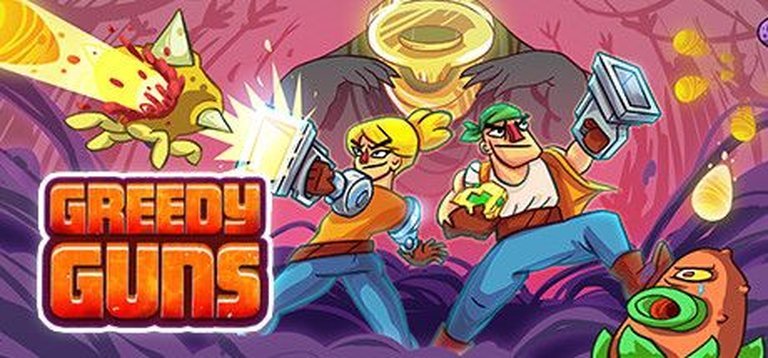
Greedy Guns is refreshingly light on narrative, a conscious design choice that perfectly suits its tone. Players assume the roles of Bob and Kate, two mercenaries in the employ of HOLO CORP, a ubiquitous corporate behemoth with a blatant disregard for ethics. Their mission is simple: land on an alien planet, kill its largest creatures, and harvest their unique DNA for profit. The narrative setup is delivered with a winking, self-aware humor, exemplified by your employer being a giant, cigar-smoking, emotive floating hand—a clear parody of corporate greed and faceless authority.
The story exists primarily as a vehicle for the action, but it’s peppered with charming, albeit shallow, touches. A mysterious, ghostly thief occasionally appears to complicate missions, hinting at a larger mystery, but this thread is never fully explored. The dialogue is sharp and tongue-in-cheek, with flawless translation (a noted strength in reviews) that adds to the cartoonish vibe. Thematically, the game is a straightforward satire of capitalism and mercenary culture. The very title, Greedy Guns, encapsulates its core ethos: avarice is the primary motivator, and weaponry is the means to satiate it. Enemies explode into showers of coins, and your character upgrades are purchased, not found, reinforcing the cycle of consumption and reward. It’s a theme that, while not deeply explored, provides a consistent and entertaining backdrop to the mayhem.
Gameplay Mechanics & Systems
At its heart, Greedy Guns is a twin-stick shooter Metroidvania. The left stick controls movement, the right stick aims your weapon in a full 360 degrees, a modern mechanic grafted onto a classic side-scrolling framework. This control scheme is exceptionally intuitive and responsive, a critical achievement noted across reviews. The game adds a second jump button (left trigger) that initially feels unusual but proves invaluable during frantic sections requiring precise aerial maneuvering while aiming and shooting.
Core Loop & Progression: The gameplay loop is classic Metroidvania: explore a large, interconnected 2D world, defeat bosses to acquire new abilities, and use those abilities to access previously unreachable areas. Abilities include a double jump, a dodge roll (granting temporary invulnerability), a ground pound that shatters certain obstacles, and a suction move to pull items from the background. However, critiques note that these abilities are often single-use keys for very specific locks—the dodge roll only works on toxic waterfalls, for instance—limiting the potential for creative environmental interaction.
Combat & Arsenal: Combat is where Greedy Guns truly shines. The weapon variety is impressive, including spread shots, grenade launchers, sniper rifles, and laser beams. Each gun has distinct pros and cons (e.g., high power but prone to overheating), encouraging strategic loadout choices. Money dropped from slain enemies is used to purchase these unlocked weapons at kiosks scattered throughout the world. A significant point of contention is the limitation of carrying only two weapons at a time. This forces players to backtrack to kiosks to swap gear, a design choice that can disrupt the flow and feels unnecessarily restrictive.
Difficulty & Checkpoints: The game’s difficulty is a mixed bag. Early sections are manageable, but later stages ramp up into near “bullet-hell” intensity, with screen-filling bosses and complex attack patterns. The game employs an extremely generous checkpoint system, resetting the player at the entrance to each room with full health upon death. This eliminates frustration from long treks back but also, as some critics argued, lowers the overall stakes and challenge, making strategic survival less important than simple persistence.
Co-op Play: The local co-op mode is a standout feature. The revival mechanic—where a living player must stand next their downed partner to resurrect them, a process interrupted by shooting or moving—adds layers of tension and strategy to the chaos. It transforms the game from a competent solo adventure into a standout shared experience, a rarity in the Metroidvania genre.
World-Building, Art & Sound
Greedy Guns presents a visually distinct world that leans into a cartoonish, almost Newgrounds-esque aesthetic. The art style is vibrant and colorful, a deliberate contrast to the grim, dark tones often associated with Metroidvanias. Character designs are grotesque yet comedic, with protagonists sporting red noses (a nod to Broforce) and enemies ranging from spiked strawberries to one-eyed frogs. Environments are varied and thematic, featuring jungles, industrial complexes, and ancient ruins, each with unique hazards like spiked wheels or thorny vines.
The animation style relies on “stretch and pivot” techniques reminiscent of early Flash animations, which, while not as fluid as traditional sprite work, complements the game’s lighthearted, chaotic energy. The soundtrack, composed by Miguel Cintra, is a chiptune-inspired score with a sci-fi edge, effectively setting the mood without being overly memorable. Sound effects are satisfyingly crunchy, with explosions and gunshots providing solid auditory feedback to the on-screen action.
Reception & Legacy
Upon its release in September 2017, Greedy Guns garnered a positive, if somewhat muted, critical response. It holds a 90% score on MobyGames based on limited reviews, with outlets like BonusStage.co.uk praising it as a “massive mercenary dream” deserving of “every cent and second invested.” Defunct Games awarded it a 78%, calling it “an easy recommendation” despite its lack of originality. Criticism focused on its repetitive combat, restrictive weapon system, and undercooked exploration elements, with New Game Network scoring it a 63%, calling it “humdrum and uninspired.”
Its legacy is that of a cult classic—a game admired for what it attempted rather than what it achieved. It did not redefine the genre but served as a robust, enjoyable homage to the run-and-gun classics of yore. Its most enduring contribution was its successful implementation of local co-op within a Metroidvania framework, a feature that remains rare. While it didn’t spark a wave of imitators, it demonstrated the viability of blending arcade shooter sensibilities with exploratory adventure, a lesson that would be echoed in later titles.
Conclusion
Greedy Guns is a game of endearing contradictions. It is both derivative and refreshing, overly generous yet frustratingly restrictive, visually simplistic but bursting with personality. It stands as a testament to the power of focused design and passionate development. While it may not reach the iconic status of its inspirations, it delivers a consistently fun, challenging, and—most importantly—cooperatively brilliant experience. For fans of Metal Slug and Contra seeking a longer, exploration-driven adventure, or for Metroidvania enthusiasts craving more action and a partner to share it with, Greedy Guns is a journey worth taking. It is a solid, often excellent, B-tier title that proves sometimes, greed is indeed good.