
- Release Year: 2018
- Platforms: Windows
- Publisher: Ghost_RUS Games
- Developer: Ghost_RUS Games
- Genre: Strategy, Tactics
- Perspective: Fixed / flip-screen
- Game Mode: Single-player
- Gameplay: City building, construction simulation
- Setting: Futuristic, Mars, Sci-fi
- Average Score: 25/100
Description
In Colony On Mars, you command a team of cosmonauts from Russia, Kazakhstan, and Kyrgyzstan who have landed on the Red Planet in the year 2289. As the colony commander, your task is to build, manage, and upgrade a settlement, collect vital resources, and ensure the survival of your team to pave the way for future human migration from Earth. The game features city-building and resource management gameplay with pixel art graphics, multiple modes including Campaign and Free Play, and a variety of buildings and resources to master.
Where to Buy Colony On Mars
PC
Guides & Walkthroughs
Reviews & Reception
steambase.io (26/100): This score is calculated from 53 total reviews which give it a rating of Mostly Negative.
store.steampowered.com (24/100): All Reviews: Mostly Negative (24% of 25)
Colony On Mars: Review
In the vast, starry expanse of video game history, where monumental titles like SimCity and Surviving Mars chart the course for city-building and space colonization sims, there exist countless smaller celestial bodies—games that launch with modest ambitions, often overlooked, yet which offer a unique lens through which to view the industry’s broader ecosystem. Colony On Mars, a 2018 indie strategy title from developer Nikita “Ghost_RUS,” is one such entity. It is a game that embodies both the aspirational spirit of solo development and the harsh realities of execution, a title whose very existence prompts a deeper inquiry into what constitutes a “game” in the modern digital marketplace.
This is not a review of a blockbuster. It is an archaeological dig into a curious artifact: a budget-tier, pixel-art simulation that promised the red sands of Mars but delivered a experience more akin to a rough, unfinished blueprint. Our thesis is clear: Colony On Mars is a fascinating case study in unrealized potential, a game whose technical shortcomings and minimalist design render it a largely failed experiment, yet one whose mere concept and place within the 2018 gaming landscape offer a poignant commentary on indie development, Steam’s ecosystem, and the eternal allure of the Martian frontier.
Development History & Context
Colony On Mars was developed and published by the enigmatic GhostRUS Games, ostensibly the solo venture of developer Nikita “GhostRUS.” Released on January 4, 2018, for Windows PC, it entered a market that was, at that very moment, reaching a fever pitch for Mars colonization games. Just a few months later, Paradox Interactive would release the highly anticipated Surviving Mars, a polished, deep simulation from seasoned veterans Haemimont Games. Colony On Mars was not competing with these titans; it was operating in a different stratosphere entirely.
The game was built with an unmistakable awareness of its limitations. Its system requirements are minuscule by modern standards—a 1.2 GHz processor, 1 GB of RAM, and a mere 100 MB of storage space—pointing to a development philosophy rooted in accessibility and perhaps the constraints of a single developer using simpler, more accessible game engines. This was not a project aiming for graphical fidelity or computational complexity; it was a straightforward, point-and-click simulation designed to run on virtually any machine.
The year 2018 was a pivotal time for digital storefronts like Steam. The platform’s direct distribution model had already democratized game development, leading to an explosion of indie titles. While this gave rise to groundbreaking successes, it also created a vast sea of smaller, often rushed products vying for attention at rock-bottom prices. Colony On Mars, with its $0.99 launch price (frequently discounted to $0.49), was a quintessential product of this environment. It was developed in a context where the barrier to entry was low, but the challenge of achieving visibility and quality was higher than ever.
Narrative & Thematic Deep Dive
The narrative framework of Colony On Mars is outlined in its official Steam description, a paragraph that does more heavy lifting than any in-game exposition. Set in the year 2288, humanity has apparently conquered other celestial bodies with names like “Nibiru” and “Keklandia” before setting its sights on Mars. The specific choice of cosmonauts from Russia, Kazakhstan, and Kyrgyzstan is a curious and mildly nationalistic detail, a small attempt to carve a unique identity in a genre typically dominated by American or pan-global narratives.
In 2289, a small team lands on the Red Planet, and the player assumes the role of their commander. The stated goal is to “build a colony, upgrade it, collect resources and survive on this planet, so that the Earthmen can later move to Mars.”
This premise taps into classic science fiction themes of manifest destiny, human resilience, and the existential challenge of terraforming a dead world. However, these themes are almost entirely tell and not show. There is no narrative progression, no scripted events, no character dialogue or development, and no story-driven missions within the campaign mode. The “plot” is a static backdrop—a premise painted on the box that the gameplay never evolves beyond. The hope of a future migration for “Earthmen” is a dangling thread never pulled, a promised payoff that the game’s scope is fundamentally incapable of delivering.
Thematically, the game gestures toward the cold, logistical reality of survival—the management of oxygen, water, and minerals as abstract numbers on a UI. Yet, without any emergent events, disasters, or human stories (like those found in RimWorld or Oxygen Not Included), these themes feel sterile and academic. The isolation and terror of Mars are reduced to a simple resource equation, devoid of the humanity that makes the genre’s best entries so compelling.
Gameplay Mechanics & Systems
The core gameplay loop of Colony On Mars is a stripped-down, real-time resource management simulation. The player must construct buildings—like water stations, mines, and oxygen generators—assign robotic units to gather resources, and slowly expand their colony’s infrastructure. The interface is purely point-and-click, and three modes are offered: a linear Campaign with five levels, a Free Play sandbox mode, and a “God Mode” that grants unlimited resources from the start.
On paper, this aligns with established genre conventions. In execution, however, the systems are plagued by profound issues that cripple the experience.
- The UI and Control: The interface is functional but deeply rudimentary. Menus are basic, and as noted in player discussions, critical features like a save/load system were seemingly absent at launch, a catastrophic omission for a strategy game. User “Zabi” on Steam forums directly asked, “Where is load/save? also it seems the game does not save progress upon exit?”
- Bugs and Glitches: This is the game’s most significant failure. Multiple player reports describe game-breaking bugs. A detailed review on RAWG describes “visual bugs abound (robots that walk above menus, menus that do not appear, overlapping buildings).” Worse, there is a reported “glitch according to which levels and buildings ‘are saved’ even if they are not built,” effectively breaking the game’s progression by providing unearned resources. This suggests fundamental flaws in the game’s codebase.
- Lack of Depth: The mechanics lack any significant complexity. There is no research tree, no citizen happiness system, no random events, and no external threats. The gameplay quickly devolves into a repetitive cycle of placing the same few buildings and waiting for resource counters to tick up. The “Campaign” mode is described as having “five pre-school difficulty levels” that can be completed in under 30 minutes.
- Achievements: The inclusion of 10 Steam achievements feels like a checklist rather than a meaningful reward structure. They are earned simply for completing basic tasks like finishing a mission or playing a specific mode, offering no challenge or incentive for mastery.
The gameplay is not just simple; it is broken and unfinished. The promise of managing a settlement is undermined by systems that barely function, offering neither the strategic depth of a management sim nor the satisfying creativity of a god game.
World-Building, Art & Sound
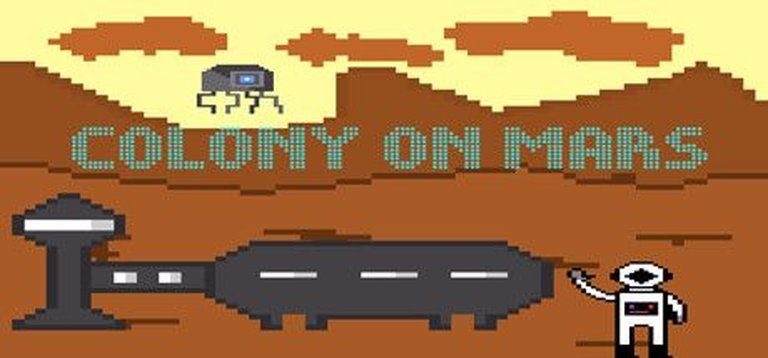
Colony On Mars presents its world through a deliberate, albeit extremely minimalist, pixel art style. The Martian landscape is a flat, reddish-brown plane dotted with static rock formations. Buildings are simple, blocky sprites, and robots are basic animated pixels. This is not the charming, detailed pixel art of Stardew Valley or Terraria; it is a utilitarian, almost primitive aesthetic that feels less like a stylistic choice and more like a necessity born from limited development resources or skill.
The atmosphere is consequently barren and lifeless—and not in the way a good Mars sim should be. It lacks the eerie beauty of a desolate planet; it instead feels empty and unpolished. The “fixed/flip-screen” visual style, as noted on MobyGames, further contributes to a feeling of claustrophobia and limitation, never allowing the player a grand view of their creation.
The sound design is similarly sparse. The RAWG reviewer notes the game has “two 8bit songs in loop that surprisingly do not tire despite its short duration.” However, they also point out a critical omission: “the game condemns the sound effects to the absolute silence of space, they did not put a sad ‘beep’ or sound effect when building buildings or moving robots.” This lack of audiovisual feedback is a critical failure in game design, making interactions feel hollow and unsatisfying.
Any attempt at world-building through environmental storytelling is nonexistent. There are no ruins to discover, no logs to find, and no sense that Mars has any history at all before the player’s arrival. The world is a blank, empty canvas with only the faintest of grids drawn upon it.
Reception & Legacy
The reception for Colony On Mars was, unsurprisingly, negative. On Steam, it holds a “Mostly Negative” rating based on user reviews, with a Steambase Player Score of 26/100. Critic reviews are virtually absent from major outlets; it was a title that slipped beneath the notice of the gaming press, existing primarily in the user-driven ecosystems of Steam and aggregator sites.
Player reviews consistently highlight its broken state and lack of content. The sentiment is perfectly captured by the RAWG reviewer who concluded, “4.1 unfinished and broken, but with potential… The game has potential… Now, the Mars Colony is run out of air because of its accumulation of bugs and glitches, its unfinished and left-over appearance and the total lack of difficulty.”
Its legacy is not one of influence or innovation but of caution. Colony On Mars serves as a stark example of the challenges facing solo developers on crowded digital platforms. It represents the “other side” of the indie boom—not the stunning success stories, but the multitude of projects that are released in a half-finished state, unable to compete on any level beyond price. It has left no mark on the genre it attempted to join; its only lasting impact is as a footnote, a game remembered only for its failings and its place in the portfolio of a developer, Nikita “Ghost_RUS,” who would go on to release numerous other low-cost, minimalist titles like Robohazard 2077 and Flex Apocalypse Racing.
Conclusion
Colony On Mars is not a good game. It is a dysfunctional collection of ideas hampered by catastrophic technical issues, a near-total lack of depth, and a presentation that fails to engage on any level. As a piece of interactive software, it is a failure.
Yet, as a historical artifact, it is strangely compelling. It is a snapshot of a specific moment in time and a specific tier of game development. It embodies the dream of building a world on a new planet, reduced to its most basic, broken components. For historians and analysts, it offers a clear case study of the perils of premature release and the immense gap between concept and execution.
The final verdict is unavoidable. Colony On Mars is not a worthwhile experience for players seeking a functional or engaging Mars colonization simulator. Its place in video game history is secured only as a curiosity—a testament to ambition thwarted by execution, a small, forgotten crater on the vast landscape of gaming, notable only for its depth of flaws. For those interested in the complete anatomy of a failed game, it provides a textbook example. For everyone else, the red planet remains best explored elsewhere.