
- Release Year: 2022
- Platforms: Windows
- Publisher: Wolfsden LLC
- Developer: Wolfsden LLC
- Genre: Role-playing (RPG)
- Perspective: Diagonal-down
- Game Mode: Single-player
- Gameplay: Japanese-style RPG (JRPG)
- Setting: Fantasy
- Average Score: 78/100
Description
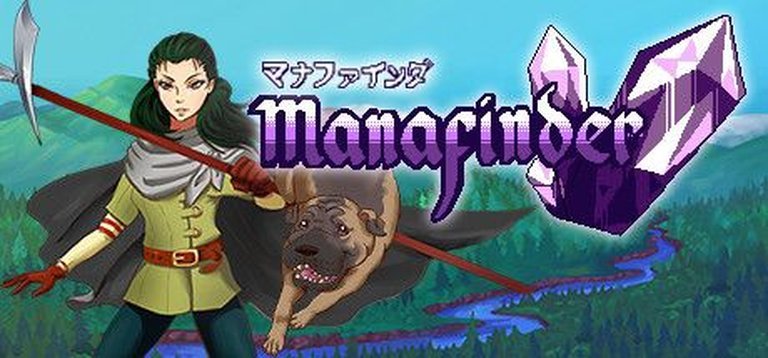
Manafinder is a 2022 RPG Maker MV fantasy RPG set in the world of Aevi. The Holy Kingdom of Manahill is humanity’s last bastion, protected by a barrier powered by manastones, but it exiles its unwanted to die in the monster-infested wilderness. These exiles form a struggling Settlement with its own failing barrier. Players take on the role of Lambda, a recent exile who becomes a ‘manafinder’, venturing into the wilds to scavenge for manastones to keep the Settlement safe. The story escalates into a conflict with the rogue goddess Illia and her followers, who seek to destroy all manastones, forcing Lambda to choose between the survival of her new home and a radical new future for humanity.
Gameplay Videos
Where to Buy Manafinder
PC
Guides & Walkthroughs
Reviews & Reception
opencritic.com (87/100): Manafinder is charmingly engaging game.
rpgamer.com (70/100): Manafinder is a cute pixel-art turn-based RPG that will appeal to many players with its sidequests and interesting battle system.
Manafinder: A Testament to Passion and Perseverance in the Indie RPG Landscape
In the sprawling, often overwhelming ecosystem of indie RPGs, where countless titles are forged in the fires of passion and released into a sea of competition, a game must possess something truly special to carve out its own legacy. Manafinder, a 2022 turn-based JRPG developed by the one-person studio Wolfsden LLC, is one such title. It is a game that transcends the typical constraints of its RPG Maker origins, offering a deeply engaging, mechanically rich, and narratively complex experience that stands as a monumental achievement in indie development.
Development History & Context: A Labor of Love Against the Odds
The story of Manafinder is intrinsically tied to its creator, Jorge Blanco. A software engineer by day, Blanco embarked on a five-and-a-half-year journey to bring his vision to life, working as a “night owl” developer to finance and create the game entirely independently. This lengthy, self-funded development cycle, free from the pressures of a publisher-mandated release date, allowed for meticulous crafting but also presented the perpetual risk of feature creep and an ever-expanding scope.
The game was built using RPG Maker MV, an engine often associated with a specific, sometimes limited, style of game. However, Blanco defied expectations. As he stated in an interview, Manafinder uses zero default RPG Maker assets. Every sprite, every tile, every animation was custom-made. Furthermore, Blanco wrote a suite of custom JavaScript plugins to push the engine far beyond its standard capabilities, creating a unique front-view battle system reminiscent of Phantasy Star and a level of visual polish rarely seen in projects from the tool.
Released on October 5, 2022, Manafinder entered a market saturated with retro-inspired JRPGs. Its challenge was not just to be good, but to be noticed. Blanco himself acknowledged the brutality of indie marketing, a “fight for attention” in a landscape where dozens of games launch daily. Despite this, Manafinder emerged not as another drop in the ocean, but as a distinct and memorable island of quality.
Narrative & Thematic Deep Dive: Morality, Exile, and the Price of Survival
Manafinder presents a world, Aevi, where humanity’s last bastion, the Holy Kingdom of Manahill, is protected by a barrier powered by manastones. The ruling class, however, maintains this “safety” through tyrannical means, exiling anyone deemed a criminal—or simply an inconvenience—to certain death in the monster-infested wilds. The survivors of these exiles form the Settlement, a fragile community struggling to maintain its own barrier and eke out an existence.
You play as Lambda, a woman exiled from Manahill for reasons unknown—a deliberate narrative choice that reinforces the arbitrary cruelty of the kingdom. Thrown into this harsh world, she is rescued by the Settlement and takes up the mantle of a “manafinder,” venturing into the wilds to scavenge the precious stones that mean the difference between life and death for her new community.
The narrative quickly evolves from a simple survival story into a complex moral drama. The Settlement is threatened by two opposing forces:
* King Vikar: The ostensibly “Holy King” of Manahill, a fallen hero whose blessings from the gods corrupted him into a despotic ruler. He represents order through oppression, a society that purges the weak and different to maintain a hollow, gilded safety.
* Illia, the Goddess of the Night: A renegade deity who believes humanity’s dependence on manastones has made them weak and threatens the natural balance of Aevi. She and her cult of nomadic followers seek to destroy all manastones, forcing humanity to survive on its own primal merits. She is an Affably Evil and Well-Intentioned Extremist, whose philosophy is a brutal form of social Darwinism.
The game masterfully avoids simple binaries. King Vikar is a Light Is Not Good tyrant, while Illia, the Dark Is Evil goddess, nevertheless has a point about the dangers of dependency and expansion. This conflict is mirrored within the Settlement itself through the ideological clash between the hotheaded revolutionary Starkas and the cautious explorer Frederick, whose rivalry escalates to lethal proportions.
Lambda’s choices throughout the game determine which path she follows, leading to three distinct endings:
1. The Frederick Ending: Lambda conquers the monstrous Tuonela abyss, slays Illia, and establishes a new kingdom for the exiles, becoming their queen. It’s a Bittersweet Ending; while a new home is found, key allies are lost, and Lambda is warned she may eventually become as corrupt as Vikar.
2. The Starkas Ending: Lambda leads a revolt against Manahill, overthrows Vikar, and takes his throne. This ending also comes with heavy costs and public distrust, another bittersweet victory.
3. The Illia Ending: In a Downer Ending born of despair, Lambda agrees with Illia’s philosophy and annihilates the Settlement herself, leaving humanity to a primal, barrier-less fate. This conclusion is an Ambiguous Ending, shown only with an image of a caveman and a beast, implying a reset of civilization itself.
The game explores heavy themes of Disproportionate Retribution, the moral compromises of survival, and whether society itself is worth saving if it’s built on exclusion and constant, desperate toil. The rule in the Settlement that forbids asking about others’ pasts adds a layer of poignant sadness, highlighting the trauma shared by all its inhabitants.
Gameplay Mechanics & Systems: Strategic Depth Wrapped in Accessibility
Manafinder’s gameplay is a masterclass in refining classic JRPG mechanics into a focused, strategic, and deeply rewarding loop.
Combat & Progression: The turn-based combat system is deceptively simple on the surface but offers significant depth through two key systems:
* Weapon Variety: Lambda is a Multi-Melee Master, capable of wielding over a dozen weapon types—spears, swords, pickaxes, claws, scythes, and even a vacuum—each effective against specific enemy types. This necessitates constant strategic switching mid-battle to exploit weaknesses.
* Elemental Imbuing: Lambda can imbue her attacks with one of seven elements (fire, water, thunder, etc.) using ores or spells. This adds a magic hit to her physical attacks and changes her resistances, but also exposes a weakness, creating a constant risk-reward calculation.
The Unleash system acts as a Limit Break, with each weapon having a unique powerful skill. Your canine companion, Scar, is a permanent Canine Companion and Assist Character who cannot be directly controlled but can be directed to focus on offense, defense, or specific targets. His presence is crucial, both mechanically and emotionally.
Progression is equally inventive. Instead of standard level-ups, Lambda offers “soul dust” collected from battles to the gods in exchange for blessings. This system allows for deep customization, letting players choose between stat boosts, new passive skills, or magic abilities.
Exploration & Side Content: The world of Aevi is explored through over 23 distinct biomes, from lush forests to crystalline caves. Side quests are not mere fetch quests but are often varied mini-games: bartending sims, trivia challenges, races, and training regimens for Scar. These activities are not just fun diversions; they are integral to upgrading your capabilities and are woven seamlessly into the lives of the Settlement’s residents.
The game also features a formidable Superboss, the Leviathan, whose defeat grants the Infinity +1 Sword Leviathan Scale accessory, which allows for devastating Unleash spam and trivializes post-game content.
World-Building, Art & Sound: Aevi Brought to Life
For a game built on RPG Maker, Manafinder’s presentation is nothing short of stunning. The pixel art is exquisite, with detailed character sprites, expressive portraits, and beautifully rendered environments that give each of the 23+ biomes a unique and memorable identity. The art style is “cute” but never simplistic, effectively conveying the beauty and brutality of Aevi.
The sound design is the package’s one relative weakness. While the soundtrack is serviceable and sets the ambiance appropriately, it is often described as forgettable. The battle theme and victory fanfare, heard most frequently, can become repetitive. However, this is a minor flaw in an otherwise stellar presentation, where the visual storytelling and world-building carry immense weight. The lore, from the history of the gods to the plight of every exile, is deeply embedded in the environment and dialogue, creating a truly Lore-Rich experience.
Reception & Legacy: A Critically Acclaimed Hidden Gem
Upon release, Manafinder garnered “Very Positive” reviews on Steam (94% positive from 74 reviews) and strong critical praise. RPGFan scored it 87/100, calling it a “charmingly engaging game,” while RPGamer awarded it 3.5/5, highlighting its “diversified mini-games” and “interesting battle system.” Critics universally praised its combat depth, charming visuals, and engaging story, though some noted the underdeveloped backstory for Lambda and occasional repetitive audio.
Its legacy is still being written. While not a commercial blockbuster, it has cemented its status as a high-water mark for what is possible with RPG Maker, demonstrating that technical limitations are no barrier to creativity and quality. It has built a dedicated fanbase, with active community engagement leading to multiple post-launch patches. Furthermore, its upcoming port to consoles by Ratalaika Games and the announced development of Manafinder II prove that Blanco’s vision has resonated deeply enough to become a sustainable franchise. It stands as an inspiration to indie developers, a testament to the power of perseverance and a singular creative vision.
Conclusion: An Indie JRPG Masterpiece
Manafinder is far more than the sum of its parts. It is a game crafted with an palpable level of care, intelligence, and passion that shines through every pixel and line of dialogue. It takes a familiar JRPG framework and injects it with strategic combat, morally complex choices, and a world that feels both magical and desperately real.
While it may have a few minor imperfections in its audio presentation, they are overwhelmingly eclipsed by its strengths: a compelling narrative that refuses to offer easy answers, a combat system that rewards strategic thinking, and a gorgeous world worth exploring. It is a triumph of indie development, a gem that deserves to be discovered and celebrated by any fan of the genre. Manafinder doesn’t just find mana; it finds its own brilliant place in the pantheon of great indie RPGs.