
- Release Year: 2004
- Platforms: Windows
- Publisher: Ihsan Ul Haque
- Developer: Ihsan Ul Haque
- Genre: Action, Puzzle
- Perspective: Top-down
- Game Mode: Single-player
- Gameplay: Exploration, Maze Generation, Real-time
- Setting: Labyrinth
- Average Score: 58/100
Description
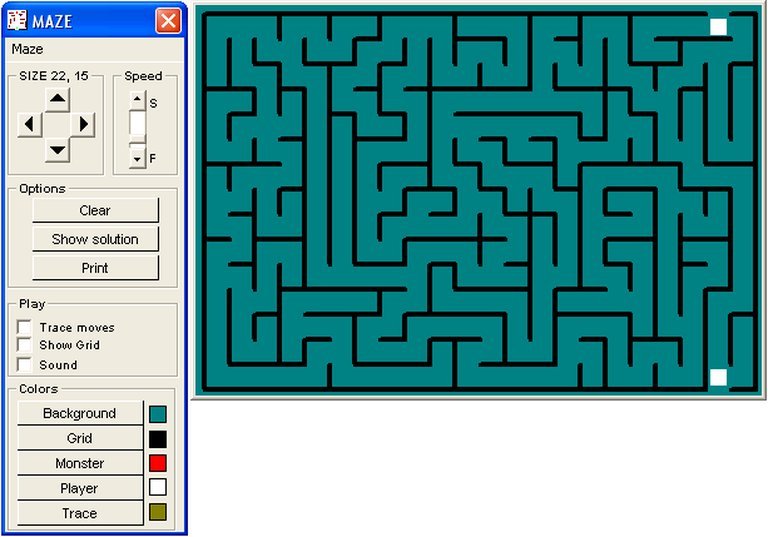
Maze is a real-time puzzle game where players navigate a customizable maze to reach the upper exit before a computer-controlled monster catches them or exits the bottom. Players can choose the maze size and explore it either in first-person or top-down view, with options to track their path.
Where to Buy Maze
PC
Mods
Reviews & Reception
imdb.com (100/100): Perfect game, just not really for everyone
mobygames.com (16/100): Unplayable.
Maze: Review
Introduction
In the vast landscape of video game history, few titles stand out as both a testament to the medium’s early experimental spirit and a cautionary tale about the pitfalls of unrefined design. Maze (2004), a freeware top-down action puzzle game, is one such title. Developed by Ihsan Ul Haque, Maze is a deceptively simple game that tasks players with navigating a procedurally generated labyrinth while evading a relentless computer-controlled adversary. Despite its modest ambitions, Maze offers a fascinating glimpse into the early 2000s indie development scene, where creativity often outpaced technical polish. This review will dissect Maze across multiple dimensions, from its development context to its gameplay mechanics, and ultimately assess its place in gaming history.
Development History & Context
Maze was released on July 21, 2004, a time when the internet was becoming a burgeoning platform for independent game distribution. Developed by Ihsan Ul Haque, a solo developer, Maze was part of a wave of freeware and shareware titles that emerged as the digital distribution landscape began to take shape. The game’s development coincided with the rise of platforms like MobyGames, which aimed to document and preserve video game history, including obscure and niche titles like Maze.
The early 2000s were a transitional period for gaming, marked by the decline of arcade culture and the rise of home consoles like the PlayStation 2 and Xbox. PC gaming, meanwhile, was experiencing a renaissance with the advent of digital distribution platforms like Steam (which launched in 2003). Maze was a product of this era, leveraging the simplicity of keyboard controls and the nascent potential of procedural generation to create a game that was both accessible and challenging.
Narrative & Thematic Deep Dive
Maze is devoid of any overt narrative or thematic depth. The game’s premise is straightforward: navigate a maze from the bottom to the top while avoiding a computer-controlled “monster.” The absence of a story or characters allows the game to focus purely on its core mechanics, but this also limits its emotional or thematic resonance. The game’s simplicity is both its strength and its weakness—it offers a pure, unadulterated challenge, but lacks the narrative or aesthetic elements that could elevate it beyond a technical exercise.
Gameplay Mechanics & Systems
Core Gameplay Loop
Maze presents players with a top-down view of a procedurally generated labyrinth. The player controls a square-shaped avatar at the bottom of the screen, while the computer controls a red “monster” at the top. The objective is to reach the top exit before the monster catches the player or reaches the bottom exit. The game offers several customization options, including the size of the maze (ranging from 5×5 to 32×24) and the ability to play with a fully drawn playfield or an explorable maze where only visited areas are revealed.
Controls and Interface
The game is controlled using the keyboard’s arrow keys, a choice that reflects its era and target audience. The interface is sparse, with minimal UI elements beyond the maze itself and the player’s avatar. The game’s real-time nature adds a layer of tension, as players must think and react quickly to navigate the maze and evade the monster.
Procedural Generation
One of Maze‘s standout features is its procedural generation system. The maze is generated algorithmically, ensuring that no two playthroughs are identical. This system adds replayability and unpredictability, as players must adapt to new layouts each time they play. However, the procedural generation is not without its flaws—players have reported instances of “dead ends” in exploration mode, where the game incorrectly marks paths as impassable, leading to frustrating and unfair gameplay.
Speed and Difficulty
The game’s speed is a significant point of contention. Even at the lowest setting, the monster moves at a pace that makes it nearly impossible for the player to reach the mid-point of the maze before being caught. This imbalance renders the game effectively unwinnable, a flaw that underscores the challenges of solo development without rigorous playtesting.
Bugs and Glitches
Maze suffers from several bugs that detract from the experience. The most notable is the “dead end” issue, where the game generates impassable walls that the monster can bypass. This inconsistency breaks immersion and undermines the game’s fairness. Additionally, the “Sounds” checkbox in the options menu appears to have no effect, as no sounds are heard regardless of its setting.
World-Building, Art & Sound
Visual Design
Maze features a minimalist visual style, with a simple grid-based maze rendered in basic colors. The player’s avatar is a blue square, while the monster is represented by a red square. The game’s art direction is functional rather than artistic, prioritizing clarity over aesthetics. The top-down perspective is a nod to classic maze games like Pac-Man, but the lack of visual flair limits the game’s appeal.
Sound Design
The game’s sound design is nonexistent. Despite the presence of a “Sounds” checkbox in the options menu, no audio cues or background music are present. This omission is a missed opportunity to enhance the game’s atmosphere and provide feedback to the player.
Reception & Legacy
Maze received a single player review on MobyGames, which awarded it a score of 0.8 out of 5, describing it as “unplayable.” The reviewer praised the game’s customizable maze size and the option to experience the maze in first- or third-person perspectives, but criticized its excessive speed, bugs, and lack of sound. The review concluded that the game would be more enjoyable if it were turn-based or featured two-player functionality.
Despite its harsh reception, Maze holds a niche place in gaming history as an example of early 2000s indie development. Its procedural generation and minimalist design reflect the experimental spirit of the era, even if its execution falls short. The game’s influence is limited, but it contributes to the broader conversation about the challenges and opportunities of solo game development.
Conclusion
Maze is a flawed but fascinating artifact of early 2000s indie gaming. Its procedural generation and minimalist design showcase the creative potential of solo developers, but its technical issues and unbalanced gameplay render it effectively unplayable in its current state. While it lacks the polish and depth of more celebrated titles, Maze serves as a reminder of the iterative nature of game development and the importance of playtesting and refinement.
In the grand tapestry of video game history, Maze occupies a minor but noteworthy thread. It is a testament to the passion and experimentation that drive independent game development, even if its legacy is one of cautionary lessons rather than enduring influence. For historians and enthusiasts, Maze offers a glimpse into a bygone era of gaming, where the barriers to entry were low, the challenges were high, and the spirit of innovation was unbridled.