
- Release Year: 2004
- Platforms: Windows
- Publisher: Akella, DreamCatcher Interactive Inc., FX Interactive, S.L., JoWooD Productions Software AG
- Genre: Action, First-person, Shooter
- Perspective: First-person
- Game Mode: LAN, Online PVP, Single-player
- Gameplay: Arcade-style, Black Tarot cards, Boss battles, Fast-paced action, First-person combat, Physics-based, Soul sucking
- Setting: Gothic, Heaven, Hell, Horror
Description
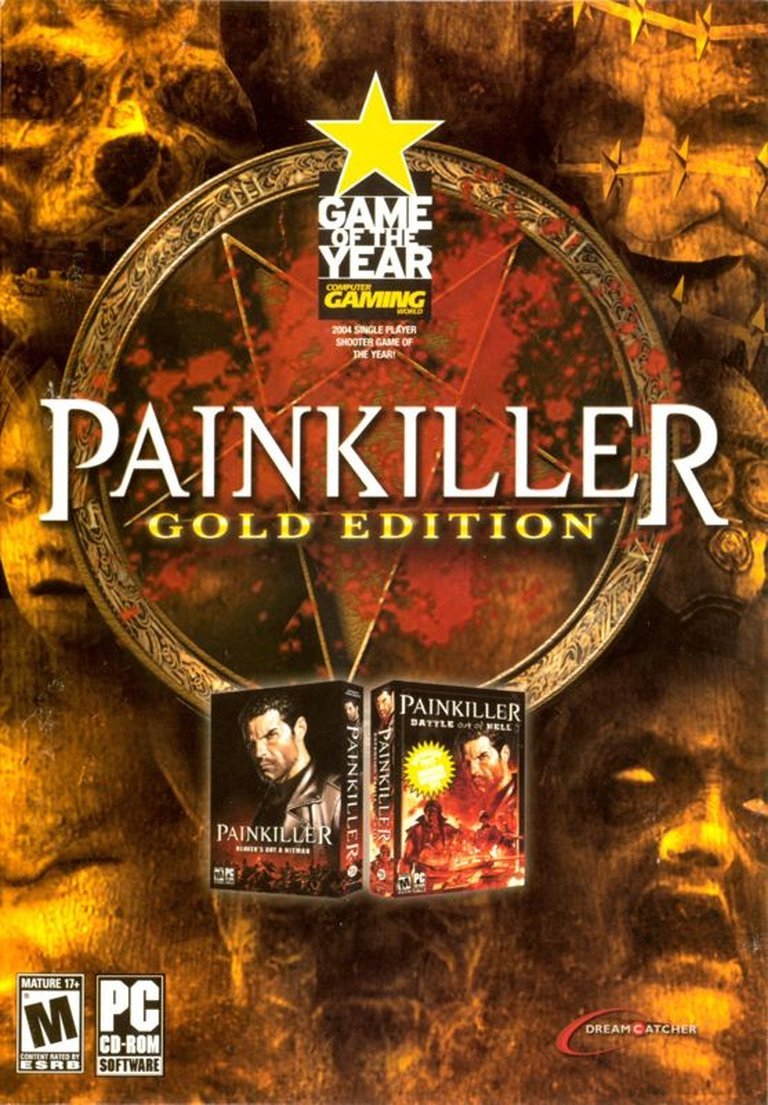
Painkiller: Gold Edition is an intense old-school first-person shooter compilation featuring the original game and its expansion, Battle Out of Hell. Set in a dark, gothic world overrun by Satan’s armies, players battle relentless waves of nightmarish enemies through varied environments like castles, churches, and a ghostly orphanage. The game emphasizes pure action over narrative, using a compass-driven structure and dual-mode weapons (like a shotgun that freezes enemies or a stake gun with grenade capabilities) to deliver cathartic, fast-paced combat against massive bosses, all enhanced by over-the-top physics and satanic horror aesthetics.
Gameplay Videos
Cracks & Fixes
Reviews & Reception
steamcommunity.com : Painkiller is an artfully designed and carefully crafted experience.
steamcommunity.com : all you need is this version too get the definate PK experience.
steamcommunity.com : its amazing, some great level design.
Painkiller: Gold Edition: Review
Introduction
In the pantheon of first-person shooters, few titles embody the unadulterated spirit of run-and-gun carnage quite like Painkiller: Gold Edition. Released in December 2004 as a definitive compilation of the original game and its expansion Battle Out of Hell, this package arrived during an era dominated by cinematic, story-driven shooters like Half-Life 2 and Doom 3. Yet Painkiller defiantly carved its own niche as a relentless, arcade-style experience where plot took a backseat to pure, unfiltered action. Its legacy endures as a cult classic, celebrated for its blistering pace, inventive weaponry, and chaotic physics. This review dissects Painkiller: Gold Edition not merely as a game, but as a historical artifact—a testament to a time when FPS design prioritized cathartic destruction over narrative complexity.
Development History & Context
Conceived by Polish studio People Can Fly (later acquired by Epic Games) and published by DreamCatcher Interactive, Painkiller was born from a three-year development cycle focused obsessively on two core elements: level design and enemy variety. According to the included “Making of” video (a Gold Edition exclusive), the team constructed a “virtual army of monsters,” pushing the Havok physics engine to create emergent, physics-based violence that was revolutionary for its era. Released shortly after the dawn of DirectX 9, the game leveraged hardware T&L support to render Gothic cathedrals, war-town ruins, and hellish realms with unprecedented detail, even if its brown-heavy palettes occasionally echoed Quake‘s aesthetic.
The gaming landscape in 2004 was bifurcated: AAA titles prioritized realism and narrative depth, while a resurgence of “old-school” shooters (e.g., Serious Sam) emphasized scale and simplicity. Painkiller straddled this divide, marrying modern tech (ragdoll physics, complex lighting) to a design philosophy harking back to Doom. The Gold Edition itself was a commercial savvy move, bundling the base game, expansion, and bonus content onto a single DVD—a rarity at a time when expansions still shipped on separate CDs. This consolidation made it a budget-friendly entry point for new players, solidifying its reputation as the definitive version.
Narrative & Thematic Deep Dive
The narrative, such as it is, exists purely as a pretext for slaughter. Players assume the role of Daniel Garner, a recently deceased soul trapped in limbo, tasked by a divine entity to purge Satan’s forces from Earth and Heaven. Cutscenes (skippable, per player demand) introduce this conflict through clunky Poser-rendered FMVs with serviceable voice acting, but the game itself treats lore as disposable exposition. Thematic coherence stems from visual motifs: gothic architecture, satanic iconography, and pulp-horror enemies (e.g., ninja specters, reapers) evoke a Hammer Films-meets-Heavy Metal album vibe.
Battle Out of Hell leans further into horror pastiche, with a ghostly orphanage level directly referencing The Changeling via a haunted ball descending stairs. Yet the game’s true narrative is environmental: the journey from cemeteries to hellscapes mirrors a descent into madness. Themes of redemption and divine wrath are present but drowned out by the relentless, black-humored chaos. As one player review quipped: “The game doesn’t bullshit around with things like a story… All you need to know is this: Satan and his generals are about to attack heaven, and that isn’t good so you need to go out there and shove a boot up his ass.” This ethos—minimalist setup, maximalist execution—became Painkiller‘s signature.
Gameplay Mechanics & Systems
Painkiller‘s brilliance lies in its distilled, loop-centric design. The core loop is deceptively simple: advance through linear arenas, slaughter waves of enemies, collect souls/health/ammo, and reach the next checkpoint. Yet within this framework lies a symphony of systemic depth:
-
Combat Arsenal: The game boasts a compact but devastating arsenal of five primary weapons, each with dual-fire modes. The Painkiller staff transforms from a spinning-blade melee weapon to an orbital projectile, while the shotgun freezes enemies for shattering. The Stakegun’s gravity-affected stakes and grenade launcher exemplify tactical versatility, and the Electro Driver’s electrified shurikens add crowd-control potential. Battle Out of Hell expands this with a flamethrower/assault rifle combo and a cluster-bomb sniper rifle. Each weapon’s “combo” move (e.g., shotgun’s primary fire freezing foes) encourages adaptive play.
-
Soul System: Defeated enemies drop green (health) or red (enhanced health + demon morph) souls. Collecting 66 souls triggers a temporary demon transformation, highlighting all enemies in flames for easy elimination. This mechanic rewards aggressive play but is marred by soul-collection pacing—green souls vanish quickly, forcing players to constantly pause and scavenge.
-
Progression & Tarot Cards: Gold, collected from destructible barrels, chests, and holy items, powers Black Tarot cards. These passive upgrades (e.g., increased movement speed, weapon damage) add meta-progression, though unlocking them often requires tedious backtracking to break every crate. The 24-card system, including the coveted “Mercy” card (unlocked on Trauma difficulty), encourages replays but feels like a checklist rather than organic design.
-
AI & Level Design: Enemy AI is functional but basic—most foes charge directly, occasionally getting stuck in geometry. However, level design compensates with varied, set-piece-driven arenas: a collapsing cathedral, an oil rig, a rollercoaster sequence. The compass eliminates key-hunting, maintaining momentum, but boss battles (e.g., the Necrogiant) often devolve into repetitive damage-sponge fights.
-
UI & Controls: The minimalist HUD features a health/ammo counter, a compass, and a soul meter. Keyboard-and-mouse controls are tight, with quick weapon-switching via mouse wheel. Load times, however, are notoriously severe—up to 10 minutes for boss stages—plaguing even modern PCs.
World-Building, Art & Sound
Painkiller excels at creating a hellish yet visually distinct world. Each chapter—Gothic, Industrial, Military, and infernal—employs a cohesive aesthetic. The Cathedral’s stained glass, the Asylum’s decaying corridors, and the Swamp’s pulsating marshes leverage the engine’s lighting to evoke dread. Enemy designs are grotesquely memorable: armored skeletons, flamethrower-wielding thugs, and biomechanical horrors like the Alastor boss. Havok physics make destruction visceral—enemies gib in showers of gore, and environmental objects (barrels, crates) chain-react explosively.
Sound design is a mixed bag. Industrial metal tracks blare between battles, but ambient moments like the Asylum’s ghostly whispers or the Opera House’s echoing silence create genuine unease. Weapon effects are punchy, though player feedback criticizes repetitive soundscapes. Crucially, the soundtrack’s silence during firefights heightens tension, making each shot and scream feel impactful.
Reception & Legacy
Upon release, Painkiller: Gold Edition earned critical acclaim (average 83% on Metacritic) for its refreshing take on the FPS genre. Critics praised its “ideal blend of instant action” (Fragland.net) and “rampant carnage” (Scott Monster), while acknowledging its narrative shortcomings. Players lauded its chaotic fun but lamented technical flaws like load times and AI quirks. Commercially, it performed respectably, buoyed by its budget-friendly Gold Edition packaging.
Its legacy is twofold. As a design document, Painkiller influenced later arcade shooters like Bulletstorm (from People Can Fly) and Ziggurat, proving that fast-paced, mechanics-driven gameplay remained viable even as the industry shifted toward realism. Culturally, it birthed a franchise with sequels (Overdose, Hell & Damnation) and a multiplayer scene remembered for its frantic 2v16 battles. Yet its true historical significance lies in embodying a “golden age” philosophy: that games could be pure, unapologetic fun without sacrificing technical ambition. As MobyGames’ archives attest, it remains a benchmark for satisfying, physics-driven mayhem.
Conclusion
Painkiller: Gold Edition is a time capsule of FPS design—an artifact where ambition and simplicity collided to create something unforgettable. Its flaws—load times, rudimentary AI, and a soul collection system that disrupts flow—are products of their era, yet its strengths—razor-sharp combat, inventive weaponry, and unapologetic spectacle—transcend time. For historians, it documents a moment when studios dared to prioritize visceral thrills over cinematic pretense. For players, it remains a masterclass in cathartic destruction. Ultimately, Painkiller isn’t just a game; it’s a manifesto. As one critic succinctly summarized: “Painkiller is a balls to the wall old school shooter, and if that’s your thing, you will absolutely love it.” In a world of increasingly complex shooters, its return to basics feels revolutionary.