
- Release Year: 2011
- Platforms: PlayStation 3, Windows, Xbox 360
- Publisher: Bethesda Softworks LLC
- Developer: inXile Entertainment, Inc.
- Genre: Action
- Perspective: Behind view
- Game Mode: Co-op, LAN, Online Co-op, Single-player
- Gameplay: Archery, Co-op puzzles, Cover-based, Dungeon crawler, Hack and Slash, Melee Combat, Shooter
- Setting: Fantasy
- Average Score: 60/100
- Adult Content: Yes
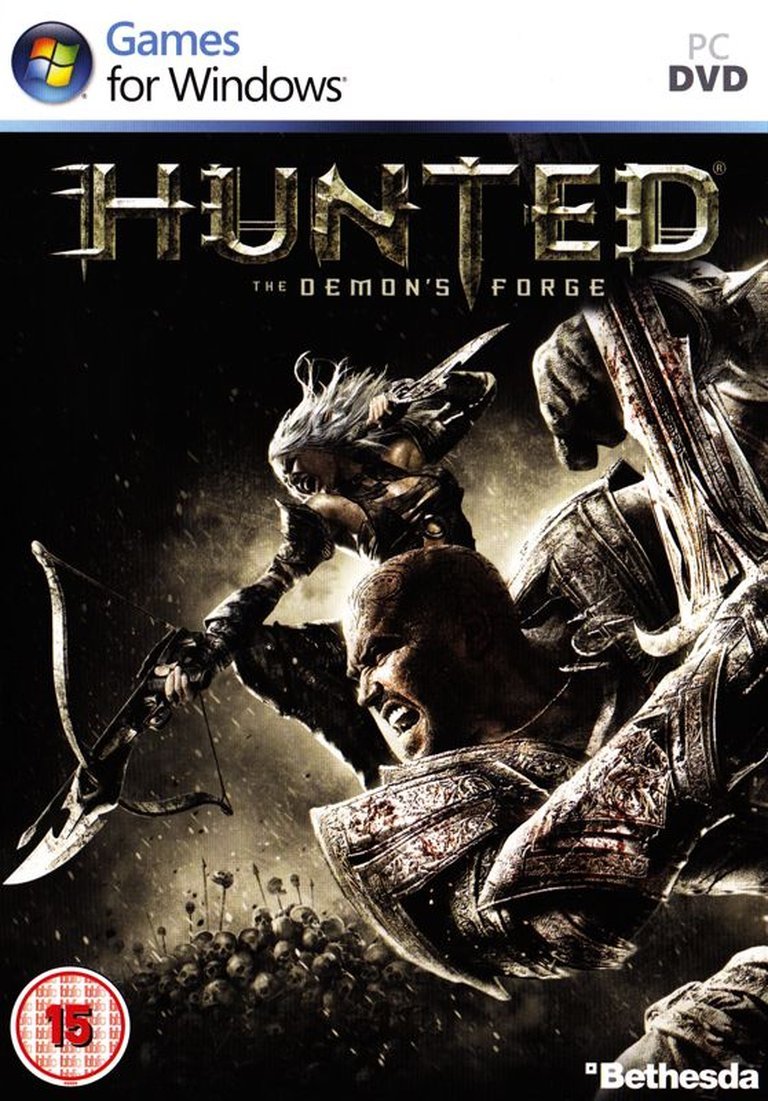
Description
In ‘Hunted: The Demon’s Forge’, players follow the intertwined fates of E’lara, an elven archer, and Caddoc, a human warrior, both seasoned mercenaries haunted by sinister demonic visions. As they traverse a dark, fantasy world, the duo must combine their unique combat skills—E’lara’s ranged attacks and Caddoc’s melee prowess—to confront looming threats and ultimately save the world from destruction. Designed for cooperative play, the game emphasizes teamwork, with both characters possessing a swappable fighting style, special abilities, and equipment that degrade over time, necessitating strategic planning and coordination. Whether playing solo with AI controls or partnering up online, players engage in intense combat while solving co-op puzzles and upgrading skills through discovery of magical crystals.
Gameplay Videos
Where to Buy Hunted: The Demon’s Forge
Cracks & Fixes
Guides & Walkthroughs
Reviews & Reception
metacritic.com (61/100): Hunted: The Demon’s Forge doesn’t excel in anything in particular and is hindered by noticeable graphical and AI problems, but it manages to offer a fair amount of fun if played in co-op.
en.wikipedia.org (61/100): Hunted: The Demon’s Forge is the latter type of game: conceptually sound, yet clumsy as delivered.
pcgamer.com (68/100): With a friend, a solid hack-and-slash, but nothing special, or half as funny as it thinks.
gamespot.com (50/100): Hunted: The Demon’s Forge buries its rock-solid ideas under a mound of execution blunders.
backloggd.com : Medival Gears of War, just not as good or refined.
Hunted: The Demon’s Forge: Review
Hunted: The Demon’s Forge is a relic of a specific moment in gaming: a mid-tier, co-op-focused action RPG developed in the era of Gears of War, cover shooters, and the early Diablo comparisons, released in 2011 by inXile Entertainment and published by Bethesda Softworks. Despite its ambition to craft an immersive dark fantasy world where players would team up as a swashbuckling elf archer and a grizzled human warrior, Hunted is a game that defies easy categorization. At its core, it is a game with ample vision but critically flawed execution, a project that exemplifies the trials of mid-tier development in the early 7th console generation. It is a game that should be remembered for how it tried to blend genre conventions — third-person shooter, dungeon crawler, co-op puzzle-solving — but is instead relegated to obscurity due to a disastrous mix of technical instability, pacing issues, and unimaginative design choices.
This review examines Hunted: The Demon’s Forge not just as a review of its surface-level qualities, but as a case study in what went wrong, what worked, and how its legacy has fared. We will analyze its development history, deconstruct its narrative and gameplay systems, appraise its artistic and auditory choices, explore its reception and commercial failure, and, finally, weigh its place in gaming history.
1. Introduction: A Forgotten What-If
Hunted is the ultimate “what could have been.” It was conceived in the fertile ground of Bethesda’s imagination — the publisher of The Elder Scrolls, Fallout, and Dishonored — by inXile Entertainment, a studio founded by 80s legend Brian Fargo, best known for Fallout and The Bard’s Tale. The game’s very subtitle, The Demon’s Forge, is a meta-joke, a callback to Fargo’s 1981 text adventure of the same name. That nostalgic nod, combined with an absurdly large voice cast — Lucy Lawless (Xena), Graham McTavish (The Hobbit, Rambo), and Laura Bailey (Critical Role, The Last of Us Part II) — suggested a project with real aspirations.
But what was released was a 7th-gen white elephant: a $60 game on launch, powered by Unreal Engine 3, shipped in June 2011, amid the rise of Skyrim (also a Bethesda title), The Witcher 2, and the ascendance of open-world epics. Against that backdrop, Hunted was a ghost before the first review even dropped.
Its premise — a dark fantasy world of orc-like Wargar, demonic forges, elven extinction, and a cursed elder liquid called Sleg — is rich, almost dark fantasy in the mold of Berserk or The Black Company. The protagonists — E’lara, a flirtatious, tattooed elf with a penchant for explosives, and Caddoc, a no-nonsense human warrior terrified of spiders — are colorful, intentionally subversive archetypes: he the quiet bruiser, she the reckless rogue. The game was built as a co-op shooter with RPG elements, emphasizing synergy, teamwork, and the joy of a fire-arrow-supported melee bash.
And yet, by almost every metric, Hunted failed. It sits at 61/100 on Metacritic, derided for its bugs, poor online integration, and what the Edge called, “a horse swishing its tail with futile persistence.” The A.V. Club echoed the sentiment: “It thinks ham-fisted cooperation is indistinguishable from effortless cooperation.” But beneath the technical wreckage lies a vision worth excavating — a game that, had it been polished, balanced, and networked properly, might have become a cult classic. This is not just a review; it is an autopsy.
2. Development History & Context
InXile & the “Small Step” Co-op Philosophy
inXile Entertainment, under Brian Fargo and Matt Findley, approached Hunted as an attempt to rethink co-op gameplay. As Findley put it in a 2010 interview: “The general definition of co-op has sunk to allowing two players to play together. We’re co-op in that all of our special skills and abilities are designed to make you work together.”
This philosophy is evident in the design intent:
– No wasted powers: E’lara’s ice arrows freeze enemies; Caddoc must shatter them.
– Co-op puzzles: One lifts, the other shoots from high ground.
– Revive system: Only by proximity and shared health vials.
The team believed in small, deliberate improvements — incremental steps toward deeper cooperation, akin to Battlestations: Midway or Tom Clancy’s Ghost Recon. They weren’t building Destiny; they were building a tight, four-player Gears of War in fantasy clothes.
The Era: 2011 — When Fantasy Was Roaming
Hunted released in May 31, 2011, in a gaming landscape dominated by:
– Portal 2 (April 2011)
– The Witcher 2 (May 2011)
– L.A. Noire (May 2011)
– Brink (May 2011) — another Unreal Engine 3 co-op shooter that bombed.
The technology was at a crossroads. UE3 was three years old, but still the industry’s workhorse. Hunted, however, used it clumsily. The engine’s lighting was muted, shader quality was low, and the physics (via NVIDIA PhysX) were glitchy, with ragdolls clipping through walls. More damningly, networking was a known UE3 Achilles’ heel, and inXile reused the Gauntlet Online system from Brink — a gamble that backfired when PC matchmaking was broken at launch, with GameSpy integration requiring manual port forwarding.
Production Challenges
The studio — 327 credited developers — worked under tight budget and timelines. While the voice acting was high-quality (Fargo’s connections), the level design was outsourced, resulting in linear, corridor-heavy maze dungeons with repetitive architecture. The AI was serviceable, but only because inXile prioritized co-op over single-player polish. The result: a game that wanted to be co-op and failed at it.
The 8–10 hour campaign was not a risk — it was a necessity, as inXile knowingly abandoned the “open-world Bethesda” model for a focused, narrative-driven experience. This was a clever choice — most mid-tier games were stretched thin. But Hunted overestimated its own appeal.
3. Narrative & Thematic Deep Dive
Plot: A Vicious Cycle of Corruption
The story follows E’lara and Caddoc, elite mercenaries hired by Seraphine, a mysterious sorceress, to retrieve a cursed artifact known as the Sleg — a silvery elixir that mutates its victims, granting superhuman strength and eternal life at the cost of their souls. The narrative unfolds across 10 chapters, blending Treasure Island-style mercenary banter with Lovecraftian horror.
Key events:
– Chapters 1–3: Retreat from a burning city, encounters with the Wargar, a spider-god boss.
– Chapters 4–6: Infiltration of Kala Moor, the demonic forge, and discovery of Annuvin, the corrupt noble.
– Chapters 7–9: Revelation that Sleg is sentient, a vicious cycle of possession — the blood of dragons, the eyes of saints, and a cycle where every possessor kills their closest friend.
– Chapter 10: Final confrontation with Annuvin, a former king who, after drinking Sleg, slaughtered his entire family.
Themes: The Curse of Power
Hunted is, at its heart, a meditation on power and corruption. The Sleg is not just a mechanism; it is an Eldritch Abomination, a cursed inheritance. The narrative device of the Death Stone — allowing players to speak to the dead — is where the game succeeds artistically. These are not your typical fantasy barks. Instead, they are confessional monologues:
“I was a knight of the 7th Order. I drank Sleg to save my village. I killed my brother with a plow. I would do it again.”
This moral ambiguity — presented in well-acted, nearly cinematic cutscenes — is Hunted at its best. The tapes, journals, and ghostly echoes of the fallen reveal that every wielder of Sleg was once a hero, corrupted by the idea of saving the world. The true antagonist is not Annuvin, but the Sleg itself — a self-sustaining cycle of evil, akin to the One Ring or Malacath’s Blessing.
Characters: Archetypal with a Twist
- E’lara: Subverts the “elf robin hood” trope. She’s a Broken Bird — haunted by her people’s genocide by Minotaurs, a fan of violence, and obsessed with explosions. Her dialogue with Caddoc is a highlight, full of dry wit and sexual wordplay — “My outfit isn’t slutty… it’s strategically placed.”
- Caddoc: The Knight in Sour Armor, a mercenary who claims “I’m not a hero” but becomes one through Reluctant Heroism. His fear of spiders is a running gag, but it’s a mask for guilt — hinted at in his ghost meditations.
- Seraphine: An “Obvious Evil” villain, who E’lara calls out as “wearing a slutty outfit,” but her femme fatale aura — portrayed by Lucy Lawless with a gravelly, witchy intonation — is deeply unsettling. She is not just a traitor; she is the puppetmaster, manipulating the Sleg cycle to find a “stronger host” — a Batman Gambit revealed in the secret ending.
The Three Endings: Thematic Payoff
- Bad Ending: “Drink Sleg” — one kills the other, becomes Annuvin 2.0.
- Good Ending: “Neither drinks” — the cycle is broken, the rat with glowing eyes suggests Sleg will return.
- Best Ending: “E’lara and Caddoc walk off together” — a Cynical Hope ending, like Blame! or Nausicaä.
The writing is R-rated, Adults Only, and M-rated for a reason — not just for gore, but for philosophical weight. It is a shame that this sophistication was buried under terrible pacing.
4. Gameplay Mechanics & Systems
Core Loop: Cover, Shoot, Hack, Repeat
Hunted is a third-person cover shooter with light hack-and-slash elements. The core loop is:
1. Approach enemy group from cover (crates, walls, weapon racks).
2. E’lara uses bow (cover-shooter style), Caddoc uses crossbow.
3. Switch to melee when enemies close — Caddoc blocks, E’lara dodges.
4. Use special attacks (learned via Crystals — red, green, blue).
5. Loot bodies, find Sleg vat (optional), proceed.
Combat: Synergy vs. Frustration
- Balance: Tight, co-op required. In single-player, AI handles the other character decently — it reloads, heals, and distracts.
- But: Finishing moves are disruptive. You must do a 3–5 second slow-mo kill, leaving your partner alone. Games like Resident Evil do this, but not in multiplayer.
- Blocking: Caddoc’s shield bash is overpowered; E’lara’s dodge is floaty.
- Weapon Degradation: A unique, ambitious system — weapons break, found on racks or enemies. But implementation is flawed:
- No inventory filter to sort weapons.
- No DPS indicator.
- ItemType tier system (White, Green, Purple) is standard, but rare finds feel unrewarding.
Progression: The “Small Step” Backfires
- Skill Tree: 6 abilities per character — 3 weapon, 3 magic.
- Crystals: Found in chests or slain enemies — each grants a random ability.
- But: No direct purchase. You must find the right crystal. Combined with 8-hour commitment, this feels like artificial difficulty.
- Magic System: Too shallow. Fire, frost, lightning, explode. No elemental synergy beyond “ice for bashing.”
The Crucible: A Missed Opportunity
The level editor — the Crucible — was the killer feature. Players could design survival arenas, share them, and earn gold to unlock new monsters. It was inspired by Diablo’s endgame systems and Battlefield’s user-generated content.
– Downsides:
– No sharing or downloading — a catastrophic design flaw.
– No sharing outside LAN.
– No co-op puzzles — just arena waves.
– Ignored in marketing — it was buried in menus.
This was inXile’s best idea — and their worst flaw.
5. World-Building, Art & Sound
Art Direction: “Brown” Fantasy
Hunted’s world is “The Dung Ages” — a grimdark Tolkien pastiche. The visual identity is unintentionally comical:
– Color palette: All browns, grays, blacks. Even daylight scenes look muddy.
– Environments: Dungeonous mazes, ruined castles, foggy lakes — all clichéd.
– Character Design:
– E’lara: A Stripperiffic, Jiggle Physics-driven elf. Her leather outfit exposes shoulders, abdomen, back, thighs. Caddoc wears a leather harness, chest bare. It’s fanservice, but not tasteless — it’s honest, almost self-aware. As TV Tropes notes, E’lara lampshades her outfit.
– Enemies: Basic orc designs (Wargar), generic minotaurs, undead skeletons. Later demons and dragons are proof-of-concept.
Sound Design: A Standout
- Kevin Riepl’s Score: A gothic metal/orchestral hybrid — think Devin Townsend + Godspeed You! Black Emperor. The title theme is haunting, choral, and epic.
- Voice Acting: Exceptional. Lawless, McTavish, and Bailey elevate the material. Their banter is unmatched by Bethesda — “Body-Count Competition” kills never get old.
- Sound Effects: Distinct weapon impacts, spell chants, environmental echoes. The crunch of bones, slicing of steel, whoosh of arrows — all well-tuned.
- Sound Over Visuals: The game sounds better than it looks. In combat, you’re absorbed by audio cues — not visuals.
The Spider God (Chapter 2)
A horror highlight. A massive, screen-filling spider (worshipped as a god) drops from the ceiling. Caddoc panics. E’lara laughs. The sound design is surreal — hissing, skittering, choral chants. It’s a glimpse of potential.
6. Reception & Legacy
Critical Consensus (61/100)
Hunted received “mixed” reviews:
– Praise: Co-op “soul”, voice acting, Crucible editor, slower combat pace.
– Criticism: “Murky graphics” (Digital Spy), “rushed” (Edge), “unplayable online” (GameSpot), “generic dungeon crawl” (Metro), “no text chat” (PC Gamer).
The split was regional:
– Positive: 360 LIVE (82/100), Czech Gamer (80/100), games xtreme (79/100).
– Negative: GameZone (50/100), Gamegravy (40/100), MMGN (40/100).
The verdict: A 7th-gen curio — not a catastrophe, but a failure of focus.
Commercial Failure & Legacy
- Sales: Sub-100k units, per leaks. No sequel promised.
- No cult following. No speedruns. No Overwatch skins.
- Findley’s 2011 promise — “A series if successful” — was naive.
- But: The Crucible editor inspired Dungeons & Dragons: Attack Wing (2012), a tabletop game with arena battles.
- InXile’s pivot: Post-Hunted, they shipped Wasteland 2 (2014), Torment: Tides of Numenera (2017), Wasteland 3 (2020). Hunted taught them: co-op requires polish.
Influence: Indirect. The co-op puzzle design was echoed in Grim Dawn (2019), and dual-character synergy in The Division (2016). But Hunted itself is never referenced.
7. Conclusion: A Game That Died in Co-Op
Hunted: The Demon’s Forge is a tragedy of intent versus execution. It is, in structure, a good game trapped in a broken body. Had inXile:
– Fixed UE3’s networking,
– Added Crucible sharing,
– Balanced finishing moves,
– Expanded the world into an open-ended design,
…they might have had a cult hit. Instead, they had a case study in failure.
But it is not without value. It is a vision of *co-op as *dialogue, synchronization, and mutual aid. The Sleg cycle is a brilliant metaphor for toxic relationships, addiction, and the **hero’s journey as a trap. E’lara and Caddoc are rare protagonists — a Platonic Life-Pair with sharp, witty chemistry.
In the end, Hunted is not a classic, but a warning. A reminder that in co-op, every technical flaw is a social flaw. One crashed lobby, one desync, one AI death — and the magic dies.
Final Verdict: 5.5/10 — “A forgotten, flawed, but fascinating artifact of early 2010s co-op design. Not recommended at $1.29 on Steam — rent with a friend, or skip entirely. But study it: this is what happens when ambition outpaces execution.”
Hunted: The Demon’s Forge is not the worst game of 2011.
It is the most haunting.