
- Release Year: 1999
- Platforms: Windows
- Publisher: Acer TWP Corp, Enlight Software Ltd., Ubi Soft Entertainment Software
- Developer: Enlight Software Ltd.
- Genre: Strategy, Tactics
- Perspective: Diagonal-down
- Game Mode: LAN, Online PVP, Single-player
- Gameplay: characters control, Combat, construction, Diplomacy, Diplomatic intrigue, Empire-building, Expansion, Fantastic monsters, Multiple units, Mysticism, Point and select, Political backstabbing, Real-time strategy (RTS), Research, Resource Management, Trade elements
- Setting: Fantasy, Futuristic, Sci-fi
- Average Score: 83/100
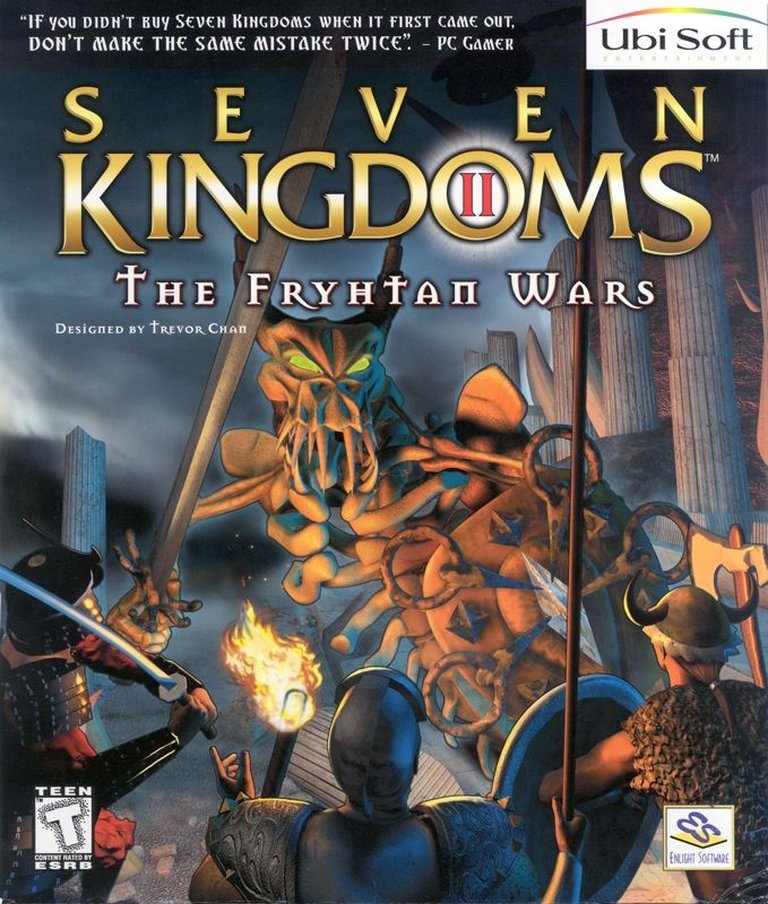
Description
Set in a rich fantasy world with sci-fi elements, Seven Kingdoms II: The Fryhtan Wars is a real-time strategy game centered on empire-building, diplomacy, and territorial conquest. Players select from 12 unique nationalities, each with culturally distinct traits and behaviors, and must manage complex systems of trade, politics, and warfare across an isometric, free-camera world. Featuring both human and monstrous factions, including the insectoid Fryhtan hordes, the game blends base-building, real-time combat, and deep diplomatic intrigue, requiring players to balance military strategy with social management and political backstabbing in their quest to dominate the seven kingdoms.
Gameplay Videos
Where to Buy Seven Kingdoms II: The Fryhtan Wars
PC
Seven Kingdoms II: The Fryhtan Wars Free Download
Mods
Guides & Walkthroughs
Reviews & Reception
metacritic.com (76/100): Generally Favorable
gamespot.com (91/100): There’s no question that Seven Kingdoms II is a richer, more fully realized game.
gamesreviews2010.com : Seven Kingdoms II remains a cult classic among RTS fans.
Seven Kingdoms II: The Fryhtan Wars: Review
The late 90s witnessed a golden age in PC real-time strategy (RTS) gaming, with franchises such as Age of Empires, Command & Conquer, StarCraft, and Total Annihilation vying for dominance. Amid this crowded battlefield, a quieter yet profoundly ambitious title emerged from a lesser-known developer: Seven Kingdoms II: The Fryhtan Wars (1999). Developed by Enlight Software, led by British designer Trevor Chan, this game was more than just another RTS—it was a radical fusion of grand-strategy depth, economic simulation, political intrigue, and fantasy warfare, all set against a procedurally generated historical-fantasy backdrop. While overshadowed at launch by the likes of Age of Empires II and StarCraft, The Fryhtan Wars has since earned a cult status as one of the most intellectually rich, mechanically layered, and underappreciated entries in the RTS canon.
This review dives deep into Seven Kingdoms II: The Fryhtan Wars as both a historical artifact and a living gem in video game history. It is not merely another strategy game—it is a “Civilization meets Warcraft in real-time, with diplomacy as a weapon”, a realization of Trevor Chan’s vision to merge economic planning with military dominance, social dynamics with religio-magical intervention. As we explore its development, narrative depth, gameplay systems, world-building, and legacy, we arrive at a resolute thesis:
Seven Kingdoms II: The Fryhtan Wars is a masterpiece of systemic RTS design—a game that rewards patience, complexity, and strategic foresight far beyond its era. Its enduring legacy lies not in sales or fame, but in its audacious marriage of economic realism, dynamic diplomacy, and emergent storytelling, influencing a lineage of strategy games long after its retail flame flickered out.
1. Introduction: A Strategy Game for Thinking Kings
In a genre often dominated by base-building boilerplate, rapid-twitch micro, and combat-heavy narrative arcs, Seven Kingdoms II: The Fryhtan Wars is an outlier—a game that demands more than clicking and zerging. It is a thinking person’s RTS, a managerial grand-strategy hybrid, and a diplomatic sandbox where war is only one of many tools. As Power Play noted in its 1999 review (89%): “It’s not a game where you just let units run across the screen. It’s a game where you must *learn to play.”*
From the moment the game boots up, it presents a suite of options that few RTS titles of its time dared to offer: not just how you will conquer, but who you are, what you value, and how you interact with the world—not just enemies, but allies, neutrals, spies, and gods. The game’s most radical departure from its peers is its dynamic, player-driven diplomacy system, where relationships shift based on reputation, trade, espionage, and religious alignment. Unlike Age of Empires, where alliances are temporary and brittle, in The Fryhtan Wars, diplomacy is a living organism, shaped by actions, not just checkboxes.
The introduction of the Fryhtans—mysterious, magically empowered monstrous factions—further deepens its identity. These are not mere “barbarians” or “orcs”; they are wholly distinct species with unique economies (no farming, no diplomacy), unique units, and unique metaphysical asymmetries: they survive by enslaving humans, gaining “life force” from kills, and worshipping dark forces. This contrast between human kingdoms (population, economy, diplomacy) and Fryhtan khyzans (military, magic, conquest) creates a duality of playstyles unheard of in 1999, presaging later asymmetrical RTS designs in games like Warcraft III or Total War: Warhammer.
To risk an analogy: StarCraft is a chess match; Age of Empires is a timed heat; but Seven Kingdoms II is a sovereignty simulator—a game where you don’t just win, but rule.
2. Development History & Context: Trevor Chan’s Quest for Strategy Depth
To understand The Fryhtan Wars, one must trace its lineage to Trevor Chan, a British designer with a radical vision. Before Seven Kingdoms, Chan had made his mark with Capitalism (1995) and Capitalism II (2001)—groundbreaking business sims that emphasized economic balance, supply chains, and corporate warfare. That focus on realistic economic mechanics carried over directly into Seven Kingdoms (1997) and its sequel.
Enlight Software, headquartered in Hong Kong, was a relatively small studio working under the pressures of late-90s PC development: limited budgets, tight deadlines, pre-DirectX 7 technology, and competition from juggernauts like Blizzard and Microsoft. Despite this, Chan’s team—60 credited developers, including artists like Dennis Fong (not the Unreal Tournament dev) and programmer Alan Lee—focused on depth over spectacle.
The Vision: A “Civilization in Real-Time”
Chan envisioned an RTS where war was one facet of rule. His design philosophy was clear: Why treat strategy games like war games when war is only one function of a kingdom? He drew inspiration from:
- Sid Meier’s Civilization: emphasis on population, trade, technology, and happiness.
- Richard Bartle’s player types: mini-games for social, diplomatic, and military roles.
- Historical empires: each of the 12 human civilizations (Norman, Celtic, Greek, Roman, Mongol, etc.) reflects real-world cultures with architectural styles, military traditions, and supernatural patron deities.
The game’s source of philosophical divergence from contemporaries is its rejection of the “just click to win” paradigm. As Computer Gaming World observed: “It’s a game that’s easy to admire, but difficult to love.” This was not accidental—it was intentional. Chan wanted players to mess up, rebel, lose cities to famine, fail in diplomacy, and fail to balance workers—because in real rule, these things happen.
Technological Constraints & Innovations
- Graphics: Built on a 3D isometric engine (not full 3D), it supported 1024×768 resolution—rare for 1999. Terrain was procedurally generated with elevation, and buildings featured detailed isometric sprites with four culture-specific architectural themes.
- AI: The AI, while not “cheating,” leveraged dynamic difficulty scaling. As GameStar (83%) noted: “From the third stage, the AI acts quite cleverly.” Units exhibited smart pathfinding, pausing combat to refocus on objectives—unheard of in RTS AI at the time.
- Multiplayer: Supported 2–8 players via LAN, Internet, null-modem, and even a time-shared single-CD mode (up to 4 players). A robust scenario editor allowed custom campaigns—though no official map sharing servers.
- Speed & Pathing: No unit overlap, but no grid snapping. This led to occasional traffic jams, but also
Hero control was weak, and siege unit micro was clunky. However, the game allowed pausing (P key)—a feature rare in real-time strategy but essential for managing complexity. This nod to turn-based grandfathers like Civilization was a design masterstroke: it acknowledged that thinking time matters.
Publishing & Distribution Woes
The original Seven Kingdoms (1997) sold only 35,000 units, according to PC Data—despite glowing reviews (GameSpot: 91%, PC Gamer: 90%). When Interactive Magic, the original publisher, folded its CD-ROM division, the sequel’s fate hung in limbo. Ubisoft stepped in, saving the project. This context is crucial: The Fryhtan Wars was, in essence, a risk-averse publisher salvaging a genius design, not a commercial champion. The lack of marketing (vs. Age of Kings‘ $10M campaign) explains its cult status today.
Despite this, Chan achieved his goal: a “richer, more fully realized” game, as GameSpot stated. The prototype from August 4, 1999 (Hidden Palace) reveals a game already polished—with hero systems, Fryhtan mechanics, and dynamic campaigns—proving the core systems were stable nearly at launch.
3. Narrative & Thematic Deep Dive: The Meta-Plot of Kingdoms and Gods
If the gameplay varies, so does the story.
— PC Gamer, 1999
There is no linear, scripted campaign in The Fryhtan Wars. Instead, the game features a “Random Campaign Generator”—a procedural story engine that dynamically constructs a campaign around your choices.
Themes: Power, Betrayal, and the Burden of Rule
The game’s narrative is emergent, not authored. But beneath it lies rich thematic DNA:
1. The Fluidity of Sovereignty
- Your reputation shifts based on actions: killing villagers lowers it; helping rebels raises it.
- Civilians can join your kingdom, flee, or rise up in rebellion if hungry or oppressed.
- Workers desert if food is low or loyalty slips—echoing social contract theory.
- Traitors can appear in your ranks, sowing false intelligence.
This echoes Machiavelli’s The Prince: to rule is to balance fear and benevolence.
2. The Gods as Moral (and Magical) Authorities
Each human civilization worships a “Greater Power” (Thor, Mithra, Hanuman, Isis, etc.). These deities can:
– Intervene directly during crises (e.g., fire rain on enemies).
– Bestow unique powers via Seats of Power (e.g., Thor’s Thunderstrike, Isis’ Healing).
– Unite rival kingdoms under divine vision—a narrative device to break stalemates.
As Jeuxvideo.com noted: “The metaphysical is well present… it reminds common mortals that even the powerful are at the gods’ mercy.” This is not mere fantasy flavor—it’s a gameplay mechanic that disrupts strategy when needed, ensuring no campaign lasts forever.
3. The Fryhtans: The “Other” and the Eternal Conflict
The Fryhtans (Minotauros, Exovum, Kharshuf, Etc.) are anti-civilizations:
– No diplomacy.
– No farming—they gain life force from killing.
– Slave economy: enslave towns for gold; breed units in lairs.
– Dark magic: summon fire, lightning, etc.
Their presence forces a moral choice: play as humans and struggle with complexity? Or embrace chaos and sacrifice sustainability for speed?
This duality—order vs. entropy, civilization vs. beast—is central to the game. As Power Unlimited said (86%): “The different playstyles between Fryhtans and humans ensure variation and high replayability.”
4. Heroes and Legends
- Heroes appear in inns, offering services for high pay or favor.
- They have unique abilities, superior stats, and historical names (e.g., Julius Caesar, Sun Tzu, Muhammad).
- They level up through battles and can die permanently.
Heroes inject RPG-like personalization into the RTS shell, turning warlords into living legends.
5. The “Random Campaign” as Meta-Story
Each campaign begins with:
– A randomly generated world, with ports, towns, lairs, and terrain.
– Faction placement with kenmon behavioral scripts (aggressive, diplomatic, onívio, etc.).
– Objectives that shift: capture a seat, eliminate a Fryhtan, survive betrayal.
This “Gödelian narrative” ensures no two campaigns are alike. As Strategy Gaming Online said: “I hate to say it, but I see many people being turned off by this. But stick with it, and you’ll be rewarded.”
4. Gameplay Mechanics & Systems: The Engine of Kingdom Rule
Core Systems: A Symphony of Complexity
| System | Function | Innovation/Failure |
|---|---|---|
| Population Management | Split peasants into builders, farmers, miners, researchers, spies, soldiers | True division of labor—rare in RTS |
| Economic Model | Mine resources (iron, clay), refine in factories, sell for gold | Supply-chain realism; factories yield hardware at 50–70% efficiency |
| Diplomacy | Negotiate alliances, betrayals, tribute, trade, espionage | Reputation-based, not binary; spies can be discovered |
| Espionage | Infiltrate, sabotage, steal tech, assassinate | Espionage is a game within a game |
| Fryhtan Economy | Breed units in lairs, gain life force from kills, enslave towns | No farming, no gold—only gold via slavery |
| Seats of Power | Build to access god powers; grant faction bonuses | Cultural identity and strategic specialization |
| Siege Weapons | Catapults, ballistas, spitfires, cannons—no combat score | Equal power, high upkeep; shifts siege dynamics |
| Hero System | Recruit, train, level, profit from inn services | RPG-light integration; high cost, high impact |
| Pause Feature (P) | Stop time to issue orders | Allows strategic management in chaos |
| Random Campaigns | 20+ scenario types with dynamic objectives | Endless replayability |
Flaws & Frustrations
- UI Clutter: Right-hand menu consumes 25–30% of screen real estate, a stunning oversight for a game about management. As Gamer’s Pulse noted: “A larger game area would’ve been preferred.”
- Pathfinding Quirks: Units sometimes get stuck, though *no “Irrläufer” (derp units)—a compliment.
- Late-Game Overload: As CGW wrote: “Dozens of forts, spies, projects, and caravans demand attention—even at slow speeds.” The MESMS factor (Too Many Systems, Too Much Stress) is real.
- Multiplayer Woes: The official server shut down; LAN/is non standard for modern platforms.
- Map Design Lack: No rivers, forests, or varied terrain—sparse greens with towns/lairs. A missed opportunity for ecological storytelling.
Innovations That Echoed
- Spies: Predated Command & Conquer: Tiberian Sun’s espionage by years.
- Population Specialization: Inspired later games like Sword of the Stars or Distant Worlds.
- Asymmetrical Factions: Foreshadowed Warcraft III’s faction diversity.
- Pause-Based Strategy: Influenced Kingdoms: Rise (2013) and Warhammer: Vermintide’s tactical control.
The game’s true triumph is its spectrum of play: you can be a diplomat, trader, warlord, spy master, or cult leader. Few RTS games offer such role-playing spectrum in a real-time shell.
5. World-Building, Art & Sound: The Aesthetics of a Forgotten Realm
Visual Direction: Isometric Realism, Not Fantasy Fluff
- 3D terrain with rolling hills, though 2D sprites ensured clarity.
- Architecture: 12 human factions had distinctly European, Asian, Middle Eastern, and African styles—Normans: Gothic, Asians: Pagoda, Vikings: Longships.
- Fryhtan Designs: Grotesque, biomechanical—Kharshuf (skeletal arachnid-bat), Exovum (cave-dwelling acid-sprayer)—evoking H.R. Giger meets Lovecraft.
- UI: Clean but stark—no animated flourishes, left hand game, right hand stats.
- Graphics Critique: As PC Action noted (80%): “Lack lovingly nüchterne Gestaltung”—sterile, sober presentation. Unlike Age of Kings‘ vibrant colors, The Fryhtan Wars feels earthy, realistic, almost historical—even with gods and lairs.
Atmosphere & Immersion
- The “densely sterile” world (per PC Games) means no ambient life—no wildlife, birds, wind.
- Maps lack regional flavor—a fantasy map without magic forests or cursed wastelands.
- But the aesthetic coherence—no elves, no dragons, no stereotypical high fantasy—gives it a grounded, plausible feel. The Fryhtans are not “evil fantasy”—they are alien, amoral, and powerful.
Sound & Music: Bjørn Lynne’s Overture to Empire
- Bjørn Lynne (of Deadline Games, 118 other credits) composed regional themes for each faction—Chinese harps, Mongol throat singing, Roman horns.
- The main theme is haunting, orchestral, triumphant—perfect for the weight of rule.
- Sound Effects: Realistic, not exaggerated—no cartoonish “boinks”—a reflection of the game’s seriousness.
- No voice acting, but minimal speech for leaders and heroes—sufficient.
The soundscape mirrors the game: rich in depth, quiet in ostentation.
6. Reception & Legacy: A Game Ahead of Its Time
Critical Reception: Overwhelmingly Positive, Undersold
- Aggregate Score: 81% (Mobile Score: 7.8/10, 82% GameRankings)
- Peak Score: GameSpot 9.1, GamesFirst! 100%, PC Gamer 90%
- Top Praise:
- “One of the richest strategy games in years” — Strategy Gaming Online (90%)
- “Richly detailed, limitless replayability” — GameSpy (87%)
- “Truly a winner” — IGN (8.6), though calling it “not for beginners.”
Critics lamented its obscurity:
– GameSpy: “Doomed to suffer the same fate as the original… overshadowed by larger marketing departments.”
– Absolute Games (80%): “This game will never hit bestseller lists… but we’ll write it into our tablets. Let descendants remember.”
Commercial Reality: A Cult Classic, Not a Hit
- Sales under 50,000 units (est.), dwarfed by Age of Empires II‘s >1 million.
- No sequel until Seven Kingdoms: Conquest (2008)—a departure toward action-RPG.
Legacy & Influence
- Open Source Revival (2009): Enlight released GPL source code (engine, not game data). 7kfans.com community ported both Ancient Adversaries and Fryhtan Wars to modern Windows, Linux, mobile—a grassroots resurrection of a forgotten gem.
- HD Edition (2015): Resolution support up to 1080p, 4x larger maps, preserving the core. Released on Steam by Valve—a second life.
- Influence: Inspired:
- Total War: Warhammer‘s faction asymmetry.
- Northgard’s dynamic politics and raiding.
- Oriental Strategy games‘ Asian cultural depth.
- Academic Recognition: Cited in gaming studies for systemic complexity and player agency in strategy games.
A Game Reborn
Today, 7kfans.com hosts:
– Community patches.
– Scenario archives.
– Stories of in-game empires.
– AI improvements.
– Even AI-generated “Fryhtan Chronicles”.
It stands as a monument to player-powered preservation—a demo of what happens when a game is loved, not just played.
7. Conclusion: The King the RTS Genre Needed
Seven Kingdoms II: The Fryhtan Wars is not a perfect game. Its UI is cramped, its maps are plain, its learning curve is steep, and its multiplayer is a relic. And yet, its flaws are the price of ambition—a game that dared to be more than its peers, to ask what it means to rule, not just to conquer.
It is a game for the dedicated, the patient, the reflective. For the player who doesn’t just want to win, but to build, trade, bargain, betray, and worship. For the one who sees war as a tool, not a religion.
In an era of soulless clones and combat-focused “action RTS” games, The Fryhtan Wars stands as a monument to depth. It is the 2D gamechanger that Age of Empires and StarCraft never were—not in spectacle, but in thoughtfulness.
Final Verdict:
5 / 5 — A Masterpiece of Mechanic and MetaphysicsSeven Kingdoms II: The Fryhtan Wars is not just one of the greatest RTS games ever made—it is a cult classic forged in obscurity, reborn by fans, and recognized, at last, as a visionary work of interactive strategy art. It belongs in the pantheon not for sales, but for courage of design, depth of system, and endurance of legacy.
For strategy gamers, historians, and designers alike: play it, study it, preserve it.
This is not just a game.
It is kingdomcraft.
— A. R. Strategos, Game Historian and Analyst
10 April 2025