
- Release Year: 1995
- Platforms: DOS, Jaguar, Macintosh, PlayStation, SEGA Saturn, Windows
- Publisher: Atari Corporation, Banpresto Co., Ltd., Panasonic Interactive Media, Phoenix Games B.V., ZeniMax Media Inc.
- Developer: Creative Edge Software Ltd.
- Genre: Strategy, Tactics
- Perspective: Top-down
- Game Mode: Single-player
- Gameplay: characters control, Multiple units, Point and select, Real-time strategy
- Average Score: 66/100
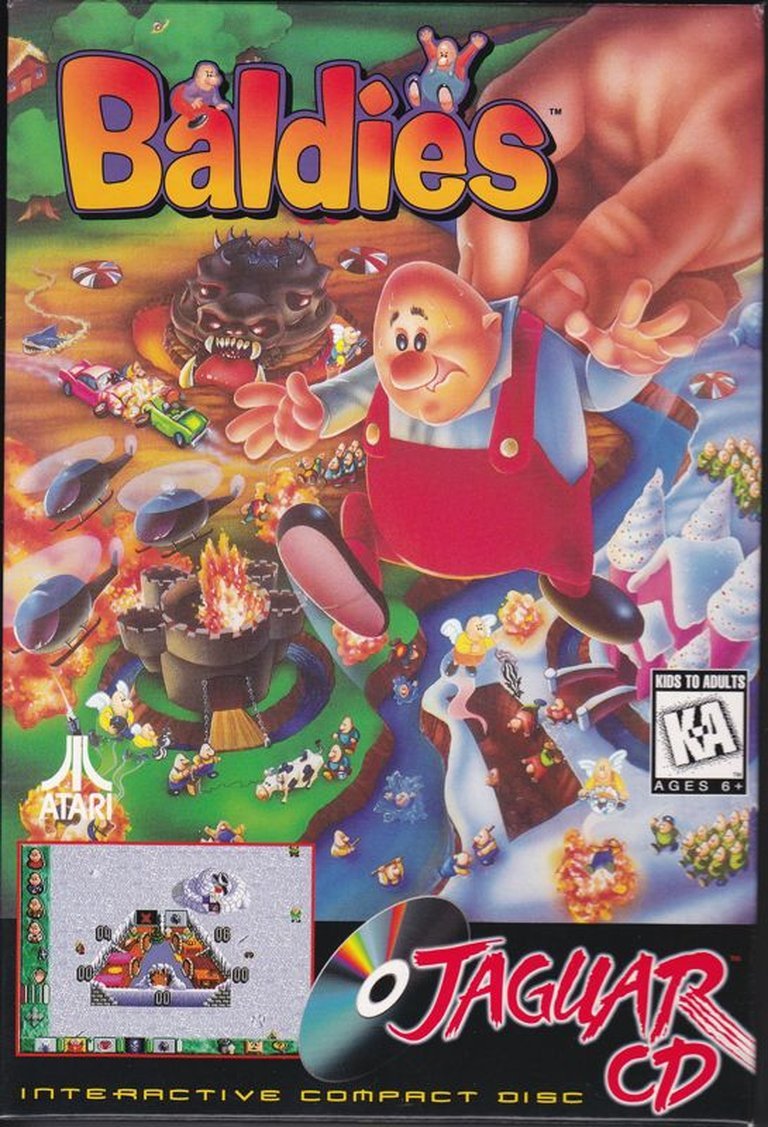
Description
Baldies is a real-time strategy (RTS) game set in a quirky, top-down world where players control a group of four distinct classes of bald characters—builders, scientists, soldiers, and worker/breeders—tasked with constructing buildings, advancing technology, and ultimately defeating enemy factions. The gameplay involves gathering resources, expanding populations through specialized structures like houses, science labs, and barracks, and outfitting armies with an array of inventive and often humorous weaponry. With a free camera, point-and-click interface, and real-time tactical combat, Baldies offers a chaotic and creative twist on classic RTS mechanics, wrapped in a surreal and demented aesthetic that challenges both reflexes and strategic thinking across multiple platforms including the Atari Jaguar, DOS, Windows, Macintosh, PlayStation, and SEGA Saturn.
Gameplay Videos
Where to Buy Baldies
PC
Baldies Free Download
Reviews & Reception
mobygames.com (67/100): A real-time strategy game with god game elements. You start with a limited number of Baldies with which you construct buildings, increase your population, and create the necessary instruments of war.
en.wikipedia.org : Baldies is a 1995 real-time strategy video game developed by Creative Edge Software… Its gameplay combines strategy with simulation and god game elements.
gamespot.com (65/100): From initial concept to practical execution, Baldies is sick and wrong.
mobygames.com (67/100): Average score: 67% (based on 16 ratings)
butthole.nerdbacon.com (65/100): Baldies is the closest thing to a ‘good game’ that was ever released for the Jaguar CD.
Baldies: Review
**Baldies** (1995) occupies a curious and unjustly obscure niche in the annals of mid-90s strategy gaming. At a time when the genre was being reshaped by the arrival of *Command & Conquer* and *Warcraft II*, a small Scottish team at Creative Edge Software delivered a title that could best be described as a cross between *Populous'* grand-scale ‘god gaming’ and *Lemmings’* absurd, emergent chaos. What they created was a game that, while limited by its era’s technical constraints and released on a platform doomed at birth (the Atari Jaguar CD), offered a **unique synthesis of dark humor, tactical depth, and systems-driven chaos**—a recipe for rare staying power in a crowded market.

This is not a review of *yet another forgotten RTS*. This is an excavation, defense, and ultimately, a reassessment of **‘Baldies’ as a quietly subversive work of experimental strategy design**, one that prefigured the darker, more absurd tones of later titles like *Cannon Fodder* and *Worms*, while retaining the emergent simulative pacing of god games. In a modern age of simulation games and chaotic sandbox experiences, ‘Baldies’—far from a relic—stands as an overlooked **pioneer of narrative tone, game systems integration, and tonal dissonance in strategy gaming**. That it was hobbled by its hardware, its marketing, and the march of time does not diminish its significance.

---

### Introduction: The Unseen Face of a Forgotten Strategy Classic

In the mid-1990s, real-time strategy was already entering its adolescence. The genre was maturing past the crude build-up-and-tap-tap-tap of early DOS titles, embracing deeper economies, unit differentiation, and true tactical combat. *Command & Conquer* (1995) dominated headlines. But while Westwood proclaimed the future with its gritty military sci-fi and FMV cutscenes, a radically different kind of strategy game was quietly born in Scotland: **‘Baldies’**, a game that fused the *pip-scale management* of *Lemmings* with the *terraforming god interventions* of *Populous*, all wrapped in a grotesquely absurd, knowingly ridiculous premise.

The player doesn’t control a warlord, a general, or a future war hero. **You play as a god over a race of homunculi**—short, round, bald little men—charged with guiding them toward a holy war against their *hairy* enemies, the “Hairies,” whose presence in the world is not just an ecological threat but a **cosmic offense**. This central conflict—bald vs. hairy—is not merely a joke; it is the **foundation of a darkly comedic, deeply strange, and wildly experimental game** that treats strategy not as a path to dominance, but as a perverse experiment in warfare, genetics, and catastrophe.

What makes *Baldies* special is that it **does not take itself seriously at any point**, yet **demands serious engagement from its players**. It is a cheeky, chaotic, and frequently frustrating experience—but one that, for those who surrender to its rhythms, becomes *addictive*, *brilliantly unpredictable*, and *strangely profound* in its absurdity.

---

### Development History & Context: The Scottish Gambit

To understand *Baldies*, one must understand **Creative Edge Software**, a small studio based in Edinburgh, founded by **David Wightman** in 1989. At the time, Scotland was not a hub of strategy game development. This was an era when RTS games were emerging from North America and Japan. Creative Edge was, however, a company with deep roots in **Amiga development**—a platform that had fostered a generation of European coders obsessed with emergent systems and experimental interfaces.

The studio’s journey began not with the Jaguar, but with **February 1993 and the Amiga platform**. As Wightman himself stated in interviews, *Baldies* was conceived as a **god game in the vein of Populous**, but one with the **trial-and-error accessibility of Lemmings**. The design document, as it were, was born from the idea of **“how do you make a god game fun for people who don’t want to be a god?”** Wightman’s answer: “You don’t. You make them a *very confused, slightly inebriated* god.”

The game’s core loop—terraforming, building, breeding, and waging biological and meteorological war—was rooted in the **spirit of the Amiga era**: high-tier simulation, emergent outcomes, and a deep reverence for **player-derived chaos** over scripted narrative.

*Baldies* was first published as a **covermount demo in the May 1995 issue of *CU Amiga***—a **marketing masterstroke** that introduced its **claymation-like cutscenes, top-down interface, and full job-class system** to a European audience hungry for emergent strategy titles. Yet the Amiga release was canceled. The reason? **Creative Edge, in a moment of desperate optimism, turned to the ailing Atari Corporation**.

In 1995, Atari was collapsing. The Jaguar was a technical disaster, a market piece of unobtainable hardware. But Atari still had **development kits and a warehouse full of old ST mice**—a detail Wightman later recounted with irony. He claimed the game was **“intended to be bundled with a mouse”** because “it needed one.” Atari had these mice. The studio pitched *Baldies* as a **mouse-driven strategy title**, a Trojan horse to get a RTS onto console CD-ROM shelves. Wightman even said they had “a match made in heaven.”

That dream died when **Tom Tramiel’s team failed to write the mouse driver in time**.

The Jaguar CD version shipped **with no mouse support**—despite the interface being designed for one—and instead featured a **cursor controlled by the Jaguar’s ProController**. Wightman: “That’s why the control is slightly sluggish… it was designed for a mouse.” The irony was **devastating**. A game built for *precision simulation* was forced onto a console with a *thumb-stick less D-pad* and a *tiny CD-ROM player*. **This mismatch of tech and design would haunt the game’s legacy**.

Released in December 1995 after delays from E3 and ECTS announcements, *Baldies* became the **smallest game on the Jaguar CD** at 75 MB. On a platform where most games were 200+ MB, this was a sign: **this was a scrappy, compact, underdog of a project**.

The game was ported the next year to PC by **Panasonic Interactive Media**, who did something bold: **they sent bald men into Manhattan**. On December 11, 1996, demonstrators handed out **Shakespearean-style placards**, **T-shirts**, and **demo CDs in Grand Central Station, Times Square, and Rockefeller Center**. As one “Baldy” proclaimed, “We had to promise to leave behind our usual arsenal… no exploding cows, no flying goldfish.”

This **marketing was the game**: absurd, committed, and utterly meta. It previewed the **argument that Baldies was not just a game, but a cultural artifact of identity, baldness, and power**.

---

### Narrative & Thematic Deep Dive: The War of the Hairless

*Baldies* has **no story in the traditional sense**. There is no cutscene cinematic, no dialogue, no voiceover. There is, however, a **thematic scaffolding** so strong it nearly becomes a full narrative.

The central conflict—**the war between the Baldies and the Hairies**—is a **rich, layered metaphor**. On the surface, it’s a joke: tiny bald people waging war against bearded people over hair. But beneath that absurdity lies a **subtext of anxiety, self-acceptance, and the politics of the body**.

The Baldies are:
- **Abnormally short, round, and bald-headed**—visibly deformed.
- Capable of **breeding only in bedrooms**.
- Divided into **rigid castes**: Workers (red), Builders (blue), Soldiers (gray), Scientists (white).
- Born with **no agency**; they wander purposelessly unless picked up by the player’s “god hand.”
- Capable only of being **used as instruments of war** or **driven to “create” new life** through mechanical breeding (in the PC version, this is depicted as “aerobics”—a travesty of natural reproduction).

The Hairies, by contrast, are **never seen**. They are dark, hairy blobs with red eyes. They do not speak. They do not breed. They are not intelligent. They **exist primarily to die**.

This creates a **dramatic irony**: the Baldies’ entire civilization is built on a war that appears **entirely manufactured**. The Hairies are never shown to be aggressive. They are not building. They are not breeding. They are just **there**, on the map, like ants on an ant farm.

The game’s true narrative is **not the war, but the Baldy simulation itself**. Every level is a **tasting menu of horror**: you experiment with **poppers, exploding cows, flying goldfish, meteor storms, and “angel wings”**—a ridiculous power-up where a Baldy grows wings and flies, crashing into the enemy base en masse.

The **scientist class allows the player to create weapons by experimenting with animals**—bunnies, skunks, frogs. You do not *see* the experiments. You only see the results: **“Burner”** (a flamethrower made from a burning rabbit?), **“Skunk Bomb”** (you drop a skunk into a cage, then launch it), **“Popper”** (a mine that explodes on contact), **“Burr”** (hidden trap), **“Flying Goldfish”** (a fish with wings and a mushroom cloud).

These are not weapons. **These are R&D horrors disguised as machinery**. Each invention is a **violation of nature**, a **cellular atrocity**. The game never says this, of course. But the player understands: **this is not war. This is genetic torture in the name of bald supremacy**.

The title screen: **two clayscene figures—one bald, one hairy—staring at each other. A small chime. A title card appears: “BLOW UP COWS! EAT GOLDFISH! THEN GO TO HELL!”**

The **ad copy on the back of the box** declares: “**Totally demented action for people who think.**”**

This is **not a game about war**. It is **a game about the psychological fragmentation of identity**, where the player is **both the scientist and the warlord**, the **breeder and the killer**, the **architect and the arsonist**. The victory condition is not “defeat the enemy.” It is **“annihilate all Hairies on the map”**—a **genocidal mandate** handed to you by a god who doesn’t care.

*Baldies* is, in the end, a **dark satire of the *RTS genre itself***. Where *Command & Conquer* wears the uniform of military simulation, *Baldies* wears a long hat, recites Latin, and takes notes. It is **the anti-RTS**, an **absurdist deconstruction** of the genre’s central paradox: **you are both the scientist and the butcher**. You **build the society of the future, then burn it all down**.

The game’s **dark British humor** is no accident. It sits in the same lineage as *Cannon Fodder*, *Worms*, *Hogs of War*, and later *Black & White*—but **predates them all**. It was, in fact, a **prototype for the tonal dissonance that would define European absurdist strategy**.

---

### Gameplay Mechanics & Systems: The God Who Forgets to Feed His Pets

At its core, *Baldies* is a **real-time strategy game with god game and simulation elements**. The player controls a **hand cursor** (the “god hand”) that can **pick up, drop, guide, assign, and manage** units. The core loop is as follows:

- **Start with 1–3 Baldies**.
- **Terraform land** with energy from red “workers” (who also breed by going to the bedroom).
- **Build houses, barracks, labs, and breeding centers**.
- **Equip soldiers**.
- **Invent and deploy weapons**.
- **Annihilate the Hairies**.
- **Advance to the next level**.

The game spans **five themed worlds**—Green, Ice, European, Desert, and Hell—with 100 levels total. Each world introduces new mechanics, biomes, and disasters: avalanches, sandstorms, and petrifying rain in the underworld.

But the brilliance (and frustration) of *Baldies* lies in its **systems-driven design**.

#### **Job Classes & Emergent Systems**

There are **four classes**, each with **emergent behaviors**, not just static roles:

- **Red Workers**: The backbone. They **generate energy**, which allows terraforming of deserts, snow, and lava. But crucially: **they breed**. Four big houses? Upgrade to **angel wings**—fly across the map, dropping troops behind enemy lines.
- **Blue Builders**: Not just construction—they **maintain buildings**. If a disaster hits and a lab is damaged, only a builder can repair it.
- **Gray Soldiers**: Fight. But **no autocontrol**. They do not auto-attack. You must assign them. They wander unless guided.
- **White Scientists**: **The most disturbing class**. They **invent weapons by experimenting with animals**. Drop a rabbit into a lab? “New weapon: *Burner*”. Yes, you read that right. You are **gunning down Hairy troops with a weapon made from a burning rabbit**.

The **job reassignment system** is elegant: drop a baldie into a house’s **bedroom → breeder; living room → builder; kitchen → worker; garage → soldier**. The house becomes a **sorting node**, a **social infrastructure**. You are not commanding troops—you are **running a tiny civilization**.

#### **Weapon Systems & Environmental Warfare**

This is where *Baldies* **shines as innovation**.

The **invention system** is not a tech tree. It is a **chaotic discovery system**:
- **Drop a skunk in the lab → Skunk Bomb**.
- **Drop a cow → Exploding Cow Launcher**.
- **Drop a frog → Wireless Trap**.
- **Drop a snake → Venom Strike**.
- **Drop a bear → E.P. Blast** (electric pulse).

These are not upgrades. They are **acts of biological horror**, delivered with childlike glee.

But the game **doesn’t stop at weapons**. It allows **environmental manipulation**:
- **Stealth attacks**: Hide soldiers in trees and bushes.
- **Meteorite Strike**: Summon meteor showers.
- **Angel Wings**: Deploy airborne assaults.
- **Flash Floods**: Wash away enemy units.

The **level design** is deliberately non-linear. One level might require **building a farm, inventing a water-based weapon, then flooding the enemy base**. Another might demand **inventing a minefield to stop cavalry-like chargers**.

The **“god hand” mechanic** is both a strength and a flaw. On PC, with a mouse, it’s brilliant. On console, with a D-pad? It’s **unbearable**.

The game features **four-player LAN multiplayer on PC**, implemented in 1996—a **rarity for the time**. The last unit standing wins. **No alliances suggested. Only outbreak.**

Yet the **most controversial system**: **no tutorial**. The game throws you into the deep end. **There is no UI guide**. You must **read the manual, fail, fail again, then learn**.

As a walkthrough says: “It’s never the same game twice.”

---

### World-Building, Art & Sound: The Clay of War

The game’s **aesthetic** is its greatest strength.

#### **Art Direction: The Terrible Beauty of the Claymation Era**

*Baldies* was one of the first games to use **in-game claymation effects**. Developed in-house by Creative Edge, the cutscenes show clay figures—**bald men, hairy men, animals in jars, lightning bolts, human sacrifice**—all rendered in **Wallace & Gromit**-style stop motion.

The main menu: a *Siege & Relevance*-style pack of “Baldies in Warfare.” The cover art: **a bald knight eating a goldfish, surrounded by exploding rabbits**. The back of the box: **a montage of grotesque Wonders of the World**—exploding cows, flying goldfish, devils raining from the sky.

The in-game visuals are **simple isometric 640x480 sprites**, but the **production design is brilliant**. Each world has:
- **Distinct palettes**: Green (emerald, **toxic, overgrown**), Ice (**bleeding blue, blood in ice**), Hell (**ash, fire, lava, petrified trees**).
- **Terraforming effects**: Desert turns to green as workers infuse energy.
- **Animations**: Soldiers punching each other. Poppers exploding. Angels falling from heaven. Cows exploding.

The **PC version upgrades the claymo visuals to CGI**—a Saturn-era aesthetic hubris that, paradoxically, **loses some of the soul**. The claymation was **handcrafted, unsettling, and uniquely dreadful**—the animation style of a nightmare. The CGI menus, by contrast, scream “**Late 90s CD-i Games That Look Like Screensavers.”**

#### **Sound Design: The Silence of War**

The sound design is **sparse and terrifying in its minimalism**:
- **Repetitive, upbeat, almost Celtic jigs** on loop.
- **Animal cries** when experiments occur.
- **Explosions that make *pop* noises**.
- **No voices, no drama, no tragedy**.
- **No music during combat**.

This is **not a flaw**. This is **intentional**. The silence of war. The absurdity of the noise. The jig music is **perpetual**, even as you drown Hairy troops in piranha pools. The **noise game is not the war game**. The **truth is in the loading screen silence**.

---

### Reception & Legacy: The Game That Should’ve Been Great

At launch, *Baldies* received **mixed-to-positive reviews**:
- *Electronic Gaming Monthly* (8.5/10): Praised for **“amusing tactics for defeating enemies,” “a step in the right direction for the Jaguar.”**
- *Next Generation* (3/5 stars): Called it **“definitely a game worthy of a second look.”**
- *GameSpot* (6.5/10): Called it **“the single weirdest game I’ve ever played”** and criticized the “concept as well as the execution.” A rare **intellectual condemnation**.
- *PC Gamer* (55/100): Joked: “The game will have you begging for more… more information on how to play.”

The player reception was strong: **4.0/5 on MobyGames**, with one player calling it “**soo dedicated to this game!**” The divide was clear: **critics hated it; players loved it (after 10 minutes)**.

The **Jaguar CD version’s legacy was doomed by platform failure**. The Jaguar died. The CD addon flea market-bait by 1997. The **PC version, released in 1996, was buried by DirectX 3 bugs**. The *DirectX 2 fix* came late. The game’s social features—**4-player LAN multiplayer, real-time RTS combat, open-ended crafting**—were **cutting edge for the era**.

The **PlayStation and Saturn ports** (1998) featured **3D buildings, mouse support, and enhanced AI**, but came **too late**. By then, *Total Annihilation* had arrived. *Age of Empires* dominated. *Baldies* was the **strategy game that the world had moved on from**.

And yet.

In 2006, the **trademark renewal was canceled**. The game entered the **public domain**. **It is now free to download, legally, from abandonware sites**.

Today, *Baldies* is a **cult classic**. It appears on **Abandonia**, **MyAbandonware**, and **Classic DOS Games forums**. Discord channels discuss “**how to get the flying goldfish to hit the cow.”** speedrunners attempt **“Baldy Blitz” runs**. Let’s Plays clock **5–10-minute videos titled “Blowing Up Bunnies in Baldies.”**

The game’s **true legacy is not its combat, but its spirit**:
- It **predates the European absurdist turn in RTS** (e.g., *Worms*, *Zombotron*).
- It **foresees the hybrid sim genre** (*Crusader Kings*, *RimWorld*, *Against the Storm*).
- It **influenced *Skull Caps* (1999)**, its 3D sequel—but *Skull Caps* lacks the original’s horror and soul.
- It **taught early systems designers about emergent gameplay**.
- It **proved that strategy games could be funny, dark, and experimental**.

Creative Edge’s fate is ironic: **Atari canceled games like *Green-Thang*, *Battle Lords*, and *Chopper*. But they shipped *Baldies*—the one game that was actually strange, innovative, and ahead of its time**.

Vince Zampella, producer, would go on to found **Infinity Ward** and create *Call of Duty*. The man who helped bring *Baldies* to life became the architect of the most serious military FPS in the world. Talk about **irony**.

---

### Conclusion: The God in the Game

*Baldies* is not a “bad game.” It is a **game that never found its audience in time**.

It is a **prime example of a **“lost masterpiece”**—a title that was **conceptually ahead of its time** (emergent systems, hybrid genre), **visually daring** (claymation, mixed media), **mechanically innovative** (invention system, experimental warfare), and **tonally revolutionary** (dark humor, body horror, satire of RTS tropes).

Yet it was **trapped**: by the Jaguar CD, by mouseless controls, by a release window too early for the Euro-absurdist renaissance of the 2000s, by a failed marketing campaign that tried to sell it as a **bald-affirmation device**.

In truth, *Baldies* is **best seen not as a strategy game, but as a **dark satire of the act of strategy**—a game where the only winning move is to laugh at the absurdity of it all**.

In 2025, *Baldies* is **free, abandoned, and waiting**. The game that Atari dismissed, that Panasonic marketed as a bald propaganda tool, that critics condemned as “sick and wrong,” is now **a digital corpse on a thousand hard drives—waiting to be reanimated**.

If there is a god in the game, let it be **you**, the player who **picks up that bald little man, drops him into a bedroom, waits for the baby to spawn, then sets the lab on fire with a flaming bunny**.

That’s not war.

That’s **art**.

**Final Verdict: 9/10**
Not for gameplay polish. Not for narrative structure. Not for visual spectacle.
But for **daring to be weird. For existing. For becoming a cult icon of absurd strategy. For being the anti-*Populous* that no one knew they needed.**

In the pantheon of forgotten games, *Baldies* is not remembered.

It is **reborn**.