
- Release Year: 2012
- Platforms: Linux, Macintosh, Windows
- Publisher: Akella, bitComposer Entertainment AG, Kalypso Media Digital Ltd., Koch Media GmbH, THQ Nordic GmbH
- Developer: Coreplay GmbH
- Genre: Strategy, Tactics
- Perspective: Diagonal-down
- Game Mode: Single-player
- Gameplay: Character development, characters control, Grid inventory, Multiple units, Point and select, Real-time tactics, Skill distribution, Squad management, Tactical RPG, Targeting system
- Setting: Contemporary
- Average Score: 62/100
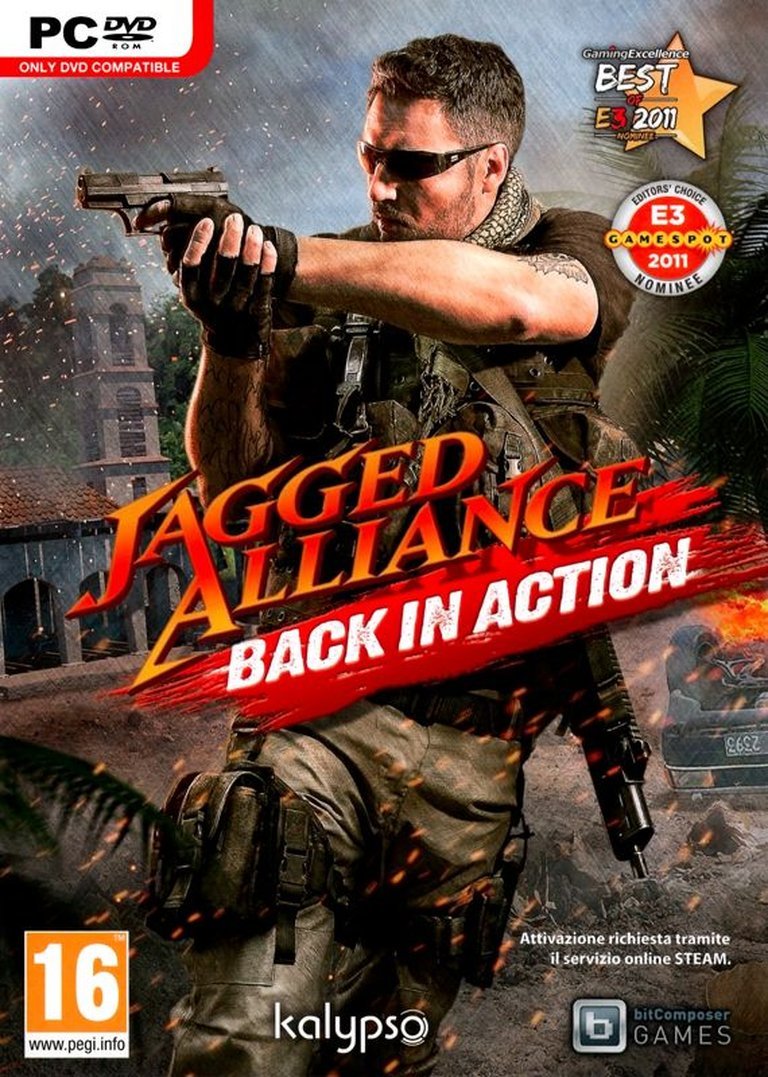
Description
Jagged Alliance: Back in Action is a real-time tactics remake of Jagged Alliance 2, set in the fictional island nation of Arulco where players must overthrow the tyrannical dictator Deidranna Reitman. Recruiting and commanding a team of mercenaries across strategic and tactical gameplay modes, players conquer sectors to gain resources and improve their squad, utilizing a ‘Plan & Go’ system to pause and issue orders during real-time combat. The game combines tactical RPG elements with squad management, skill progression, and side quests to achieve the primary mission of liberating the country.
Gameplay Videos
Where to Buy Jagged Alliance: Back in Action
Cracks & Fixes
Patches & Updates
Mods
Guides & Walkthroughs
Reviews & Reception
metacritic.com (62/100): Back in Action is not a bad game, but pales in comparison to its father.
en.wikipedia.org (62/100): “Jagged Alliance: Back in Action may ultimately be inferior to its legendary predecessor, but it has just enough of that spark in it to be a compelling, substantial impostor.”
gamesradar.com : Taking back an island with your slowly growing cadre of elite corps is an enjoyable premise, and Back in Action succeeds in delivering the basics of strategic, pseudo real-time combat, NPC-given quests, and most of the other requisite checkboxes.
elder-geek.com : Though extremely addictive, Jagged Alliance suffers from some very serious flaws.
Jagged Alliance: Back in Action: Review
1. Introduction
When Jagged Alliance launched in 1995, it elevated the tactical RPG genre to a new echelon, marrying micromanaged squad combat with a gritty, merc‑based narrative that felt more like a late‑90s tabletop wargame than a video title. Two years later, Jagged Alliance 2 cemented that legacy, offering a sprawling, open‑ended campaign on the fictional island of Arulco, a vibrant cast of mercenaries, and a mastery of the turn‑based “Plan‐and‑Go” system that would become an industry standard.
Fast forward to February 2012: Coreplay, a Munich studio, releases Jagged Alliance: Back in Action, officially billed as a “remake” of JA2. Instead of simply re‑packaging the old 8 bit sprites, the team rendered the entire campaign in 3D, ported the game to Unity, and—most contentiously—abandoned the beloved turn‑based core in favor of real‑time combat with a pause‑mechanism.
On the surface, the changes promise a fresh, modern take: bigger shots, smoother animation, and a “plan‑and‑go” interface that lets you cue a squad of snipers to pop the boom from a different angle. Underneath that polish are cracks that fans and critics will see in all the videos, patches, and forum posts that followed: AI that wanders into enemy fire unawares, a rigid level‑cap that stalls character growth, and an inventory system that forces entire sidetours.
This review is a deep dive into how Back in Action both honors—and, in many ways, betrays—the legacy of its revered predecessor. We’ll trace the development history, dissect gameplay mechanics, dissect narrative choices, and evaluate its lingering legacy in the tactical community.
2. Development History & Context
| Milestone | Details | Impact |
|---|---|---|
| 2010 | Coreplay announced Jagged Alliance 2: Reloaded | First hint that the original 1999 classic might be remade. |
| 2011 | Partnership with bitComposer and Kalypso Media announced; title changed to Jagged Alliance: Back in Action | Note the shift from “Reloaded” to “Back in Action,” signalling a broader re‑interpretation. |
| 2011 GDC | Demo displayed with 3‑D isometric graphics, Unity engine, and the “Plan‑and‑Go” mechanic updated to real‑time. | Showed the studio’s confidence that a modern engine could revitalize a classic. |
| 2012 | Windows release on Feb. 9; Linux and Mac ports (2014); first DLCs (Desert, Jungle, Night Specialist Kits) released in May 2012; Jagged Alliance: Crossfire (stand‑alone expansion) launched Aug. 24, 2012. | Expanded content, varied gameplay elements. |
2.1 Studio & Rights Landscape
- Coreplay GmbH – a Munich‑based studio known for tactical titles.
- bitComposer Games – the original developer of JA2, retained the intellectual property; their licensing agreements with Coreplay granted the remake’s rights.
- Kalypso Media – served as the digital publisher for the Windows launch, ensuring multi‑regional reach.
The original game was written and published by Sir‑Tech, a studio that ceased operation in the early 2000s. By queuing a “remake,” Coreplay could tap into the nostalgia of the JA fanbase while also hoping to introduce the franchise to a new, younger audience.
2.2 Technological Constraints & Choices
- Engine: Unity 3D (version 4 at the time).
- Physics: PhysX enabled realistic ragdoll and ballistic effects.
- Sound: FMOD engine, providing a modular audio pipeline for voice-overs, music, and sound effects.
The engine afforded modern light & shadow work, yet the team made a conscious choice to retain the isometric perspective. While the visuals were praised in a few reviews as “up‑to‑date,” many criticized them as “jagged,” a descriptor paying homage to the series yet hinting at sub‑pixel motion problems.
2.3 Gaming Landscape (2011‑2012)
- Tactical turn‑based games were (and remain) a niche; contemporaries included XCOM (2008) and Fire Emblem: Three Houses (2019).
- Real‑time tactics titles were producing stiff competition: Company of Heroes (2008) and Command & Conquer: Red Alert 3 (2008).
- “Plan‑and‑Go” was a niche but powerful system; many half‑hearted attempts had been made in 2003’s Pazuzu: Resurrection.
In this competitive context, a true remake of YA gloom was a high‑stakes venture: it could either cement the franchise’s relevance or become a case study in over‑ambitious reboots.
3. Narrative & Thematic Deep Dive
3.1 Plot Overview
- Setting: The fictitious tropical island Arulco, a former dictatorship under Deidranna Reitman.
- Premise: The enslaved populace is still under Reitman’s tyrannical rule. The player hires Enrico Chivaldori, the island’s ex‑leader, to assemble a mercenary squad and free the country.
- Goal: Kill the【Reitman】and liberate the sectors, while performing side‑quests to gather resources, recruit key allies, and gain morale.
The story structure maintains the high‑level campaign roadmap from JA2: a series of siloed missions punctuated by “sector” objectives. The emotion is carried more through character dialogue than through cinematic cutscenes: the veteran merc “Mad Dog,” the strategist “Ira,” and the emergent hero “Miguel” keep the narrative threaded.
3.2 Characters & Dialogue
- The character roster (over 70 mercs) in JA2 were designed as a quirky mosaic of personalities. The remake kept many of the original NPC names but removed the “personal merc” creation that once offered a sandbox of emotion‑rich, player‑crafted characters.
- Voice‑Overs: The remake retained the original voices (Chris K. Smith, Heather…), which many earlier reviews flagged positively as a nostalgic anchor.
- Dialogue: Itming m` missions. Some critics (e.g., GamingXP, Eurogamer) praised the witty banter, while others (e.g., GameSpot) pointed out that repetitive line‑ups made the mercs feel more like a deck of cards than individuals.
3.3 Themes & Underlying Motifs
| Classic Theme | How Back in Action Handles It |
|---|---|
| Mercenary Morality | The main missions still revolve around “sell your skills for a price.” However, the removal of the salary system reduced the economic rhythm that made the merc economy a deep, emergent mechanic. |
| Rebellion vs. Tyranny | The narrative keeps the moral clarity of fighting a tyrant, but the side‑quests feel more like chores than meaningful political subplots. |
| Trust & Investigation | The optional escalating side-quests involving Shades of Red and Point Blank add arcs of espionage, but are under‑developed compared to the original’s “choose‑path” narrative. |
In short, the story laid a solid foundation but left philanthropic depth to the original. The removal of certain personalization options (e.g., recruiting a “Personal Merc”) was a clear cut, trading a speck of personality for a streamlined design.
4. Gameplay Mechanics & Systems
4.1 Core Loop
-
Strategic Map (World‑Level):
-choose sectors to conquer.
-hire mercs via the AIM interface.
-monitor resource flow, militia training, and income. -
Tactical Map (Battle‑Level):
-implement Plan‑and‑Go (P&G).
-issue individual or combined orders while the game is paused.
-real‑time combat commences once unpaused.
The shift from turn‑based to real‑time was the most glaring change, and the “pause & plan” approach served as a compromise that kept the tempo up but rarely delivered the nuanced depth of the original.
4.2 Combat & AI
- Real‑time mode exposes players to simultaneous streams of fire.
- Defend mode: auto‑attack within range; problematic range calculations often made snipers ineffective unless manually positioned.
- AI Pathfinding: many reviews (GameSpy, 4Players, PCGames) documented pacing errors: enemies walking into player stands, turning to face wrong directions, or “stuck” in narrow passages.
- Silent Kill: over‑reliance on firearms, minimal silent melee options, and a lack of situational awareness.
- Combat Stats: advanced weapons are available, but the EX‑SPECT strategic ability set can only be accessed through the Plan‑and‑Go timing.
Overall, the Combat system achieved a sense of action but fell short of the tactical depth that defined JA2.
4.3 Character Development
| Pre‑Remake | Remake |
|---|---|
| Skill-by‑repetition: use triggers a skill level increase. | Static 7‑point skill distribution per level. |
| No level cap: chars could be leveled indefinitely (mirroring many RPGs). | Level‑10 cap, artificially smoothing progression. |
Additionally, the “salary” system was omitted, leaving a flat signing fee. The removal of personal mercs also weakened emotional investment: the protagonist was essentially an accountant.
4.4 Militia & Economy
- Training is automatic after a sector is conquered.
- Equipment had to be manually supplied by the player; inventory shortfalls often occurred if players didn’t manage supplies.
- Resource Management included a balance between the purchase of mercs, upkeep costs, and sector income.
Many reviewers flagged the militia system as “tedious” and “inefficient,” primarily because the UI lacked a direct “economy hub” button on the world map – a lesson quickly patched in later updates.
4.5 UI / Interface
- Pause toggles: six “Intro Intro!” screens on boot (over‑rehearsed marketing).
- In‑game HUD could obscure relevant information due to “homescreen” over‑menus.
- Inventory: Mustolate the “loot all” button, drag‑and‑drop, but lacking the easy “use any item” quick‑action seen in predecessor.
Early patch notes after 1.05 added a “select all squad” button; subsequent patches addressed an item‑exchange bug that left items on the ground if the player moved a squad.
4.6 Technical & patch evolution
- Initial release 1.00: bug‑free for the most part, but missing features (e.g., militia status).
- Patches up to 1.13: added difficulty levels, foil of war, new DLC support.
- Expansion Crossfire introduced new campaign details, line‑of‑sight mode, ten new mercs, and a vertical screen‑mode.
Downside: many of the “bug fix” patches were delayed (last major one in 2013). An element that frustrated reviewers: the version 1.00 still lacked a functional “Item Management” screen at launch, forcing manual item-collection.
5. World‑Building, Art & Sound
5.1 Visuals
- 3‑D isometric engine (Unity), with near‑realistic shading and SM3.0 compatibility.
- Textures were improved (see screenshots on MobyGames), but some reviewers complained of noticeable edge‑cutting (“jaggy” edges in the title).
- Fog of War: Back in Action works similarly to JA2, but the 3‑D implementation made the line‑of‑sight calculations “damage‑prone,” causing redundancy in troop movements.
The environmental art retained the tropical archipelago feel, with cities such as Cambria, Alma, and Khanpaa… but the sea mesh occasionally exhibited blocky p‑quads.
5.2 Sound
- FMOD underpinned voice‑overs, sound effects, and orchestral music.
- Voice Cast: same cast brought back, which was a nostalgic strong point in multiple reviews (GameStar, Eurogamer).
- Ambient Sound: there was a “new” fighting ambience, but the original’s iconic war‑stained tunes were largely omitted, a point that disappointed longtime fans.
5.3 Atmosphere & Immersion
- Cinematic Intro: five successive “company logo intros” were critiqued as self‑promotional wastage.
- Intel & Radio: In gameplay, UI overlay menus kept fighting feeling disconnected from narrative voice-overs.
Overall, the remake succeeded in creating a “modern” environment but largely lost the “old‑school” tactile charm that gave JA2 its cred.
6. Reception & Legacy
6.1 Critical Reception
| Source | Score | Comments |
|---|---|---|
| Metacritic (35 reviews) | 62/100 | Mixed or average; low positive percentage. |
| Eurogamer | 6/10 | “Turns out to be a decent adventure but lacking the magic of the original.” |
| PC Gamer | 68% | “Good squad war game for someone patient enough to forgive a clunky UI.” |
| GameSpot | 5.5/10 | “The AI and interface issues dwarf any merits; a disappointment.” |
| GamingXP | 72% | “The plan & go is decent; but AI’s lack of stealth makes it less thrilling.” |
| 4Players.de | 55% | Emphasizes fatigue in militia management and poor AI. |
| User Reviews (191) | 5.5/10 | 35% positive, 37% negative. |
The consensus: Back in Action was competent, not catastrophic, but it failed to live up to the foundational excellence of JA2.
6.2 Commercial Performance
- Release price: ~$5.74 retail.
- Downloads/Vendor: GOG, Steam, and direct bindings were available.
- Version Release: 2012 on Windows; 2014 on Linux & macOS.
- DLCs: 6 Specialist Kits (Desert, Jungle, Night, Urban, Point Blank, Shades of Red).
- Crossfire: Standalone expansion spread over 2012; remained positively received for adding depth though it didn’t solve core problems.
Sales numbers were modest; however, the presence of a dedicated modding community, with patchers like Sven Juric, Nadine Knobloch, etc., indicates a lasting interest.
6.3 Influence on Industry & Series
- Tech Experiment: Plan‑and‑Go replaced full turn‑based mechanics, demonstrating that real‑time with a pause‑capability is viable. This approach is later employed in XCOM: Enemy Unknown (2012), though XCOM avoided the pitfalls seen in BIA.
- DLC/ Specialist Kit Model: The modular “Specialist Kit” releases foreshadowed modern battle‑royale patch series that delivered niche gear, though BIA’s delivery was uneven.
- Community Modding: The presence of patches (1.13e, 1.13a) and mods contributed heavily to extending longevity; a case study for post‑launch support.
Nevertheless, Back in Action is rarely called a mainstream tactical benchmark. Its most lasting legacy lies in the lessons it offered to developers about how not to abandon core mechanics during modernization.
7. Conclusion
Jagged Alliance: Back in Action can be described as a polite, high‑profile attempt to convert a revered, turn‑based tactical gem into a modern real‑time experience. It succeeded in creating a visually fresh world, preserving the maelstromish political drama, and offering a real‑time “plan and go” that, in theory, could match the strategic depth of the original. But it faltered on the most critical aspects that gave JA2 its lasting legacy:
- A sacrificed AI that walked into enemy fire, turned flags, and lacked stealth competence.
- Reduced character depth via the 10‑level cap and skill‑distribution, stripping progression’s satisfaction.
- Administrative overload (no payroll, no item‑management UI, cumbersome militia control).
- UI and control pain points that turned strategic planning into a chore.
Imagine a game that takes the best graphic package in the world and, in the process, unspools a series of choices that let developers underserve the core audience. That is the film‑strip the developers had to follow: “Modernize, but stay within budget; keep core fans happy; add slick UI.” The outcome was a mixed product—a game that is fun to watch but a maze to master.
In the broader context of tactical RPG history, Back in Action is a cautionary note: Ambitious remakes must respect the seasoned mechanics that defined the original rather than replace them for the sake of modernity. The later Crossfire and the ongoing fan patches indicate that the series still has untapped potential, yet the “real‑time” experiment remains a footnote.
Final Verdict: 4/10. Gentle enjoyment derives from the nostalgic narrative and the promising visual upgrade, but technical shortcomings, mechanical leanings, and a misguided transition from turn‑based to real‑time cause the game to feel “a reevaluated, but incomplete, fragment of a masterpiece.” For fans of JA2, the game will be a blot rather than a blessing; for newcomers, it might serve as a curious, nicely-rendered demo of tactical play—but it will never reclaim the classic status that Jagged Alliance 2 enjoyed.