
- Release Year: 2012
- Platforms: Windows
- Publisher: Big Fish Games, Inc
- Developer: Vast Studios Inc.
- Genre: Adventure
- Perspective: Fixed / flip-screen
- Game Mode: Single-player
- Gameplay: Hidden object, Mini-games
- Setting: Detective, Mystery, Vansig family mansion
Description
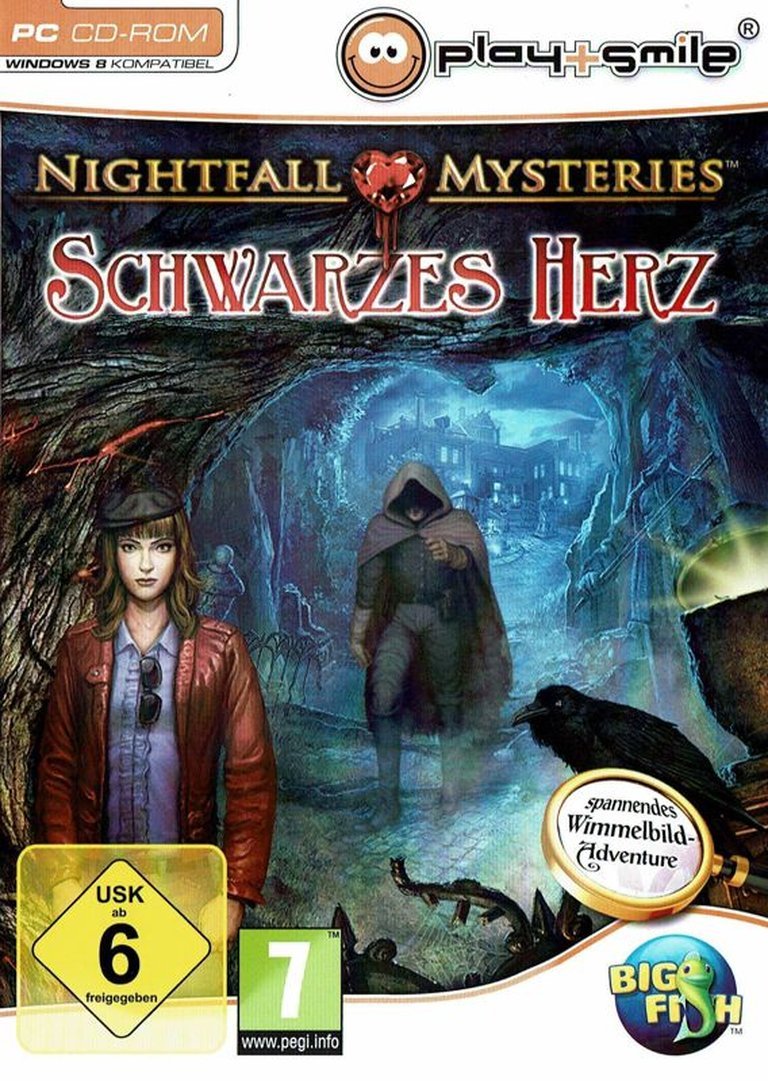
Nightfall Mysteries: Black Heart is the third installment in the popular adventure series, where players must rescue the kidnapped Viggo and Christine from the foreboding Vansig family mansion. This game combines hidden object searches, mini-games, and adventure elements in a dark, atmospheric setting. With customizable options including an ‘Extreme’ difficulty mode for no hints, players are immersed in a mysterious and challenging experience. While some critics noted outdated visuals, others praised the game’s engaging narrative and solid gameplay, making it a worthwhile addition to the series.
Gameplay Videos
Nightfall Mysteries: Black Heart Guides & Walkthroughs
Nightfall Mysteries: Black Heart Reviews & Reception
gamezebo.com : Nightfall Mysteries: Black Heart proves that even a good series can get a little long in the tooth
Nightfall Mysteries: Black Heart: Review
In the shadowed landscape of point-and-click adventure and hidden object games (HOGs), few series managed to carve out a distinct niche quite like the Nightfall Mysteries. Born from the creative crucible of Vast Studios and championed by the digital distributive powerhouse Big Fish Games, the series blended gothic horror with classic detective tropes, creating a legacy that, while not always lauded, was consistently intriguing. But legacies are tested by time, and as a franchise matures, it risks calcifying into a formulaic echo of its former self. This is the precarious position occupied by Nightfall Mysteries: Black Heart, the third installment in a saga that began with the promising Curse of the Opera and continued with the well-received Asylum Conspiracy. As a professional game journalist and historian, I have delved into this title’s digital archives, examining its mechanics, its narrative, and its place in the pantheon of casual gaming. My thesis is this: Nightfall Mysteries: Black Heart represents a critical inflection point for the series. It is a technically competent but artistically and creatively stagnant sequel that exemplifies the mid-2010s HOG boom’s reliance on established tropes at the expense of innovation, ultimately serving as a competent, if unremarkable, capstone to a trilogy that had once shown such promise.
Development History & Context
To understand Black Heart, one must first understand its creators and the environment in which it was forged. Vast Studios Inc., the Canadian development house behind the title, was a prolific developer in the casual gaming space, particularly during the Big Fish Games era. Their portfolio, as documented on sites like MobyGames, is a testament to their focus on formulaic yet polished hidden object adventures, with titles like Written Legends: Nightmare at Sea and the Dark Canvas series sharing the same DNA as the Nightfall Mysteries entries. The development of Black Heart was a concentrated effort, credited to a core team of 19 individuals, led by Producer Michael Sauro, Art Director Pawel Romasz, and Programming Director Sergey Kloubkov. This structure suggests a well-oiled machine, honed by years of producing content for this specific market. The art direction, spearheaded by Romasz, and the animation work by David Janer and Artur Doroszko, indicate a dedicated focus on visual consistency, even if the final product would be criticized for its “perplexingly grainy visuals.”
The technological constraints of the era are paramount. Released on March 2, 2012, Black Heart was built for an audience of primarily Windows PC gamers, a market dominated by downloadable titles from Big Fish Games. The game operates on a classic “fixed/flip-screen” engine, with static backgrounds and pre-rendered environments that were the industry standard for the genre. This wasn’t a limitation born of ambition but a deliberate choice to ensure stability and compatibility across a wide range of consumer hardware. The game’s business model was also a product of its time: a commercial release, with a “Collector’s Edition” available that included a bonus chapter, wallpapers, and a strategy guide—a common practice for premium HOGs designed to justify a higher price point.
Crucially, the title emerged from a gaming landscape saturated with similar content. The late 2000s and early 2010s were the golden age of the casual HOG. Following the success of titles like the early Mystery Case Files games, the market was flooded with developers imitating the formula: a spooky narrative, lavish (if sometimes repetitive) hand-painted scenes, and a steady stream of hidden object puzzles and brainteasers. Competitors like Artogon (with their Shiver series) and Elephant Games were all fighting for the same disposable income. In this crowded field, Black Heart had to prove its worth, not by reinventing the wheel, but by offering a compelling reason for players to choose the Vansig family’s latest misadventure over the dozens of other gothic mysteries vying for their attention. Its development was less a bold artistic statement and more a calculated exercise in franchise management—a product designed to meet the established expectations of its core fanbase.
Narrative & Thematic Deep Dive
The narrative of Black Heart is a direct continuation of the soap-opera drama that defined its predecessors. The plot, as summarized across multiple sources, is a classic tale of “the one that got away.” Protagonists Viggo and Christine, having seemingly escaped the clutches of the nefarious Vansig family, find their newfound peace violently shattered when an enemy they thought dead resurfaces to kidnap Viggo. Christine, left powerless, must call upon the player—the ever-silent, ever-capable detective—for help. The mission is explicit: delve into the mysterious Blackhill Manor and rescue Viggo from the vengeful wrath of the Vansigs.
On the surface, this is a compelling enough hook, a return to a familiar wellspring of familial evil. The game’s structure is dictated by a clear goal: penetrate the Vansig estate, navigate its many rooms and secret passages, and systematically reclaim Viggo from his captors. The narrative progresses through a series of revelations, each tied to a new area of exploration. The player uncovers the family’s dark history, learns of their various secrets, and pieces together their ancient, sinister plans. However, the plot suffers from a profound lack of genuine tension. As noted in several reviews, the villainy is cartoonish. The elder Lady Vansig, as a character, fails to inspire genuine dread, with one review citing a “Frau Farbassina” accent that undermines her menace. The narrative is less a tightly woven mystery and more a checklist of gothic tropes: a sprawling mansion, hidden catacombs, a creepy nursery, secret rooms, and a family tree riddled with scandal.
The character archetypes are formulaic. Christine is the damsel in distress, her role limited to being the catalyst for the adventure. Viggo is the prize, a passive captive whose presence is felt more through his absence than any active contribution to the story. The Vansigs themselves—Vladd, Victor, Violtta—are less developed characters and more obstacles, each guarding a piece of a larger puzzle. The dialogue, as one can infer from the static nature of the genre, is functional at best, serving solely to deliver exposition and task objectives. The underlying themes of family curses, inherited evil, and the battle between good and malevolence are present but are explored with a shallow brushstroke. There is no thematic depth to uncover; the game simply presents these elements as the foundational pillars of its haunted house setting. The narrative, in essence, is a serviceable vehicle for the gameplay, but it offers little in the way of intellectual engagement or emotional resonance, failing to elevate itself beyond the standard haunted mansion fare.
Gameplay Mechanics & Systems
Black Heart is, at its core, a hidden object adventure game, and its gameplay loops are built entirely around this genre’s established conventions. The experience is a cyclical process of exploration, item gathering, and puzzle-solving. The player is guided by a combination of sparkling hotspots, which trigger Hidden Object Scenes (HOS), and a journal that logs critical clues and collectsible items. The map system, as detailed in the walkthrough, serves as a vital navigational tool, indicating which locations have active objectives, thus minimizing aimless wandering, though backtracking remains a frequent necessity.
The central gameplay loop is as follows: enter a new area, scan the environment for interactive elements, collect items, use those items to unlock new areas or solve environmental puzzles, and progress the narrative. This loop is consistently broken up by HOSs, which are the primary method for acquiring key inventory items. These scenes are, for the most part, straightforward list-finds. However, the game attempts to inject a modicum of variety by integrating “yellow-lettered” items that require an action to be revealed (e.g., “open the box to find the key”) and “green-lettered” items that are the result of combining two or more objects in the scene. While a welcome attempt to break monotony, the implementation is simple and rarely presents a significant challenge.
Beyond the HOSs, the gameplay is dominated by a vast array of inventory-based puzzles and standalone mini-games. The puzzles are diverse, ranging from simple item combinations (using the correct key on the correct lock) to complex, multi-stage environmental puzzles. The walkthrough provides a stunning enumeration of these challenges: assembling a family tree to unlock a door, arranging gears on a control panel to create a circuit, solving a sliding tile puzzle to open the front door, and even a valve-turning mini-game in the Demon Reliquary. These puzzles are generally well-designed, requiring logical thought and observation. The inclusion of multiple difficulty levels, including a punishing “Extreme” mode that disables all hints, as noted by Casual Game Guides, demonstrates a consideration for player skill.
However, the sheer volume of puzzles, while a hallmark of the genre, can become overwhelming. The game often feels less like an adventure and more like a puzzle compendium held together by a thin narrative. Furthermore, the quality of the mini-games is inconsistent. Some are clever and satisfying, while others, as GameZebo‘s review lamented, are “at least two that appear broken and simply cannot be solved, even when using the solution provided by the built-in strategy guide.” This is a critical flaw that can bring the entire experience to a frustrating halt. The user interface is clean and functional, with a clear inventory and accessible journal and map, but it adheres so strictly to genre norms that it lacks any identity of its own. The gameplay is a masterclass in executing the HOG formula, but it is also a prime example of its limitations.
World-Building, Art & Sound
The world of Black Heart is its most significant asset, a richly imagined gothic environment that serves as the stage for the game’s drama. The primary setting, the Vansig family mansion, is a character in its own right. The game unfolds across a diverse array of locations, from the treacherous Blackhill Bridge and the decaying Abandoned Playground to the opulent Grand Staircase, the eerie Nursery, the dark Wine Cellar, and the foreboding Catacombs. This architectural journey is designed to evoke a sense of spatial progression and escalating dread, pulling the player deeper into the family’s accursed domain. The world-building is enhanced by the game’s lore, uncovered through journals, audio tapes, and environmental storytelling, which reveals the complex and tragic history of the Vansig lineage.
Artistically, the game presents a mixed bag. The environments are meticulously detailed, filled with cluttered shelves, dusty artifacts, and ornate furnishings that create a palpable sense of history and decay. This detailed clutter is essential for the hidden object scenes, which, according to GameZebo, are “uncluttered and fairly simple.” The art direction leans heavily into a classic illustrated realism, favoring dark, muted colors with occasional, stark highlights to draw the player’s eye to interactive elements. However, the most consistent criticism leveled at the game, echoed by both Casual Game Guides and JayIsGames, is its technical execution. The visuals are described as “perplexingly grainy” and “blocky, low resolution.” This isn’t merely a stylistic choice; it’s a technical shortcoming that undermines the art’s ambition. The static, slideshow-style presentation, while standard for the time, makes the world feel less like a place to inhabit and more like a series of dioramas to be observed. The brief animated moments, such as the aforementioned crashing helicopter, are so rudimentary they break the immersion rather than enhance it.
The sound design fails to compensate for these visual shortcomings. The musical score, as described in reviews, is “inoffensive but completely unremarkable.” It provides a suitable atmospheric backdrop but lacks any memorable themes or dynamic shifts that would elevate the tension or emotion of key moments. The sound effects are functional but sparse. The voice acting is perhaps the most missed opportunity. While the game features “relatively plentiful” dialogue, the performances are described as “not overly compelling or enthusiastic.” The central villain, in particular, suffers from a caricatured portrayal that prevents her from being truly menacing. The audio-visual experience, in its totality, creates a world that is rich in concept but impoverished in execution. The atmosphere is sustained more by the player’s own imagination, filling in the gaps left by the dated graphics and uninspired sound, than by any tangible power of the game’s presentation.
Reception & Legacy
Upon its release in early 2012, Nightfall Mysteries: Black Heart received a lukewarm reception, a fact reflected in its modest Metascore of 65, based on just two critic reviews. This score places it squarely in the “Mixed or Average” category, a fitting summation of its overall quality. The critical response was a tale of two perspectives, split between those who found a competent genre exercise and those who saw a tired retread.
Casual Game Guides offered a more positive assessment, awarding it an 80%. The review praised the game’s quality puzzles and adventure, noting that it “will satisfy fans as well as those totally unfamiliar with the series.” The reviewer was particularly impressed by the inclusion of the “Extreme” difficulty mode, seeing it as a feature for dedicated players seeking a greater challenge. The verdict was pragmatic: “it may not reinvent the genre, or even reinvent the franchise, but… it serves up quality puzzles and adventure.”
Conversely, GameZebo delivered a scathing 50%, articulating the game’s primary failings. The review argued that while the previous entries were “critically well-received,” the series “doesn’t appear to be aging well.” The game was dismissed as “outdated and disinterestedly half-baked,” with the final, damning conclusion that “with so many better choices on the market, there’s just not much reason to bother with this one.” This critique highlights the competitive nature of the casual market; in a sea of similar titles, merely being competent was no longer enough to guarantee success. Player reviews, though sparse in the official MobyGames record, suggest a similarly divided audience, with some enjoying the familiar comfort of the formula and others finding it tedious and uninspired.
Commercially, as a Big Fish Games title, Black Heart likely performed adequately within its niche, capitalizing on the established fanbase of the series and the platform’s massive reach. Its legacy, however, is far more complex. As the third and final chapter in the core trilogy, it effectively brought the Vansig saga to a close, with a sequel, Haunted by the Past, releasing in 2015 but shifting to a new narrative. In the grander scheme of video game history, Black Heart is not a landmark title. It did not innovate, it did not define a new subgenre, and it has not been the subject of significant academic analysis. Instead, its legacy is as a case study in the mid-2010s casual gaming market. It represents the apex of a specific, formula-driven development model, and also its limitations. It demonstrates that a franchise’s goodwill can only carry it so far before a lack of creative evolution leads to stagnation. For fans of the Nightfall Mysteries series, it is a concluding, if flawed, chapter. For historians of the HOG genre, it is a quintessential example of a sequel that failed to transcend its established conventions, eventually being overshadowed by more imaginatively crafted titles that would soon emerge.
Conclusion
After a comprehensive examination of Nightfall Mysteries: Black Heart, a definitive verdict becomes clear. It is a game of two halves, a title that perfectly encapsulates both the strengths and the weaknesses of the hidden object genre at a specific point in its history. On one hand, it is a meticulously crafted, technically proficient adventure. Its world, though visually dated, is rich in gothic atmosphere and intricate detail. Its gameplay is a robust and satisfying collection of puzzles and hidden object scenes, offering a substantial playtime and a challenge that can be tailored to different skill levels. For a fan seeking more of the familiar, spooky mystery that defined the series, Black Heart delivers exactly that.
On the other hand, this adherence to formula is the game’s ultimate failing. It is a sequel that offers no new ideas, no artistic growth, and no meaningful evolution from its predecessors. The narrative is a rote retread of familiar tropes, the visuals are a product of an era of graphical compromise, and the audio fails to provide any memorable identity. It is the work of a skilled developer operating on autopilot, confident in their ability to execute a proven formula but unwilling or unable to push the boundaries of what a HOG could be.
Therefore, Nightfall Mysteries: Black Heart holds a specific, if minor, place in video game history. It is not a bad game, but it is an unremarkable one. It serves as a poignant coda to the original Nightfall Mysteries trilogy, a final adventure that reminds us why the series was compelling, while also highlighting the creative fatigue that had begun to set in. For the casual gamer looking for a few hours of undemanding puzzle-solving and spooky atmosphere, it is a perfectly acceptable choice. But for anyone seeking innovation, narrative depth, or a truly memorable experience, the vast landscape of gaming offers far superior alternatives. Its legacy is one of comfortable competence, a final ember in a trilogy that burned brightly at the start but flickered out with a sigh rather than a bang.