
- Release Year: 2006
- Platforms: Windows
- Publisher: Cinemaware, Inc.
- Genre: Compilation
- Perspective: Not specified
- Game Mode: Single-player
- Setting: Fantasy
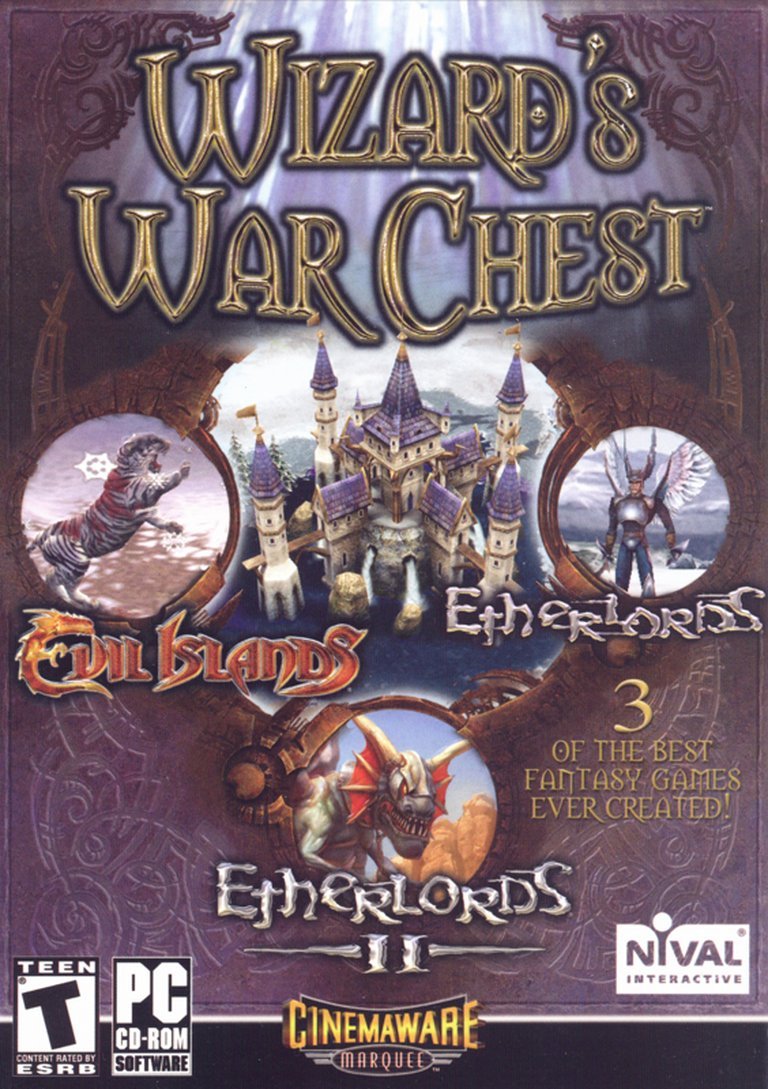
Description
Wizard’s War Chest is a 2006 compilation game that brings together three fantasy titles from Cinemaware: Evil Islands: Curse of the Lost Soul, Etherlords, and Etherlords II. These games combine adventure, strategy, and role-playing elements with rich storytelling and over 300 spells to cast across their battlefields.
Wizard’s War Chest Mods
Wizard’s War Chest Cheats & Codes
Etherlords (PC)
Press ~ to open the console. Enable cheat mode with ‘EtherRevelation’, then enter specific codes.
| Code | Effect |
|---|---|
| EtherRevelation | Enables cheat mode |
| view spells | Gives list of spells and codes for the add command |
| health | Shows your hero’s health |
| add creature (creature code) | Add given creature to combat |
| change what # | Change hero’s current attributes |
| give all # | Give # of all resources save ether |
| hide_hand | Hide enemy’s hand |
| hide_fog | Hide fog of war |
| load | Load mission |
| lose | Lose combat or mission |
| open_fog | Remove fog of war |
| save | Save mission |
| change enemy # | Set enemy hero’s health in combat |
| change health # | Set hero’s health in combat |
| change mana # | Set hero’s mana in combat |
| change link # | Set hero’s mana links in combat |
| swap | Swap enemy and yourself |
| view_hand | View enemy’s hand |
| win | Win combat or mission |
| mana | Shows your hero’s current mana |
| links | Shows your hero’s mana links |
| view army | Show army information |
| player | View player information |
| view resources | View resources |
Etherlords II (PC)
Press ~ to open the console. Enable cheat mode with ‘etherrevelation’, then enter specific codes.
| Code | Effect |
|---|---|
| etherrevelation | Enables cheat mode |
| give all | 15 of all resources except ether |
| add creature [creature code] | Add creature |
| add spell [spell code] | Add spell |
| hide_hand | Hide enemy hand |
| view players | Info about combatants |
| view army | Info about your army |
| view hand | Info about your hand |
| view spells | List spell and creature codes |
| lose | Lose mission/battle |
| player | Player information |
| load | Quick load |
| save | Quick save |
| open_fog | Remove fog of war |
| hide_fog | Restore fog of war |
| change enemy health # | Set enemy hero’s health |
| change enemy mana # | Set enemy hero’s mana |
| change enemy links # | Set enemy hero’s mana links |
| change health # | Set hero’s health |
| change mana # | Set hero’s mana |
| change links # | Set hero’s mana links |
| swap | Swap enemy with yourself |
| view resources | View resource info |
| view_hand | View enemy hand |
| view creature | View info about creature |
| win | Win mission/battle |
| add creature XXXX | Adds the creature to the playing field (XXXX = 4-letter code) |
| add spell XXXX | Adds the spell to your hand (XXXX = 4-letter code) |
Evil Islands: Curse of the Lost Soul (PC)
Open the console with the key and enter codes.
| Code | Effect |
|---|---|
| lootall | All mission map objects |
| give 0 exp # | Get # exp |
| give 0 money # | Get # money |
| thingamabob | Opens cheat menu |
| quit | Quit game |
| help | Show all Codes |
| fps | Toggle frame rate display |
Wizard’s War Chest: Review
Introduction
In the annals of video game history, few compilations offer such a concentrated dose of early 2000s fantasy strategy and RPG ambition as Wizard’s War Chest. Released in December 2006 by Cinemaware, Inc., this bundled package gathers three distinct yet thematically linked titles from developer Nival Interactive: Evil Islands: Curse of the Lost Soul (2000), Etherlords (2001), and Etherlords II (2003). More than a mere convenience for enthusiasts, this compilation serves as a time capsule, preserving the experimental spirit of an era when studios blended turn-based tactics, real-time RPG exploration, and card-battle mechanics into singular, ambitious experiences. Wizard’s War Chest is not merely a collection of games; it is a testament to the bold, often flawed, creative visions of a developer pushing the boundaries of fantasy gameplay. While its legacy is overshadowed by later juggernauts, the compilation remains a vital artifact for understanding the evolution of strategy RPGs and the unique contributions of Nival Interactive.
Development History & Context
Wizard’s War Chest emerged from the crucible of early 2000s game development, a period defined by rapid technological advancement and genre experimentation. Nival Interactive, founded in 1996, was a studio known for its ambition in the strategy space, leveraging nascent 3D engines and complex design philosophies. The compilation’s games were crafted across three years, reflecting the studio’s evolving mastery of its tools. Evil Islands, the earliest title, debuted in 2000 amidst a gaming landscape dominated by the rise of DirectX 7/8 and the explosion of real-time strategy (RTS) hybrids. Its development was constrained by the limitations of the era, with polygon counts and AI capabilities forcing compromises in scope and scale. By the time Etherlords and its sequel arrived in 2001 and 2003, Nival had refined its approach, leveraging more stable engines and burgeoning online multiplayer infrastructure.
The compilation itself was curated by Cinemaware, Inc., a publisher with a storied history in reviving classic arcade and computer games. Their involvement lent Wizard’s War Chest a sense of archival purpose, positioning it as a definitive package for fans seeking to experience Nival’s fantasy trilogy without hunting down individual releases. Technically, the compilation was distributed on CD-ROM, a medium still prevalent in 2006 before the digital distribution revolution. The games ran on Windows, requiring players to contend with compatibility issues on modern systems—a recurring challenge for pre-2010 titles. Contextually, Wizard’s War Chest arrived during a transitional phase for PC gaming, where physical media persisted even as platforms like Steam gained traction. Its release was a niche affair, targeting dedicated strategy enthusiasts rather than a mainstream audience, reflecting the cult status of its constituent parts within the broader gaming zeitgeist.
Narrative & Thematic Deep Dive
The compilation’s three titles offer divergent narrative approaches, yet they are unified by a shared thematic obsession: the dynamics of power, magic, and consequence in fantasy realms. Evil Islands: Curse of the Lost Soul frames its story as a personal odyssey of survival and redemption. Players awaken on a hostile archipelago, cursed and isolated, navigating a world where morality is gray and choices carry irreversible weight. The narrative emphasizes freedom and consequence, with a non-linear structure allowing players to pursue quests at their own pace. Themes of isolation and corruption permeate the plot, mirroring the game’s emphasis on stealth and tactical precision over brute force. Characters are archetypal—mercenary heroes, enigmatic sorcerers—but their interactions feel grounded, reflecting the game’s focus on player-driven emergent storytelling.
Etherlords and Etherlords II shift focus to geopolitical conflict, set in a post-cataclysmic world where four distinct races vie for dominance after the “Time of Change.” The Synthets (mechanical beings), Chaots (chaos-wielding anarchists), Vitals (life-affirming druids), and Kinets (kinetic energy controllers) embody philosophical extremes, their conflicts serving as a metaphor for ideological warfare. Etherlords II deepens this narrative by centering a single protagonist whose journey spans five non-linear campaigns, with hero development tracked through visual evolution—scars, armor upgrades, and altered appearances symbolizing growth. Dialogue is functional yet evocative, with lore snippets delivered through card descriptions and mission briefings that expand the world’s mythos. Underlying all three games is a consistent thematic thread: magic as both a tool and a corrupting force. In Evil Islands, it fuels curses and hidden truths; in the Etherlords series, it manifests as strategic resources that demand careful management. This cohesion elevates the compilation beyond a simple bundle, presenting a cohesive exploration of fantasy power dynamics.
Gameplay Mechanics & Systems
Wizard’s War Chest is defined by its mechanical diversity, with each game offering a distinct core loop that showcases Nival’s design range. Etherlords pioneered a hybrid of turn-based tactics and card-battle mechanics, where players deploy “creature-cards” and cast spells on a 3D battlefield. Over 150 creatures and 300 spells, each with unique properties, demanded strategic depth as players balanced resource generation, defense, and aggressive plays. The system rewarded foresight, with combos and counter-moves turning the tide of battle. Etherlords II refined this formula with significant quality-of-life improvements: a persistent hero system, a “rucksack” for storing additional spells, and a powerful map editor that allowed players to create custom scenarios. The sequel’s non-linear campaigns and transport mechanics (boats, tunnels) added layers of strategic flexibility, though its complexity could overwhelm newcomers.
Conversely, Evil Islands eschewed turn constraints for real-time RPG exploration blended with tactical combat. Its standout innovation was the “small, well-placed strike” philosophy, encouraging stealth, flanking, and environmental manipulation. A customizable camera allowed players to zoom in for equipment inspections or pull back for tactical overview, emphasizing player agency in both combat and traversal. With 80 quests and support for six-player co-op, the game fostered emergent narratives, though its aging AI and janky controls occasionally undermined its ambitions. All three games shared a foundation of resource management, but Etherlords focused on magical essence and creature deck composition, while Evil Islands relied on stamina, equipment durability, and consumables. The compilation’s UI, while serviceable, reflected the era’s functionalism—information-dense but lacking the polish of contemporary titles. Flaws included Etherlords’ occasional balance issues (e.g., overpowered spell combos) and Evil Islands’ inconsistent difficulty spikes, but these quirks underscore the games’ experimental spirit.
World-Building, Art & Sound
The compilation’s world-building is a masterclass in atmospheric fantasy, with each title crafting distinct yet complementary realms. Evil Islands delivers a claustrophobic, oppressive archipelago, its decaying forests and crumbling ruins evoking a sense of decay and isolation. The art direction leans into gritty realism, with low-poly models and muted textures creating a lived-in, melancholic atmosphere. Sound design emphasizes environmental storytelling—wind howling through abandoned villages, the clink of armor on stone—enhancing the feeling of vulnerability. Etherlords and Etherlords II contrast this with vibrant, painterly landscapes. The Synthets’ metallic citadels, Chaots’ infernal lava fields, and Vitals’ biomes brimming with flora and fauna create a tapestry of elemental diversity. Character designs are striking, with ethereal sorcerers and biomechanical creatures embodying each faction’s ethos. The art style blends painterly backgrounds with crisp 3D models, a product of early 2000s engine limitations that paradoxically lent the games a timeless charm.
Soundtracks further differentiate the worlds. Evil Islands employs an ambient, minimalist score that mirrors its desolate setting, while the Etherlords series opts for orchestral bombast, with leitmotifs tied to each race. Voice acting, where present, is stilted but earnest, with NPCs delivering lore snippets in thick accents that add regional flavor. Combat sound effects are satisfyingly weighty, from the thud of a mace in Evil Islands to the crackle of spells in Etherlords. Though the compilation’s visuals and audio are dated by modern standards, their cohesion creates immersive microcosms. The worlds feel cohesive because they are built around core themes—decay in Evil Islands, elemental conflict in Etherlords—ensuring that even technological constraints serve the narrative.
Reception & Legacy
Upon release, Wizard’s War Chest received minimal mainstream attention, a fate common to niche strategy compilations. Contemporary reviews were sparse, with outlets like IGN noting the package’s value for fans but offering no critical scores. Commercial performance was modest, reflected in its availability on platforms like Amazon and eBay at budget prices. However, the compilation fostered a dedicated cult following, particularly among fans of Nival’s work. Etherlords gained recognition for its innovative card-tactical fusion, while Evil Islands was lauded for its ambition despite its technical flaws. Over time, the compilation’s reputation has evolved into that of a historical curiosity—preserved by archival sites like MobyGames but rarely revisited.
Its legacy is most evident in Nival’s influence on subsequent strategy games. Etherlords’ blend of deck-building and tactics anticipated later hybrids like Gwent, while its non-linear campaigns and hero development foreshadowed RPG elements in strategy titles. Evil Islands, though less influential, pushed for emergent gameplay in a pre-Open World era. The compilation itself remains a benchmark for thematic bundling, demonstrating how disparate games can cohere under a unifying concept. Yet, its legacy is also cautionary; the games’ age and niche appeal underscore the ephemeral nature of mid-budget PC titles. Today, Wizard’s War Chest is primarily studied by historians and fans seeking to understand the early 2000s experimental phase of strategy RPGs, a testament to Nival’s bold, if imperfect, vision.
Conclusion
Wizard’s War Chest is more than a compilation—it is a capsule of ambition, preserving three distinct yet interconnected visions of fantasy gaming from a developer unafraid to innovate. While its age imposes technical and design limitations that may challenge modern players, the package’s strength lies in its diversity: the tactical depth of Etherlords, the emergent storytelling of Evil Islands, and the refined heroics of Etherlords II collectively chart the evolution of Nival Interactive’s craft. Cinemaware’s curation ensures these games are accessible as a cohesive whole, united by themes of power, consequence, and magical intrigue. Though overshadowed by later genre titans, Wizard’s War Chest holds a vital place in video game history as an artifact of a more experimental era. Its flaws—dated visuals, imbalanced mechanics, and niche appeal—are outweighed by its historical significance and the sheer joy of exploring its rich, inventive worlds. For enthusiasts of strategy RPGs or fans of developer retrospectives, this compilation is not just a relic but a revelation—a reminder of the boundless potential that lies at the intersection of imagination and technology. Final Verdict: A flawed but fascinating time capsule, essential for historians and niche strategy fans alike.