
- Release Year: 2001
- Platforms: Windows
- Publisher: Microïds
- Developer: Super X Studios
- Genre: Strategy, Tactics
- Perspective: Top-down
- Game Mode: LAN, Online PVP, Single-player
- Gameplay: Real-time strategy, Space combat
- Setting: Futuristic, Sci-fi
- Average Score: 72/100
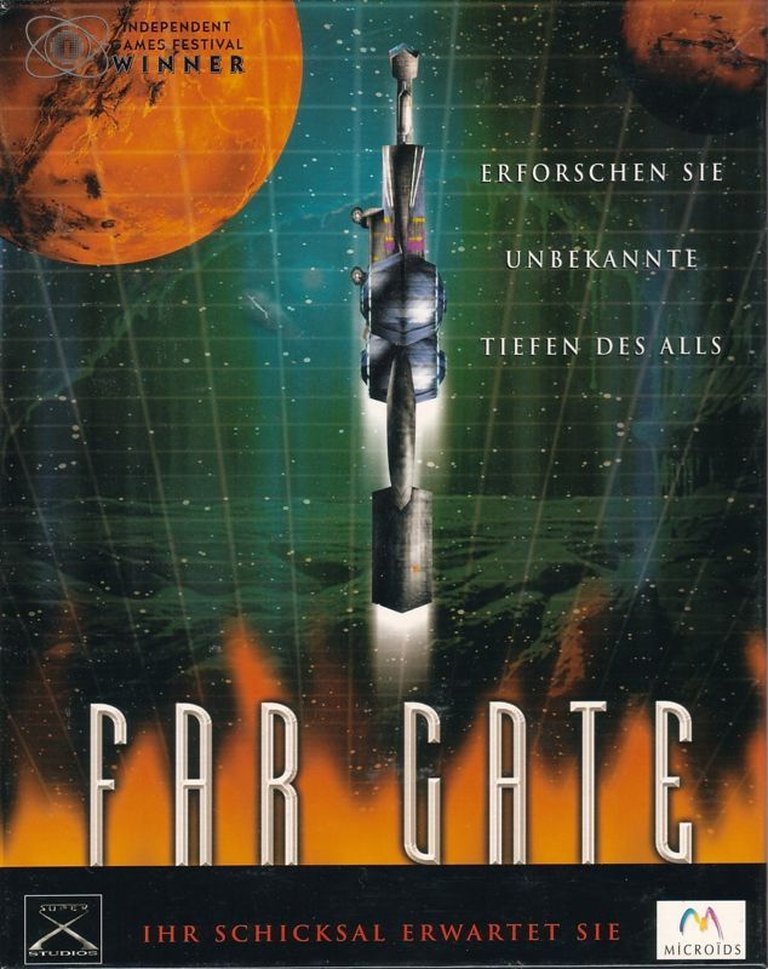
Description
In ‘Far Gate’, humanity discovers a new planet only to encounter two hostile alien races: the organic Nue-Guyen and crystalline Entrodii. While fending off these extraterrestrial threats, Earth’s own factions are causing internal strife. It’s up to you to command advanced space fleets and protect the galaxy from both alien invasions and human treachery in this sci-fi real-time strategy game.
Far Gate Free Download
PC
Far Gate Cracks & Fixes
Far Gate Patches & Updates
Far Gate Mods
Far Gate Reviews & Reception
ign.com (80/100): Super X Studios brings us a fully 3D space adventure with both fun and frustration onboard.
Far Gate Cheats & Codes
PC
Enter ‘superxstudios’ at the main menu to unlock all missions. Type ‘/182461’ during a mission to enable cheats, then use the following codes.
| Code | Effect |
|---|---|
| superxstudios | Unlock all missions |
| /182461 | Enable cheat mode during a mission |
| /gates | Additional money |
| /instabuild | Build all units instantly |
| /kenny | Kill all enemies |
| /fog | Toggles fog of war |
| /stats | Displays statistics |
Far Gate: Review
Introduction
In the grand tapestry of video game history, certain titles shimmer with a unique, poignant brilliance—ambitious, groundbreaking, yet ultimately overshadowed by circumstance and comparison. Far Gate, developed by Super X Studios and published by Microïds, is one such gem. Emerging from the ashes of an indie development boom, it promised to redefine the real-time strategy (RTS) genre by conquering the final frontier: true 3D space combat. Winner of the 2000 Independent Games Festival Audience Choice Award under its original title The Rift, the game arrived in 2001 with lofty aspirations. Yet its release was tragically timed—September 11, 2001—and it was inevitably measured against the towering shadow of Homeworld. This review will argue that Far Gate, despite its technical shortcomings and narrative quirks, stands as a fascinating artifact of independent game development—a flawed, audacious love letter to sci-fi that dared to imagine space warfare not as a flat plane, but as a living, breathing cosmos. Its legacy lies not in perfection, but in the courage of its vision and the distinct personality it carved in a crowded genre.
Development History & Context
Far Gate’s journey began in 1999 as The Rift, a passion project for a four-man team at Thrushwave Technology led by James Thrush. With Dustin Wood and Jeff House handling art, and Chris Overstreet crafting sound, the studio nurtured a radical ambition: to create a fully three-dimensional space RTS where solar systems were dynamic, living entities. Their inspiration was twofold: the grand operatic narrative of Space Battleship Yamato (evident in the game’s anime-style character portraits) and a deliberate avoidance of Homeworld’s alien-ship tropes. As artist Jeff House later explained, “the group wanted it to have a feel akin to Space Battleship Yamato… the reason they also went in the direction of creatures/entities as the enemies was because of the release of Homeworld, which they felt they’d copy too much if they had alien ships.” This led to the creation of two non-traditional factions: the organic, squid-like Nue-Guyen and the crystalline, fractal Entrodii.
The game’s technical scope was audacious for a small team. Super X Studios built an entirely custom engine, the “Super X Engine,” to handle massive battlefields with thousands of objects, complete with orbital mechanics and physics-driven motion. When The Rift won the IGF Audience Award in 2000, publisher Microïds swooped in, funding a full retail expansion. Thrushwave rebranded as Super X Studios, swelling to ten members. Yet the game’s development cycle coincided with a shifting industry landscape. Homeworld (1999) had already redefined space RTS, and Homeworld: Cataclysm (2000) raised the bar. By the time Far Gate launched on September 11, 2001, its $29.99 price point and unpolished edges made it an underdog against AAA titans. As the studio somberly acknowledged in a release statement, the date was “unfortunate” and a reminder of games’ potential to “promote ideals of education, humanity and global cooperation.”
Narrative & Thematic Deep Dive
Set in 2104 AD, Far Gate unfolds in a post-apocalyptic Earth ravaged by World War III. Humanity’s last hope lies in colonization of Proxima Centauri, where a probe detected a habitable world. Players assume the role of Jacob Viscero, a charismatic Han Solo-esque black marketeer blackmailed into service by the Proximan Defense Corps. His nemesis is Admiral Kristoff, a fanatical military officer enforcing martial law and later revealed to be orchestrating the colonization as a plot to exile dissenters. The story pivots on a classic sci-fi trope: mistaken identity and first contact. Upon reaching Proxima, colonists discover the planet is toxic, not habitable. This triggers a galactic three-way war between humans, the Nue-Guyen (organic entities that “swim” through space via wormholes), and the Entrodii (crystalline lifeforms that view organics as expendable).
The narrative unfolds through lengthy, unskippable cutscenes blending in-engine renders with anime-style portraits. These scenes, voiced by Studio Harmonie in Montreal, stretch up to five minutes and emphasize character drama—Viscero’s reluctant heroism, Kristoff’s descent into madness, and Chancellor Corynn’s political maneuvering. While praised by some critics for being “well told” (GameSpot), the plot suffers from thin dialogue and pacing issues. The Nue-Guyen’s initial hostility stems from mistaking Terran ships for Entrodii, leading to a predictable alliance twist in later missions. Themes of exploration, betrayal, and interspecies misunderstanding are rich but underdeveloped. By the finale, the Entrodii’s fortress at Cygnus X-1 is destroyed, and the Nue-Guyen assist in terraforming Vesta, leaving Earth’s fate ambiguously unresolved. The campaign’s 17 missions are framed as a redemption arc for Viscero, transforming from a self-serving smuggler to a unifying leader—yet this arc feels rushed, undercut by the game’s focus on tactical skirmishes over character depth.
Gameplay Mechanics & Systems
Far Gate’s core innovation lies in its fully realized 3D space combat, where units move freely along the X, Y, and Z axes, and planets orbit suns in real-time. This dynamic environment creates tactical depth: players can flank enemies above or below a 2D plane, use asteroids for cover, or exploit orbital positions. Yet the implementation is double-edged. The game eschews traditional technology trees, unlocking new units (over 75 in total) based on mission progression—a choice that streamlines early gameplay but limits long-term strategy. Each faction plays distinctly: Terrans rely on modular, human-designed ships; Nue-Guyen deploy living bio-organisms that regenerate; Entrodii fracture into crystalline shards during combat. In multiplayer, players can command all three factions, but the single-player campaign restricts players to Terrans, alienating fans of the game’s most original creations.
The interface is both ingenious and frustrating. Four foldable control panels (squads, units, commands, objectives) slide in from the screen edges when hovered over, maximizing viewport—a praised innovation by PC Player Germany (78%). However, camera controls are a major flaw. The Z-axis movement is clunky, often triggering a selection box instead of altitude control during intense battles. Unit grouping is rigid: ships must be assigned to one of ten fixed-size squads, leading to accidental inclusion of resource pods in combat fleets. Pathfinding is erratic, and units frequently ignore orders in crowded spaces.
Artificial intelligence relies heavily on scripting, making missions feel like puzzles rather than dynamic battles. Experienced players can exploit enemy patterns for quick victories, while novices face frustration as opponents “don’t play by similar rules” (Wikipedia). Base-building, centered on deployable hexagonal hubs with expandable arms, is visually striking but functionally limited. Defensive turrets are weak, and resource mining via utility pods feels slow. A campaign editor allowed players to craft missions, but the lack of a skirmish mode and multiplayer issues (e.g., sparse GameSpy lobbies) limited replayability. Bugs—including crashes, long load times, and cutscene glitches—further marred the experience, as noted by Computer Gaming World (40%), which lamented that “controls completely negate the experience.”
World-Building, Art & Sound
Far Gate excels in its world-building, translating astronomical concepts into playable environments. Star systems like Proxima Centauri and Arcturus are rendered with planetary orbits, asteroid belts, and even a green sun (a nod to artistic license over stellar physics). This celestial ballet creates an immersive sense of scale, even with the necessary “Acceptable Breaks from Reality” (TVTropes)—e.g., compressed travel times and habitable planets near Earth. The factions’ designs are a triumph of imagination: Nue-Guyen ships resemble bioluminescent sea creatures, while Entrodii structures are geometric, light-refracting crystalline fortresses. Terran tech occupies a grounded middle ground, with utilitarian ships and modular bases.
Visually, the game holds up as a technical marvel for its era. Particle effects for explosions and wormholes (DNA-shaped pink/blue strands) and detailed textures on capital ships earned praise from GameSpy (74%), which called the graphics “top-notch.” Yet compared to Homeworld, the aesthetic lacks cohesion. Planets are often Earth-like despite toxic descriptions, and space backgrounds, while pretty, lack the haunting emptiness of Relic’s masterpiece. Sound design is the weakest pillar. The soundtrack, described by IGN’s Dan Adams as “a horrible 80s sci-fi flick,” uses synthesizers and violins that clash with the game’s darker themes. Sound effects are functional but uninspired—lacking the weight of laser fire or the eerie resonance of alien communications. Voice acting, while competent, struggles with stilted dialogue, and the unskippable cutscenes amplify these flaws.
Reception & Legacy
Upon release, Far Gate received mixed-to-positive reviews, with a 66% Metacritic score reflecting its polarizing nature. German critics were particularly generous, with PC Action awarding 82% for its “user-friendly interface” and “opulent graphics.” Adrenaline Vault (70%) celebrated it as a “dramatic effort towards entertainment rather than a quick profit,” highlighting its indie spirit. Conversely, GameSpot (63%) deemed it “saddled with a clumsy interface,” while Gamekult (40%) dismissed it as a “copy of Homeworld” with inferior gameplay. Players were equally divided: some cherished its unique factions (MyAbandonware user SynthBrioche called it “unforgettable”), while others cited its “chaotic battles” and “poor camera” as dealbreakers.
Compared to Homeworld, Far Gate suffered inevitably. IGN dubbed it “Homeworld Light,” and its two-year delay meant it arrived after the genre’s innovator had already defined the blueprint. Its September 11 release, though unintentional, limited marketing impact and overshadowed its launch. Culturally, it became a footnote—a cautionary tale of ambition vs. polish. Yet its legacy endures. As an early indie 3D space RTS, it paved the way for titles like Haegemonia: Legions of Iron (2003). The Super X Engine, refined post-Far Gate, powered other Super X games, including Times of Conflict. For niche fans, it remains a “peculiar” (MyAbandonware user Militant Nod) curiosity—a time capsule of when small studios dared to challenge industry giants with radical ideas.
Conclusion
Far Gate is a game of contrasts: a technical marvel hampered by crippling flaws, a bold narrative drowned in cutscene bloat, and a unique vision perpetually compared to its superior peers. Its greatest strength lies in its audacity—the way it embraced 3D space not as a gimmick, but as a canvas for tactical and artistic expression. The Nue-Guyen and Entrodii, with their biological and crystalline aesthetics, remain standout creations in a genre often dominated by conventional starships. Yet its weaknesses—unreliable controls, stilted AI, and a lack of polish—prevent it from reaching the heights of its inspiration.
In the grand scheme of gaming history, Far Gate occupies a fascinating niche. It is less a masterpiece and more a testament to the passion of indie developers in the early 2000s—a flawed, passionate attempt to push boundaries when the odds were stacked against it. For players willing to overlook its dated mechanics, it offers a rewarding experience: a sprawling 3D battleground, a story of redemption across the stars, and factions that feel truly alien. Its legacy, however, is one of what could have been—a reminder that even in failure, ambition can carve a unique space in the cosmos of interactive entertainment. Far Gate is not the game Homeworld was, but it is the game Super X Studios dared to dream—and for that, it deserves a place in the archives of gaming history.