
- Release Year: 2005
- Platforms: Windows
- Publisher: IncaGold GmbH, IncaGold plc, OOO Polyet Navigatora
- Developer: Wolfgroup
- Genre: Action
- Perspective: 1st-person
- Game Mode: Single-player
- Gameplay: Shooter
- Average Score: 45/100
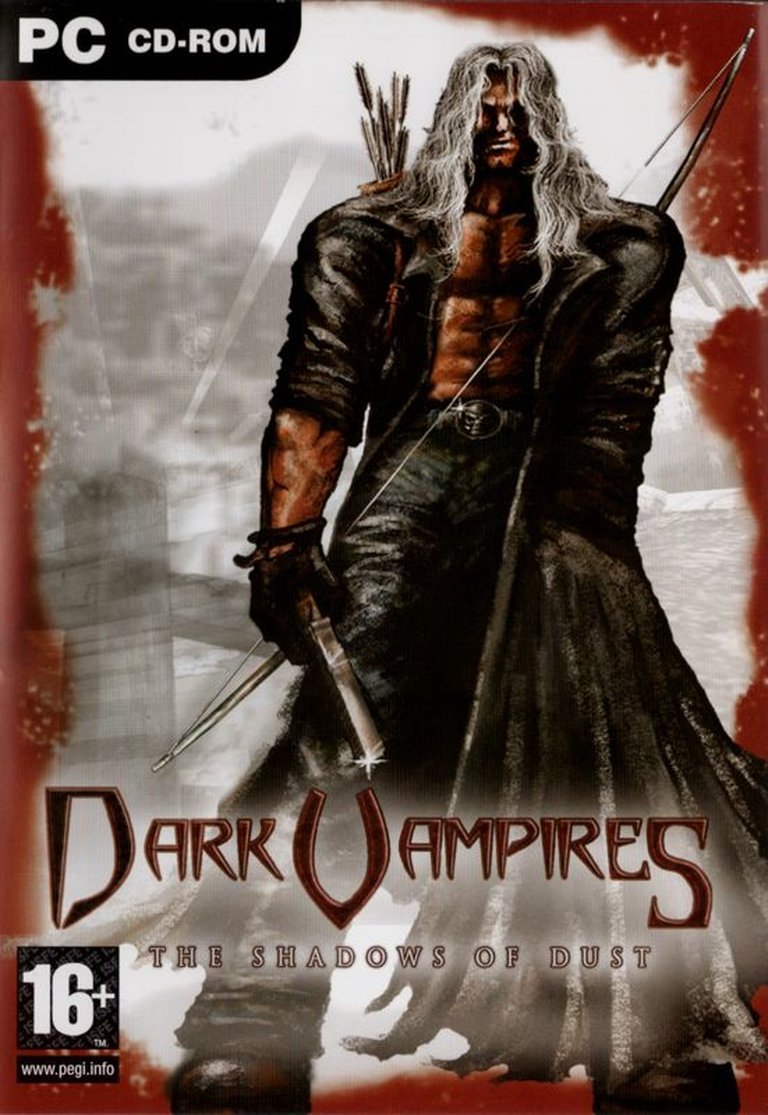
Description
In Dark Vampires: The Shadows of Dust, players assume the role of Jack Peters, a fearless vampire hunter targeted by the powerful Dark Council. Traversing ten intense levels, players must use their arsenal of weapons—including revolvers, throwing stars, and bows—to vanquish hordes of vampire assassins. With its first-person shooter mechanics and backdrop of vampire lore, this game delivers an action-packed experience in a supernatural world.
Gameplay Videos
Dark Vampires: The Shadows of Dust Cracks & Fixes
Dark Vampires: The Shadows of Dust Patches & Updates
Dark Vampires: The Shadows of Dust Mods
Dark Vampires: The Shadows of Dust Guides & Walkthroughs
Dark Vampires: The Shadows of Dust Reviews & Reception
mobygames.com (14/100): Average score: 14%
myabandonware.com (65.8/100): with a whopping 3.3/5 rating.
abandonwaregames.net (94.9/100): Overall: 9.49 /10
howlongtobeat.com (10/100): Rating 1
Dark Vampires: The Shadows of Dust Cheats & Codes
PC (Steam)
Trainer must be downloaded and run separately. Functions are activated in-game using the specified keys.
| Code | Effect |
|---|---|
| Numpad 1 | Grants immortality |
| Numpad 2 | Grants infinite ammo |
| Numpad 3 | Grants infinite alternative ammo |
| Numpad 4 | Grants endless arrows |
| Numpad 5 | Grants quick kills |
| Numpad 6 | Grants easy wins |
Dark Vampires: The Shadows of Dust: Review
Introduction
In the pantheon of famously terrible video games, certain titles achieve a legendary, almost mythical status. They are not merely bad; they are cultural touchstones, cautionary tales whispered among gamers with a mixture of derision and morbid curiosity. They are the stuff of forum legends, the subject of angry reviews on long-defunct gaming magazines, and the black sheep of any respectable developer or publisher’s catalog. Released on February 8, 2005, Dark Vampires: The Shadows of Dust is one such title. Hailing from the Belarusian developer Wolfgroup and published by the notoriously prolific budget label IncaGold, this first-person shooter promised a dark, atmospheric tale of vampire hunting. What it delivered, however, was something else entirely: a monument to technical incompetence, design bankruptcy, and the cynical exploitation of a popular genre. This review will serve as a deep dive into the history, mechanics, and legacy of this infamous title, arguing that Dark Vampires is not just a bad game, but a fascinating relic of a bygone era in gaming—one that stands as a stark counterpoint to the artistic and technical ambitions of its contemporaries.
Development History & Context
To understand Dark Vampires: The Shadows of Dust, one must first understand the ecosystem that birthed it. The early 2000s were a time of dramatic transition in PC gaming. The industry was moving away from the shareware and CD-ROM bin mentality of the 90s, but the budget segment, particularly in European markets, remained a chaotic and often unregulated space. Publishers like IncaGold, along with peers like TopWare and CDV, built their business model on acquiring and repackaging low-cost, often Eastern European-developed titles for the mass market. These games rarely had the polish, budget, or development time of AAA releases from studios like id Software or Valve, but they promised a familiar experience at a fraction of the price.
The developer, Wolfgroup, was a Belarusian studio with a portfolio that included other budget titles like Star Wraith IV: Reviction (2004). This context is crucial. Dark Vampires was not the product of a grand artistic vision or a desire to innovate. It was a commodity, a product designed to fill a shelf space and capitalize on the enduring popularity of the first-person shooter genre, which was at that time dominated by the epic narratives of Half-Life 2, the competitive multiplayer of Unreal Tournament 2004, and the military realism of Call of Duty. The technological context of its release is equally telling. While other developers were pushing the boundaries with the Source Engine and the CryEngine, Dark Vampires was built on the aging Vision 7 engine, a middleware solution that was already several years old by 2005, known for its dated graphics and rigid limitations. The game was released in February 2005 in Russia and later made its way to Western European markets in 2006, a time when the FPS genre was more crowded and sophisticated than ever. The developers’ vision, as described in the sparse marketing materials, was simple: create a straightforward action shooter where the player, as vampire hunter Jack Peters, battles waves of the undead. However, the extreme technological constraints and the lack of both time and budget ensured that even this modest ambition would be catastrophically unfulfilled.
Narrative & Thematic Deep Dive
If one were to approach Dark Vampires as a narrative experience, they would find a vacuum. The game’s plot, as outlined on the box and in the brief loading screen descriptions, is the most threadbare of premises imaginable. The player assumes the role of Jack Peters, a vampire hunter so effective that he has earned the ire of the “Dark Council,” a governing body of vampires who have decided he must be eliminated. Their solution is to send “wave after wave of vampire assassins” to kill him. In response, Jack decides to be “offensive” and proceeds to “walk through the ten levels while shooting everything that crosses his way.”
This is the entirety of the story. There are no cutscenes, no character development, no dialogue beyond the grunts of combat, and no exposition to explain Jack’s backstory, the nature of the Dark Council, or the world in which these events take place. The promised “haunting world” and “deeply woven narratives” described in some promotional blurbs are a complete fabrication. The game’s thematic foundation, which should be rich with gothic horror and the classic man-versus-supernatural conflict, is utterly barren. There is no atmosphere of dread, no exploration of vampiric lore, and no sense of a larger world at stake. The game’s Russian titles, Тень вампира. Ночной охотник (Shadow of the Vampire. The Night Hunter) and Тень вампира 2: Мститель возвращается (Shadow of the Vampire 2: The Avenger Returns), even attempt to frame the experience as a sequel or a more substantial tale, but the product itself contains none of this content.
Characters are non-existent beyond their function as a target. Jack Peters is a silent, blank slate, a pair of hands holding weapons. The “vampire assassins” are not characters but moving sprites, their identities and motivations as transparent as the paper-thin premise. This complete lack of narrative cohesion or thematic depth is perhaps the game’s most profound failure. A horror or action game can overcome simplistic storytelling if it delivers on atmosphere or thrilling action. Dark Vampires fails on both counts, leaving the player with not a story to follow, but a hollow, repetitive task to complete.
Gameplay Mechanics & Systems
The core gameplay loop of Dark Vampires is a study in monotony and broken mechanics. As described by players and critics, the experience is a staggering procession of identical, ten-minute battles. Each of the ten levels tasks the player with killing exactly 60 enemies. The process is as follows: enter a level, a handful of vampires spawn, the player kills them, a new wave spawns, the player kills them, and this continues until the quota is met. The cycle is punctuated only by short, jarring loading screens, creating a “kill, load, kill, load” rhythm that one German critic aptly described as a “stupider Moorhuhn-clone in 3D.” The term “Moorhuhn,” a popular German shooting-gallery game, is used here not as a compliment, but as a descriptor for the game’s simplistic, point-and-shoot nature, stripped of any context, strategy, or fun.
The combat itself is a masterclass in dysfunction. The enemies, as noted in multiple reviews, possess an artificial intelligence (AI) that can charitably be described as nonexistent. They do not use tactics, seek cover, or flank the player. Instead, they spawn and move directly towards the player’s position, often getting stuck on level geometry like walls or crates. Their only behavior is to shoot if the player is within range, a task they perform with an almost insulting lack of precision. This makes every encounter less a fight and more a simple reaction test, where the player simply has to aim at the slow-moving, often-stuck targets before they can do the same to you.
The player’s arsenal is equally uninspired. The game offers a handful of weapons, including a revolver, a throwing star (shuriken), and a bow, as one review noted. However, the implementation of these weapons is as shallow as the selection itself. There is no meaningful difference in feel or function between them. The game’s controls, described as “established shooter controls with mouse and keyboard,” are hampered by a “much too sensitively set up” control scheme that makes precise movement a frustrating chore, as pointed out by PC Games.
The progression system is non-existent. There are no upgrades, no new abilities, and no meaningful character development. The player starts the game with their basic arsenal and finishes it with the same. The game’s difficulty, which some critics found “hellishly hard,” is not a product of clever design or challenging encounters, but of the poor collision detection, unresponsive controls, and the simple fact that the player is often swarmed by enemies who can fire through walls, a bug that critics noted as a sign of the game’s broken state. The entire gameplay experience is a soulless, repetitive grind, devoid of the feedback loops, strategic depth, or satisfying escalation that define even the most basic shooters.
World-Building, Art & Sound
The world of Dark Vampires is not a place to be explored, but a series of sparse, disconnected arenas to be purged. The game’s art direction is a catastrophic failure. Screenshots from the era depict environments that are not just dated, but actively ugly and empty. The levels are small, claustrophobic, and repetitive, featuring simple, boxy architecture and textures that are blurry and indistinct. This is a far cry from the richly detailed, atmospheric locales seen in contemporaries like Thief: Deadly Shadows or even budget titles that at least made an attempt at coherent design.
The game’s attempt at a “haunting world” is completely undermined by its visual execution. There are no gothic cathedrals, fog-shrouded alleyways, or decaying mansions. Instead, players are treated to generic, brownish-grey corridors and nondescript rooms that lack any sense of place or purpose. The character and enemy models are equally primitive. The vampires are generic, vaguely humanoid sprites that fail to evoke any sense of dread or menace. Their animations are stiff and limited, and their design is uninspired. The game’s tag on UVList.net, which lists “creatures, vampires, locations, city” as themes, is a cruel joke; there is no city, only a series of indistinguishable rooms.
The sound design is the final nail in the coffin of atmosphere. There are no haunting musical scores to build tension, no ambient sounds to suggest a living, breathing world of darkness. The sound effects are basic and repetitive, the cacophony of gunfire and enemy grunts providing a constant, grating noise but no real audio feedback. In short, the audio-visual presentation of Dark Vampires does not serve to create a believable or immersive world. Instead, it creates a sterile, artificial void, a series of empty rooms where the player is expected to perform a menial task with no emotional or contextual anchor.
Reception & Legacy
The critical and player reception to Dark Vampires: The Shadows of Dust was, to put it mildly, abysmal. Today, it is remembered as one of the worst video games ever made, a title whose infamy is cemented by its Metascore of 14% and a player score of 1.4 out of 5 on MobyGames. This score is based on a mere four critic reviews, each of which is a scathing indictment of the product.
German magazine GameStar awarded it a 20 out of 100, calling it “hellishly hard” and advising players to go “back to the grave.” PC Action was even more vitriolic, giving it a 19/100 and complaining of a “peinliche Kollisionsabfrage” (embarrassing collision detection) and “null Abwechslung” (zero variety), summing up the experience as something players would “annoy themselves with” after paying “six euros for this crap.” PC Games awarded a similarly low 15/100, describing it as a “blank horror” and a “Moorhuhn-clone,” concluding that players would be better off letting a vampire bite them than subjecting themselves to the “grottenschlechter Shooter” (grotty shooter). The harshest review came from the Russian site Absolute Games, which gave the game a 1 out of 100, noting that even if the game had the promised ten levels instead of the three it apparently contained, it “would not have been saved.”
This universal panning established Dark Vampires’ reputation as a commercial and critical failure. Its legacy, however, has evolved from that of a simple failure to that of a legendary piece of “so bad it’s good” gaming history. It has become a touchstone in discussions about shovelware, predatory publishing practices, and the stark contrast between mainstream and budget-tier development. It is frequently cited alongside titles like Big Rigs: Over the Road Racing and E.T. the Extra-Terrestrial as an example of a game so fundamentally broken that it defies belief. The game has even gained a second life on abandonware sites like My Abandonware and AbandonwareGames.net, where it can be downloaded for free, allowing a new generation of players and content creators to experience its legendary awfulness firsthand. Its legacy is not one of influence, but of infamy—a cautionary tale and a benchmark for video game failure.
Conclusion
Dark Vampires: The Shadows of Dust is not merely a bad game; it is a perfect storm of incompetence, cynicism, and technical failure. From its non-existent narrative to its repetitive, broken gameplay, its ugly art direction to its non-existent sound design, every aspect of the title is a testament to a development and publishing process that valued speed and cost efficiency over quality, creativity, or even basic competence. It failed to deliver on its modest promises and was rightly crucified by critics upon release. Yet, in its sheer, unmitigated awfulness, it has achieved a strange form of immortality. It serves as a historical artifact, a snapshot of the budget gaming landscape of the mid-2000s, and a stark reminder of the gulf that existed between the ambitious AAA titles of the era and their low-budget counterparts. As a piece of interactive media, it is a failure. As a subject of historical analysis, it is fascinating. For anyone interested in the history of video games, Dark Vampires: The Shadows of Dust is not a game to be played for fun, but one to be studied as a monumental, and in its own way, unforgettable, failure. It belongs on the shelf next to the worst of the worst, a monument to all that can go wrong when a game is built not with passion, but with apathy.