
- Release Year: 2001
- Platforms: Windows
- Publisher: 1C Company, Microids SA, Microïds
- Developer: Microïds Canada Inc.
- Genre: Driving, Racing, Simulation
- Perspective: 1st-person, Behind view
- Game Mode: LAN, Single-player
- Gameplay: Arcade mode, Career mode, Time Attack, Track racing, Vehicle upgrades
- Setting: Real-world
- Average Score: 65/100
Description
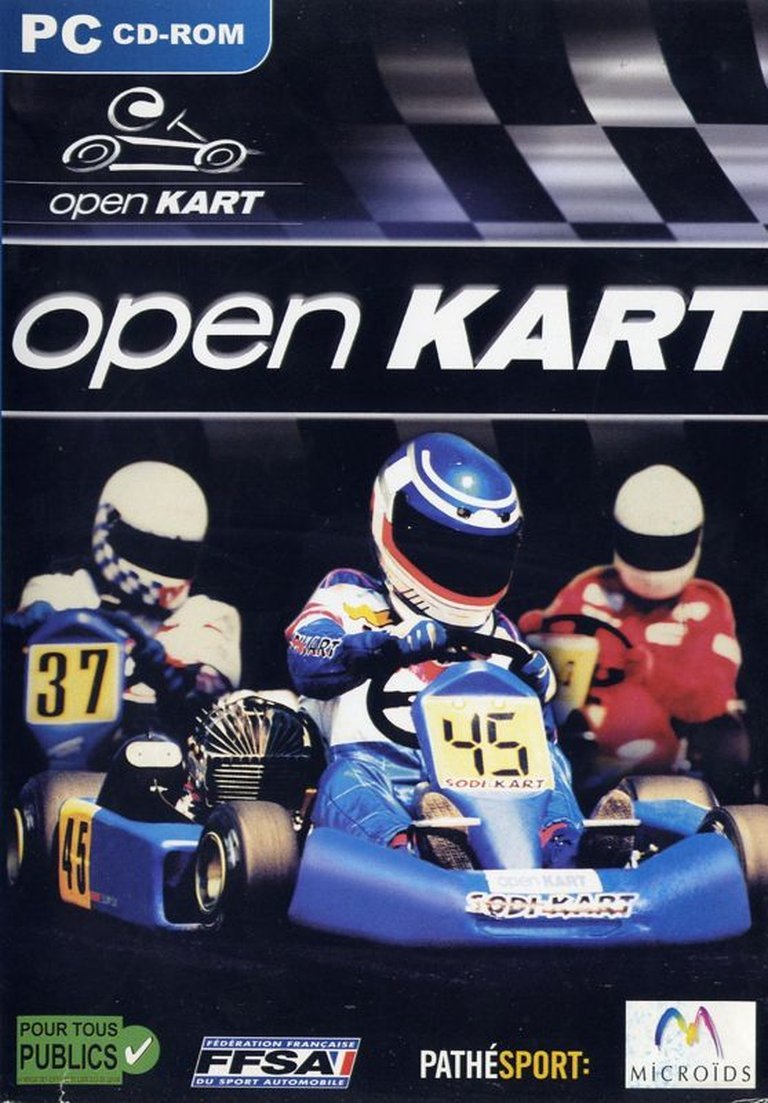
Open Kart is a go-kart racing simulation that focuses on career progression. Players compete in three engine classes (100cc, 125cc, and 200cc), racing on ten globally inspired circuits available in long and short versions. Success in races earns prize money and attracts sponsorships, which fund critical kart part replacements and upgrades to maintain competitive performance. Beyond career mode, options include an arcade mode featuring random course selections and a time attack mode for solo best-lap challenges. The driving physics strike a balance favoring accessible, action-oriented handling.
Gameplay Videos
Open Kart Cracks & Fixes
Open Kart Mods
Open Kart Reviews & Reception
en.wikipedia.org (68/100): More liberal use of the premise would have garnered better results, but because it’s a take on a less seen sport than other titles, its attempt and portrayal alone are commendable and respectable at least.
metacritic.com (57/100): A promising and feature-packed racing game that regrettably suffers from unsophisticated physics, limited difficulty, and potential instability.
wikiwand.com (68/100): More liberal use of the premise would have garnered better results, but because it’s a take on a less seen sport than other titles, its attempt and portrayal alone are commendable and respectable at least.
ign.com (68/100): Serious Karting. But is it for the gamer or the lawn mower modder?
mobygames.com (68/100): Open Kart is a go-kart simulation. The heart of the game is its career mode where the player races to the top in three classes: 100cc, 125cc and 200cc.
Open Kart: A Detailed Retrospective
Introduction
Open Kart (2001), developed by Microïds Canada Inc. and published by Microïds, stands as a unique entry in the racing simulation genre, offering a focused experience centered on go-kart racing. At a time when console racing games like Super Mario Kart dominated the market, Open Kart sought to bring a more realistic and simulation-driven approach to PC gamers. While it never achieved the same level of cultural impact as its console counterparts, it carved out a niche for itself with its career-driven mechanics and technical depth. This review will dissect the game’s development, narrative, gameplay, and legacy, ultimately assessing its place in video game history.
Development History & Context
Studio and Vision
Developed by Microïds Canada Inc., Open Kart was part of a broader effort by the studio to explore simulation genres beyond their more famous adventure titles like Syberia. The game was showcased at E3 2001, highlighting its use of the NetImmerse 3D game engine and the Havok physics engine, which were cutting-edge at the time. The team aimed to create a realistic karting experience, complete with wear-and-tear mechanics, sponsorship systems, and authentic track designs.
Technological Constraints and Gaming Landscape
Released in 2001, Open Kart arrived during a transitional period for PC racing games. While console racing titles like Mario Kart and Crash Team Racing thrived on arcade-style fun, PC racing simulations were dominated by more serious offerings like F1 Racing Championship and Grand Prix Legends. Open Kart attempted to bridge this gap by offering a middle ground: a simulation with arcade-like accessibility. However, the game’s reliance on the NetImmerse engine—known for its use in adventure games—meant that it lacked the polish of dedicated racing engines like rFactor or GTR.
Key Team Members
The development team included:
– Stéphane Grefford (Production Manager)
– Jonathan Morin (Lead Artist)
– François Lapikas (Lead Design)
– Cyril Labordrie & Rémi Veilleux (Lead Programming)
Many of these developers later worked on Syberia and X’treme Roller, indicating a studio strength in simulation and adventure genres.
Narrative & Thematic Deep Dive
Plot and Characters
Open Kart lacks a traditional narrative, but its career mode provides a structured progression system. Players assume the role of an aspiring kart racer, competing in three classes (100cc, 125cc, and 200cc) to climb the ranks. The game emphasizes realism by incorporating sponsorship deals, part upgrades, and track-specific tuning—elements that ground the experience in the world of professional karting.
Dialogue and Themes
There is minimal dialogue, but the game’s thematic focus is on competition, perseverance, and mechanical mastery. The career mode reinforces this by requiring players to balance performance with financial management, as sponsors offer better deals based on rankings. This creates a sense of progression and consequence, even in the absence of a traditional story.
Gameplay Mechanics & Systems
Core Gameplay Loop
The game’s heart lies in its career mode, where players race to earn money, upgrade parts, and attract sponsors. Each race requires strategic decisions:
– Part Replacement: Tires, engines, and other components degrade over time, necessitating repairs.
– Sponsorships: Higher rankings attract better sponsors, providing more funds for upgrades.
– Track Mastery: Each of the 10 tracks (with long and short versions) demands different driving techniques.
Combat and Progression
Unlike traditional racing games, Open Kart focuses on technical driving rather than aggressive combat. Collisions are physics-based but rarely catastrophic, emphasizing precision over chaos. Progression is tied to financial management, as players must balance spending on upgrades versus saving for future races.
UI and Innovations
The UI is functional but dated by modern standards. The career mode interface tracks rankings, sponsorships, and part conditions, while the race HUD provides speed, lap times, and position. The game also features a time attack mode and LAN multiplayer for up to 8 players, though the latter was limited by the era’s networking technology.
Flaws and Criticisms
Reviewers noted several issues:
– Lack of Difficulty: The AI was criticized for being too forgiving, making the game easy to master.
– Physics Shortcomings: While Havok provided solid collision detection, the driving model felt “glued to the track,” lacking the weight and responsiveness of later simulations.
– Performance Issues: The game struggled with frame rate drops during multi-kart races, a common issue for the NetImmerse engine.
World-Building, Art & Sound
Setting and Atmosphere
The game features 20 tracks across 10 countries, from Canadian cities to Egyptian pyramids. While visually impressive for the time, the tracks often felt more like “novelties” than realistic circuits. The weather system (rain, dry conditions) added variety but had minimal impact on gameplay.
Visual Direction
The graphics were praised for their detail and color, particularly in driver animations and environmental effects (e.g., tire marks, smoke). However, the lack of damage modeling was a missed opportunity, as karts remained pristine despite collisions.
Sound Design
The sound effects were functional but unremarkable:
– Engine Sounds: The 100cc engines sounded like “whirring weedeaters,” while higher classes offered more depth.
– Environmental Audio: Crowd noise was sparse, and rain effects were limited to visual cues.
– Music: The soundtrack was forgettable, with generic racing themes that lacked memorability.
Reception & Legacy
Critical and Commercial Reception
Open Kart received mixed reviews, with an average critic score of 68% (MobyGames) and a Metascore of 57 (Metacritic). Praise was directed at its career mode, track variety, and visuals, while criticism focused on physics, difficulty, and performance issues.
Key reviews:
– IGN (6.8/10): “More liberal use of the premise would have garnered better results.”
– GameSpot (6.2/10): “Uneven proposition that is too fleeting for most.”
– PC Zone (3.7/10): “Passable but dull compared to Super Mario Kart.”
Legacy and Influence
Open Kart did not leave a lasting mark on the racing genre, but it remains a curiosity for its simulation-focused approach to karting. Its career mechanics influenced later titles like TrackMania and Mario Kart 8 Deluxe, which incorporated sponsorships and part upgrades. However, its technical limitations relegated it to obscurity, overshadowed by more polished contemporaries.
Conclusion
Open Kart was an ambitious but flawed attempt to bring realistic karting to PC gamers. Its career mode, track design, and visuals were ahead of their time, but physics, difficulty, and performance issues held it back. While it never achieved mainstream success, it remains a notable entry in the history of racing simulations—a game that tried to bridge the gap between arcade fun and hardcore realism, but ultimately fell short of both.
Final Verdict: A niche title with historical interest, Open Kart is a forgotten gem for simulation enthusiasts but lacks the polish to stand alongside genre classics.