
- Release Year: 1999
- Platforms: Windows
- Publisher: New Media Generation, Summitsoft Entertainment, WalkOn media publishing
- Developer: New Media Generation
- Genre: Strategy, Tactics
- Perspective: Diagonal-down
- Game Mode: Online PVP, Single-player
- Gameplay: Base building, Money Management, Settlement Capture, Squad Formation, Unit recruitment, Unlockable Units
- Setting: 17th Century Europe, Alternate history
- Average Score: 42/100
Description
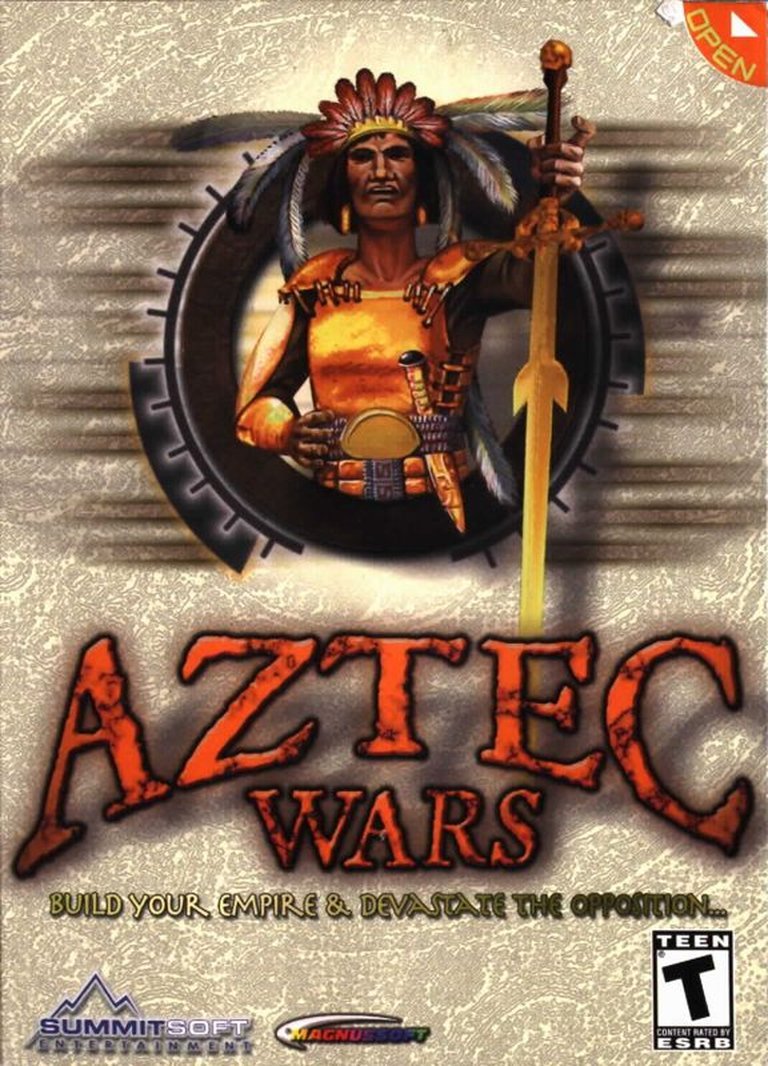
Aztec Wars is a real-time strategy game set in an alternate 17th century Europe where the Aztecs, having already conquered France, Germany and Spain, are now being resisted by the Russes and Cathayans. Each mission starts with basic houses that can be upgraded to villages, cities, or fortresses, allowing access to different units and buildings specific to each civilization. The game features distinct factions with unique units like war bears, steam tanks, and yeti warriors. Players can control units to protect and expand their territories, capturing enemy settlements to unlock new units. With a single Russes campaign and extensive multiplayer support, Aztec Wars offers a blend of base building and strategic unit deployment in a unique historical context.
Where to Buy Aztec Wars
PC
Aztec Wars Mods
Aztec Wars: Review
Introduction
In the crowded pantheon of late-1990s real-time strategy (RTS) games, few titles embody the spirit of audacious, unpolished ambition quite like Aztec Wars. Released in 1999 by Russian studio New Media Generation and later distributed abroad as a budget title, this obscure gem plunges players into a fantastically warped alternate history where the Aztec Empire, having crossed the Atlantic centuries ahead of Columbus, has overrun Europe and Africa. Only the “Russes” and “Cathayans” stand against this Mesoamerican juggernaut, armed with war bears, psychic yetis, and steam-powered tanks. Its legacy is one of cult curiosity—a game celebrated for its gonzo creativity yet criticized for its technical shortcomings and simplistic design. This review posits that Aztec Wars, despite its flaws, remains a fascinating artifact of 90s strategy gaming, offering a uniquely chaotic and charming vision of “what if” history that continues to resonate with a niche audience.
Development History & Context
Aztec Wars emerged from the studios of New Media Generation, a Moscow-based developer whose credits reveal a dedicated but modest team of 80 individuals. Led by project head Alexey Rybakov, with Natalia Brodovskaya penning the original alternate-history concept, the team crafted a vision rooted in absurdity and spectacle. Released in Russia in 1999, the game arrived during an era dominated by titans like StarCraft and Age of Empires II, setting an impossibly high bar for RTS innovation. Technically constrained by its budget and era, Aztec Wars operated on isometric 3D graphics that were serviceable but lacked the fluidity of its contemporaries. Its development was further complicated by the team’s focus on unique unit designs over systemic depth, resulting in a game that prioritized “Rule of Cool” realism—Russes deploying axe-firing steam tanks, Aztecs riding gunpowder-trained bison, and Cathayans deploying psychic yetis. By the time it reached Western markets in 2002 (rebranded as The Aztec: True History of Empire), the RTS genre had evolved toward greater complexity, leaving Aztec Wars feeling like a relic from an earlier, more experimental phase of the genre.
Narrative & Thematic Deep Dive
The game’s narrative is a masterclass in alternate-history audacity, albeit one executed with the subtlety of a sledgehammer. Set in the 17th century, it posits that the Aztec Empire, leveraging anachronistic technology like Spider Tanks and fireball-throwing priests, has conquered Spain, Germany, and France, now menacing the “Russes” (a stand-in for a resurgent Russia) and the “Cathayans” (a China-Japan amalgam with ninjas and war elephants). The single Russes campaign casts the player as a newly appointed leader tasked with repelling this invasion, aided by an Arabian inventor who supplies zeppelin bombers after a daring rescue mission. Characters are archetypal and thinly sketched—the noble Russes commander, the Aztec high priest with mystical powers, and the Cathayan strategist—but their interactions are conveyed through clumsy FMVs and in-game text. Dialogue is painfully simplistic, with the Polish version (a common release) suffering from abysmal voice acting and lip-sync issues so severe that characters appear to chew gum while delivering lines. Thematically, the game explores colonialism through a lens of inverted expectations, positioning Aztecs as colonizers and Europeans as the underdogs. Yet this is undercut by its juvenile tone, reducing complex historical clashes to a series of “kill or be killed” battles. The overarching theme of technological anachronism—pitting Aztec obsidian blades against Russian steam engines—feels less a coherent narrative than a checklist of eccentric ideas.
Gameplay Mechanics & Systems
At its core, Aztec Wars streamlines RTS conventions to the point of absurdity. The sole resource is money, generated automatically via mines and farms placed on fertile terrain, eliminating the micromanagement of harvesters seen in peers like Age of Empires. Players begin each mission with basic houses that produce infantry but can be upgraded—costly and irreversible—to villages, cities, or fortresses. Each tier unlocks new buildings and units: a “bear’s cave” for Russes war bears, a “yoga tower” for Cathayan psychic attacks, or an Aztec “spider stable” for their mechanical walkers. Units are garrisoned defensively but can be grouped into squads for offensive maneuvers, though their AI is notoriously erratic, often freezing mid-battle or “shaking in place” in a glitchy seizure. Combat revolves around overwhelming force rather than strategy, with objectives rarely deviating from “destroy all enemy settlements.” This simplicity is a double-edged sword: while accessible to newcomers, it disappoints veterans seeking tactical depth. Unit design is wildly imbalanced—Russes bears decimate infantry but are useless against structures, while Aztec Spider Tanks are lethally accurate but agonizingly slow. The game’s most innovative system is the “Enemy Exchange Program,” allowing players to capture enemy bases and build their unique units, such as Aztec fire priests in a Russes fortress. However, this is undermined by a clunky UI and unintuitive controls (no tutorial necessitates consulting the manual), while the repetitive “build-and-flood” loop grows tedious. Multiplayer offered 30 maps for up to seven players, a feature that likely salvaged some replay value but couldn’t compensate for the campaign’s brevity.
World-Building, Art & Sound
Aztec Wars excels in world-building through sheer, unapologetic creativity. Its alternate Europe is a vivid tapestry of contrasting aesthetics: Aztec settlements adorned with pyramids and obsidian weaponry contrast with Russes’ industrial strongholds and Cathayans’ pagoda-style fortresses. Each faction’s technology reflects its theme: Russes use treaded vehicles and zeppelins, Cathayans opt for wheels and psychic warriors, while Aztecs shun the wheel entirely, favoring walking or hopping machines like their one-footed cannon. This extends to units, which are color-coded for clarity—Cathayan ninjas shift from blue to red upon capture, and Aztec eagles wear faction-specific plumage. The art direction, led by Andrew Chernyshov, balances budget constraints with charm; terrain is well-modeled with day/night cycles and water effects, while units like the yellow-furred Cathayan yeti or Aztec bison riders are endearingly grotesque. Sound design is similarly inconsistent: a handful of atmospheric tracks (described as “great, if sparse”) evoke a sense of grandeur, but unit voice lines are cheesy and grating. The FMVs, however, are a low-point, with stiff 3D animations and voice acting so poorly synchronized that characters’ mouths lag behind dialogue by seconds. Despite these flaws, the game’s visual identity remains its greatest strength—a testament to the team’s ability to transform a shoestring budget into a cohesive, if bizarre, universe.
Reception & Legacy
Upon its Western release in 2002, Aztec Wars was met with a critical shrug, earning a paltry 42% average on MobyGames based on four reviews. Scores ranged from Power Unlimited’s generous 76% (praising its “original theme”) to Hacker’s scathing 14%, which deemed it an “obvious miss.” Common grievances included its simplistic gameplay, abysmal story, and technical hiccups, though some reviewers conceded that its graphics and music were “nice.” Commercially, it faded into obscurity as a bargain-bin curiosity. Yet its reputation has since undergone a curious rehabilitation. In retro gaming circles, it is celebrated for its audacious alternate history and unhinged unit designs, earning a cult following for its “so bad it’s good” charm. TV Tropes and MobyGames highlight its influence on niche concepts like “Alternate History Wank” and “Steampunk” in strategy games, though it never achieved the genre-defining status of StarCraft. Its legacy endures in modding communities and fan-made scenarios, where its mechanics are occasionally refined. Ultimately, Aztec Wars stands as a cautionary tale of ambition over execution—a game that dared to reimagine history but lacked the polish to compete with its peers.
Conclusion
Azcet Wars is a paradox: a game that is technically primitive yet conceptually inspired, narratively threadbare yet visually inventive. Its greatest achievement is creating a universe where Aztec Spider Tanks duel Russian steam bears, a vision so audacious it overshadows its gameplay deficiencies. For strategy novices seeking a break from complex mechanics, it offers accessible, if repetitive, fun; for genre veterans, it serves as a fascinating relic of late-90s experimentation. While its legacy is unlikely to rival that of its contemporaries, Aztec Wars remains a testament to the power of bold ideas in gaming. Its place in history is assured—not as a masterpiece, but as a gloriously flawed time capsule of a what-if world, forever remembered for its hopping cannons and yellow-furred yetis. Verdict: A guilty pleasure for alt-history buffs, but a forgettable footnote for RTS purists.