
- Release Year: 1998
- Platforms: Windows
- Publisher: RedWolf Design
- Developer: RedWolf Design
- Genre: Action, Strategy, Tactics
- Perspective: Side view
- Game Mode: Hotseat, Single-player
- Gameplay: Board game, Customizable, Resource Management, Settlement Building
- Average Score: 37/100
Description
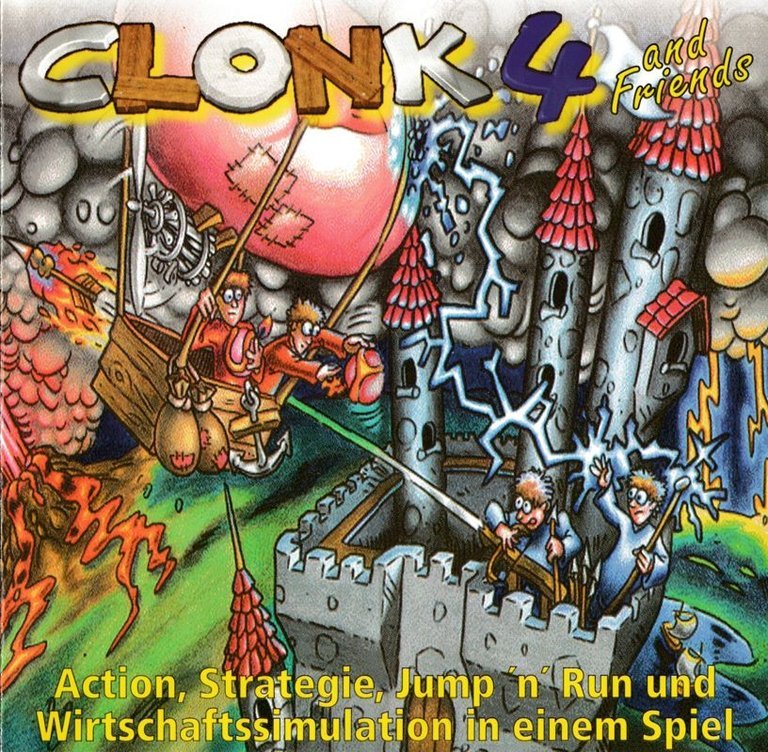
Clonk 4 is a strategic action game for up to four players via split-screen, combining real-time strategy with platform action. This Windows debut allows for enhanced graphics and customization options, including a built-in editor and C scripting for endless scenario creation. Players control Clonks through varied missions that involve resource gathering, base building, and combat, while character progression adds depth across saved profiles.
Clonk 4 Free Download
PC
Clonk 4 Guides & Walkthroughs
Clonk 4 Cheats & Codes
PC
Enter codes via MS-DOS command line in the Clonk directory.
| Code | Effect |
|---|---|
| clonk4 Katastrophen | Enables professional mode in the game options |
Clonk 4: The Controversial Genesis of a Sandbox Revolution
Introduction
In the sprawling landscape of late-1990s European gaming, few titles embodied the spirit of grassroots innovation quite like Clonk 4. As the fourth iteration of a German-developed series that began in 1994, this installment represented a seismic technological leap—transitioning from DOS to Windows while introducing unprecedented modularity. Though critically panned at launch for its primitive visuals and stiff controls, Clonk 4 laid the foundation for one of gaming’s most enduring cult franchises by pioneering an ecosystem where players could become creators. This review argues that while Clonk 4 was functionally flawed, its revolutionary customization tools and split-screen multiplayer established core DNA that would influence sandbox design for decades, ultimately securing its place as a foundational text in the evolution of user-generated content games.
Development History & Context
Studio Origins and Vision
Clonk 4 emerged from RedWolf Design, a one-man studio led by German programmer Matthes Bender. Having honed the series through three DOS-era predecessors (Clonk, Clonk 2 Debakel, and Clonk 3 Radikal), Bender recognized the need to modernize the engine to survive in the Windows-dominated market. The studio’s philosophy—rooted in democratizing game creation—was crystallized in Clonk 4‘s integrated editor and C-like scripting language (later formalized as C4Script), allowing players to modify nearly every game element.
Technological Constraints and Opportunities
Released in 1998, Clonk 4 leveraged DirectX 3 for its Windows port, enabling 1024×768 resolution, true texturized landscapes, and infinite scrolling—a radical departure from Clonk 3‘s fixed map boundaries. However, this transition introduced technical compromises: the removal of the previous scenario editor in favor of scripting, platform limitations (Pentium 133 MHz CPUs, 32MB RAM), and crude audio synthesis. Crucially, the game’s split-screen multiplayer supported only local (same-PC) play, foreshadowing the networking ambitions of its successor, Clonk Planet.
Gaming Landscape
1998 was a watershed year for real-time strategy (RTS) and sandbox games. The Settlers III (1998) popularized economic simulation, while SimCity 2000 (1994) demonstrated user-generated content potential. Yet Clonk 4 carved a unique niche by blending RTS mechanics with Lemmings-style physics and Worms-like tactics—a hybrid approach that would later echo in titles like Minecraft (2011) and Terraria (2011).
Narrative & Thematic Deep Dive
Absence of Traditional Narrative
Clonk 4 deliberately eschews linear storytelling in favor of scenario-based objectives. Missions range from deploying Clonks to defend against hostile wipfs (monsters) to establishing sustainable economies through mining, farming, and infrastructure. The “plot” is experiential—players progress through a campaign of 30+ missions, each with minimal dialogue and environmental storytelling via hazard events (earthquakes, volcanic eruptions).
Thematic Core: Survival and Agency
The game’s central theme is survival through creation. Clonks—endearing, stick-figure creatures—must adapt to dynamic environments where gravity, erosion, and resource scarcity dictate success. This philosophy resonates with the series’ enduring value: empowering players to engineer solutions rather than follow predetermined paths. The lack of character arcs or lore allows focus on sandbox mechanics, positioning Clonk 4 as an open-ended laboratory for emergent gameplay.
Gameplay Mechanics & Systems
Core Loops
Clonk 4 features three interconnected loops:
1. Economic Loop: Gather resources (coal, gold, water) → build structures (smelters, power plants) → create goods (armor, weapons).
2. Combat Loop: Deploy Clonks → utilize terrain to trap enemies → upgrade units with acquired loot.
3. Exploration Loop: Navigate procedurally generated landscapes → discover natural disasters → adapt strategies dynamically.
Multiplayer and Progression
Split-screen mode supported 1-4 players, with persistent profiles saving stats and crew experiences. Clonks developed skills (e.g., improved digging speed, toxin resistance) through repeated missions—a precursor to RPG mechanics in later titles. However, the absence of networked multiplayer limited competitive scalability.
Customization Systems
The game’s most groundbreaking feature was its “total customizability”:
– Integrated Editor: Allowed map design, object placement, and scenario scripting.
– C4Script: A C-like language for creating entirely new objects (vehicles, monsters) and altering gameplay logic.
However, this system was later abandoned in favor of the scenario editor in *Clonk Planet (2000), creating a discontinuity that frustrated early modders.*
World-Building, Art & Sound
Dynamic World Design
The Clonk universe featured 2D side-scrolling landscapes with layers including dirt, rock, water, and acid. Key innovations:
– Physics Engine: Gravity, object rotation, and recoil for projectiles.
– Environmental Hazards: Earthquakes shifting terrain, volcanoes spewing lava, and comets causing meteor showers.
– Modifiable Terrain: Clonks could dig, build bridges, and alter elevation—creating early sandbox mechanics.
Visual and Audio Direction
Art direction favored functionality over polish:
– Graphics: “Malbuchgrafik” (stick-figure visuals) with low-resolution textures, criticized by PC Action magazine but efficient for real-time simulation.
– Sound Design: Minimalist bleeps and hums (department store music), reflecting technical limits but contributing to a quirky, accessible atmosphere.
Atmosphere and Immersion
The combination of dynamic hazards and player-driven changes fostered emergent chaos. A calm mining operation could suddenly erupt into volcanic disaster, forcing adaptive strategy—anticipating the “procedural rhetoric” later perfected in Minecraft.
Reception & Legacy
Initial Criticism
At launch, Clonk 4 scored 37% from PC Action Germany (“störrische Steuerung” – stiff controls; “Kaufhausmusik” – department store music). Players found the learning curve steep, and the visuals outdated compared to contemporaries like Command & Conquer: Red Alert (1996).
Community and Commercial Impact
Despite tepid reviews, the game’s modding capabilities ignited a grassroots movement:
– Freeware Transition: In 2001, RedWolf Design released Clonk 4 as freeware, accelerating community contributions.
– CCAN Network: The Comprehensive Clonk Archive Network (CCAN) became a hub for user-generated content, hosting thousands of scenarios.
– Influence on Industry: Games like Worms (1995) and The Settlers (1993) were redefined by Clonk 4‘s hybrid approach. Its DNA is visible in:
– Minecraft and Terraria (user-generated content)
– Factorio (economic loops)
– OpenTTD (shared simulation legacy)
Legacy in Open-Source Continuation
When commercial development halted, fans revived the series as OpenClonk (2010), using Clonk Rage‘s engine but rejecting backward compatibility with earlier mods. This pivot underscored Clonk 4‘s foundational role in bridging the shareware era to open-source innovation.
Conclusion
Clonk 4 stands as a paradox: technically rudimentary yet conceptually revolutionary. Its clunky controls and simplistic graphics failed to capture mainstream acclaim upon release, yet its integrated editor and scripting system democratized game creation long before the term “modding” entered common parlance. By empowering players to redefine Clonk’s universe—transforming stick figures into armies, mines, and cities—the game established a blueprint for participatory entertainment. Though superseded by Clonk Planet‘s networking and Clonk Rage‘s cross-platform support, Clonk 4‘s legacy endures in the global proliferation of user-generated content engines. It was not the most polished game of its year, but it was undoubtedly one of the most visionary—a testament to how technical limitations can birth revolutionary possibilities when paired with creative freedom.