
- Release Year: 1997
- Platforms: DOS, Windows
- Publisher: Megamedia Corp.
- Genre: Compilation
- Average Score: 81/100
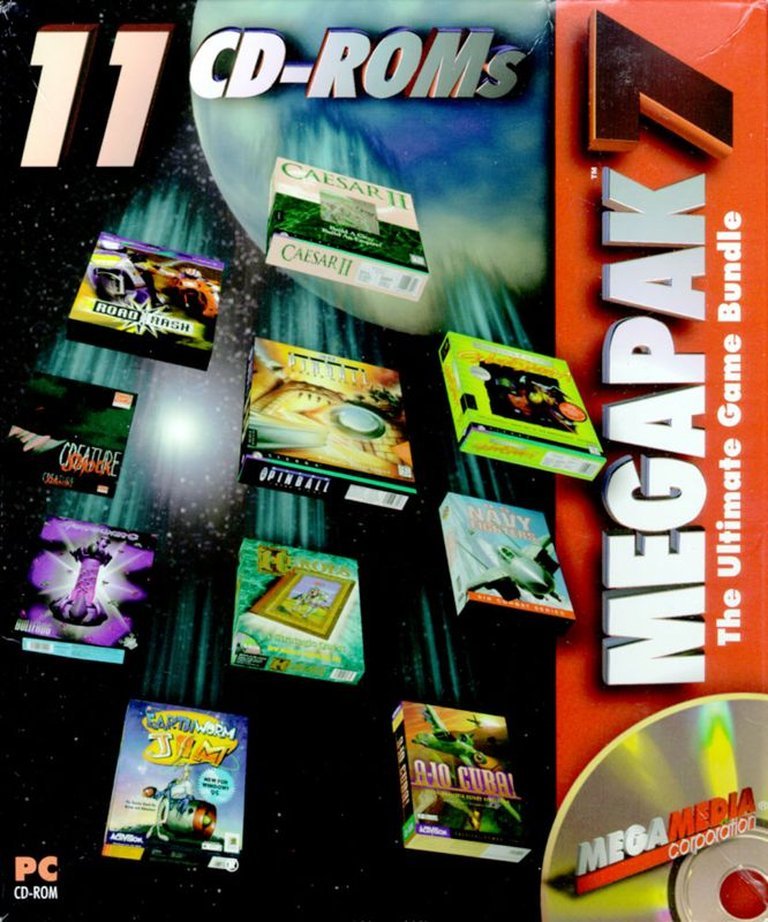
Description
Megapak 7 is a 1997 compilation of 10 classic games, including titles like Earthworm Jim, Heroes of Might and Magic, and Road Rash. Published by Megamedia Corp., this collection offers a diverse range of genres, making it a versatile choice for gamers seeking variety and value.
Megapak 7 Reviews & Reception
mobygames.com (92/100): Average score: 92% (based on 4 ratings)
Megapak 7 Cheats & Codes
Super Nintendo (SNES)
Enter memory addresses using a memory editor or flash memory controller, or use a Game Genie or Pro Action Replay. Passwords are entered at the title screen.
| Code | Effect |
|---|---|
| 7E013F:0F | Access Versus Mode from title screen |
| 7E00E0:04 | Always Clear Stage |
| 7E0B74:?? | Checkpoint modifier |
| 7E0BB0:01 | Enable alternate music in Shade Man’s stage |
| 7E0BA0:04 | Infinite Energy Cans |
| 7E0C61:FF | Unlimited Slide Time |
| 7E0C5E:?? | MegaMan Color Modifier |
| 7E0BA4:?? | Rush Letter Plate Modifier |
| 7E00BA:?? | HUD/Sprite/BG Modifier |
| 7E00AD:?? | Screen Brightness Modifier (In-Game) |
| 7E1DF2:??–7E1E00:?? | Password Modifier |
| 7E0B8105 | Unlimited Lives |
| 7E0B8409 | Unlimited Lives (alternative) |
| 7E0C2E01 | Unlimited Energy |
| 7E0BA6E7 | Unlimited Bolts |
| 7E0BA703 | Unlimited Bolts |
| 7E0BA004 | Unlimited Energy Cans |
| 7E0BA201 | Unlimited Super Cans |
| 7E0B9FFF | Rush Suit |
| 7E0BA44F | Super Fist Upgrade for Rush Suit |
| 7E0BA384 | Unlimited Beat Whistles |
| 7E0C2F03 | Can’t be hit |
| 7E0C5FFF | Autofire Mega Buster |
| 7E0C61FF | Unlimited Slide Time |
| 7E0C1601 | Hyper MegaMan |
| 7E0C1AF4 | Moon Jump |
| 3E49-8D05 | Fast Weapon Charge |
| 6DD6-5462 | Get Items From Anywhere |
| 6DD8-7DD2 | Hit Anywhere |
| 6DDA-7DAD | Skip Intro Screens |
| DDD6-ED64 | Skip Intro Screens |
| C740-E7A5 | Get Revenge On Rush Code |
| D674-E7AD | Unlock All Stages From The Start |
| DD77-EFDD | Unlock All Stages From The Start |
| C2D4-7FD7 | Stage modifier |
| C00C-8F?? | Start Game On Level ?? |
| C00C-9173 | Start Game On Level |
| 7235-7654-1145-2551 | RUSH Power-up |
| 6853-5646-1241-7515 | Full Power |
| 1415-5585-7823-6251 | Ultimate/Vs. Mode |
| 7853-5856-2245-7515 | Almost all items and 999 bolts |
| 8735-2517-4416-8362 | Skips intro level |
| 8775-2587-4416-8362 | Starts at selection screen for first 4 robot masters |
| 7853-8124-3245-7314 | Start at 2nd set of bosses with 999 bolts |
| 8735-2587-3416-2362 | Junkman defeated |
| 8735-2556-3553-8332 | Junkman, Freezeman and Burstman defeated. H and R letters obtained |
| 8731-2587-5416-4366 | Have 4 Energy Tanks, 4 Weapon Tanks, Super Tank |
| 1755-8187-6486-2322 | Eight Robot Masters Unlocked initially |
| 8775-2517-5412-8362 | Burst Man defeated |
| 8375-2757-6457-8262 | Cloud and Freeze Man defeated |
| 8375-2717-6416-8362 | Cloud defeated |
| 8375-2756-8553-2372 | Cloud, Freeze, Junk, Burst defeated |
| 8375-2757-1453-2262 | Cloud, Freeze, Junk defeated |
| 8235-7652-2547-2133 | Dr. Wily’s level part 2 |
| 1235-7452-3547-8173 | Dr. Wily’s level part 3 |
| 8275-2746-3547-8333 | First set of robot masters and Turbo Man defeated |
| 1235-2542-2143-8333 | First set of robot masters defeated, Turbo Man and Protoman defeated |
| 8235-2442-1547-2333 | First set of robot masters, Turbo Man, Shade Man, Protoman defeated |
| 8235-3452-8547-2333 | First set of robot masters, Turbo Man, Shade Man, Protoman, Spring Man defeated |
| 8775-2747-2457-2262 | Junk and Freezeman defeated, H letter and Rush search |
Megapak 7: A Time Capsule of 90s PC Gaming Glory
Introduction
In an era when CD-ROMs revolutionized PC gaming by enabling vast worlds, full-motion video, and multimedia experiences, compilations like Megapak 7 emerged as indispensable arsenals for the modern gamer. Released in late 1997 by Megamedia Corp. (Koch Media in European markets), this anthology bundled ten iconic titles across eleven discs, offering a panoramic survey of mid-90s PC innovation. From the gothic horror of 3-D Ultra Pinball: Creep Night to the strategic depth of Caesar II, Megapak 7 wasn’t merely a collection—it was a curated museum of the era’s greatest hits. This review posits that Megapak 7 stands as the pinnacle of the Megapak series, a definitive snapshot of PC gaming’s golden age, whose enduring value lies in its unparalleled diversity, technical ambition, and prescient curation.
Development History & Context
Studio and Vision
Megamedia Corp. (later Koch Media) founded the Megapak series in 1994, pioneering the compilation model to democratize access to premium games. Megapak 7 was their seventh such venture, explicitly marketed as “the greatest game pack ever put together” (GameFAQs). The vision was aspirational: to consolidate ten best-selling, genre-defining titles into a single, affordable package. Unlike many compilations that padded content with obscure titles, Megamedia curated A-list games, each a critical or commercial success in its own right.
Technological Constraints
The games were developed between 1994–1996, reflecting the technological constraints and opportunities of the 486-to-Pentium transition era. SVGA graphics (640×480) were cutting-edge, while CD-ROMs enabled unprecedented asset density—Creature Shock alone spanned two discs with its pre-rendered FMV sequences. The compilation’s system requirements (Intel Pentium, 16MB RAM, Windows 95, 2X CD-ROM) underscored its target audience: enthusiasts seeking to leverage new hardware. DOS compatibility ensured accessibility to legacy systems, though Windows optimization was increasingly prioritized.
The Gaming Landscape
1997 was a renaissance for PC gaming. Real-time strategy (RTS) dominated (Caesar II, Heroes of Might and Magic), action-platformers thrilled (Earthworm Jim), and simulations pushed realism (U.S. Navy Fighters). Multiplayer was evolving, with titles like Road Rash and Genewars supporting LAN modem play. Megapak 7 encapsulated this diversity, offering a sampler of nearly every major genre—empire-building, pinball, flight combat, FMV adventure, and even experimental hybrids like Genewars’ “sports with genetic engineering.”
Narrative & Thematic Deep Dive
Megapak 7’s narratives span millennia and galaxies, united by themes of ambition, survival, and absurdity:
- Gothic Horror: 3-D Ultra Pinball: Creep Night traps players in a haunted castle where “ghosts, gremlins, and gargoyles wreak havoc” (MobyGames). The narrative unfolds through environmental storytelling—ticking clocks, spectral apparitions—and a final confrontation with the “goblin king,” embodying classic horror tropes of good vs. ancient evil.
- Military Realism: A-10 Cuba! and U.S. Navy Fighters ground their stories in geopolitical tension. Players defend Guantanamo Bay from guerrillas or dogfight with MiGs, emphasizing duty, technological superiority, and the moral grayness of interventionist warfare.
- Empire and Power: Caesar II immerses players in Roman statecraft, where “upstart Gauls, invading barbarians, and restless citizens” threaten imperial ambition (MobyGames). Themes of urban planning, resource management, and political intrigue mirror real-world governance dilemmas.
- Sci-Fi Horror: Creature Shock presents a claustrophobic nightmare on the UNS Amazon, a ship lost near Saturn. The narrative blends B-movie horror with existential dread as players uncover the fate of a crew consumed by bio-engineered horrors, reflecting 90s anxieties about unchecked biotechnology.
- Absurdist Satire: Earthworm Jim subverts tropes with a worm in a super-suit battling Psy-Crow, an “intergalactic bounty hunter” (MobyGames). Its dialogue and scenarios—e.g., saving “What the Heck”—lampoon superhero clichés and embrace surrealism.
- Genetic Futurism: Genewars and Missionforce: CyberStorm explore bio-engineering as both salvation and threat. In Genewars, players genetically mutate creatures for sports; in CyberStorm, they pilot “Bioderms” in cyborg wars, questioning the ethics of human augmentation.
These narratives collectively mirror the 90s’ cultural obsessions: historical revisionism (Caesar II), technological paranoia (Creature Shock), and post-Cold War militarism (A-10 Cuba!).
Gameplay Mechanics & Systems
Megapak 7’s gameplay is a masterclass in genre diversity, each title pioneering mechanics that would define its category:
Action & Simulation
– Road Rash: Combated racing with brawling at 150MPH, enabling players to “punch, kick” rivals (MobyGames). Its network multiplayer (up to 8 players) was revolutionary for competitive multiplayer.
– U.S. Navy Fighters and A-10 Cuba! delivered authentic flight simulations, with “photo-realistic graphics” and “rear-view mirrors” (MobyGames). A-10’s “over 20 weapons systems” and mission-based structure foreshadowed modern military sims.
– 3-D Ultra Pinball: Creep Night used 3D environments for physics-based puzzles, with “lightning-quick bank shots” and three interconnected tables (courtyard, lab, dungeon).
Strategy & RPG
– Heroes of Might and Magic blended RPG hero progression with tactical hex-based combat, allowing players to “recruit heroes, gather armies” across multiple scenarios (MobyGames). Its “network/modem play” fostered competitive communities.
– Caesar II refined city-building with “dozens of authentic structures” and “trade routes” (MobyGames), requiring players to balance citizen happiness against military threats.
– Missionforce: CyberStorm introduced persistent mech customization: players upgraded “weaponry” and “genetic structures” of Bioderm pilots, merging squad tactics with RPG progression.
Experimental & Innovative
– Creature Shock used FMV and pre-rendered graphics for on-rails exploration, its “one gigabyte of content” pushing CD limits (MobyGames).
– Earthworm Jim broke platformer norms with physics-based humor—e.g., using Jim’s head as a helicopter propeller.
UI and Accessibility
The compilation featured a unified launcher, but individual games varied in UI design. Caesar II’s SVGA interface was intuitive, while Creature Shock’s FMV menus felt dated. Manuals were “comprehensive,” aiding newcomers to complex sims like CyberStorm (GameFAQs).
World-Building, Art & Sound
Visual Direction
Megapak 7’s art styles span millennia:
– Earthworm Jim’s hand-drawn, grotesque characters (e.g., Psy-Crow) defined 90s cartoonish excess.
– Caesar II’s Roman vistas and Heroes of Might and Magic’s fantasy landscapes showcased SVGA’s potential for detailed environments.
– Creature Shock pre-rendered, Alien-inspired corridors created a suffocating atmosphere, while U.S. Navy Fighters’ cockpit realism grounded its simulation.
– 3-D Ultra Pinball’s gothic tables—complete with gargoyles and chandeliers—were technical showcases for 3D graphics.
Sound Design
Audio ranged from diegetic to cinematic:
– Road Rash’s engine roars and metal-on-metal combat defined its anarchic tone.
– Caesar II’s classical soundtrack evoked imperial grandeur.
– Creature Shock’s synthesized horror scores and voice acting (e.g., static-filled transmissions) amplified tension.
– Earthworm Jim’s jazz-funk soundtrack and over-the-top sound effects cemented its comedic identity.
Atmosphere
The compilation’s strength lies in tonal diversity: Caesar II’s meticulous planning contrasts Road Rash’s chaotic rebellion; Creature Shock’s dread juxtaposes Earthworm Jim’s silliness. This variety ensured no single mood dominated, offering players emotional range from epic to absurd.
Reception & Legacy
Critical Acclaim
Megapak 7 was a critical triumph, with a 92% average on MobyGames based on four reviews:
– PC Player (Germany) awarded 100%, praising its “bunte Mischung” (colorful mix) and value proposition.
– Power Play (Germany) hailed it as “der wohl beste Teil der Megapak-Serie,” citing its “stimmige Compilation” (cohesive compilation).
– GameStar scored 87%, noting it was “Nummer 2 unter den Compilations” (second-best compilation) and superior to its sequel, Megapak 8.
– PC Joker gave 81%, conceding it fell short of Gigapak 1’s classics but emphasized its affordability.
All reviews highlighted the bundle’s value: “Falls Sie noch keines dieser Spiele besitzen, sollten Sie unbedingt zuschlagen” (PC Player).
Commercial Performance
While exact sales figures are elusive, its release in Australia, New Zealand, and Europe (per VGTimes) suggests strong distribution. The inclusion of eleven discs underscored its premium status—equivalent to a collector’s edition.
Legacy and Influence
Megapak 7 cemented the compilation model as a viable strategy for maximizing back-catalog revenue. Its curation—prioritizing genre diversity and iconic titles—set a benchmark for future bundles like Gigapak. Today, it preserves landmark games: Earthworm Jim’s design influenced platformers, Heroes of Might and Magic defined turn-based strategy, and Creature Shock remains a cult FMV artifact. As one Reddit user noted, its “bunte Mischung” offered “etwas für jeden Geschmack,” anticipating modern services like Steam’s genre-curated sales.
Conclusion
Megapak 7 is more than a compilation—it is a time capsule, a meticulously curated anthology capturing PC gaming’s most vibrant era. Its genius lies in balancing blockbuster action (Road Rash), cerebral strategy (Caesar II), and experimental ambition (Creature Shock) into a cohesive, value-driven package. While individual games show their age (e.g., DOS-era UI quirks), their collective impact endures. The compilation’s critical acclaim, commercial reach, and legacy as the “best Megapak” (GameStar) solidify its place in history. For modern players, Megapak 7 is a window into the 90s’ boundless creativity; for historians, it’s a testament to the power of bundling. In an age of digital storefronts, its physical, eleven-disc presence remains a tangible artifact of a time when PC gaming was a sprawling, uncharted frontier. Verdict: An essential, genre-defining anthology whose value transcends nostalgia.