
- Release Year: 2002
- Platforms: Windows
- Publisher: SibGame
- Developer: SibGame
- Genre: Puzzle, Tile matching puzzle
- Perspective: Side view
- Game Mode: Single-player
- Gameplay: Tile matching puzzle
- Average Score: 70/100
Description
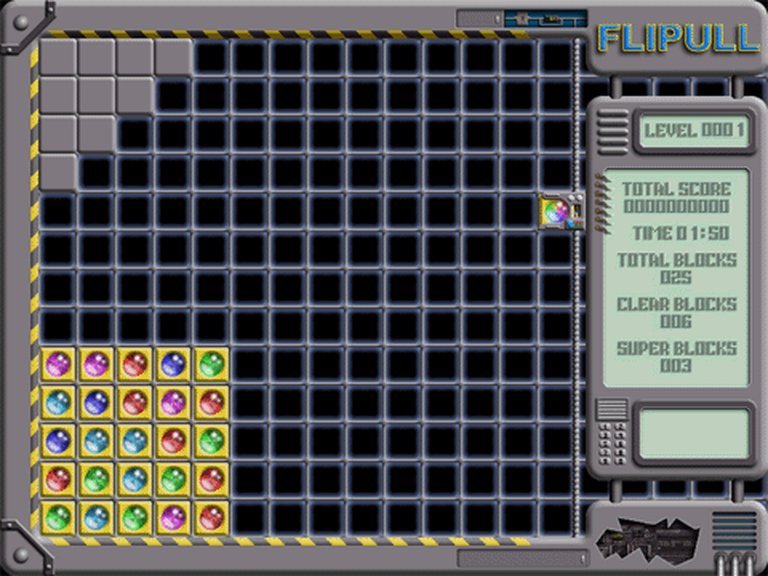
Flipull is an arcade-style puzzle game where players aim to destroy as many blocks as possible on a grid, earning points and advancing through increasingly difficult levels. The game features over 100 levels, customizable skins, and a tile-matching gameplay mechanic similar to Puzznic. Originally released by Taito in 1989, it has been ported to various platforms, including the Famicom, Game Boy, and modern consoles as part of Taito Legends.
Gameplay Videos
Flipull Mods
Flipull Reviews & Reception
gamefaqs.gamespot.com (70/100): Flipull is a cute and endearing puzzler.
Flipull Cheats & Codes
Nintendo Entertainment System (NES)
Enter Game Genie codes at the main menu. For Level Select, enter the button sequence at the title screen.
| Code | Effect |
|---|---|
| SXUONTVG | Infinite Tries |
| 0313:01 | Always Win Round |
| Down, Left, Right, Up, A, Right, Down, B, Up, Left, Start | Unlocks Level Select screen |
Game Boy
Enter the following button sequence at the title screen:
| Code | Effect |
|---|---|
| Down, Left, Right, Up, A, Right, Down, B, Up, Left, Start | Unlocks Level Select screen |
Flipull: Review
Introduction
In the crowded pantheon of puzzle games, few titles manage to carve out a unique niche through sheer mechanical ingenuity. Flipull, a 1989 arcade creation by Taito Corporation, stands as a testament to this principle. Born in an era dominated by Tetris and Dr. Mario, this obscure gem introduced a revolutionary “block-flipping” mechanic that blended spatial reasoning with chain-reaction physics. While its Western release under the name Plotting relegated it to cult status, Flipull deserves recognition as a foundational innovator in the puzzle genre. This review deconstructs its legacy, examining how a game about bouncing blocks across grids influenced design philosophy, endured through decades of ports, and remains a satisfying cerebral challenge. Our thesis: Flipull is an unsung masterpiece of puzzle design, whose elegance lies in transforming simple rules into profound strategic depth.
Development History & Context
Taito Corporation, the legendary studio behind Space Invaders and Bubble Bobble, developed Flipull on their Taito L System arcade hardware in 1989. This choice placed it alongside contemporary arcade titans like Rainbow Islands and Chase H.Q., leveraging Taito’s hardware prowess for fluid animations and responsive controls. The creators’ vision was refreshingly minimalist: to create a “pure” puzzle experience where mechanics, not narratives, drove engagement. Technological constraints of the era—limited palettes, sprite-based graphics, and mono sound—forced ingenious design; the game’s block symbols and blob character were distilled to their most recognizable forms. The gaming landscape was saturated with falling-block puzzles, but Flipull diverged by emphasizing lateral thinking and spatial causality. Its ports to home systems (NES, Game Boy, Amiga, and ZX Spectrum, among others) further adapted its core concept, often simplifying visuals for weaker hardware. The Game Boy version, for instance, retained the core loop while reducing levels from arcade standards to 50 and streamlining controls for a handheld experience. This adaptability underscored the game’s robust design philosophy.
Narrative & Thematic Deep Dive
Flipull eschews traditional narratives, instead weaving a thematic tapestry from its mechanics. The “plot” is existential: a blob character navigates a grid, manipulating blocks to restore order to a chaotic space. Its world is a microcosm of cause and effect, where every action triggers consequences. The blob—described as a “cute, endearing” creature in Game Boy reviews—serves as a player avatar, embodying persistence against entropy. Dialogue is nonexistent, replaced by the silent language of physics: clinks, shatters, and resets. Underlying themes emerge through gameplay: inevitability (chain reactions as domino effects), resource management (limited “wild card” blocks), and strategic foresight (planning moves ahead to avoid dead ends). The absence of narrative forces players to confront these themes directly, making the game a meditation on logic and consequence.
Gameplay Mechanics & Systems
At its core, Flipull is a symphony of precision and prediction. The player controls a blob on a vertical ladder, shooting symbol-matched blocks at formations. When a fired block collides with identical symbols, those vanish, while the next block in the sequence bounces back to the player. This creates a high-stakes loop: wrong moves waste time and leave the player with unusable blocks. Key systems include:
– Physics-Based Chain Reactions: Clever setups can trigger cascading clears, rewarding foresight.
– Ricochet Mechanics: Angled ceilings allow players to target blocks from above, adding verticality.
– Wild Cards: Starting blocks act as jokers, enabling initial clears but requiring careful management.
– Time Pressure: Levels demand clearing a minimum block count before time expires.
The Game Boy version refines this with two modes: Normal (allowing “power points” to escape unwinnable states) and Advance (punishing mistakes). UI is Spartan yet effective, with clear symbols and a visible timer. Its flaws are equally telling: the lack of a save system (noted in GameFAQs reviews) forces marathon sessions, while difficulty spikes near level 20 demand rote memorization. Yet these limitations amplify the game’s tension, making each clear a cathartic victory.
World-Building, Art & Sound
Flipull’s world is a grid-based abstraction, but its art direction maximizes clarity and charm. Blocks are adorned with distinct symbols (circles, crosses, diamonds, and lightning bolts), ensuring instant recognition even on low-res screens. The blob character, with its animated hops and wide eyes, injects personality into a sterile environment. Sound design mirrors this simplicity: percussive thunks for shots, satisfying pops for clears, and a looping, chiptune melody that’s “catchy but repetitive” (per GameFAQs). The arcade’s YM2203 OPN chip creates a brighter, more dynamic score than the Game Boy’s monophonic version, yet both versions serve the gameplay—audio cues signal successful combos or imminent failure. Visually, the game’s “dizzying backgrounds” (Destructoid) and fixed screens create a contained, hypnotic space, focusing the player on the puzzle itself.
Reception & Legacy
Upon release, Flipull found niche success in arcades, particularly in Japan where it retained its original name. Western ports like Plotting on home computers were met with muted praise for their mechanics but overlooked due to the puzzle genre’s oversaturation. The Game Boy version (1990) earned a respectable 7/10 from GameFAQs, lauded as “cute and endearing” but criticized for its difficulty curve and absence of save functionality. Its legacy, however, blossomed retroactively. The game’s inclusion in Taito Legends (2005) for PS2 and Xbox introduced it to a new generation, while modern re-releases in Taito Memories Joukan (2005) and the Arcade Archives series (2022) cemented its cult status. Influenced games like Puzznic and Qix echo its chain-reaction logic, though none matched its elegance. Today, it’s revered for its purity—a puzzle game where every move feels consequential, a rarity in an era of Skinner-box designs.
Conclusion
Flipull is a masterclass in restrained design. It proves that profound engagement can arise from minimalist rules, transforming block-matching into a dance of prediction and consequence. Its legacy lies not in commercial dominance but in its DNA: a blueprint for puzzle games that prioritize intellectual reward over spectacle. The Game Boy version’s lack of save features and punishing difficulty may alienate modern players, yet these flaws are inseparable from its appeal—each cleared level is a hard-won triumph. In the annals of gaming history, Flipull stands as a quiet innovator, a forgotten gem whose influence echoes in every chain reaction of Candy Crush or Hexic. For those seeking a pure, unadulterated puzzle experience, it remains not just a relic of the past but a timeless challenge. Verdict: A foundational masterpiece, essential for puzzle enthusiasts and historians alike.