
- Release Year: 2019
- Platforms: Windows
- Publisher: WhiteLake Studio
- Developer: DG Games Workshop
- Genre: Action
- Perspective: Diagonal-down
- Game Mode: Single-player
- Gameplay: Arcade, Shooter
- Setting: Futuristic, Sci-fi
- Average Score: 77/100
Description
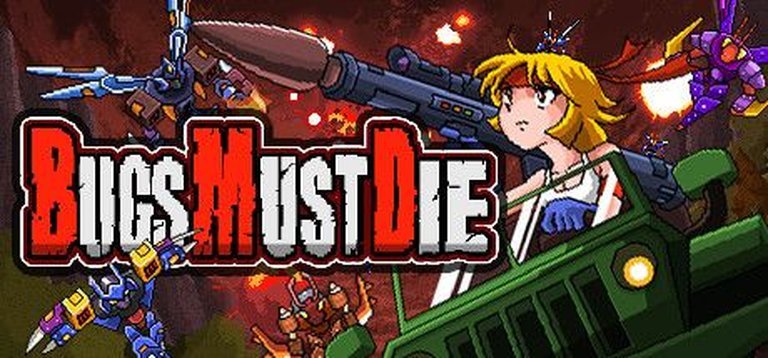
Bugs Must Die is a frantic top-down arcade shooter and spiritual successor to Konami’s ‘Jackal’, set in a sci-fi future where players command elite agents and upgradeable futuristic vehicles to battle swarms of diverse alien bugs. Featuring twin-stick controls, pixel art aesthetics, and 80s/90s arcade nostalgia, the game challenges players to destroy hordes of extraterrestrial pests and pop-culture bosses across intense 2D scrolling levels.
Gameplay Videos
Where to Buy Bugs Must Die
PC
Bugs Must Die Cracks & Fixes
Bugs Must Die Mods
Bugs Must Die Guides & Walkthroughs
Bugs Must Die Reviews & Reception
store.steampowered.com : There’s no denying that Bugs Must Die could use a little more polish here and there, but overall it’s a fairly enjoyable retro-inspired arcade shooter.
nichegamer.com (85/100): It’s not the best game in the genre I’ve ever played, but it does enough right to get a recommendation from me if you are in the market for a challenging new twin stick shooter.
opencritic.com (70/100): Its not the best game in the genre I’ve ever played, but it does enough right to get a recommendation from me if you are in the market for a challenging new twin stick shooter.
Bugs Must Die: Review
Introduction
In the crowded landscape of retro-inspired shooters, Bugs Must Die stands out as a bold, if flawed, homage to classic arcade action. Developed by DG Games Workshop, this pixel-art twin-stick shooter pays tribute to Konami’s Jackal while carving its own niche with a mix of vehicular combat, RPG elements, and pop-culture parodies. Released in 2019, the game arrived during a resurgence of retro-styled indie titles, but its blend of chaotic gameplay and nostalgic charm makes it a standout entry in the genre. This review will dissect Bugs Must Die across its narrative, mechanics, presentation, and legacy, arguing that while it stumbles in polish and design cohesion, its sheer variety and replayability make it a worthy addition to any shooter enthusiast’s library.
Development History & Context
The Studio and Its Vision
DG Games Workshop, a small indie studio based in Shanghai, China, was founded in 2016 with a mission to create “fun, challenging, and beatable” indie games. Bugs Must Die is their debut title, born from a desire to revive the spirit of Jackal (1986), a top-down jeep shooter by Konami. The team saw an opportunity to modernize the formula with contemporary mechanics while retaining the arcade sensibilities of the 1980s and 1990s.
The studio’s name, “Dragonglass,” is a playful nod to Game of Thrones, reflecting their blend of Eastern and Western influences. Their goal was to appeal to both Chinese and global audiences, a challenge given China’s strict gaming regulations. By publishing on Steam, they bypassed local censorship and targeted a broader market.
Technological Constraints and the Gaming Landscape
Developed in Unity, Bugs Must Die leverages pixel-art aesthetics to evoke nostalgia while incorporating modern design elements like RPG progression and procedural generation. The game’s development cycle was longer than anticipated—originally slated for a January 2019 release, it was delayed to April due to polish and balancing issues. This delay highlights the challenges faced by small teams striving for quality in a competitive indie space.
At the time of its release, the twin-stick shooter genre was thriving, with titles like Enter the Gungeon and Nex Machina setting high standards for mechanics and presentation. Bugs Must Die aimed to differentiate itself through its vehicular combat, pop-culture parodies, and multiple gameplay modes.
Narrative & Thematic Deep Dive
Plot and Characters
The story of Bugs Must Die is straightforward: as an elite agent of the Galactic Pests Control Company, you’re dispatched to planet M-79 to stop an invasion by Mantis Beings, who have cloned Earth’s pop culture icons as bosses. The narrative is delivered through brief, pixel-art cutscenes and text, with a translation that, while functional, occasionally feels clunky.
The protagonists include three vehicles (a jeep, tank, and hovercraft) and two Mantis Agents, each with unique weapon systems. The vehicles are customizable, while the Agents offer agile, bullet-hell-style combat. The Mantis Beings, meanwhile, are a chaotic mix of mechs, giant insects, and parodies of figures like Street Fighter’s Ryu and Resident Evil’s Mr. X.
Themes and Tone
The game’s tone is unapologetically campy, blending sci-fi action with humor. The Mantis Beings’ pop-culture parodies range from clever to confusing, with some bosses feeling like random mashups rather than cohesive designs. Thematically, Bugs Must Die leans into the “bug genocide” premise with gusto, offering little moral ambiguity—your mission is to exterminate, and the game revels in the spectacle of destruction.
Gameplay Mechanics & Systems
Core Loop and Combat
Bugs Must Die is a twin-stick shooter at heart, but its vehicular combat and RPG elements add depth. Players control vehicles or Agents, switching between up to six primary weapons (e.g., miniguns, rockets, lasers) and nine sub-weapons (e.g., napalm, airstrikes). Each weapon can be upgraded with in-game currency, allowing for tactical customization.
The combat is fast-paced and chaotic, with enemies spawning from off-screen and terrain occasionally obscuring visibility. The game’s difficulty is adjustable: hardcore players can attempt Story Mode with basic weapons, while others can grind for upgrades. The “Battle Core” mechanic—deploying a temporary turret when your vehicle is destroyed—adds a layer of strategy.
Modes and Progression
- Story Mode: 16 levels with one boss per level. Completing it unlocks all characters.
- Challenge Mode: 8 remixed levels with secret bosses and unique rewards.
- Hell Mode: A roguelike dungeon crawl with escalating difficulty and loot.
The game’s progression system rewards exploration and replayability, though the UI for weapon management feels clunky compared to modern shooters.
World-Building, Art & Sound
Visual Direction
The pixel-art style is a love letter to the 8-bit and 16-bit eras, with vibrant, detailed sprites and fluid animations. The environments—jungles, wastelands, underground bases—are varied but occasionally suffer from cluttered layouts that obscure enemies or power-ups.
The boss designs are the game’s standout visual element, blending sci-fi grotesquery with pop-culture nods. However, the sheer variety can feel disjointed, as if the developers couldn’t decide on a cohesive aesthetic.
Sound Design and Music
The soundtrack is a synth-heavy mix of chiptune and orchestral tracks, evoking the energy of classic arcade games. The sound effects—explosions, gunfire, alien screeches—are punchy and immersive, though the voice acting (limited to cutscenes) is stiff.
Reception & Legacy
Critical and Commercial Reception
Bugs Must Die received mixed-to-positive reviews. Critics praised its weapon variety and replayability but criticized its UI, translation issues, and occasional frustration with off-screen enemies. User reviews on Steam were overwhelmingly positive (85% positive), with players appreciating the game’s challenge and nostalgia factor.
Commercially, the game sold modestly, with estimates suggesting around 4,000 units. Its low price point ($4.79 on sale) and free demo helped attract players, but it remained a niche title.
Influence and Impact
While not a commercial juggernaut, Bugs Must Die contributed to the twin-stick shooter revival of the late 2010s. Its blend of vehicular combat and RPG elements influenced later indie titles, and its pop-culture parodies foreshadowed trends in games like Ready Player One. The developers’ responsiveness to player feedback—such as adding quality-of-life improvements—set a positive example for indie studios.
Conclusion
Bugs Must Die is a flawed but ambitious shooter that succeeds in delivering chaotic, replayable fun. Its strengths—weapon variety, multiple modes, and nostalgic charm—outweigh its weaknesses, such as clunky UI and inconsistent boss designs. While it may not rival genre giants like Enter the Gungeon, it carves out a unique identity as a love letter to arcade shooters and pop culture.
Final Verdict: A worthy addition to the twin-stick shooter canon, Bugs Must Die earns a place in video game history as a passionate, if imperfect, tribute to retro action. For fans of arcade-style mayhem, it’s a must-play.