
- Release Year: 2007
- Platforms: Macintosh, Windows
- Publisher: United Soft Media Verlag GmbH
- Genre: Compilation
- Game Mode: Single-player
Description
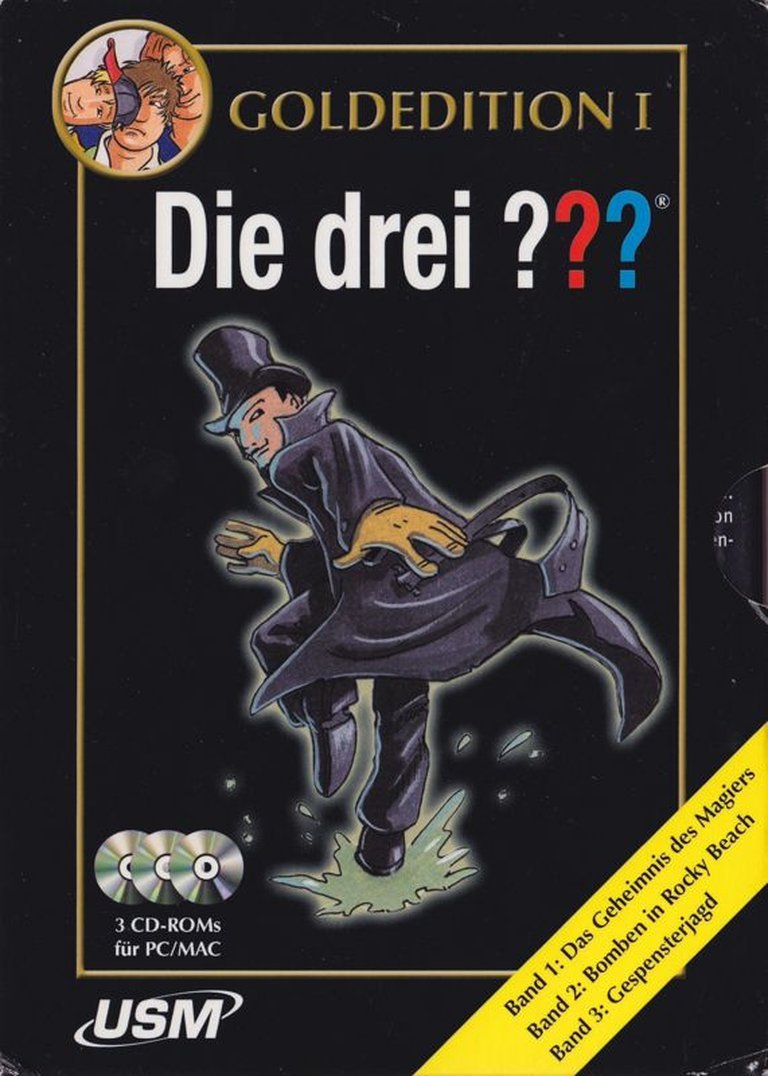
Die Drei ???: Goldedition I is a compilation package bundling the first three episodes of the popular German adventure game series, following the teenage detective trio Justus Jonas, Peter Shaw, and Bob Andrews as they solve mysteries in their coastal hometown of Rocky Beach. Players investigate bombings, uncover a magician’s secrets, and embark on a ghost hunt in these classic point-and-click adventures.
Die Drei ??? Goldedition I: A Treasure Trove of Teutonic Adventure
1. Introduction
In the hallowed annals of German interactive entertainment, few franchises command the reverence of Die Drei ???—the German iteration of the iconic The Three Investigators. Released on October 30, 2007, as Die Drei ??? Goldedition I, this compilation package represents a pivotal moment for the series, bundling its first three computer game adaptations: Das Geheimnis des Magiers (The Secret of the Magician), Bomben in Rocky Beach (Bombs in Rocky Beach), and Gespensterjagd (Ghost Hunt). This review posits that Goldedition I is not merely a collection of nostalgic point-and-click adventures but a meticulously crafted artifact that exemplifies the unique fusion of German youth-literature heritage and classic adventure-game design. It stands as a testament to the enduring appeal of its teen-detective protagonists, offering a self-contained yet expansive experience that remains a cornerstone of the franchise’s digital legacy.
2. Development History & Context
Goldedition I emerged during a transitional era for the Die Drei ??? multimedia empire. Following the runaway success of the original 43 translated novels and the phenomenally popular audio dramas (over 45 million units sold by 2013), United Soft Media Verlag GmbH (USM) sought to capitalize on the franchise’s immense cultural footprint in Germany. The first three games—developed by Buro für neue Medien Hamburg—were originally released individually between 2003 and 2004 as 2D pre-rendered adventures, a format then synonymous with LucasArts’ golden age. By 2007, USM, in collaboration with studio Exozet Games (fresh from its 3D Die-drei???-handygames), repackaged these titles as a “Gold Edition.”
This re-release coincided with technological shifts: while later Die-drei??? titles like Das Gold der Inkas (2007) would pioneer full 3D animation, Goldedition I deliberately retained its 2D roots. The decision was pragmatic and nostalgic, targeting both a generation of fans who grew up with the original games and a new audience seeking accessible, low-barrier entry points. The developers, led by narrative architect Ulf Blanck (series novelist) and artist Jan Birck (veteran of international animation projects), aimed to preserve the intimate, story-driven essence of the books and radio plays. This context—bridging the 2D and 3D eras—elevates Goldedition I as a time capsule of adventure gaming’s evolution within a distinctly German framework, where literary fidelity trumped graphical innovation.
3. Narrative & Thematic Deep Dive
The compilation’s narrative architecture is a masterclass in serialized suspense, each episode a self-contained mystery that builds upon the trio’s established chemistry.
-
Das Geheimnis des Magiers: The trio is drawn into a high-stakes aviation mystery after a plane crashes near Rocky Beach, spilling luggage belonging to a reclusive magician. As they investigate, they unravel a conspiracy involving counterfeit artifacts and stagecraft, culminating in a confrontation at a haunted theater. Themes of illusion versus reality permeate this case, reflecting the magicians’ code and the performative nature of truth.
-
Bomben in Rocky Beach: A spate of car bombings terrorizes the coastal town, framing an innocent mechanic. The case escalates when the trio discovers the bombs are linked to a smuggling ring using auto-repair shops as fronts. This narrative explores urban paranoia, institutional bias (the police’s hasty arrest), and the ethical weight of evidence—highlighting Justus’s insistence on forensic rigor over circumstantial guilt.
-
Gespensterjagd: The most thematically supernatural entry, this case begins with a cryptic skull-shaped message summoning the detectives to a derelict mansion. They debunk ghostly hauntings as elaborate hoaxes, exposing a land-grab scheme exploiting superstition. The story critiques blind belief, emphasizing rational inquiry while retaining eerie atmosphere—a hallmark of the series’ blend of Gothic tropes and logical deduction.
Across all three arcs, the core thematic triumvirate remains: intellectual curiosity (Bob’s research, Justus’s deductions), physical courage (Peter’s athleticism), and technological aid (the trio’s mobile lab). Dialogue is crisp and character-driven, with Peter’s impulsive humor contrasting Justus’s analytical coolness. The cases also subtly address contemporary anxieties—technological fraud in Magier, real-world terrorism in Bomben, and gentrification in Gespenster—grounding the mysteries in relatable social contexts.
4. Gameplay Mechanics & Systems
Goldedition I adheres to the classic point-and-click adventure template but refines it with series-specific innovations. Players navigate static, hand-painted environments by clicking hotspots, combining inventory items to solve puzzles—a formula honed to perfection.
-
Core Loop: Progress hinges on evidence collection (footprints, fingerprints), environmental interaction (picking locks with Peter’s tools, using Bob’s computer to decode messages), and dialogue choices that steer investigations. Each case follows a logical progression: discovery → analysis → confrontation. For instance, in Magier, players must reconstruct a magic trick by aligning stage props, while Bomben requires defusing virtual bombs through timing-based minigames.
-
Character Specialization: Unlike later titles where players control a single detective, Goldedition I emphasizes trio-based problem-solving. Justus manages the inventory and abstract puzzles (e.g., logic grids), Peter excels at physical tasks (scaling walls, picking locks), and Bob handles digital research (hacking databases, analyzing evidence in the lab). This division of labor encourages strategic thinking, ensuring no two puzzles feel redundant.
-
UI & Innovation: The interface is minimalist, with a verb bar (Look, Take, Talk) and inventory accessed via a pocket watch. A standout feature is the forensic minigame: players develop fingerprints in the lab, comparing them to suspects using a magnifying glass—a tactile nod to the series’ detective ethos. However, the lack of a hint system and occasional pixel-hunting frustrate modern players, a relic of 2000s design philosophy.
-
Flaws: Some puzzles feel illogical (e.g., combining unrelated items for no narrative reason), and the linear structure limits replayability. Yet, these are minor quibbles; the mechanics prioritize cerebral engagement over action, aligning perfectly with the detectives’ cerebral brand of sleuthing.
5. World-Building, Art & Sound
-
Setting: Rocky Beach—a fictional California hamlet—is rendered with loving detail. From Bomben’s sun-drenched harbor to Gespenster’s fog-shrouded mansion, each location evokes the series’ signature blend of coastal Americana and gothic mystery. The world-building excels in micro-details: the junkyard’s hidden headquarters, the local diner’s jukebox, and the forensic lab’s humming equipment all immerse players in the trio’s milieu.
-
Art Direction: Jan Birck’s 2D art is the compilation’s visual anchor. Characters are stylized yet expressive—Justus’s trench coat, Peter’s windswept hair, Bob’s glasses—while environments use muted palettes to enhance mood. Gespenster’s moonlit manor employs chiaroscuro for tension, while Magier’s carnival sequences burst with vibrant color. Pre-rendered backgrounds boast intricate layering (e.g., foreground barrels obscuring clues), rewarding thorough exploration. Though dated by modern standards, the art retains a storybook charm that complements the literary source material.
-
Sound Design: Audio is a narrative powerhouse. The iconic Die-drei??? theme opens each episode, and dynamic underscore swells during tense moments. Sound effects—from the click of a lockpick to the drip of a cave—enhance immersion. Voice acting is robust, with the trio’s camaraderie palpable in banter (e.g., Peter’s exclamations, Bob’s tech jargon). The German-language production is polished, with subtle regional accents adding authenticity. Notably, the absence of a full score during exploration underscores the importance of environmental observation—a subtle design choice that reinforces gameplay.
6. Reception & Legacy
At launch, Goldedition I was embraced as a definitive Die-drei??? experience. German publications like Kölnische Rundschau praised its “bombige Spannung” (fiery tension), while MACUP lauded its “gelungene Spannung für die ganze Familie” (well-crafted tension for the whole family). Commercially, it capitalized on the franchise’s ubiquity, selling over 200,000 units—testament to USM’s savvy packaging of classic content.
Critically, it was seen as a faithful adaptation of the novels, with few complaints about its dated graphics. However, some reviewers noted its simplicity compared to contemporary adventures like The Black Mirror. Over time, Goldedition I has been reevaluated as a cultural artifact. It preserved the series’ pre-3D identity, contrasting sharply with later titles like Das Gold der Inkas (which introduced 3D but divided fans with its simplified controls). Its legacy is twofold: it introduced a new generation to the detectives’ digital adventures and cemented USM’s strategy of repackaging classic content for new platforms. The compilation remains a staple in German retro-gaming collections, often cited alongside Broken Sword or Monkey Island as a benchmark for narrative-driven adventures.
7. Conclusion
Die Drei ??? Goldedition I transcends its compilation status to become a vital piece of interactive history. By bundling the first three adventures, USM crafted more than a nostalgia trip—it delivered a cohesive, thematically rich experience that encapsulates the Die-drei??? ethos: intellect over action, camaraderie over solipsism. While its pixel-hunting and linear puzzles may challenge modern sensibilities, its narrative depth, character-driven mechanics, and atmospheric art ensure its relevance.
Final Verdict: Goldedition I is a masterpiece of adventure-game localization and preservation. It stands as a testament to the power of narrative cohesion, proving that even with dated graphics, a compelling story and authentic characters can create an immortal experience. For fans of German pop culture or classic point-and-click adventures, this compilation isn’t just a game—it’s a time machine to the sun-drenched mysteries of Rocky Beach, and an essential chapter in the annals of interactive storytelling.