
- Release Year: 1999
- Platforms: Macintosh, Windows
- Publisher: 1C Company, DreamCatcher Interactive Inc., Nordic Softsales AB
- Developer: Earthlight Productions Inc.
- Genre: Adventure
- Perspective: 1st-person
- Game Mode: Single-player
- Gameplay: Puzzle elements
- Setting: Futuristic, Sci-fi
- Average Score: 66/100
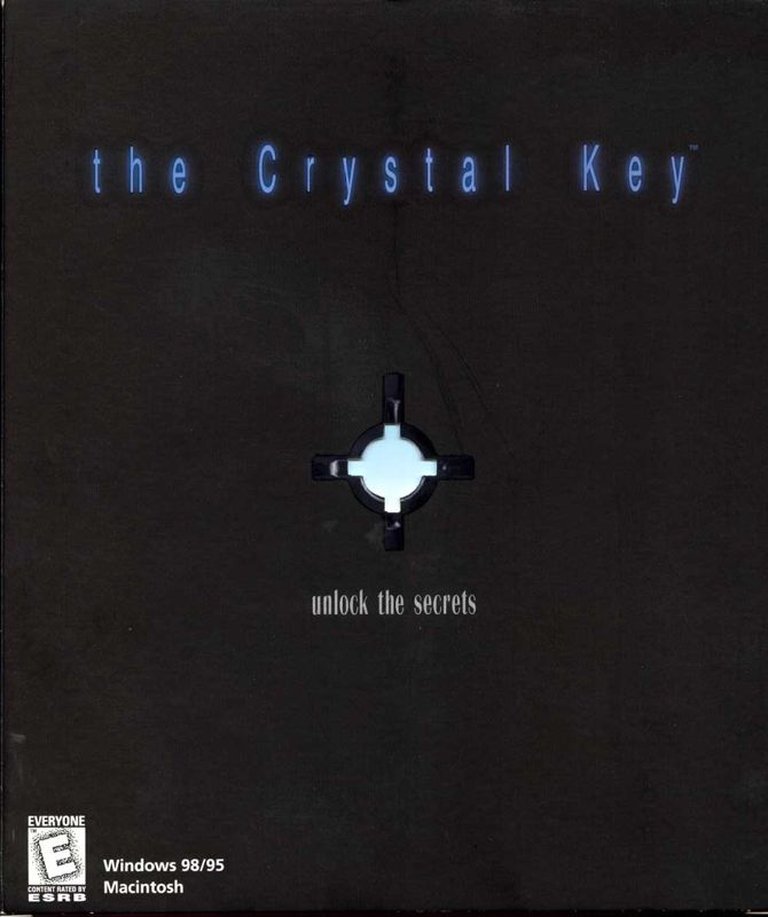
Description
The Crystal Key is a sci-fi adventure game released in 1999, where players navigate through beautifully animated worlds to stop an evil megalomaniac threatening their universe. With a Myst-like first-person perspective and puzzle-based gameplay, the game offers a mix of exploration and problem-solving across various futuristic environments.
Gameplay Videos
The Crystal Key Free Download
The Crystal Key Guides & Walkthroughs
The Crystal Key Reviews & Reception
mobygames.com (54/100): This game is a technical nightmare and suffers from extremely poor development.
uhs-hints.com : Adventure game that will appeal to fans of Myst. Nicely illustrated worlds create a pleasing atmosphere. Puzzles are of easy to medium difficulty. The ending is a disappointment.
The Crystal Key: A Flawed Gem of the Myst Era
Introduction
In the twilight of the 20th century, as the adventure game genre basked in the afterglow of Myst‘s commercial dominance, a wave of imitators emerged. Among them was The Crystal Key, a 1999 science-fiction odyssey developed by Earthlight Productions and published by DreamCatcher Interactive. Promising a journey across alien worlds to save Earth from a cosmic tyrant, it arrived with ambitious visuals and a budget price point. Yet, behind its shimmering vistas lay a game fraught with technical demons and design choices that betrayed its five-year gestation. This review dissects The Crystal Key not merely as a product, but as a cultural artifact—a snapshot of an era where ambition and execution often collided. While it achieved remarkable commercial success, its legacy is one of tantalizing potential realized only partially, making it a fascinating, if frustrating, entry in the annals of adventure gaming history.
Development History & Context
The Birth of a Vision
Conceived by husband-and-wife duo John and Jennifer Matheson in the mid-1990s, The Crystal Key was born from a desire to create a science-faction adventure that echoed the immersive exploration of Myst but with its own identity. Earthlight Productions, a small Canadian studio, embarked on a five-year development odyssey, a period marked by both creative ambition and significant technological hurdles. John Matheson served as the project’s linchpin, handling programming while also contributing to the game’s art, alongside a core team of ten artists. This multi-faceted approach, while showcasing dedication, ultimately stretched the studio thin and contributed to the game’s protracted timeline.
Technological Constraints and the QuickTime Quandary
The Mathesons’ vision hinged on QuickTime VR, Apple’s technology for creating interactive 360-degree panoramic environments. This choice allowed for seamless, rotatable views of alien landscapes—a cutting-edge feature in 1999. However, the engine became a double-edged sword. The game’s reliance on QuickTime introduced fragility and compatibility issues. Players had to install a specific version of QuickTime before running the game, or face crashes and save-corruption errors. Worse, the entire application was essentially a QuickTime wrapper, making performance heavily dependent on the player’s CD-ROM drive speed and system resources, which often led to sluggish loading and frustrating pixel-hunting.
The DreamCatcher Gambit
By 1999, DreamCatcher Interactive was strategically positioning itself as a purveyor of affordable, quality adventure games. Having found success with titles like Jewels of the Oracle, the publisher saw The Crystal Key as a key title to bolster their portfolio and compete in the burgeoning “Myst-like” market. Released on November 22, 1999, at a budget price ($20 MSRP), it was distributed on two CD-ROMs—common for games of its scope. DreamCatcher marketed it heavily, leveraging its sci-fi setting and visuals to attract fans of exploration-based adventures. This gamble paid off commercially, though creative compromises would become apparent upon release.
Narrative & Thematic Deep Dive
A Cosmic Conundrum
The plot of The Crystal Key is a quintessential late-90s sci-fi adventure: Earth intercepts a distress signal from the ancient alien race, the Arkonians, fleeing the genocidal warlord Ozgar. As Ozgar’s forces attack Earth, the player is dispatched in a experimental hypership to the signal’s origin. There, they discover a network of portals and the eponymous Crystal Key—a device capable of traversing these portals to the abandoned Arkonian colonies: a verdant starting world, a desert planet, a dense jungle, and the sunken city of Suralon. The goal: collect the Key’s components, learn the Arkonians’ secrets, and ultimately confront Ozgar on his mothership to save humanity.
Character and Dialogue: Echoes in the Void
The narrative unfolds with minimal direct interaction. The player remains a silent, unnamed protagonist—a blank slate for the player’s own imagination. Dialogue is practically nonexistent, with information relayed through environmental storytelling and holographic journals left behind by the Arkonians. This approach, while atmospheric, results in a profound sense of isolation. Characters like Ozgar exist only as a looming threat, and the Arkonians are distant benefactors whose presence is felt only through their abandoned technology. The narrative leans heavily on archetypes: the chosen one, the evil overlord, the technologically superior but vanquished civilization.
Thematic Undertones
Beneath its simple surface, the game explores themes of abandonment and burden. The Arkonians, possessing the means to defeat Ozgar, chose instead to flee, scattering their worlds and hiding their most powerful artifact. Their journals reveal a civilization that prioritized survival over confrontation, leaving their salvation to an outsider—a stranger tasked with cleaning up their mess. This raises subtle questions about responsibility and the ethics of leaving a problem for others to solve. The game also plays with the idea of legacy and knowledge: the Arkonians left behind intricate puzzles and technology, trusting that a worthy individual would decipher their meaning. However, this legacy is presented as a treasure hunt rather than a profound inheritance, with the player’s reward being merely the cessation of a threat, not enlightenment or connection to the Arkonians themselves.
Gameplay Mechanics & Systems
Core Loop: Exploration and Puzzling
At its heart, The Crystal Key adheres strictly to the point-and-click adventure formula. Movement is restricted to jumping between static, panoramic screens, with the camera rotatable 360 degrees. Navigation relies on environmental hotspots indicated by cursor changes—a direct inheritance from Myst. The core loop involves exploring these locales, collecting items in a “spacepack” inventory, and using them to solve puzzles and unlock new areas. The game’s structure is nonlinear, allowing players to revisit worlds as they acquire new tools, though progression ultimately requires solving puzzles in a specific order.
Puzzle Design: A Mixed Bag
The puzzles are the game’s most contentious element. Some are praised for their logic and integration with the environment: aligning lenses to focus sunlight, decoding alien symbols, or operating complex machinery. Others fall flat, criticized for being illogical or reliant on trial-and-error. Inventory management is particularly flawed; many items lack descriptions or even names, forcing players to experiment blindly (“What is this strange gizmo?”). A notorious example involves drag-and-drop mechanics, where objects must be positioned in specific 3D space—a cumbersome process made difficult by the QuickTime interface, which often confused panning with dragging.
Technical and Interface Failings
The QuickTime engine imposes significant limitations. Save-game corruption was rampant, with players advised to back up their save files regularly. Disk-swapping between CDs interrupted immersion, and the jungle world’s confusing, monotonous layout led to frustration. The inventory system, while simple, was criticized for its lack of feedback. Puzzles requiring players to remember specific coordinates or symbols seen earlier added unnecessary backtracking, as there was no in-game journal. These issues compounded to create a gameplay experience that could be rewarding but was often undermined by poor design and technical instability.
World-Building, Art & Sound
Visual Splendor and Environmental Storytelling
The Crystal Key excels in world-building. The four primary environments—lush grasslands, arid deserts, impenetrable jungles, and the haunting, flooded ruins of Suralon—are rendered with impressive detail for their time. The use of QuickTime VR allowed for seamless 360-degree vistas, creating a strong sense of place. Lighting and atmospheric effects, like the glow of alien artifacts or the shimmer of water in Suralon, enhance immersion. The art direction successfully evokes distinct moods: the tranquility of the starting world gives way to the desolation of the desert and the claustrophobia of the jungle.
Sound Design: The Silent Void
In stark contrast to its visuals, the game’s audio is minimal and often absent. Subtle sound effects—footsteps, machinery hums, dripping water—provide basic environmental cues but lack depth. Background music is virtually nonexistent, leaving many sequences feeling hollow. This stark silence, while potentially atmospheric in isolated moments, more often contributed to the game’s sense of emotional detachment. The lack of a musical score robbed key sequences of gravity, making the climactic confrontation with Ozgar feel emotionally flat.
The Beauty in the Details
Despite its flaws, the art team (including John Matheson, Jay Olauson, and Carolyn Olauson) crafted moments of genuine beauty. The sunken city of Suralon, with its crumbling structures and schools of fish swimming through hallways, stands out as a highlight. The debris of Arkonian civilization—abandoned vehicles, holographic logs, and intricate machinery—tells a story without words. The alien design, from the organic shapes of their portals to the industrial bleakness of Ozgar’s ship, provides a consistent and compelling sci-fi aesthetic. Even the jungle world, despite its frustrating navigation, is visually dense, with layers of foliage and rock textures that create a believable, if confusing, ecosystem.
Reception & Legacy
Critical Divide: Hopeful Exploration vs. Flawed Execution
Upon release, The Crystal Key received a mixed-to-negative critical reception, aggregating to a 54% average (based on 13 reviews). Praise was often reserved for specific elements: IGN lauded its “pleasing and appealing graphics” and “challenging and intriguing puzzles,” while Adventure Gamers found it “a very fun, satisfying game for Myst clone fans.” However, criticism was widespread and often scathing. IGN noted “major bugs,” and Computer Games Strategy Plus dismissed it as a game “devoid of redeeming qualities.” Common complaints included the QuickTime engine’s instability, the illogical inventory puzzles, the abrupt anticlimactic ending, and the pervasive sense of being a “low-quality Myst clone” (The Electric Playground). Players echoed these sentiments, with one user review bluntly stating it was a “complete waste of time and money.”
Commercial Triumph Against Critical Odds
Despite its critical drubbing, The Crystal Key was a remarkable commercial success. Shipped in over 120,000 units in the first quarter of 2000, it debuted at #14 on PC Data’s charts. By March 2004, it had sold over 500,000 copies in North America alone, making it DreamCatcher’s best-selling title of 2000 and representing 32% of the company’s sales that year. This disconnect between critical reception and commercial performance highlights the power of budget pricing, effective marketing, and the enduring appeal of the exploration-based adventure genre to a mainstream audience. It became a cornerstone of DreamCatcher’s strategy and a key title for its parent company, Cryo Interactive, in their North American market penetration.
Enduring Legacy: A Curio and a Cautionary Tale
The Crystal Key‘s legacy is complex. It spawned a direct sequel, Crystal Key II: The Far Realm (2004), developed by Earthlight in collaboration with Kheops Studio. However, the original is largely remembered as a footnote—a “ho-hum” release quickly forgotten, as GameSpot later noted. Its primary historical significance lies in its exemplification of the late-90s Myst-clone phenomenon. It showcases both the ambition (ambitious worlds, innovative use of QuickTime VR) and the limitations (fragile tech, derivative design, poor puzzle flow) inherent in that era’s adventure game development. It serves as a cautionary tale about the dangers of protracted development cycles and over-reliance on unproven technology. For preservationists and historians, it remains a fascinating artifact—a game that captured the public imagination commercially but failed to achieve critical acclaim, leaving behind a legacy of technical quirks and a tantalizing, unrealized vision.
Conclusion
The Crystal Key stands as a testament to a specific moment in gaming history—a time when the immersive worlds of Myst captivated audiences, and studios raced to capture that magic. As a product of Earthlight Productions’ five-year labor, it possessed genuine strengths: breathtaking panoramic vistas, intriguing sci-fi concepts, and moments of genuinely clever puzzle design. Yet, these virtues were systematically undermined by a crippling reliance on the QuickTime engine, leading to instability, poor interface design, and a gameplay experience often mired in frustration. Its narrative, while atmospheric, remained too sparse to create emotional resonance, and its climax felt like a perfunctory afterthought.
Commercially, The Crystal Key was an undeniable success, proving that a well-marketed, budget-priced adventure could still find a massive audience. Critically, however, it was rightly criticized for its technical flaws and derivative nature. It is not a forgotten masterpiece but rather a flawed curio—a game that offers a glimpse into the ambitions and growing pains of the late-90s adventure scene. For historians, it documents the era’s technological constraints and design tropes. For players, it remains a challenging, often frustrating experience best approached with patience and nostalgia.
In the final analysis, The Crystal Key is a game of dichotomies: ambitious yet technically broken, visually stunning yet emotionally vacant, commercially successful yet critically reviled. It occupies a unique space in the genre’s history—not as a classic, but as a compelling artifact that exemplifies both the promise and the peril of chasing the Myst dream. Its legacy is less one of enduring quality and more of a fascinating, cautionary reminder of the volatile interplay between technology, design, and market forces in the formative years of 3D adventure gaming.