
- Release Year: 2011
- Platforms: PlayStation 3, Windows
- Publisher: THQ Inc.
- Developer: Relic Entertainment
- Genre: Action
- Perspective: Third-person
- Game Mode: Online PVP, Single-player
- Gameplay: Cover-based shooting, Melee Combat, Third-person shooter
- Setting: 000 universe, Warhammer 40
- Average Score: 77/100
Description
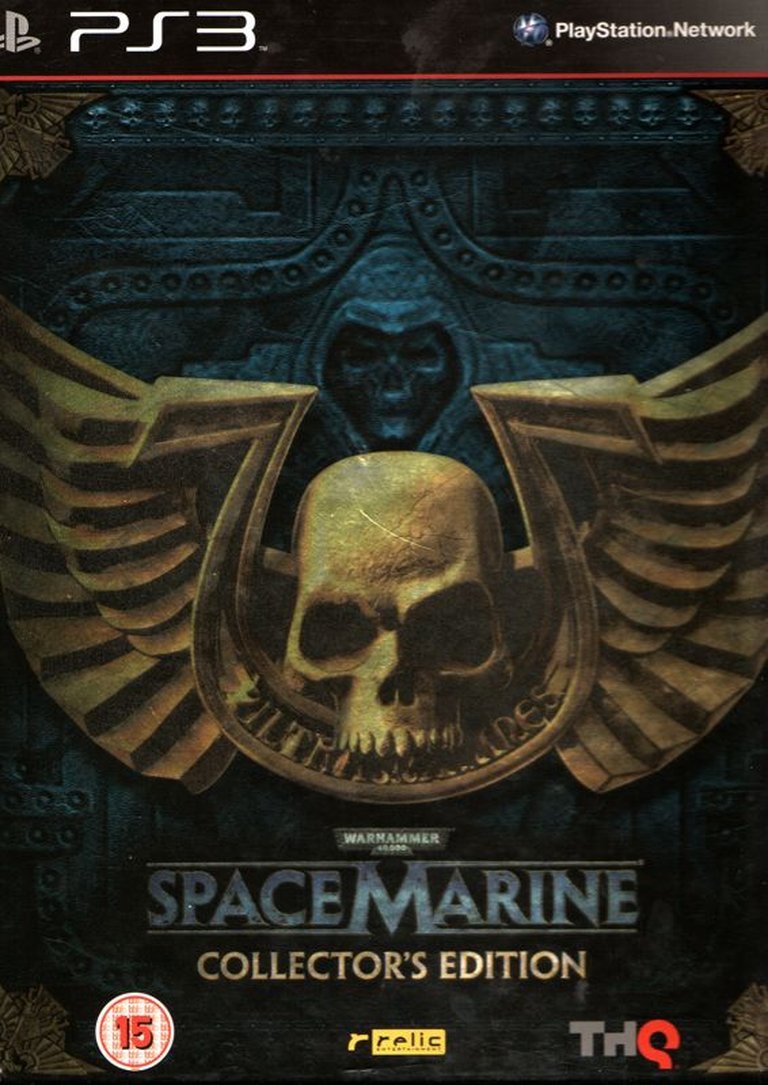
Warhammer 40,000: Space Marine (Collector’s Edition) is a third-person shooter and hack-and-slash game set in the grimdark Warhammer 40,000 universe. Players take on the role of Captain Titus of the Ultramarines, engaging in both melee and ranged combat against the forces of Chaos. The Collector’s Edition includes the base game along with exclusive physical extras such as a soundtrack, artbook, and collectible cards. The gameplay features a unique ‘Fury’ meter that enhances abilities and a regenerative force shield for intense combat action.
Gameplay Videos
Warhammer 40,000: Space Marine (Collector’s Edition) Cracks & Fixes
Warhammer 40,000: Space Marine (Collector’s Edition) Patches & Updates
Warhammer 40,000: Space Marine (Collector’s Edition) Mods
Warhammer 40,000: Space Marine (Collector’s Edition) Reviews & Reception
ign.com (85/100): Warhammer fans can breathe a bit easier.
metacritic.com (69/100): Dusting off 14 years of cobwebs and creakiness, the Master Crafted Edition makes the 2011 original look, sound, and play as close as possible to brand new.
Warhammer 40,000: Space Marine (Collector’s Edition): Review
Introduction
In the grim darkness of the 41st Millennium, where war is eternal and hope is a heresy, Warhammer 40,000: Space Marine emerged as a landmark moment for Games Workshop’s venerable franchise. Released in 2011, this unapologetically brutal third-person shooter marked the first major attempt to translate the visceral, lore-heavy experience of tabletop war into a personal, combat-centric action game. Its Collector’s Edition—blessed with tangible relics of the Imperium—was more than a packaging gimmick; it was a sacrament for devotees, offering a physical bridge to the universe’s gothic grandeur. Yet beyond the poly-resin purity seals and foil cards lay a game that defied industry trends, eschewing cover systems for relentless, weighty carnage. Today, as the franchise celebrates its renewed relevance with Space Marine II, this reevaluation dissects the 2011 original’s legacy, dissecting how its hybrid combat, thematic depth, and audacious design cemented its status as a cult classic despite—or perhaps because of—its imperfections.
Development History & Context
Relic Entertainment’s pivot from strategy (Dawn of War, Company of Heroes) to action was a gamble rooted in creative ambition. Recruiting talent from console titans like Gears of War and God of War, the studio sought to capture the “feel” of a Space Marine: superhuman yet grounded, tactical yet explosively violent. Raphael Van Lierop’s direction emphasized a departure from the era’s dominant cover-shooter template, rejecting regenerating health and chest-high walls in favor of an aggressive, momentum-based loop. This was partly technological—Relic’s Havok engine enabled satisfying physics-based combat—but also philosophical: Space Marines don’t hide; they advance.
The 2011 landscape was brutal. Released alongside Gears of War 3, Space Marine competed for attention in a market saturated with cover-based shooters. THQ’s publishing gamble, however, reflected confidence in the 40k brand’s untapped potential. Though two sequels were planned, THQ’s bankruptcy in 2013 shelved them, leaving the original as a standalone testament to Relic’s vision. The Collector’s Edition itself—featuring art books and soundtracks—was a THQ hallmark, a pre-release trend that rewarded early adopters with physical artifacts of the game’s universe. Decades later, with Relic now self-published and Space Marine II realizing the sequel’s promise, the 2011 original remains a pivotal artifact of the franchise’s evolution.
Narrative & Thematic Deep Dive
Set on Forge World Graia, a vital manufactorum cranking out war machines for the Imperium, the campaign’s plot unfolds with grim efficiency. Orks, led by the bombastic Warboss Grimskull, invade en masse, forcing the Ultramarines’ 2nd Company—led by stoic Captain Demetrian Titus (voiced by Mark Strong)—to intervene. The narrative initially feels like a straightforward xenocide: secure titans, repel greenskins, purge heretics. Yet this simplicity masks a sharp thematic core, explored through Titus’s squad dynamics. His grizzled second-in-command, Sergeant Sidonus, embodies unwavering loyalty, while the hyper-zealous Tactical Marine Leandros serves as a foil, rigidly adhering to the Codex Astartes—the Space Marines’ bible of warfare.
The true narrative twist hinges on Chaos’s insidious corruption. Inquisitor Drogan, initially an ally, is revealed as a puppet of the Chaos Lord Nemeroth, whose possession of the “Psychic Scourge” weapon unleashes daemons upon Graia. This escalation forces Titus to confront a heresy that transcends mere aliens: Chaos preys on dogma. Leandros’s eventual accusation—that Titus’s immunity to Warp energy marks heresy—cracks the Ultramarines’ ideological armor, exposing the fragility of absolute doctrine. Titus’s final exchange with Leandros—“The Codex is a guide, not a cage”—is a rebuke of blind loyalty, framing heroism as adaptability. The unresolved cliffhanger, with Titus dragged into Inquisition custody, adds tragic weight, humanizing a super-soldier defined by duty now branded traitor.
Gameplay Mechanics & Systems
Space Marine’s genius lies in its combat loop: a seamless blend of ranged firepower and visceral melee, executed without a cover system. Titus’s regenerating “Iron Halo” force shield and health-dependent executions create a rhythmic dance of aggression. When wounded, stunning enemies triggers brutal finishers—decapitations, cleavings—that restore health, rewarding risk with catharsis. The “Fury” meter amplifies this, enabling bullet-time or supercharged melee, later upgradeable for tactical depth.
Weapons are lovingly replicated from tabletop lore. The boltgun’s thunderous report, the heavy bolter’s chugging spray, and the thunderhammer’s earth-shattering impacts all feel weighty and consequential. New additions, like the Vengeance Launcher’s sticky grenades, inject variety without betraying the 40k ethos. Enemy design reinforces this duality: Orks are hordes to be carved apart, while Chaos forces demand tactical precision, with Traitor Marines forcing players to prioritize executions.
Multiplayer, though initially delayed, offered robust 8v8 battles and the co-op “Exterminatus” horde mode. Class-based loadouts—Tactical (balanced), Devastator (heavy weapons), and Assault (jump packs)—encouraged teamplay, though map design occasionally fell short. The Collector’s Edition’s digital extras (e.g., multiplayer skins) added replay value, but the game’s longevity stemmed from its core combat’s addictive flow.
World-Building, Art & Sound
Graia is a character unto itself. Relic’s industrial gothic aesthetic—cathedral-sized manufactorums, smoke-choked factories, and colossal Titans—evokes the Imperium’s oppressive grandeur. Lighting is key: strobing emergency lights in Ork-infested corridors, and the eerie glow of Warp portals, immerse players in the 40k ethos of decay and divinity.
Sound design elevates the chaos. Cris Velasco and Sascha Dikiciyan’s score merges orchestral bombast with industrial clangs, underscoring battles like a grim liturgy. Weapon audio is tactile—each bolt casing hitting the floor, each chainsaw revving—and Leandros’s nasally whines or Sidonus’s grunts ground the spectacle in character. The Collector’s Edition’s physical soundtrack and art book extend this immersion, letting fans savor concept art and compositions that breathe life into the universe’s grim tapestry. Even the purity seal replica, with its magnetic attachment, feels like a relic of Titus’s own armor—a tactile piece of fiction.
Reception & Legacy
Upon release, Space Marine polarized critics. Metacritic scores ranged from 70 (PS3) to 76 (Xbox 360), with praise for its combat authenticity and 40k atmosphere and criticism for its linearity and thin narrative. IGN lauded the “recreation of the 40k universe,” while Eurogamer decried its “convenient” level design. Players lauded the multiplayer but lamented the lack of squad commands in co-op.
Yet time has been kind. The game’s refusal to embrace cover-shooter tropes presaged a resurgence of arena shooters like DOOM (2016), which borrowed its execution-for-health loop. Its “Exterminatus” mode influenced horde modes across the industry. The Collector’s Edition became a holy grail for 40k collectors, with vinyl soundtracks and art books fetching premium prices. Most significantly, it vindicated Relic’s gamble: Space Marine proved a third-person action game could capture 40k’s soul without sacrificing spectacle. The 2021 “Anniversary Edition”—bundling all DLC for free—sparked a renaissance, while Space Marine II’s 2024 release (with Titus now a Primaris Marine) finally resolved Titus’s fate, cementing the original’s place in canon.
Conclusion
Warhammer 40,000: Space Marine is a flawed masterpiece: a linear campaign with repetitive enemy patterns, yet one whose combat perfection and thematic ambition transcend its shortcomings. The Collector’s Edition, with its art book and purity seal, is more than a curio; it’s a microcosm of the game’s ethos—a tangible connection to a universe where devotion is measured in grit and glory. Titus’s journey—his battle against Orks, Chaos, and dogma—remains a poignant metaphor for the 40k saga itself: even the mightiest fall prey to betrayal, but redemption is carved in steel.
As a historical artifact, Space Marine stands as a testament to creative risk-taking in a risk-averse industry. Its legacy endures not just in sequels and spin-offs but in how it redefined what a 40k game could be: not just a simulation of war, but an apotheosis of the warrior. For fans, the Collector’s Edition remains a relic of that revolution—a box of faith, fury, and unyielding resolve. In the grim darkness of the far future, there is only war, and Space Marine lets you wage it with glorious, satisfying, unforgettable prejudice.