
- Release Year: 2005
- Platforms: Windows
- Publisher: IDDK Group
- Developer: G5 Software LLC, HBM Ltd
- Genre: Action, Simulation
- Perspective: Third-person
- Game Mode: Single-player
- Gameplay: Aviation, Flight, Helicopter, Shooter, Vehicular combat
- Setting: Europe, World War II
- Average Score: 69/100
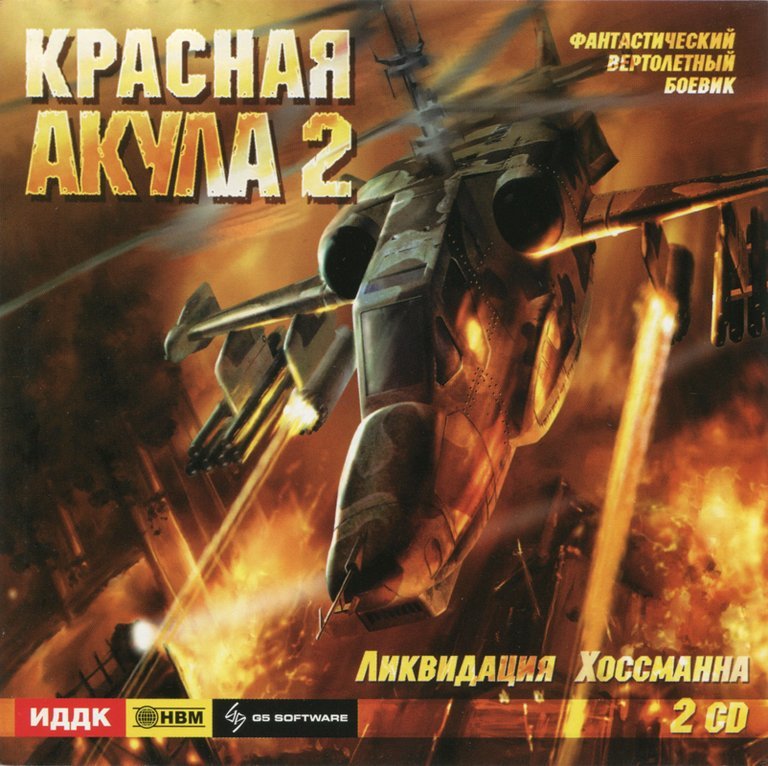
Description
Red Shark 2 is a simulation game where players pilot a high-tech helicopter sent back in time to World War II to prevent historical alterations. Engaging in vehicular combat across Europe, the Pacific, and Mediterranean regions, players battle fascist forces using the helicopter’s powerful cannon, normal missiles, and homing missiles. The game features third-person perspective with cinematic camera angles and mouse-based controls for direction and aiming.
Red Shark 2 Cracks & Fixes
Red Shark 2 Reviews & Reception
gamepressure.com (76/100): Red Shark is an opportunity to feel yourself as a pilot of an armed till teeth helicopter, without reading the manual of how to control rotary-wing machinery or to conduct an air fight.
Red Shark 2 Cheats & Codes
PC
Use a text editor to edit the ‘gamesettings.script’ file in the game folder. Add the line: set bool ConsoleEnabled = true. Begin gameplay and press [F3] to display the console window. Enter one of the following codes. Press [Esc] to close the console window.
| Code | Effect |
|---|---|
| enabled_missions = [mission number] | Enable indicated mission |
| loadfullammo | Full ammunition (alternate) |
| setimmortalmode | God mode (alternate) |
| fullammo | Reset ammunition quantity |
| god_mode = [true or false] | Toggle God mode |
| detail_texture = [true or false] | Toggle graphics detail texture |
| immortal = [true or false] | Toggle invincibility |
| unlimited_ammo = [true or false] | Toggle unlimited ammunition |
| zone_texture = [true or false] | Toggle zone map as terrain texture |
| setunlimitedammo | Unlimited ammunition (alternate) |
| enabled_missions = true | Unlock all missions |
| god | God mode |
| don | Unlimitedammo |
| SetImmortalMode | God Mode |
| LoadFullAmmo | Full Ammo |
| SetUnlimitedAmmo | Unlimited Ammo |
| immortal = true | Immortality |
| god_mode = true | God Mode |
| unlimited_ammo = true | Unlimited Ammo |
| fullammo | Full Ammo |
Red Shark 2: A Time-Traveling Helicopter Sim’s Forgotten Legacy
Introduction
In the crowded pantheon of World War II flight simulators, few titles dared to embrace pure, unadulterated action quite like Red Shark 2. Released in April 2005 by Russian developers HBM Ltd and G5 Software LLC, this sequel to a cult classic thrusts players into a high-stakes temporal conflict: piloting a futuristic KA-50 helicopter to prevent a Nazi physicist from rewriting history. While its contemporaries like IL-2 Sturmovik prioritized realism, Red Shark 2 doubled down on arcade thrills—glossy cinematic combat, massive-scale battles, and a pulpy time-travel narrative. Yet, despite its ambitious scope and niche appeal, the game remains a footnote in gaming history. This review dissects Red Shark 2’s ambitious design, its successes and shortcomings, and its enduring legacy as a flawed but fascinating artifact of mid-2000s PC gaming.
Development History & Context
Red Shark 2 emerged from the crucible of Russia’s burgeoning post-Soviet game development scene. Its creators at HBM Ltd and G5 Software LLC were veterans of Eastern European studios, bringing experience from titles like Cuban Missile Crisis: The Aftermath. The project was spearheaded by Project Lead Michael Khripin and Game Designer Peter Porai-Koshits, who envisioned a sequel that retained the first game’s kinetic energy while expanding its world. Technologically, the title built upon its predecessor’s foundation but pushed boundaries for 2005: developers boasted “maps of up to 256 sq. km” with “hundreds of thousands of trees, buildings, and active ground units,” a bold claim considering the era’s hardware constraints (recommended specs: Pentium III 700MHz, 128MB RAM, 32MB graphics card).
The gaming landscape in 2005 was dominated by Western AAA titles (Battlefield 2, Call of Duty 2) and hardcore sims (Lock On: Modern Air Combat). Red Shark 2 deliberately carved its own niche, blending arcade accessibility with scale. Its Russian setting and narrative—rooted in a “Planetary Anti-terror Organization” combating Nazi time-travel experiments—reflected a distinct cultural perspective on WWII. Published domestically by IDDK Group, the game garnered little international fanfare, remaining a cult curiosity outside Eastern Europe.
Narrative & Thematic Deep Dive
Red Shark 2’s plot is B-grade sci-fi pulp executed with earnest conviction. Set in a near-future where time travel is weaponized, the game introduces Hans Hossman, a young Nazi physicist scarred by witnessing the first Red Shark’s temporal incursion. In 2013, Hossman uses his own time machine to return to WWII, developing “fantastical” weapons to alter the war’s outcome. The player, as a pilot for the Planetary Anti-terror Organization, is dispatched across European, Pacific, and Mediterranean theaters to neutralize Hossman’s influence.
The narrative unfolds through 15 “point correction” missions, framed as strategic interventions by Russian special forces. Missions range from convoy escorts and officer assassinations to defending settlements and destroying installations. While dialogue is sparse (no full vocal performances are noted), cutscenes and briefings emphasize urgency and moral stakes: the player is a “lone wolf” wielding futuristic tech against overwhelming historical odds. Themes of causality and the burden of intervention permeate the story, though they’re never deeply explored. Hossman’s tragic backstory—obsessed with erasing the trauma of the first Red Shark—adds a layer of pathos to an otherwise straightforward “good vs. evil” conflict. The game’s greatest narrative strength lies in its sheer audacity: merging WWII with high-concept sci-fi in a way few contemporaries dared.
Gameplay Mechanics & Systems
Red Shark 2’s core loop revolves around piloting a heavily armed KA-50 helicopter through large-scale battles. Control is mouse-driven for aiming and movement, with keyboard inputs for altitude and weapons, prioritizing accessibility over simulation depth. The helicopter’s arsenal is robust: a “250mm quick-firer” cannon, unguided S-8 rockets, and homing Vikhr anti-tank missiles, each suited to different threats—tanks, infantry, or aerial targets.
Missions emphasize variety and chaos. Players must multitask: providing close air support for ground troops while intercepting enemy convoys and defending objectives. The scale is impressive—battles feature “hundreds of active ground units” across vast maps—but this often leads to performance issues on recommended hardware, with frame drops during intense engagements. AI is functional but rudimentary: enemies swarm predictably, and friendly forces exhibit little tactical cohesion.
Progression is mission-based, with no persistent upgrades; success hinges on mastering the controls and exploiting weapon synergies. The camera system offers “cinematic angles,” dynamically shifting to highlight missile impacts or explosions, enhancing the arcade feel. However, flaws abound: collision detection is inconsistent, and the difficulty curve spikes sharply, with later missions demanding pixel-perfect dodging against overwhelming fire. Despite these issues, the core combat loop is undeniably satisfying—the visceral thwump of missiles hitting armor and the roar of the cannon provide immediate gratification.
World-Building, Art & Sound
Red Shark 2 excels in creating a lived-in WWII setting infused with sci-fi elements. Environments are diverse: European hedgerows, Pacific islands, and Mediterranean coastlines are rendered with a mix of detail and abstraction. Art Director Maxim Luschik’s team achieved impressive density—hundreds of unique buildings, vehicles, and terrain features populate each map—though textures are low-resolution by modern standards. The KA-50 helicopter itself is a star, modeled with care and visible upgrades (e.g., missile pods) between missions.
Sound design is functional yet atmospheric. Andrew Burmistrov’s score blends militaristic marches with synth-driven tension, underscoring the game’s anachronistic tone. Weapon effects are punchy and distinct, but engine sounds lack dynamism, and environmental audio (wind, explosions) is flat. The absence of voice acting beyond brief radio chatter robs the narrative of personality, relying instead on text briefings and visual cues. Still, the game’s art direction succeeds in its central paradox: making a futuristic war machine feel grounded in historical chaos.
Reception & Legacy
Upon release, Red Shark 2 received minimal critical attention. Metacritic lists no critic reviews, reflecting its niche status. Player reviews were similarly sparse, with MobyGames showing a tepid average of 3.0/5 (based on a single rating) and MyAbandonware noting a slightly better 3.67/5 (3 votes). Its primary appeal was in Eastern Europe, where it earned cult status for its uncompromising action. GamePressure’s user score of 7.6/10 praised its “dynamic shooter” ethos, calling it “fun first and foremost.”
Long-term, Red Shark 2’s legacy is one of unfulfilled potential. Its time-travel premise predated games like Wolfenstein: The New Order (2014) but lacked their narrative polish. The game’s influence is subtle: it demonstrated that large-scale aerial combat could work in an arcade framework, inspiring indie titles like Strike Suit Zero (2013). Yet, its technical flaws and obscurity cemented it as a curiosity rather than a touchstone. The Red Shark series itself faded after this installment, with no confirmed follow-ups. Today, it survives on abandonware sites, a relic of an era when Russian developers blended Eastern Bloc creativity with global genre tropes.
Conclusion
Red Shark 2 is a flawed but fascinating artifact of mid-2000s PC gaming. Its ambitious fusion of WWII history, sci-fi, and arcade action resulted in a game that was both technically impressive and mechanically inconsistent. While its narrative never transcends pulp simplicity and its combat suffers from AI and performance issues, the sheer joy of piloting a futuristic helicopter through sprawling historical battles remains undeniable. For modern players, it offers a glimpse into a pre-Call of Duty era of unapologetic genre mashups.
In the grand tapestry of flight simulators, Red Shark 2 is neither a masterpiece nor a failure—it is a bold, if imperfect, experiment. It stands as a testament to the creativity of its Russian developers and a reminder that even niche, overlooked games can carve out unique identities. As a time-traveling footnote, it may not have changed history, but for those who pilot its KA-50, it provides an unforgettable, if fleeting, thrill. Verdict: A cult classic worth rediscovering for fans of high-octane aerial combat and alternative history.