
Description
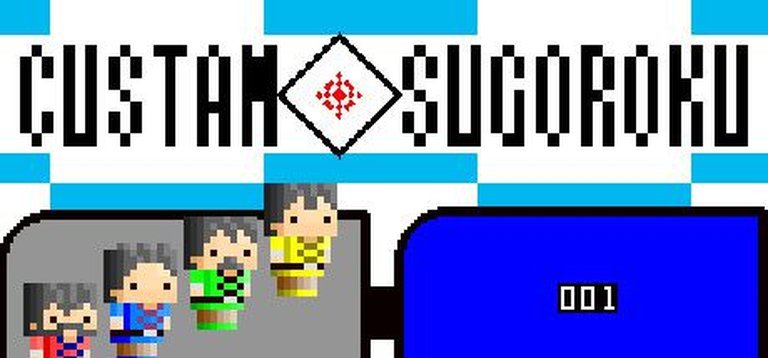
Custam Sugoroku is a digital dice board game that lets players create, save, and share custom game boards using mouse and keyboard input. Supporting 1-4 players via local same/split-screen multiplayer, the game features twelve different event types per cell and allows full customization of displayed characters, providing a top-down 2D scrolling puzzle party experience with replayable maps.
Custam Sugoroku Patches & Updates
Custam Sugoroku Guides & Walkthroughs
Custam Sugoroku: Review
Introduction
In the vast, ever-expanding universe of digital gaming, where hyper-realistic graphics and cinematic storytelling often dominate the zeitgeist, there exists a quiet corner dedicated to the elegant simplicity of analog traditions. Custam Sugoroku, released by the enigmatic developer Winglay on October 24, 2020, stands as a profound testament to this niche. Translating the Japanese board game sugoroku (a “race to finish” game akin to Western tables) into a digital framework, it offers not merely a replication, but a radical reimagining of the genre centered on player agency and communal creation. This review posits that Custam Sugoroku, despite its minimalist presentation and modest ambitions, represents a remarkably pure distillation of shared gaming joy. Its legacy lies not in graphical fidelity or narrative depth, but in its unwavering commitment to being a blank canvas for collective imagination—a digital sandcastle for friends to build and storm together.
Development History & Context
Custam Sugoroku emerged from the singular vision of Winglay, a developer whose portfolio remains shrouded in mystery, with this title being their most documented release. Operating in the indie space of 2020, a year defined by global isolation and a renewed craving for local connection, Winglay identified a gap in the market: a modern, accessible, and infinitely replayable digital board game that championed face-to-face interaction. The technological constraints were deliberately minimalistic. Released exclusively on Windows with startlingly low system requirements—including an Intel Core i3 processor, 4GB RAM, and just 20MB of hard drive space—the game eschews modern graphical horsepower in favor of broad compatibility and stability. This choice reflects a core design philosophy: accessibility over spectacle. The gaming landscape of 2020 saw a surge in cozy games and social indie titles, but few offered the structural flexibility of Custam Sugoroku. It arrived not as a competitor to AAA behemoths, but as a humble tool, akin to a digital set of LEGO bricks, inviting players to construct their own fun within the familiar, comforting framework of a dice-and-cells board.
Narrative & Thematic Deep Dive
To seek a traditional narrative in Custam Sugoroku is fundamentally to misunderstand its purpose. The game dispenses with pre-written plots, character arcs, and dialogue entirely. Instead, its narrative is emergent, co-authored by the players themselves through the act of creation and play. Its thematic core revolves around chance, consequence, and communal storytelling. The 12 distinct event types available for placement on custom boards serve as the building blocks of potential drama: a space might propel a player forward three steps, send them hurtling back five, grant an extra turn, or impose a temporary penalty. These mechanics embody the age-old themes of sugoroku—the capriciousness of fortune, the strategic mitigation of risk, and the shared experience of triumph and setback. The ability for players to input custom character text for each event cell transforms the board into a microcosm of shared humor, inside jokes, or intricate role-playing scenarios. A space labeled “Bankrupt! Pay 500 Gold to the Bank” or “Blessed by the Cat Goddess! Roll Again” becomes a node in a story only the playing group understands. The true narrative is the unfolding drama of the race itself—a real-time saga of lucky rolls, devastating missteps, and frantic negotiation, fueled solely by player interaction and the game’s fundamental rules.
Gameplay Mechanics & Systems
The core gameplay loop of Custam Sugoroku is elegantly simple, yet its depth emerges from the systems layered atop this foundation. The primary mode revolves around a turn-based race on a grid-based board. Players take turns rolling virtual dice (via input keys like Z, C, B, or M for players 1-4) and moving their pieces the corresponding number of cells. The core tension arises from the event cells populating the board. With 12 pre-defined event types (e.g., “Move Forward/Back X Spaces,” “Lose/Gain a Turn,” “Swap Positions with Player X”), these cells introduce unpredictable consequences that can drastically alter the race’s momentum. The true innovation, however, lies in the Map Editor. Accessed via mouse and keyboard, this tool empowers players to become architects of their own chaos. They can define the board’s size and shape, place event cells strategically (or chaotically), and assign custom text labels to each cell, creating unique rulesets and thematic experiences. Saved map files can be easily shared and loaded, enabling near-infinite replayability. The UI is starkly functional—a top-down 2D grid with minimalist player pieces and clear event icons. While the lack of controller support (a noted limitation in the Steam description) confines players to keyboard input, the dedicated keybindings for each player (e.g., Player 1: Q/A for navigation, Z for decision) ensure smooth, simultaneous play during turns. The game excels as a pure party game, where the mechanics serve as a framework for social interaction, laughter, and competitive camaraderie.
World-Building, Art & Sound
Custam Sugoroku‘s world-building is not depicted through lush environments or detailed lore, but constructed by the players within the editor. A meticulously crafted board titled “Dragon’s Lair Marathon” or “Cosmic Cash Grab” implies a setting and atmosphere entirely through its event labels and layout. A board littered with “Trap!” or “Treasure!” cells evokes a dungeon-crawl vibe; one with “Puppy Parade!” or “Rainbow Bridge” suggests a whimsical journey. The visual direction is purposefully utilitarian. The top-down 2D scrolling view employs clean, crisp lines and a limited color palette typical of indie puzzle games. Player pieces are distinct but simple shapes, and event cells use clear icons (arrows, clocks, exclamation marks) to signal their function without clutter. This minimalist aesthetic prioritizes clarity and functionality, ensuring players can instantly parse the board state during frantic play. Sound design, however, remains a notable absence. The provided sources offer no mention of audio, implying the experience is likely accompanied solely by the click of keyboard inputs and perhaps basic system sounds. This silence heightens the focus on the tactile, visual, and social aspects of the game, placing the burden of atmosphere entirely on the collective imagination of the players and the thematic labels they create.
Reception & Legacy
At launch, Custam Sugoroku navigated the crowded Steam storefront with minimal fanfare. Critical reception was virtually non-existent; Metacritic lists no critic reviews, and the MobyGames page documents only user contributions, not professional critiques. Its launch was also hampered by a significant technical hiccup noted in the Steam description: “Sales are delayed. There is a problem and the controller is now unsupported.” This likely limited its initial reach among players preferring controller input. Player reviews on platforms like MobyGames and Steam (as per the provided sources) are also absent, suggesting a small but dedicated initial player base. However, its reputation has quietly evolved among a niche audience. Sales data from GameSensor indicates it grossed over $5K and attracted more than 1,000 owners, a respectable figure for a niche, low-budget indie title. Its legacy is less about influencing blockbuster design and more about preserving and democratizing a specific type of social gaming. It stands as a digital successor to classic sugoroku titles like Goemon: Mononoke Sugoroku (1999) and The Sugoroku ’92: Nariagari Trendy (1991), offering superior customization and accessibility. Its influence is seen in the continued demand for local multiplayer party games on PC, proving that shared physical space around a screen remains a powerful draw. It didn’t revolutionize the industry, but it carved out a valuable niche as a reliable, infinitely customizable tool for social connection.
Conclusion
Custam Sugoroku is not a game you play for its graphics, story, or complex systems. You play it with other people, using its simple mechanics and powerful editor to generate unique moments of laughter, surprise, and friendly rivalry. It is a triumph of function over form, a digital distillation of the timeless appeal of rolling dice and moving pieces with friends. While its lack of controller support and absence of audio are undeniable drawbacks that limit accessibility, its core strengths—the unparalleled map customization, the smooth local multiplayer for up to four players, and the pure, unadulterated focus on shared gameplay—are exceptional. It fulfills its niche perfectly: it is a blank slate, a digital toolkit for creating and experiencing the simple, enduring joy of a board game race. In an era increasingly dominated by solitary online experiences and cinematic spectacle, Custam Sugoroku stands as a humble yet vital artifact—a reminder that the most profound gaming magic often arises not from pixels and polygons, but from the shared space around a screen and the collective imagination of the players gathered there. It earns its place in video game history as a pure, if niche, expression of communal play.